These are interesting findings, some challenging, some conflated with transplant rejection use, and some unclear. We need to spend some time on this. One issue is especially concerning. The claim that repeated intermittent dosing produces persistent functional impairment despite apparent recovery between doses directly challenges the proposed advantage of intermittent dosing and its assumed therapeutic window. If true, this would be especially consequential for the geroscience hypothesis. However, the relevance of this finding would rest on whether the investigators actually tested an intermittent regimen rather than continuous exposure in a cell-culture system or conventional immunosuppressive treatment. I would also want to examine whether the investigators measured actual immune function rather than merely the abundance of immune-cell subsets or expression of selected proteins. As one example based on related information I have considered, expanded regulatory T-cell populations could reduce pathological inflammation while also suppressing some effector responses. A change in their abundance alone does not establish whether the net effect is beneficial or detrimental.
Before getting too involved with this, it would help to be able to read the full research paper to assess the quality of the methodology, procedures, how exceptions were handled, etc.
Very brief comments about the studies cited by the OP.
[1] Buron F, Malvezzi P, Villar E, Chauvet C, Janbon B, Denis L, Brunet M, Daoud S, Cahen R, Pouteil-Noble C, Gagnieu MC, Bienvenu J, Bayle F, Morelon E, Thaunat O. Profiling sirolimus-induced inflammatory syndrome: a prospective tricentric observational study. PLoS One. 2013;8(1):e53078. doi: 10.1371/journal.pone.0053078. Epub 2013 Jan 7. PMID: 23308138; PMCID: PMC3538748.
Link:
Some key quotes - I bolded the essential points.
“30 kidney transplant recipients that required a switch from calcineurin inhibitor to sirolimus-based immunosuppression, were prospectively followed for 3 months. Inflammatory symptoms were quantified by the patients using visual analogue scales and serum samples were collected before, 15, 30, and 90 days after the switch.”
“66% of patients reported at least 1 inflammatory symptom, cutaneo-mucosal manifestations being the most frequent. Inflammatory symptoms were characterized by their lability and stochastic nature, each patient exhibiting a unique clinical presentation. The biochemical profile was more uniform with a drop of hemoglobin and a concomitant rise of inflammatory acute phase proteins, which peaked in the serum 1 month after the switch. Analyzing the impact of sirolimus introduction on cytokine microenvironment, we observed an increase of IL6 and TNFα without compensation of the negative feedback loops dependent on IL10 and soluble TNF receptors. IL6 and TNFα changes correlated with the intensity of biochemical and clinical inflammatory manifestations in a linear regression model.”
" The percentage of patients with sirolimus trough levels within the target (6–12 ng/mL) at 15, 30, and 90 days were respectively 62%, 72% and 92%, and was not significantly affected by CYP3A5 genotype (Figure 1A).
Calcineurin inhibitor posology was reduced by 50% weekly and stopped after one month.
Changes in concomitant immunosuppressive drugs are summarized in Table 2. Briefly, mycophenolate mofetil posology was reduced in 2 patients and replaced at the same dose by mycophenolate acid in one because of diarrhea. Prednisolone was followed at the same dose for all but one."
“In line with previously published works, sirolimus introduction was associated with: i) a trend for a better eGFR, ii) an increase of cholesterolemia, and a drop in kalemia and phosphoremia (Table 3). No case of NODAT was observed during the follow-up period.”
“Cutaneous symptoms were the most frequent, affecting half of the patients (14/29, 48%). Stomatitis was almost as common (12/29, 41%), while fatigue (7/29, 24%) and arthralgia (4/29, 14%) appeared less frequent (Figure 2A). The intensity of the symptoms was generally mild (Figure2A, 2C) but some patients presented a more severe clinical picture, occasionally (Pt #25 & #27; 2/30; 7%) requiring drug withdrawal.”
“Symptoms were usually mild, transient, and asynchronous.”
My commentary:
Smallish sample - 30 patients. 20 of them had symptoms - meaning 1/3 did not. 66% is fairly high - but key point is that each patient who experienced symptoms usually experienced only 1-2 from the collection of symptoms, and the most frequent centered around skin and mouth ulcers. Importantly, symptoms were mild, transient and asynchronous. Some hematological impact and raised LDL. No glucose/diabetic effect in this small cohort. Key thing to keep in mind: these patients were on other immunosuppressants at the same time for at least part of the trial. Also this looked to be fairly high dose of rapamycin - the trough was 6-12 ng/mL!
My takeaway is that a consistently high dose that results in elevated troughs (compared to most biohackers here) might be a factor. I was reassured by the fact that not all patients experienced these effects even at this high dose (although 66% is a significant majority!). Furthermore, these were mild and transient when they occurred and they didn’t occur in concert - usually 1-2 symptoms. However, it is likely worth keeping an eye on your bloodwork - watch for hemoglobin drops etc., and also keep an eye on your lipid panel - consider LLT. Additionally, I was gratified to see that rapamycin did seem to have good effects on eGFR and no elevation in potassium and phosphorus - which was a concern with rapa impact on the kidneys.
Yes, there do seem to be some kind of balance perturbations in various inflammatory markers, but it’s hard to make out if that’s a big negative or simply MOA.
Bottom line: Yes, there is a chance of a strong negative reaction (at least 1:30), but odds are that even if you are on continuous high dose with a high level of trough, while you might experience symptoms, these should be mild, transient and centered around skin and mouth ulcers. It also seems to say that very high doses are more problematic. For me: this study does not push me to stop or modify my rapamycin regimen. YMMV.
OK, I see that quoting every study makes the posts insanely long, I will therefore no longer do so, merely add my commentary, and since I provided the links to the studies, you can check them out yourself to see if I characterized them accurately.
[2] Mahé E, Morelon E, Lechaton S, Sang KH, Mansouri R, Ducasse MF, Mamzer-Bruneel MF, de Prost Y, Kreis H, Bodemer C. Cutaneous adverse events in renal transplant recipients receiving sirolimus-based therapy. Transplantation. 2005 Feb 27;79(4):476-82. doi: 10.1097/01.tp.0000151630.25127.3a. PMID: 15729175.
80 patients. 74 of them on mycophenolate mofetil and steroids combined with sirolimus. That right there makes this harder to evaluate for impact focused on sirolimus - while it’s possible that these agents separately don’t result in symptoms, you cannot exclude the possibility that the combination with rapamycin is different than if all were taken separately. Nonetheless, all of them had skin issues, and/or mouth ulcers. More concerning half had edemas and 15% angioedemas. Smaller percentages had gingevitis, lip or nail issues. One reassuring aspect: these were mild symptoms - of course, that’s enough to quit for some, but objectively: mild. For me: well, I have this - pimples on face/scalp, inconsistently come and go - in my case too, it’s mild. Not enough to stop or modify my rapamycin regimen. I have had no edema - that would worry me a bit more. Major limitation: I have not had access to the full paper, so I can’t say what dose of sirolimus was used.
[3] Rana JS, Sheikh J. Serum sickness-like reactions after placement of sirolimus-eluting stents. Ann Allergy Asthma Immunol. 2007 Feb;98(2):201-2. doi: 10.1016/S1081-1206(10)60699-0. PMID: 17304893.
Can’t comment - no abstract. However, this is a special kind of delivery mechanism which is systemic and rather different from the way most here take it (orally) - not sure how that impacts the findings.
[4] Molinari M, Al-Saif F, Ryan EA, Lakey JR, Senior PA, Paty BW, Bigam DL, Kneteman NM, Shapiro AM. Sirolimus-induced ulceration of the small bowel in islet transplant recipients: report of two cases. Am J Transplant. 2005 Nov;5(11):2799-804. doi: 10.1111/j.1600-6143.2005.01082.x. PMID: 16212644.
This is a well-known issue. Traditionally, it’s only seen for high dose patients. Here we are also told that the dose was higher than usual at the particular clinic where this study was conducted. I don’t have access to the full paper, so can’t say how high the dose was. For me: not relevant as I don’t think my dose is high enough, but I certainly keep close tabs on my lung function - so far no issues.
[6] Kraig E, Linehan LA, Liang H, Romo TQ, Liu Q, Wu Y, Benavides AD, Curiel TJ, Javors MA, Musi N, Chiodo L, Koek W, Gelfond JAL, Kellogg DL Jr. A randomized control trial to establish the feasibility and safety of rapamycin treatment in an older human cohort: Immunological, physical performance, and cognitive effects. Exp Gerontol. 2018 May;105:53-69. doi: 10.1016/j.exger.2017.12.026. Epub 2018 Feb 3. PMID: 29408453; PMCID: PMC5869166.
My commentary:
Not really sure what this study is doing in the “negative for rapamycin” post - it seems it’s the opposite even as claimed in the paper itself, although there are significant limitations: only 11 patients in the sirolimus group and short duration. Some AE, but very mild: skin rash, mouth ulcer, gastro. Judged to be safe. Some bloodwork effect, seen before, lower hemoglobin etc. For me: mostly irrelevant.
[7] Mercalli A, Calavita I, Dugnani E, Citro A, Cantarelli E, Nano R, Melzi R, Maffi P, Secchi A, Sordi V, Piemonti L. Rapamycin unbalances the polarization of human macrophages to M1. Immunology. 2013 Oct;140(2):179-90. doi: 10.1111/imm.12126. PMID: 23710834; PMCID: PMC3784164
My commentary:
This is something that has been explored before. However, the import of this shift in balance from M2 to M1 is uncertain. For this reason, unless I see some clearly deleterious long term effects, I put in the “interesting fact” category that’s not really actionable. For me: irrelevant unless I my inflammatory biomarkers go haywire - so far, at least my hsCRP seems stable (0.3-0.5).
[8] Gomez-Fernandez C, Garden BC, Wu S, Feldman DR, Lacouture ME. The risk of skin rash and stomatitis with the mammalian target of rapamycin inhibitor temsirolimus: a systematic review of the literature and meta-analysis. Eur J Cancer. 2012 Feb;48(3):340-6. doi: 10.1016/j.ejca.2011.11.028. Epub 2011 Dec 27. PMID: 22206873.
This deals with temsirolimus. Yes, it is an mTOR inhibitor, but I don’t know how these findings might map to sirolimus. And this is a metaanalysis - so, not much to say here. For me: irrelevant.
[9] Umemura A, Park EJ, Taniguchi K, Lee JH, Shalapour S, Valasek MA, Aghajan M, Nakagawa H, Seki E, Hall MN, Karin M. Liver damage, inflammation, and enhanced tumorigenesis after persistent mTORC1 inhibition. Cell Metab. 2014 Jul 1;20(1):133-44. doi: 10.1016/j.cmet.2014.05.001. Epub 2014 Jun 5. PMID: 24910242; PMCID: PMC4079758.
My commentary:
This is in mice. And it’s in mice with already compromised liver function, liver cancer, on a high fat diet. I would not put much stock in this unless we see clear human studies, especially that dosing from mouse to humans for rapamycin is extremely fraught. That said, it makes sense to keep an eye on your liver panel. For me: other than keeping an eye on my liver panel, which I would do regardless, this is mostly irrelevant at this stage - waiting for results in humans.
Info sheet for everolimus from Novartis. OK. Informational, but not very relevant to my situation.
[11] Yamanaka K, Petrulionis M, Lin S, Gao C, Galli U, Richter S, Winkler S, Houben P, Schultze D, Hatano E, Schemmer P. Therapeutic potential and adverse events of everolimus for treatment of hepatocellular carcinoma - systematic review and meta-analysis. Cancer Med. 2013 Dec;2(6):862-71. doi: 10.1002/cam4.150. Epub 2013 Oct 22. PMID: 24403259; PMCID: PMC3892390.
My commentary:
This is a meta review of everolimus AE in a setting of solid tumors where everolimus was at least one of the agents. That makes this hard to get a clear picture of everolimus AE. Those where AE which appeared at high doses (10mg/day) don’t seem very relevant to most here. That said, even where the AE were compiled, they were not especially dire: “The meta-analysis revealed the odds ratios (95% confidence interval [CI]) of stomatitis: 5.42 [4.31–6.73], hyperglycemia: 3.22 [2.37–4.39], anemia: 3.34 [2.37–4.67], pneumonitis: 6.02 [3.95–9.16], aspartate aminotransferase levels: 2.22 [1.37–3.62], and serum alanine aminotransferase levels: 2.94 [1.72–5.02], respectively.” For me: not concerned, not serious AE at lower doses, not relevant - keep an eye on liver panel.
I’ll make my summerizing global commentary on the implication of all these studies in the next post.
Lots of things wrong in this post, and it starts off very quickly.
I’ll start with the underplaying of the animal studies where it says rapamycin “has been hyped as an anti-aging supplement—merely based on results observed in some animal experiments”
Wow - Talk about understating the rapamycin animal longevity test results!
The truth is rapamycin is by far the most validated longevity drug ever tested… by dozens of labs, and tested dozens and dozens of times in yeast, worm, fish and animal longevity studies that have all proven positive, in every organism tested, from yeast, to … worms to mice to rats to fish to monkeys… no other compound comes even 10% as close to being as well validated. Full details covered here: Why Take Rapamycin? (part 2)
Then the guy goes off on a tangent comparing dosing levels in studies that are 3X to 100X higher than what is used in longevity. Sure - there are toxicities at high levels for rapamycin, just as there are for virtually every drug in the world (as well as even “water” which can kill you if you drink enough of it in a short period of time). So yes, “dose” is the poison, as they say, nothing really new or helpful here.
We’ve known for many years now that the transplant dosing studies of rapamycin don’t apply to the longevity dosing strategies that are designed to avoid persistent immune suppression (that are actually desired in the transplant patients). So - different use cases, mean different dosing strategies and different side effects profiles. Nothing very new here - but this guy seems to have not followed the research very close.
Then it seems he pulls lots of bits of data from studies, that are irrelevant to the doses used for longevity purposes.
He either doesn’t know what he’s analyzing, or he’s trying to write a hit piece on a rapamycin.
Here is a detailed fact check on the rest of the post, from Claude Opus 5 (Paid):
Fact-check: “Rapamycin inducing systemic inflammation” (post #1 by man_li)
Bottom line: the citations are real and mostly quoted accurately, and the underlying phenomenon — sirolimus-induced inflammatory syndrome — is genuine. But every supporting study except one used continuous daily dosing at trough levels of 6–12 ng/mL or higher (transplant), 10 mg/day (oncology), 0.1 mg/kg/day (islet pre-conditioning), or 5 mg/kg/day i.p. (mice). The one study performed in healthy older adults is the one the post misrepresents: it is a null result on cytokines, not a “surge.” Reframed against 3–6 mg once weekly, roughly two of the eleven references survive as relevant.
Post #2 discloses this is a translation of a Zhihu article, which explains several sourcing errors (e.g., a temsirolimus meta-analysis described as rapamycin; a solid-tumour meta-analysis described as HCC trials).
Claim-by-claim
[1] Buron 2013 (SIRILYGRE) — accurate on numbers, overstated on inference.
Verified: 30 kidney transplant recipients switched from a CNI to sirolimus 2 mg/day, target trough 6–12 ng/mL, 3-month prospective follow-up; 66% reported ≥1 inflammatory symptom, cutaneomucosal most frequent; IL-6 and TNFα peaked at 1 month alongside CRP, fibrinogen, haptoglobin and a haemoglobin drop.
Corrections: it is a prospective observational tricentric study, not a “clinical trial” (Wyeth-funded). “Higher elevations correlating directly with more severe manifestations” oversells the statistics: TNFα change vs clinical score was r = 0.24, p = 0.04 (~6% of variance); IL-6’s significant correlations were with fibrinogen (r = 0.31) and CRP (r = 0.33). The authors describe the symptoms as “labile and stochastic,” mostly mild, with 2/30 withdrawing for severe symptoms. Most importantly for the dosing question: the authors found no correlation between sirolimus trough level and severity within the 6–12 ng/mL window — the paper establishes a continuous-exposure syndrome, not an exposure–response curve.
[6] Kraig 2018 — this is the post’s central claim, and as written it is false.
The numbers are arithmetically correct but were lifted from the rapamycin columns of Table 8 with the p-values, the placebo arm and the assay floor removed:
Serum cytokine (pg/mL)
RAPA pre → post
within-group p
vs placebo p
Placebo pre → post
IL-6 (Luminex)
0.56 → 2.04 (+264%)
0.32
0.17
2.37 → 0.41 (−83%)
TNF-α
12.08 → 14.00 (+16%)
0.10
0.02
14.07 → 12.45 (−12%)
IL-10
3.21 → 1.86 (−42%)
0.10
0.61
4.45 → 3.59 (−19%)
IL-6 (hs-ELISA)
3.56 → 4.33
0.64
0.71
1.79 → 1.92
The Luminex lowest standard was 16 pg/mL — every IL-6 value above was extrapolated below the curve, with out-of-range values set to zero. The authors’ own words: “No statistically significant RAPA (or placebo) effects were seen in serum cytokine levels,” and on the confirmatory high-sensitivity assay, “RAPA did not affect IL-6 levels in the serum.” The only between-group signal (TNF-α, p = 0.02) is partly a placebo decline, and the authors explicitly flag it as non-uniform and hypothesis-generating.
Additional errors: dose was 1 mg/day for ≥8 weeks (cytokines sampled at 6 weeks); “6.1–8.2 ng/mL” were the maximum levels in the four phase-1 subjects (cohort range 4.7–11.8, mean 7.2 ± 2 ng/mL — i.e. continuous trough well above weekly dosing); and subjects were “generally healthy” with stable comorbidities and concomitant medications, not “no baseline chronic conditions.” Adverse events in the rapamycin arm were one facial rash, one stomatitis, two GI complaints.
[7] Mercalli 2013 — accurate, but at ~8× the weekly milligrams of a longevity protocol.
Verified: in vitro, rapamycin 10 ng/mL added continuously during LPS+IFN-γ (M1) or IL-4 (M2) polarization of macrophages from six healthy donors → increased IL-6/TNF-α/IL-1β and reduced IL-10 in M1, apoptosis in M0/M2. In vivo, 12 type 1 diabetics on rapamycin monotherapy 0.1 mg/kg/day (~7 mg/day, ~49 mg/week), trough target 8–10 ng/mL, ≥4 weeks pre-islet transplant: CRP, ESR and fibrinogen rose significantly, and LPS-stimulated PBMC cytokine release plus ex vivo polarization capacity shifted toward M1. The mechanism is real and independently supported (Weichhart 2008, TSC–mTOR and innate inflammation). Note the M1 shift was measured under TLR4 challenge and as polarization capacity, not as resting systemic cytokines.
[8] Gomez-Fernandez 2012 — wrong drug. This is temsirolimus, 25 mg IV weekly in oncology, not oral rapamycin: all-grade rash 45.8% (RR 7.6), stomatitis 44.3% (RR 11.1), high-grade ~3% for each. The “independent of the cancer” framing is defensible (RRs are vs control arms), and mucocutaneous toxicity is the one class effect that does carry down to low doses — but the incidence figures don’t transfer.
[9] Umemura 2014 — real paper, non-transferable model. Mice on 3 months’ high-fat diet plus the carcinogen DEN, given rapamycin 5 mg/kg/day intraperitoneally for 2 weeks, or hepatocyte-specific Raptor knockout (permanent genetic mTORC1 ablation). Allometric scaling puts 5 mg/kg/day i.p. around 0.4 mg/kg/day human-equivalent (~28 mg/day for 70 kg) by parenteral route, versus ~0.9 mg/day averaged for 6 mg weekly oral at ~14–18% bioavailability — one to two orders of magnitude apart, in obese carcinogen-exposed animals. IL-6↑/STAT3 activation/IL-10↓ and enhanced HCC are correctly reported; “rapamycin’s pro-inflammatory effects are directly mediated by mTORC1 inhibition” is the authors’ interpretation in that context, not a general human claim.
[10] Zortress label — numbers right, significance claim false, logic non-sequitur. The 2013 label’s liver transplant study: deaths at 12 months 13/245 (5.3%) everolimus + reduced tacrolimus vs 7/243 (2.9%) tacrolimus control — no statistical test reported for mortality, and the everolimus arm also had deliberately reduced tacrolimus. In that same trial “liver function test abnormal” was 7% on everolimus vs 10% on control, which contradicts the hepatic-injury narrative it’s cited to support. The label’s boxed mortality warning is for de novo heart transplant, attributed to serious infections — an immunosuppression signal, not an inflammatory-liver one.
[11] Yamanaka 2013 — mischaracterized. Not “four clinical trials evaluating everolimus for HCC”: it is a meta-analysis of four RCTs in breast cancer, carcinoid/NET, pancreatic NET and RCC (n = 1963) at everolimus 10 mg/day (trough ~13 ng/mL, Cmax ~61 ng/mL). Transaminase ORs came from only two of those four trials: AST 2.22 [1.37–3.62], ALT 2.94 [1.72–5.02] for any-grade elevations; in the random-effects sensitivity analysis AST was non-significant (2.07 [0.62–6.97]). “Substantial increase in transaminase levels” overstates a 2–3× odds of any-grade enzyme elevation at a 70 mg/week continuous oncology dose.
Appendix items
[2] Mahé 2005 — percentages all verify (79/80 = 99% cutaneous events; 25% serious; 7% stopped; acneiform 46%, scalp folliculitis 26%, hidradenitis 12%, chronic oedema 55%, angio-oedema 15%, aphthous ulceration 60%, epistaxis 60%, gingivitis 20%, lip fissure 11%, onychopathy 74%, paronychia 16%). Three corrections: only 44 of 80 were switched from CNIs (36 were de novo on sirolimus); “18 months” is the mean sirolimus duration; 74/80 were also on MMF plus steroids. “All symptoms resolved upon discontinuation” is not in the paper. The authors’ conclusion: events were “usually mild” but often the reason for stopping. Several listed items (chronic oedema, epistaxis, nail dystrophy) are mTOR-inhibitor toxicities rather than cytokine-driven inflammation.
[3] Rana 2007 — the weakest citation in the post. Two case reports of serum sickness-like reaction after sirolimus-eluting stents, where total device drug load is 71–314 µg and whole-blood Cmax is ~0.57 ng/mL for one stent — per FDA, “10 to 20 fold lower than…oral administration.” Competing causes include polymer hypersensitivity (a labelled contraindication) and mandatory dual antiplatelet therapy. This says nothing about systemic dosing.
[4] Molinari 2005 — accurate. Two islet recipients with symptomatic small-bowel ulceration resolving on withdrawal; the authors attribute it to high-dose sirolimus within combination immunosuppression.
[5] Champion 2006 — numbers accurate, framing misleading. This is a case series of 24 patients who already had pneumonitis (8 previously reported) at one Paris centre — not 24 treated patients of whom nearly all developed it. Symptom and imaging counts are quoted correctly (cough 23, fatigue 20, fever 16, dyspnoea 8; BOOP pattern 19; lymphocytic alveolitis 19), as is full recovery within 6 months of withdrawal. The paper’s own stated limitation: “The sirolimus trough level in patients from this single center was higher than that usually used.” Reported mTOR-inhibitor pneumonitis incidence on daily dosing is ~4–5% (oncology), and dose reduction alone was insufficient — withdrawal was needed in all 24.
Exposure comparison: cited regimens vs 3–6 mg once weekly
Steady-state human PK (all commercial sirolimus; t½ ≈ 62–69 h):
Regimen
Weekly mg
Cmax
48 h
Trough
Weekly AUC (approx.)
2 mg/day (Buron, label)
14
15.0 ng/mL
—
7.6 ng/mL, 24/7
~1,610 ng·h/mL
1 mg/day (Kraig)
7
—
—
~7.2 ng/mL (4.7–11.8)
~800 ng·h/mL
0.1 mg/kg/day (Mercalli)
~49
—
—
8–10 ng/mL target
~5,000+ ng·h/mL
7 mg weekly (Wallgren 2025, measured)
7
26.7 ± 10.7
4.1 ± 1.2
1.17 ± 0.44
~800 ng·h/mL
6 mg weekly (scaled)
6
~23
~3.5
~1.0
~690 ng·h/mL
3 mg weekly (scaled)
3
~11
~1.8
~0.5
~345 ng·h/mL
Two things follow. First, weekly 6 mg delivers roughly 40% of the weekly milligram exposure of the mildest regimen in the post (2 mg/day) and ~12% of Mercalli’s. Second, and more important mechanistically, the shape differs: at 7 mg weekly, blood levels exceed the transplant trough floor (~6 ng/mL) for only about 1–1.5 days of the 7, and pre-dose Cmin was below immunosuppressive levels in every participant. Every study in the post maintained ≥6–10 ng/mL continuously — which is precisely the condition under which the Buron syndrome, Mahé dermatoses and Champion pneumonitis were observed. Real-world data agree on the levels: ~0.87 ng/mL per mg at 24 h for commercial formulations (compounded ≈31% of that per mg, so PEARL’s 5 and 10 mg compounded ≈ 1.5 and 3 mg commercial-equivalent).
What the weekly-dose human data actually show
PEARL (48 weeks, n=114, 5 or 10 mg compounded weekly, RCT): adverse and serious adverse events similar across arms; blood biomarkers stayed within normal ranges; more GI complaints on drug; one anaemia case.
RAPA-EX-01 (2026; 13 weeks, n=40, exactly 6 mg weekly, RCT, CRP a prespecified secondary): CRP difference +4.26 mg/L (95% CI −0.04 to 8.68, p = 0.152), driven entirely by two treated participants with CRP 17 and 50 mg/L; excluding them the difference was <1 mg/L. But total AE burden was 57% higher (99 vs 63 events), including one hospitalised pneumonia, and sensitivity analyses showed blunted functional gains from exercise.
Off-label user survey (n=333; most common dose 6 mg weekly): of 44 conditions surveyed, the only one significantly more frequent in users was mouth ulceration; a non-significant trend toward more infections.
Rapalog counter-evidence the post omits entirely: everolimus 0.5 mg/day or 5 mg/week for 6 weeks improved influenza vaccine response ~20% and reduced PD-1⁺ T cells; selective TORC1 inhibition reduced infection rates over 12 months in 264 elderly subjects (p = 0.001) with up-regulated antiviral gene expression. Intermittent dosing in mice was specifically designed to spare mTORC2 and extends lifespan while reducing metabolic/immune side effects.
Where the post’s concern does have traction at 3–6 mg/week
Aphthous stomatitis / mouth ulcers — the one signal that reproduces at longevity doses, dose-dependent, mechanistically a direct mucosal mTOR effect. Kraig saw it at 1 mg/day; the user survey found it as the sole excess condition.
Idiosyncratic CRP spikes in a minority — the two RAPA-EX-01 outliers (CRP 17 and 50 mg/L) are exactly what Buron’s “labile, stochastic, individually unique” phenotype would predict at low frequency. This argues for checking hs-CRP rather than for assuming population-level inflammation.
Infection risk is not zero — one pneumonia in 20 treated participants at 6 mg/week, plus the non-significant infection trend in survey data, against Mannick’s opposite finding at lower rapalog exposure. Unresolved.
Acneiform rash, oedema, mild MCV/lipid/HbA1c shifts — seen at 6 mg/week in RAPA-EX-01 (LDL +0.32 mmol/L, HbA1c +1.74 mmol/mol, MCV −2.9 fL; all statistically significant, clinically small).
No human data beyond ~1 year at any longevity dose, and the thread’s own dose-dependence anecdotes (problems at 12 mg/week, none at 6 mg) are consistent with the exposure argument rather than against it.
What does not transfer
The IL-6/TNF-α “surge” in healthy adults (null result, misreported), hepatic injury/HCC extrapolation from i.p.-dosed obese carcinogen-treated mice, everolimus mortality in liver transplantation, stent hypersensitivity, and pneumonitis incidence from a high-trough single-centre case series.
Verdict: ~8 of 11 citations are quoted accurately but at exposures 3–50× a weekly longevity protocol and in continuously immunosuppressed, comorbid, polypharmacy populations; 2 are mischaracterised at the source level (temsirolimus→rapamycin; solid-tumour RCTs→HCC trials); 1 — the only healthy-cohort study, and the post’s strongest-sounding claim — inverts a null result into a “surge” by deleting p-values, the placebo arm, and an assay floor. The honest version of the argument is narrow: mucositis is real at 3–6 mg/week, a minority may mount idiosyncratic acute-phase responses, and infection risk needs longer trials — the systemic pro-inflammatory syndrome, as documented, is a property of continuous trough-maintained dosing.
You are correct… in my face and leg edema side effects and inflammation.
I was dosing high 12 mg weekly (not monthly) with no recovery… much like an organ transplant patient might dose daily… preventing development of MTOR-2.
You wrote:
The claim that repeated intermittent dosing produces persistent functional impairment despite apparent recovery between doses directly challenges the proposed advantage of intermittent dosing.
Exactly… rapamycin dose must include a recovery period. For me 6 mg weekly works.
Summary conclusions of my analysis of the OP’s studies:
Taken as a whole, there isn’t much unity in these studies. Mostly it seems like a collection of negatives with little in the way of unifying overarching themes. It’s a mixed bag. That said, it’s not worthless.
The most valuable finding centers around how rapamycin imbalances pro and anti-inflammatory molecules, and how going too far might be overall negative in excessive systemic inflammation. However, there is a lot of uncertainty about what the implications are of these imbalances. When confronted with unusual biochemical pathways and outcomes it is hard to know what is actually a net positive and what a net negative.
This goes back to my firm adherence to the black box approach to biology. I’ve described this approach repeatedly, but, well, here it is again. You have inputs into a black box - you know the inputs, but the box is black so you cannot see what is going on inside of the box, you can only speculate. At the other end you have outcomes - these are also known. So you know that with these inputs you get those outcomes - the why, the how and the which is the speculation in the middle.
To bring it back to rapamycin we have the input (rapamycin) and we have the output (life extension in animal models). How? What happens in the black box? We don’t know, we can only speculate. It is very dangerous to proceed from mechanistic speculation - this is banking on what is going on inside the box you cannot see into. You might be wrong. So, if I know that if a mouse/dog/cat/marmoset takes rapamycin (input) and gets health/life extension (output), I would be foolish to say “well, rapamycin imbalances M1 and M2 macrophages and therefore increases inflammation and it’s bad, let’s prevent that”. We don’t know that, we might mess up the outcomes. Unless we know 100% what happens inside the box, it’s dangerous to claim something we have no proof of.
That’s the situation and my approach to the most central finding in these papers (not all papers - just a couple of them) - the purported systemic inflammation induced by rapamycin. There is the claim that we see that inflammation in mice. Yet the mice live longer. So is it safe to attempt to mess with that process? Or is it better to say “perhaps that inflammation is actually part of the MOA of rapamycin we don’t quite understand - what matters is the OUTCOME, therefore I will not try to mess with it”.
Obviously, this approach has its limitations, because there is clearly such a thing as adverse events or side effects which are undesirable. How do we know when it’s a genuine AE worth fighting, and when it’s just part of the MOA which we should not mess with. Well, for some aspects we can look to the ITP results (at least in mice). For example, if there is glucose dysregulation by rapamycin - good or bad? Well, we do know that fighting that on some level by pairing rapamycin with glucose control agents such as acarbose or SGLT2i gives us synergistic effects better than either agent alone, well, we have at least part of the answer. Obviously there are a lot of gambles involved here. We all look at the same mechanisms and pathways and we all have our own takes and gambles on what matters. I believe that in case your lipids get dysregulated with rapamycin, it’s worth pursuing LLT - I might be wrong, you might therefore choose differently.
As to the rest: I think for things like skin issues, lung issues, liver issues - the dose makes a difference. If we are not trying to suppress immunity (because we are not transplant patients), then there is no reason to go high on the dose. Lower doses seem to have fewer side effects. Many of these studies used very high doses, often in combination with other drugs - not much we can learn from those.
I don’t think the totality of those papers point us to a definite conclusion about rapamycin as a life extension agent. We did not learn much about excess risks beyond that which we already knew about. Here I would put more stock in Matt Kaeberlein’s collection of 300+ personal reports from biohackers symptoms which were pretty benign - mouth ulcers, some skin issues, perhaps some gastrointestinal issues. We have had several “safety” trials of lower dose rapamycin in humans - for examnple the PEARL trial. No issues came up. Some of the reports are contradicted by other evidence - like gingevitis - which in mice as well as anecdotal human reports have the opposite (positive) effect.
So bottom line - nothing in this collection of studies should scare those who use rapamycin in moderate - pulsed doses and who don’t experience symptoms or blood biomarker derangements - which the vast majority don’t experience. However, there is - or should be - no dogma here. If you experience unaccpetable side effects, by all means discontinue rapamycin. You may have a specific medical condition or situation where rapa is contraindicated - DON’T TAKE IT! If you feel better taking regular holidays - 3 months on, 3 months off etc. - do that! This is not a biblical commandement - “thou shalt take rapamycin for ever and ever, amen”. We believe in personalized medicine - practice it. Listen to your body. Test yourself. Hopefully you run regular blood tests, urine tests and imaging where needed.
Finally, let us never forget that we have no evidence of life extending benefits of rapamycin in humans. Period. Yes, we have hints of benefits for ApoE4 carriers, this and that. But. That’s not proof of global health/longevity benefits. RAPAMYCIN REPRESENTS A GAMBLE. You are gambling that the pros outweigh the cons. You might be wrong - or wrong in your case. Don’t overhype your response to rapa. There may be downsides - for marmosets arthritis is a straight up negative with rapamycin… humans, who knows - risky IMO. You might experience deranged biomarkers. Modify your regimen - dose, protocol, timing. If higher glucose or LDL (rare on this list), consider modifying or getting on LLT and glucose control agents.
We are gambling. My view: there are no genuine provable life extension drugs for humans. If I merely take care to simply not fall prey to my weakest links - things like lipids, glucose, BP etc. - then at best, with good diet and exercise I’ll live as long as my body was designed for, full potential. If I want more, I need to step up to the plate with a gamble - rapamycin is my gamble. If I never walk into a casino, my odds of winning are ZERO. If I step in, I might: win, draw or LOSE. I choose to gamble on rapamycin. Everyone makes their own decision at their own risk tolerance. I assess the evidence, including negative such as the collection of studies by the OP and I make my decision. I am taking 8mg a week right now. As evidence rolls in - I might stop altogether, or keep going depending on what the evidence says. Will I win, draw or lose? I have no idea. This is just my take - for today. YMMV. Best of luck!
Well. I looked through many other articles this author wrote in their column, including ones on rapamycin, metformin, SGLT2 inhibitors, intermittent fasting, and more, and almost all of them list how these things are harmful to health, which contradicts mainstream views. Like “Healthy people taking metformin actually end up getting diabetes. Metformin promotes cancer. Metformin causes neurodegenerative diseases such as Parkinson’s and dementia.”
I was shocked when I first read them. Now I feel that all these articles can indeed be ignored.
It is highly likely that an AI model (or an AI-assisted writing tool) researched and wrote this post.
The analysis exhibits clear confirmation bias by omitting the vast body of literature that demonstrates rapamycin’s anti-inflammatory and longevity-promoting effects.
While the underlying scientific papers and data cited are real, several distinct structural, stylistic, and artifactual “fingerprints” reveal heavy AI generation:
The Definitive AI Structural Blueprint
The “Hook and Pivot” Introduction: The text opens with a standard LLM formula: a definition of the drug, followed by a dramatic contrast (however, in recent years, it has been hyped as…).
The Appendix / Numbered Section Split: AI models frequently struggle to organize long references cleanly in a single linear flow, often resulting in abrupt transitions like appending a separate “Appendix: Clinical Studies” section at the end that recaps studies already alluded to in the text.
The Structured Citations: The rigorous formatting of numbered bracketed citations ([1], [2], etc.) paired with a perfectly formatted academic reference list at the bottom is a classic LLM output style when prompted to “write a scientific review with citations.”
Rhetorical and Syntactical Patterns
Transition Tropes: Phrases like “Furthermore,” “A significant safety concern…”, and “These findings align with…” are heavily favored transition words in AI training data, appearing at nearly identical frequencies throughout the text.
The Synthesis-to-Bullet Ratio: The post systematically groups complex biomedical mechanisms into neat, digestible subheadings (“Rapamycin Promotes Inflammation via M1 Macrophage Polarization”, “Rapamycin Promotes Inflammation via mTORC1 Inhibition”) followed by direct study summaries. This is the exact output structure an LLM produces when given a prompt like: “Write a detailed critical analysis of rapamycin’s pro-inflammatory effects citing clinical trials.”
Contextual and Content Nuance
Accurate Data, Selective Framing: The studies cited (such as the Kraig et al. 2018 healthy older adult trial or the Buron et al. 2013 study) are real peer-reviewed papers. However, an AI was likely used to synthesize these specific papers because the prompt specifically filters and highlights a contrarian narrative—rapamycin’s pro-inflammatory and adverse effects—while contrasting it with its popular perception as an anti-aging longevity supplement.
Summary
While a human almost certainly curated the topic or provided a prompt containing these specific references, the prose, synthesis, bullet-point architecture, and bibliographic layout strongly bear the hallmark of an LLM.
While the studies cited in the post are real and accurately reported regarding adverse events (such as stomatitis, skin rashes, or transient cytokine fluctuations in certain trials), the post functions as a one-sided argument. It cherry-picks data to build a strict narrative against rapamycin while ignoring how gerontologists and immunologists reconcile these findings.
Several key areas of research and nuance are left out:
The Dual Nature of mTOR and Inflammation (Inflammaging vs. Acute Inflammation)
The post focuses heavily on acute inflammatory side effects (like skin lesions or temporary increases in cytokines like IL-6), but it leaves out the broader context of “inflammaging”—the chronic, low-grade, sterile inflammation that drives aging.
Chronically high mTORC1 activity promotes cellular senescence, which pumps out pro-inflammatory factors (known as the senescence-associated secretory phenotype, or SASP).
By inhibiting mTORC1, long-term or intermittent rapamycin has been shown in many other studies to reduce systemic chronic inflammation over time, clear senescent cells, and rejuvenate immune function (notably improving vaccine response in older adults, as shown in landmark studies by Mannick et al.).
The Context of Dosage and Intermittent Regimens
The clinical trials cited in the post typically used immunosuppressive or high daily doses (e.g., 1 to 2 mg/day continuously) designed for transplant patients or cancer treatment.
In contrast, modern longevity research focuses on low-dose, intermittent, or weekly regimens designed to partially inhibit mTORC1 without causing chronic immunosuppression or severe adverse side effects.
The post equates the high-dose side effect profile seen in transplant patients with the preventative paradigm investigated in longevity science, ignoring how dose adjustments completely change the risk-benefit ratio.
Overwhelming Preclinical and Clinical Longevity Data
By framing rapamycin’s anti-aging hype as “merely based on results observed in some animal experiments,” the post glosses over the most robust and replicated longevity findings in modern biology:
The Interventions Testing Program (ITP): Funded by the National Institute on Aging (NIA), multi-center studies have repeatedly shown that rapamycin is the most consistent and robust pharmacological intervention for extending both lifespan and healthspan in mice, robustly delaying multiple age-related diseases across genetically diverse strains.
Canine Longevity Studies: Ongoing trials (like the Dog Aging Project) are evaluating rapamycin in companion dogs, showing improvements in cardiac function and healthspan parameters without the severe toxicities highlighted in the post’s transplant-patient references.
Summary
The post is not scientifically “fake”—the cited adverse events are documented side effects of mTOR inhibitors in clinical settings. However, it is heavily biased. It treats rapamycin exclusively through the lens of transplant nephrology and oncology (where high doses are used and side effects are common) while completely omitting the immunological, geriatric, and pharmacological data that explain why researchers study it for longevity in the first place.
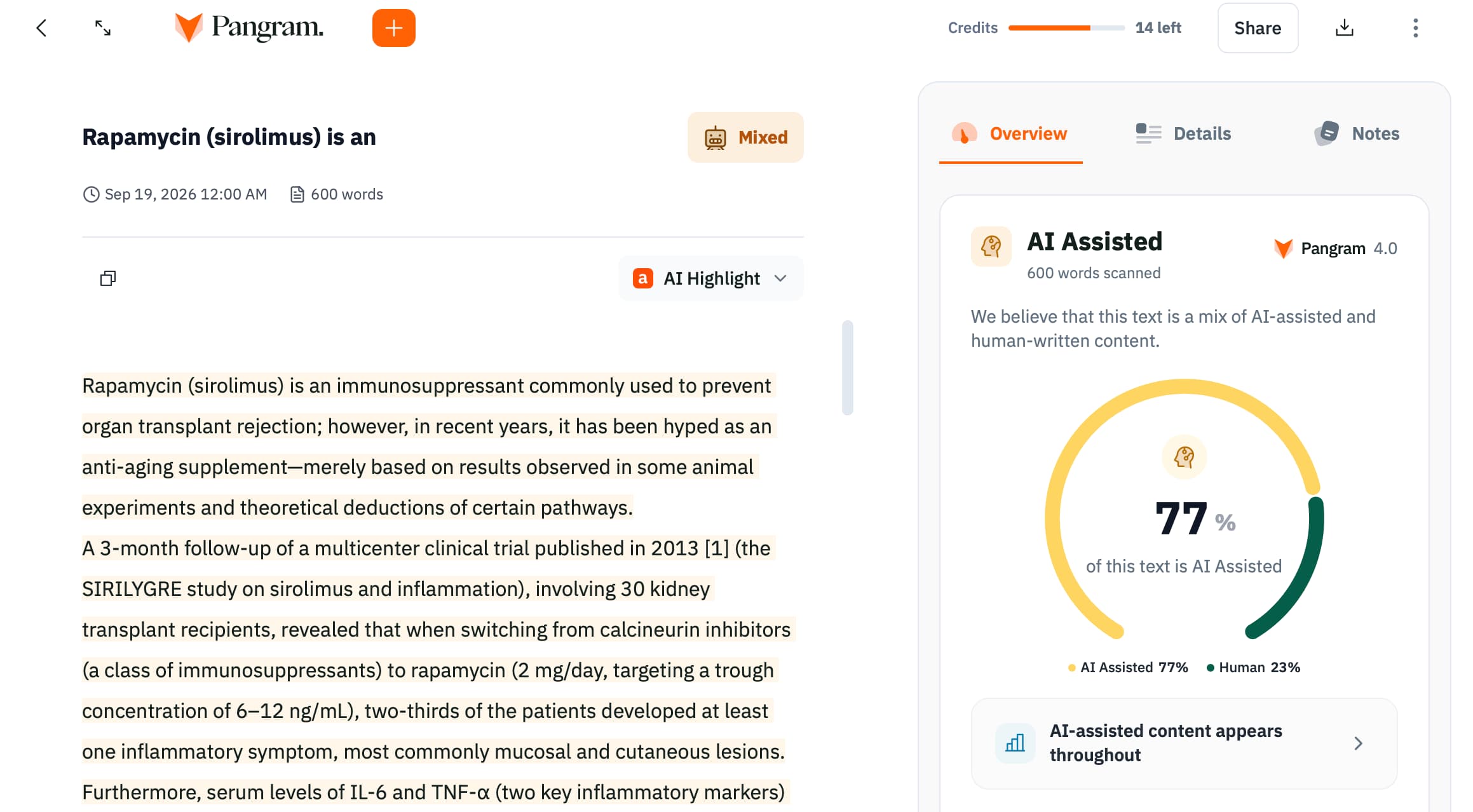
Interesting question… I wonder if Pangram (which I used to analyze the text in English) also works with Mandarin Chinese Characters. https://www.pangram.com. I’m just using the free version and have maxed out my usage for today.
Or perhaps there is a Chinese equivalent to Pangram to analyze the text to see if its AI generated.
I followed this author “听风就是雨” for a while, he likens the Chinese version of ‘Crémieux’. He gets attention by “whistleblowing” biohacking ideas (Keto Rapa). His article was written by hand and backed by science.