Article at;
https://www.visualcapitalist.com/ranked-the-countries-with-the-best-and-worst-health-care-in-2026/
Article at;
https://www.visualcapitalist.com/ranked-the-countries-with-the-best-and-worst-health-care-in-2026/
Thailand and Mexico are punching above their weight, in terms of spending per capita. In Mexico, I can walk 2 blocks to a pharmacy and get a consult from the doctor on duty on any issue. Like India, medication is cheaper here, because they have a strong generics manufacturing industry, which means I’m able to find better and cheaper medication.
Quite a few countries are missing from this list, and it’s not clear to me if that’s because of lack of data.
This is the top and bottom of the full list. There are a number of ways to operationally define health care quality. Surprisingly, the rankings do not change in large ways across different perspectives. Much of the low ranking in the US is due to a combination of income and access inequality, structural inefficiencies, and perverse economic incentives. Nonetheless . . . the wealthiest nation.
I know, I consulted the full list.
I wonder how/if that would change if the US wasn’t as rich as it is.
Most experts in health care economics and systems do not see a feasible way out of the system the US has backed itself into. I spent several fascinating hours looking into the history of how we got to this point. In hindsight, the wrong turns are easy to see. The equation is different now. There is so much money in disintermediation across the system spectrum that no Congress or administration could survive an all out assault. The best strategy now is incremental change, perhaps moving up the ladder a few points. For the wage earners and non-wage earning elite above them, US sickness and disease care is arguably the best in the world. The same cannot be said for wellness, etc.
One interesting finding is that Canada is even worse than USA. So much for government sponsored plan.
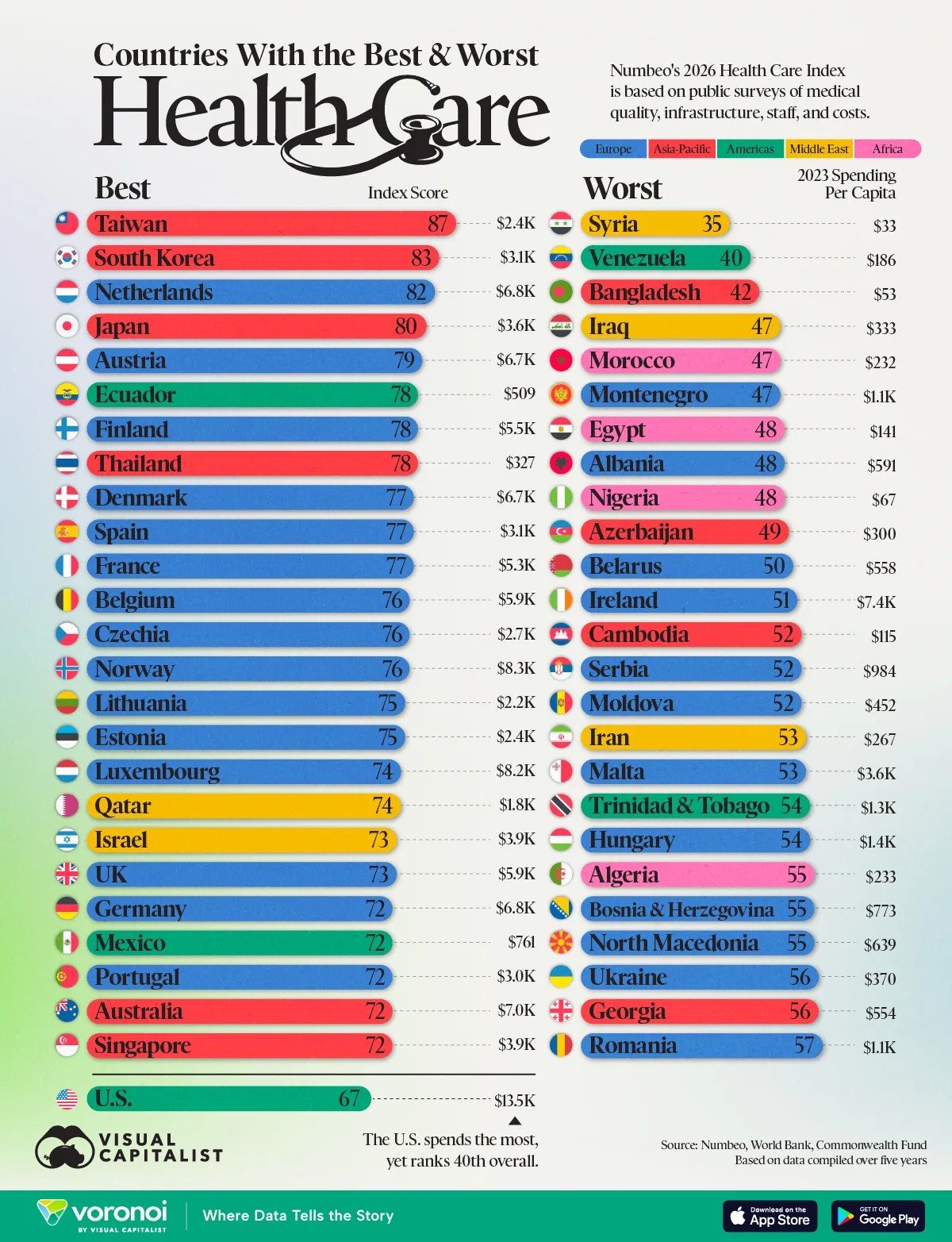
According to what I see, Canada is not worse than the US, It is 34th and US is 40th. On the expense index, Canada is 32nd and the US 38th.
Irrespective of Canada’s rating, It does not support drawing any inferences related to the quality of public heath care systems since all of the G7 or the G20 for that matter operate on the principle of Universal Health Coverage (UHC), where the government guarantees, mandates, or heavily subsidizes healthcare access for the entire population. Among advanced economies, the US is a distinct outlier and turns in substandard statistics across the board.
Taiwan’s healthcare system, known as the National Health Insurance system, was established in 1995. It is widely considered a masterpiece of healthcare engineering, frequently topping global indexes for efficiency, patient satisfaction (routinely above 80–90%), and accessibility. Thinking like scientists instead of ideologues, the government conducted a global meta-analysis of healthcare, blending the single-payer governmental administrative efficiency of Canada, the choice and competition of the American private provider network, and the mandatory enrollment of Germany, all digitized via a centralized IT infrastructure. The world could take note and, of course, their health outcomes statistics are enviable.
I don’t like the word mandatory, the rest I agree with. Btw, I didn’t see the full list, so I missed the fact Canada was ahead, though not in a good place either.
Think: driver’s license, insurance, property tax, obeying traffic signs. Some mandatory behaviors are essential to an efficient civilized society. Economic free riders are a systemic inefficiency. We in the US are overrun with them.
My comments on Taiwan’s health care system failed to acknowledge its stressors. They have several. Like the US and many other on the G20, their system is stressed by an aging population and low replacement birth rate. This transition is stressing budgets with predictable knock-on effects. Also, since anyone can go to any provider for any service (no gating or triaging), utilization of the system is likely higher than efficient for its returns. Some form of gating may be necessary. Also work hours and ratios are less than ideal.
It is mess. We agree on that but some additional distinctions are helpful. First, requiring that all citizens and residents participate in a nation’s health care system is not telling them they have to visit the doctor. It does, however, make economic sense to do so when one is ill but the drivers drivers are very much different. It is empirically clear that with a good system, people go to a doctor when they feel that they need to go. In the US, that is not the case for more than half, likely 60%, of the population. GDP is the single best indicator of quality of life and economists and the CBO have estimated that the contribution to the GDP of a Taiwan-type system would be 1.8% which, in current dollars, would be 573.4 billion dollars or an extra $4,370 in real purchasing power per household annually. This positive net contribution is driven by an increase in economy-wide productivity, a healthier and more reliable labor force, fewer healthcare costs for horizonal illnesses, reduced care and treatment times and costs, and an increase in the nation’s capital stock as capital shifts from medical bureaucracy into productive enterprise. This is all shorthand but the detailed evidence is rich and abundant, which is why most nations other than the US invest in this particular kind of human capital infrastructure. Of course, none of this touches on the personal contributions of having a healthier, longer living family. The longevity and health span data are compelling.
Given the source of data collection was derived from surveys answered by website visitors the underlying methodology has important limitations that make it better interpreted as a public perception of healthcare quality in each country and system.
It measures, “How good people think healthcare feels and functions”.
It is fundamentally a perception survey
That’s a big limitation as the index is not built primarily from:
Instead, it relies heavily on subjective impressions.
Perhaps not worthless, but I’d guess that the best indication here is the nations past experiences rate against current experiences.
I agree that there is a pretty obvious economic argument. Healthier people means healthier workforce, more productive, less disruptive. Chronic disease is hugely costly for everybody.
Problem is, lots of people in the US (and other places) profit greatly from the current system and have absolutely zero incentive to change things. Huge amounts of the spending go into the pockets of big businesses and wealthy people. Furthermore, you basically have the weird situation where the food and advertising (big tech too) industry promote unhealthy lifestyles, and the drug companies offer you solutions for a price.
So you can get addicted to short form videos, stay up late, buy shit on Amazon with one click, and order your enormous burger on an app at 2am. But don’t worry because there’s a nice new GLP1RA to help you lose the weight. Everybody makes a profit, except the poor sucker paying for everything and killing his health. At the risk of getting political, my view is that the minimalist regulation approach only works when people aren’t going to behave blatantly unethically, and it assumes that people will behave in an educated and rational way. Unfortunately, the reality shows that companies will exploit people to extract every last dollar, and that people (including all of us here) do not behave rationally. IMO there needs to be legislation at both ends - restrictions on unhealthy practices, smoking, food advertising, portion sizes, delivery times etc, education in school. Heavy-handed perhaps, but IMO necessary. Just look at the per-capita spending, holy shit. Spending 5.4x more than the number 1 place, while ranking 39 places lower. Yikes.
Still, I have to express scepticism at the results in this infographic. The UK ranking higher than Germany, Singapore or Australia is suspicious. Maybe a reflection of the weird way that British people are terrified to criticise the almighty NHS, even though it’s absolutely terrible.
And lastly, I think if an individual has the means (i.e. $ and education) it’s a massive benefit. You can buy your way to most things - shorter wait times, faster scans, better technology, new treatments etc.
As I mentioned, there are many perspectives from which to assess the notion of global comparative health. The metrics summarized in this infographic are a bit better than some are appreciating but the distinctions are at the margins because there is a high degree of correspondence across perspectives, including the less nuanced hard metrics. For the number one hard metric – longevity-- the US places 55th at birth and 42nd at age 65. Moreover, the usual suspects are leaders and the leaders have universal government structured health care systems. You can play around with these factoids here: List of countries by life expectancy - Wikipedia
Yes, a great deal of money is attached to the US system disintermediation. This is why a coalition of medical care systems and pharma have been fighting for many decades to prevent the US from switching to a single payer system. The administrative overhead from the entire Medicare system is 4.5% with the remainder going directly to the (inefficient) health care provider system. The structure of the Medicare system – which is excellent in my experience and according to systems analysts – could be expanded to accommodate the full US population. In contrast, the administrative overhead from privately operated systems is 25% before the first dollar goes to care. It used to be much higher than this (typically north of 30%) until the ACA put a cap on how much profit the industry could extract. But even these numbers overstate the inefficiencies of the privately managed system because the 75% portion that goes into the health care system is then further siphoned off by PBMs and other systems.
Of course, none of this applies to the wealthy and the small percent of people like us who know how to exploit the loopholes in the system.
The Study and its title are substantially useless. What are the standards of quality? This seems to be addressing simply cost. If there is restricted access and compensation the costs will go down, if people are generally sick, the costs will go up unless of course they can’t get treatment like in Canada.
Universal healthcare means everyone gets a lot of nothing. If they claim something is covered, and yet the compensation is below the cost to provide it, it effectively does not exist.
That means Everyone gets diminished care at a low cost because very little care is ever provided. That is the opposite in the United States and the reason that United States healthcare is the best in the world.
I spit out my coffee.
The US health care system is only the best at wasting money.
It isn’t all bad but mostly it wasted money.
I am a physician which doesn’t make me any kind of expert but I just wanted to point out my perspective. The perverse incentives are legendary.
This is not the case. A substantial family of comparative metrics assess, at the core, cost per unit of outcome. The US is in the company of third-world nations on all of them. However you slice or dice it, aggregate per person health care costs substantially more in the US than it does in other advanced nations and produces poorer quantitative outcomes (e.g., healthspan, lifespan – even happiness and life satisfaction in many cases) than those nations. If you want to do some back of napkin math that many would find surprising, use the by nation global cost and lifespan data an calculate a metric as simple as aggregate cost per person year lived by nation.
But for the money we spend we do a a few things well.
We get vaccines almost entirely for free.
Shingles and pneumovax at age 50 - lower than many especially the Pneumovax.
Mammogram rates are near the top
Colonoscopy rates are the highest by far
Statin use very high - now we need it more probably but still.
And if someone needs a surgery, we tend to get it pretty fast with some regional variations. But, mostly, people aren’t waiting 6 months for surgery.
And no amount of healthcare spending is going to get life expectancy highest in the world with the other structural problems regarding crappy food, lack of exercise, excessive work hours and commute time and overall stress levels - lack of vacation, childcare, wealth inequality.
My post part you are responding to was primarily a preamble to the conclusion.
Culture and data quality are too varied to reach quality conclusions. What are the measures of “quality”?
For example if everyone that gets a cold goes to the doctor because that is part of their culture the cost per benefit would be huge. If only with non life threatening but severe injury is the metric for a touch point there will be fewer but higher benefits per visit.
In India other than in the cities one must be near death to travel or one just dies and there is little documentation and no cost. How many visits in the US are entirely unnecessary and actually do more harm by leading to liability related studies finding incidentalomas prompting further testing that then adds cost and harm.
I did not see the metrics, method for collecting, raw data summaries, validation, confounders and adjustments to match population age, sex, comorbidities.
They may be there but I didn’t see them.
With Romania so low, it is clear to me that this list is far from good for evaluating what countries are good in terms of healthcare for longevity and prevention. Sure, the Romanian public healthcare system is very bad, but if you live in one of the bigger cities and have money for private healthcare (which is very inexpensive relative to other western countries) and also consider options for preventative healthcare, then Romania likely among the best countries on this list. It certainly has more freedom than most European countries in terms of ability to buy various supplements, drugs, blood tests and healthcare services. So for people that are proactive about their own health, I would rank it high. Especially compared to many of the wealthier Europeran countries where you commonly need a doctor’s referral for everything.