I was reading that there is a kind of slow-release form of Citracal (Citracal Slow Release 1200) that takes up to 8 hours for the calcium to be fully released, and presumably the same would be true of the citrate in the pill (the pill also contains calcium carbonate; I am unsure exactly the mixture of the two forms of calcium). It might be beneficial to have citrate in such a slow-release form, though one would pay the price of having to also take in a lot of calcium.
I asked Google Gemini 2.5 Pro about how the Slo-Cal tech in the pill works, and it reports:
When you ingest a Citracal Slow Release 1200 tablet, the moisture in your digestive system interacts with the tablet’s components. A crucial ingredient, hydroxypropyl methylcellulose (HPMC) , a hydrophilic (water-loving) polymer, begins to absorb this fluid and swells, forming a viscous gel layer around the tablet. This gel acts as a barrier, and the calcium salts—both calcium carbonate and calcium citrate—trapped within this matrix can only be released as the gel slowly dissolves and erodes.
This process ensures a gradual and continuous release of small amounts of calcium into the intestine over several hours. This is beneficial because the body has a limited capacity to absorb calcium at any given time. By providing a steady, controlled supply, “Slo-Cal” technology aims to maximize the amount of calcium that can be absorbed and utilized by the body, rather than being excreted unused.
I think it depends on the blend / mixture of calcium citrate versus calcium carbonate, and then also how much one is aiming to take.
A single dose of Citracal Slow Release 1,200 has 1,200 milligrams of elemental calcium. If 100% of it was part of calcium citrate (more precisely, calcium citrate-tetrahydrate), that would be 5.7 grams of calcium citrate, which would give you about 3.8 grams of citrate. But if the mixture is 50%-50%, then you’d get half that, which is still a decent amount.
But if one is aiming to take 6 grams of citrate per day, say, then the amount in a Citracal pill would be too low, yes.
(The above calculation is according to OpenAI’s o3. I checked it by doing a Google search, also.)
I have some of the non-slow-release kind, and can say they are big, thick, heavy pills. I could even imagine someone choking on one. I stopped taking them a year or so ago just because I decided that amount of calcium in my diet is probably excessive.
In which case you are right that could be substantially calcium citrate tetrahydrate. One reason I went to a chemical broker for my citrates was to get certainty as to what I was buying.
@John_Hemming, I took the following today to see if it would help with GERD. This with my morning coffee and no food until lunch.
400 mg of magnesium citrate
300 mg of calcium citrate
750mg of sodium citrate
Felt high until early afternoon. Colors were brighter; felt separated from my body, as though observing it; and had a pleasant relaxed feeling. A mouth ulcer from rapamycin felt more painful. Then I crashed and took a 1.5 hour nap and feel more or less back to baseline.
I calculated the figures based on what I thought would enable maximising citrate intake whilst avoiding an excess of any cation. This comes out with the conclusion that a high proportion of Sodium is a good idea (over 50%). That may sound counterintuitive, but I have used it for over 4 years.
I have more recently dropped Calcium (last couple of years). It dissolves better without Calcium, but I may experiment with Calcium again at some stage in the future.
The precise ratios in the citrate mix my company sells (cytravo) can be found here:
John,
Sorry a bit late to this but have a question. Do you do/recommend citrate daily for a while lets say one month per year or it is something you would rather keep taking as part of a normal daily regimen.
Its slightly complicated, but some daily is a good idea.
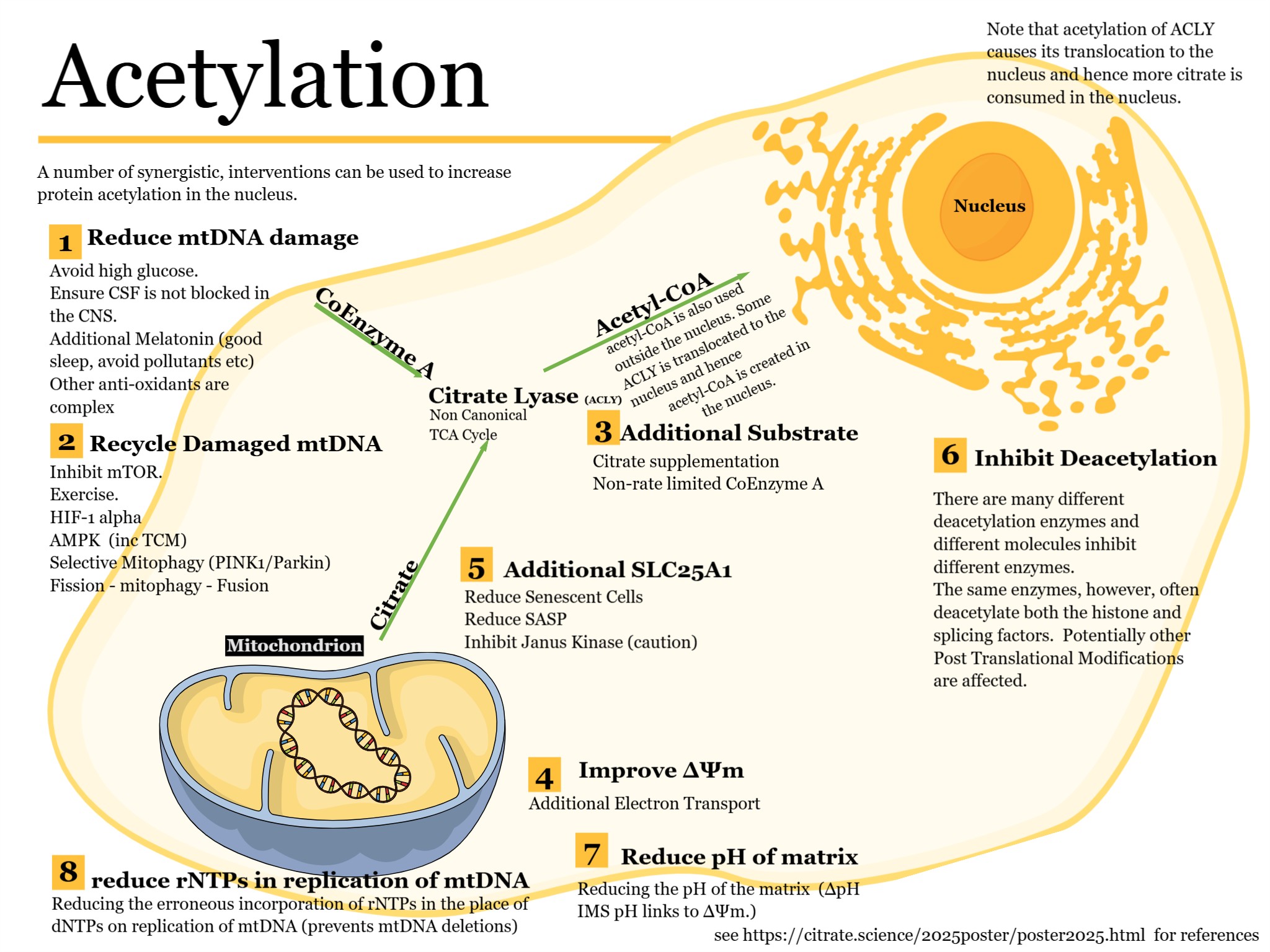
The problem is that you are intervening in a combinatory pathway. I will attach the infographic. The underlying issue is that you want more mitochondrial efficiency, but a bit of citrate helps.
I asked chatGPT because I have not heard this. It did not confirm this. I have taken a lot of citrate today and felt dehydrated a bit, but not because of the volume of urine.
It would be interesting to see the sources that claim citrate is actually a diuretic.