Pyridoxamine — Advanced Glycation (AGE) Cross-Link Inhibition

My approach when arguing a case is to obtain references that substantiate my view so that it is possible for other people to read the evidence. I have also got paid chatGPT,claude and gemini accounts.

I put the question “what research exists as to the effect of pyridoxal-5-phosphate supplementation on longevity” into all three. They all say having low serum P5P is bad for longevity. P5P is the active form. However, there is not really much on the issue of supplementation and longevity.

I find the interplay between the B vitamins quite interesting. I like @ConquerAging 's work, but I would not make a decision purely on his reporting of any particular impact on his own metabolism.

I have no problem with the idea that @Cole and I disagree about whether or not to supplement B6, how much to supplement and which form.

However, I think relying on the US regulator when all the other regulators take a different view is a mistake.

If I don’t respond to any other point on this matter that is simply because I have not seen any argument as to why I should change my mind that is worth responding to. I don’t need the last response on any discussion.

I will continue supplementing with P5P although when reordering I may look at taking the dose down a touch.

Are we talking about pyridoxine/P5P neuropathy because there is a theoretical risk of neuropathy from pyridoxamine supplementation?

I think we are talking about it because there is a question as to what is the best form of B6 to supplement. (given that pyridoxamine is hard to get).

I don’t see any point of mega-dosing P5P or pyridoxine when the topic is specifically about pyridoxamine and its unique glycation-inhibiting properties.

2 Likes

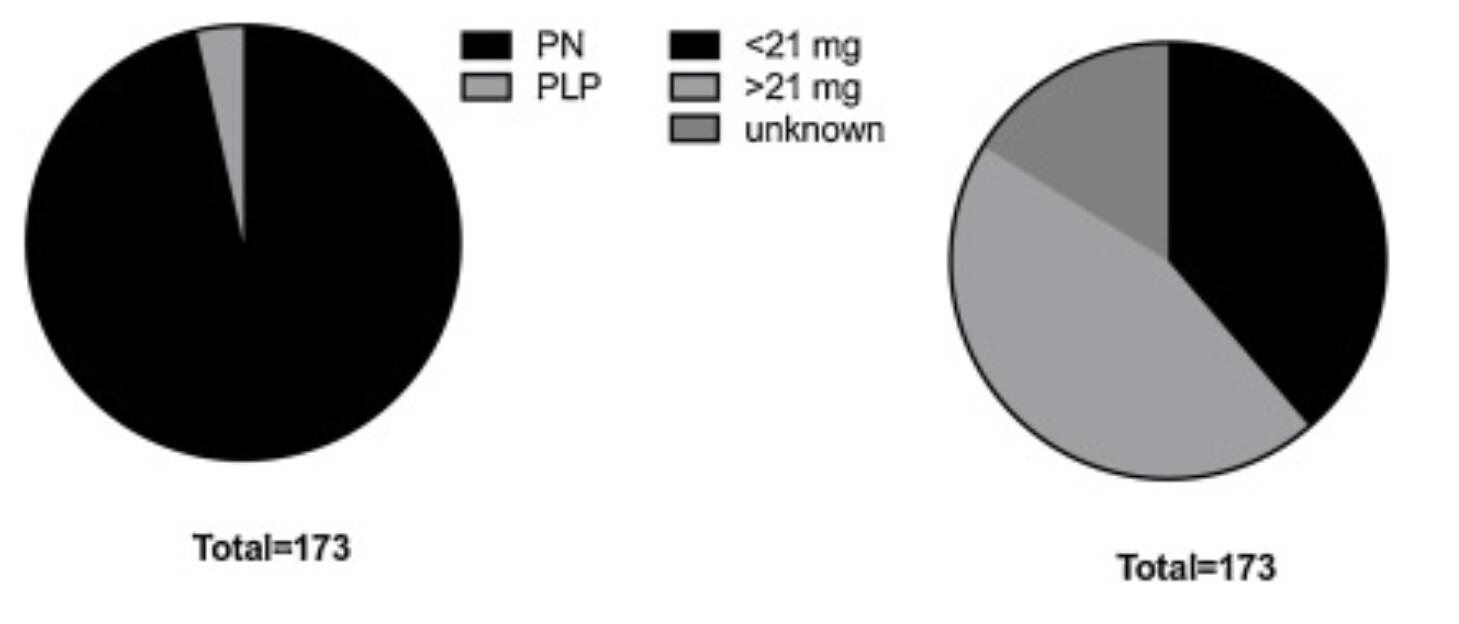
There have been reported cases of neuropathy associated with pyridoxal-5-phosphate (P5P), even at very low doses, though overall instances are extremely rare. Currently, safety upper limits for vitamin B6 are based entirely on data from pyridoxine, as long-term safety data specifically for P5P remains unavailable. Theoretically, P5P should be significantly safer than pyridoxine. I suggest you either adhere to the standard safety guidelines for general vitamin B6, or base your intake on the dosages currently utilized in short-term P5P clinical trials.


The chart above shows which forms of vitamin B6 were used in cases of vitamin B6–related neuropathy.

It’s an option, but unfortunately you also have to take NAC at 900mg+ to get the approx. 300mg of pyridoxamine… because they all package it that way:

The most useful analytical takeaway is the cross-positioning itself. The identical NAC 300 + pyridoxamine 75 mg tablet is sold by Cafoli as a respiratory mucolytic, by Alniche/Steris as a nephroprotective, and (on some pages) as a dietary supplement — three incompatible regulatory framings for one molecule. That’s the signature of a marketing-led fixed-dose combination with no settled, regulator-sanctioned indication behind it, riding on the antioxidant/anti-AGE rationale of two component molecules whose combination was never approved in a stringent market. None of these four products clears your top-tier entry bar; they’re branded-generic/PCD marketing SKUs.

1 Like

Taking the “active form” is not ideal at all, and in fact, in terms of antiglycative effects, pyridoxamine is the most active form.

Typically pyridoxal-5-phosphate is referred to as the active form of B6, becuase it is the coenzymatically active form that cells use. However, it does not get absorbed intact to a significant extent because it gets hydrolyzed into pyridoxal in the digestive tract, so paying more for the so called “active form” is basically a waste of money.

Also if we’re talking about anti-glycative benefits, then pyridoxamine is the most active form of vitamin B6. You’ll get weaker effect if you consume pyridoxal-5-phosphate or pyridoxine or any other form.

I agree with you though that avoiding toxicity is important. While for most people, it’s not a concern at 100 mg or less daily, there are rare exceptions to that rule as evidenced by case reports in the literature. This usually only shows up after long term exposure. This probably reflects different genes, but some people would be extra sensitive for whatever reason. In any case, regardless of the dose one takes, to reduce the risk of toxicity it is generally adviseable to spread the dose throughout the day and take it with meals to even out the concentration of it in the blood and cells.

All the forms can cause neuropathy. including pyridoxal-5-phosphate. Pyridoxine is the one most likely to cause neurotoxicity.

2 Likes

the easiest and cheapest way to get pyridoxamine is as a research-grade reagent; standalone consumer products are quite rare. To be honest, I’ve never worked in a laboratory, so I’m not sure if substances sold as research reagents are safe for human consumption. From what I’ve observed, their production and bottling lines handle various chemical compounds, meaning the equipment isn’t dedicated solely to pyridoxamine. I have the exact same concern regarding 17α-estradiol. @RapAdmin

1 Like

Buying most chemicals from Legit research lab sales websites is actually pretty hard - they validate that you are part of a lab or educational research group. You can’t, as a typical consumer, just go to the Sigma Aldrich website and expect to buy the reagents.

Then there are the whole world of grey-market “research products” - and thats anther game entirely. Can you trust them? Probably not something you want to do for a long-term dosing strategy (at least I wouldn’t).

2 Likes

In looking at the issue with chatGPT(5.5) I had a partial response on pyridoxamine: “Pyridoxamine is not widely marketed because it was previously developed as a pharmaceutical candidate for diabetic complications, limiting its commercial availability in many countries.”

As far as I can tell it has a dynamic equilibrium with P5P. Although P5P cannot pass into cells it can be dephosphorylated and then pass into cells and be rephosphorylated which is safer than PN. There are a lot more reports from overdosing of PN than P5P. Whichever way B6 is something to be careful with. Particularly Pyridoxine (PN).

Hence unless you can actually supplement with PM (where the active component is phosphorylated to Pyridoxamine 5′-phosphate) best supplement with P5P.

For years, targeting advanced glycation end products (AGEs) was seen as a holy grail for arresting diabetic nephropathy (diabetic kidney disease). Preclinical data were glowing: oral pyridoxamine dihydrochloride (Pyridorin), a vitamin B6 derivative developed by NephroGenex, routinely rescued renal function in diabetic rat models by scavenging toxic carbonyls and reactive oxygen species.

However, translating benchtop success to bedside reality proved to be a multi-million-dollar bottleneck.

The Trial and the Flop

The hype hit a wall during Phase 2/3 evaluations. In a pivotal 1-year, multi-center, randomized controlled trial, investigators evaluated the efficacy of Pyridorin (150 mg and 300 mg BID) against a placebo in patients with Type 2 diabetic nephropathy who were already stabilized on standard-of-care ACE inhibitors or ARBs.

The readouts were unforgiving:

  • Primary Endpoint Failure: Pyridorin failed to demonstrate any statistically significant reduction in the progression of serum creatinine concentrations compared to the placebo at 52 weeks.
  • Secondary Deficits: The drug showed no meaningful impact on estimated glomerular filtration rate (eGFR) decline or overall proteinuria (urine protein-to-creatinine ratios remained virtually unaltered).

The Post-Mortem

Subgroup analyses threw a minor lifeline, suggesting that patients in the lowest tertile of baseline serum creatinine (those with earlier, less severe kidney impairment) might retain some therapeutic benefit. Armed with these post-hoc insights, a Phase 3 study (PIONEER-CSG-17) was designed under an FDA Special Protocol Assessment to target earlier-stage cohorts with strict blood pressure stabilization windows.

Unfortunately, the clinical momentum stalled out entirely. Beset by financial distress, NephroGenex ultimately filed for bankruptcy, and the once-promising AGE-inhibitor joined a long list of metabolic pipeline casualties. The Pyridorin saga remains a textbook warning that robust biomarker reduction in animals does not automatically safeguard human nephrons.

1 Like

It’s a shame this was the end of pyridoxamine studies in humans. This trial was doomed to fail IMO. Pyridoxamine doesn’t reverse glycation (it’s not a crosslink breaker) it slows down glycation. Glycation is a very slow progress that slowly accumulates and causes damage over years and decades. If pyridoxamine worked you would not expect to see reversal and improvement in kidney disease. Rather you would expect to see a slowdown of further decline, something that might take perhaps 5 years to become noticeable between groups in a trial.

It’s such a shame that this drug company tried to designate pyridoxamine as a drug, thus effectively getting it banned as a supplement in the US, and then fails to test it properly, and now it remains stuck being categorized as a drug in the USA.

2 Likes

It appears research-grade pyridoxamine is unfit for human consumption. The quality control is simply inadequate, even from top-tier brands like Merck. Based on the human trials I checked, the oral pyridoxamine administered is all synthesized in-house by university labs. Sigma-Aldrich chemicals are kept strictly for analytical use.

2.1 Chemicals
Pyridoxine (PN, ≥98%), D3-pyridoxine (D3-PN, ≥98%), pyridoxamine-5′-phosphate (PMP, ≥98%), pyridoxal (PL, ≥99%), pyridoxal-5′-phosphate (PLP, ≥98%) and perchloric acid (PCA, 70%) were obtained from Sigma–Aldrich (Steinheim, Germany). D3-pyridoxamine (D3-PM) was obtained from Cambridge Isotope Laboratories (Andover, USA). D3-pyridoxal-5′-phosphate (D3-PLP) was obtained from Buchem (Apeldoorn, The Netherlands). Tridecafluoroheptanoic acid (TDFHA, >98%) was obtained from Alfa Aesar (Kandel, Germany). Water and acetonitrile (ULC/MS quality) were obtained from Biosolve Chimie (Dieuze, France).

Pyridoxamine (pyridoxamine∙HCl) was obtained from Tohoku University School of Medicine (Sendai, Japan) @RapAdmin

This is certainly a supplement I would like to take.

Unfortunately, real pyridoxamine is hard to get. The products on Amazon that claim to be B6 pyridoxamine are not actually true pyridoxamine.

It is, of course, available from our usual Indian suppliers under the name of Renosave Forte. It’s a prescription drug that combines pyridoxamine with NAC. The strongest dose I can find is 75 mg of pyridoxamine with 300 mg of NAC. This is okay with me because I take NAC and don’t mind taking more.

The dosage range is:

In the major human trials investigating pyridoxamine (under the drug name Pyridorin) for microvascular protection and diabetic kidney disease, researchers targeted the following dosage ranges:

Moderate Dose: 150 mg taken twice daily (300 mg total per day).

High Dose (Phase 3 Standard): 300 mg taken twice daily (600 mg total per day).

In these studies, a total daily intake of 300 mg to 600 mg was identified as the therapeutic window. This concentration was necessary to effectively circulate in the bloodstream, scavenge reactive carbonyls, and inhibit the formation of Advanced Glycation End-products (AGEs) before they could cross-link with tissue.

"When you search for “pyridoxamine” on Amazon, their algorithm automatically substitutes standard B6 products because true pyridoxamine is not legally available as an over-the-counter supplement in the United States.

In 2009, the FDA banned the sale of pyridoxamine as a dietary supplement. This occurred because a pharmaceutical company was running Phase II clinical trials on it as an investigational new drug (under the name Pyridorin) to treat diabetic kidney disease. Under FDA regulations, once a substance is formally investigated as a new prescription drug, it loses its supplement status.

Because of this regulatory barrier, you will not find genuine pyridoxamine on mainstream retail sites. People targeting AGE inhibition and matrix cross-linking usually have to shift to alternative, legally available carbonyl scavengers."

Obtaining true pyridoxamine for personal consumption in the United States is virtually impossible through standard retail channels due to the 2009 FDA ruling that classified it as an investigational new drug.

Here is the current reality of trying to source it:

Mainstream Retailers

You will not find pyridoxamine at local pharmacies, vitamin shops, or online retailers. If you search for it on platforms like Amazon or iHerb, their algorithms will automatically redirect you to standard Vitamin B6 (pyridoxine) or P-5-P. As previously noted, these do not possess the same AGE-inhibiting chemical structure.

The Unique Mechanism of Pyridoxamine

Vascular matrix stiffening—a primary driver of reduced microvascular compliance—is largely caused by the accumulation of AGEs and Advanced Lipoxidation End-products (ALEs). These form when reactive carbonyl species (RCS), such as methylglyoxal, biochemically attack the amino groups of structural proteins like collagen and elastin, creating rigid cross-links in the extracellular matrix.

Pyridoxamine is uniquely equipped to intervene in this process due to its chemical structure:

  • Carbonyl Scavenging: Pyridoxamine contains a highly reactive nucleophilic amino group. This allows it to act as a potent “carbonyl scavenger.” It binds directly to pathogenic reactive carbonyls before they can cross-link with vascular proteins, effectively neutralizing them.
  • Metal Ion Chelation: Pyridoxamine chelates catalytic metal ions (like copper and iron) that are necessary for the oxidative chemistry that drives AGE/ALE formation.
  • Clinical Focus: Because of this specific mechanism, pyridoxamine was heavily investigated as a pharmaceutical therapy (under the name Pyridorin) specifically to prevent vascular and renal damage by inhibiting AGE formation.

Pyridoxamine treatment ameliorates large artery stiffening and cerebral artery endothelial dysfunction in old mice

Protective Effects of Pyridoxamine Supplementation in the Early Stages of Diet-Induced Kidney Dysfunction

How Does Pyridoxamine Inhibit the Formation of Advanced Glycation End Products? The Role of Its Primary Antioxidant Activity

Pyridorin in Type 2 Diabetic Nephropathy

Pyridoxamine improves survival and limits cardiac dysfunction after MI

The effect of aminoguanidine (AG) and pyridoxamine (PM) on ageing human cortical bone
4 Likes

Thanks for sharing. I completely forgot that India is such a treasure trove for this kind of stuff.

Looking at the *IndiaMart website what seems available are Renosave Forte tablets of NAC 300mg + pyridoxamine 75mg
Requesting that, I was offered:

Acetylcysteine (300mg) + Pyridoxamine dihydrochloride (50mg) @ 45 USD per box (150 Tablets)

So… higher price than initially shown, lower mg of PM per tablet.
Caveat Emptor

Your using the wrong vendor.

I looked into this further:

“When you swallow P5P, it encounters alkaline phosphatase, an enzyme bound to the membrane of your intestinal mucosa (the gut lining). This enzyme hydrolyzes the phosphate ester bond, converting the P5P back into unphosphorylated pyridoxal. Pyridoxal is then easily absorbed by cells in the small intestine via passive, carrier-mediated diffusion.
" The moment pyridoxal crosses into the intestinal cells or reaches the liver, an enzyme called pyridoxal kinase immediately attaches a new phosphate group back onto it. This turns it back into P5P.”

1 Like

Exactly. This is why P5P supplements could be almost considered a scam if they are promoted as superior because they are the “active form of vitamin B6”. In reality taking P5P orally is largely like taking expensive pyridoxal.

2 Likes

I looked further and found that in research studies p5p has been shown to work well in protecting against AGEs in lab rats. The doses used were 300-600 mg/kg of body weight per day. Even at the human equivilency dose that’s way too much for me. Thank you for your posts leading me to learning this.

1 Like