https://www.biorxiv.org/content/10.1101/2025.02.13.638188v1.full#ref-69
Mescaline is legal in CO
1 Like
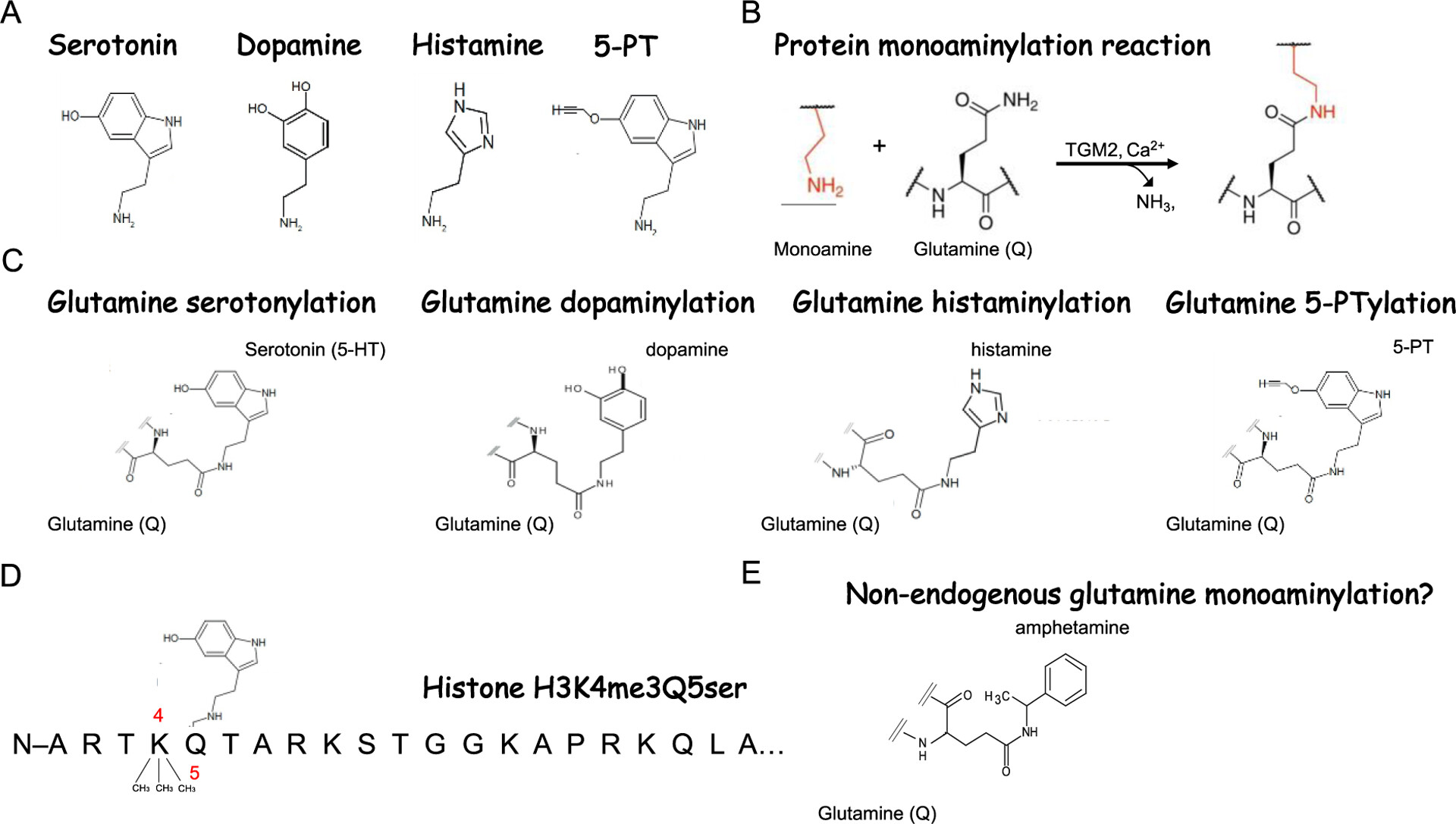
the enzyme is very dependent on Ca2+ spikes (mb epileptic people are more prone)
kind of like acetylation
Extracellular Matrix (ECM) Proteins
Many of the initial studies on monoaminylation examined the modification of fibronectin, a major glycoprotein important to the maintenance of both structure and signaling in the ECM34, 121. In the CNS, in vitro evidence suggests the possibility that fibronectin serotonylation by glial cells increases the deposition of ECM proteins, constituting a potentially pro-fibrotic mechanism34. In the periphery, fibronectin serotonylation by a competing transglutaminase, Factor XIII-A, decreases collagen fibrillogenesis, constituting a potentially anti-fibrotic mechanism39. Fibronectin serotonylation also promotes the proliferation and migration of smooth muscle cells, suggesting that such fibronectin modifications are important in the cellular response to ECM signals38, 122–124. Brain ECM reorganization is thought to be an important mechanism by which psychedelics, particularly psilocybin and 3,4-methylenedioxymethamphetamine (MDMA), “reopen” critical periods in mature animals, reenabling social reward learning125, 126. Enduring ECM protein modifications by such tryptamines and phenethylamines could, hypothetically, promote long-term ECM remodeling.
“we demonstrate that a diverse set of proteins are potential targets of TGM2-mediated phenethylaminylation by 4PM, an alkyne-functionalized derivative of mescaline, in primary human astrocytes”
“dopamine, like serotonin, can also form covalent bonds with histone H3 at glutamine 5 (H3Q5dop”
1 Like
transamidation modifications of cellular proteins (including monoaminylation) in cultured cells under conditions in which large Ca2+ elevations are not likely expected 33, 34, 85–87. These observations may be due to the fact that in living cells TGM2 can have variable sensitivities to activating or inhibiting stimuli88. For instance, a shorter TGM2 isoform expressed in astrocytes is less sensitive to inhibition by GTP and is, resultingly, more prone to Ca2+ activation89. Despite these potential exceptions, TGM2 is generally thought to be latent in the absence of substantial intracellular Ca2+ elevations90. TGM2 also likely requires prolonged calcium elevation for robust activation91. Although our examination of the effects of 4PM on cellular Ca2+ dynamics is limited, our data indicate that 4PM alone may not stimulate a consistently robust elevation in TGM2 activity across all of our cell strains
1 Like