Part of that is that women live longer and AD incidence goes exponential around 70-80 and beyond, so men die before it explodes in prevalence.
For virtually anyone who wants to live to 100 or beyond, if you don’t have Apo E2/2 you will be at an extremely high probability of getting AD unless you (and future science and medicine) find way to mitigate it.
See here for an example of what things look like for late 90s and 100s:
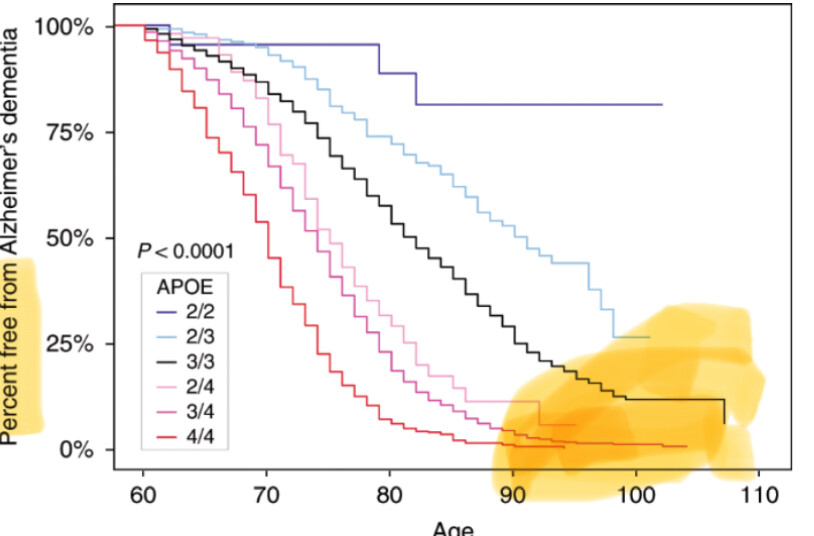
Full paper and discussion below. The conclusion of who will get AD is fundamentally different if we are talking about people who on average die by 77-82 years of age or who on average die in their 90s, 100s or beyond.
(perhaps unless you are Apo E2/2 - even Apo E2/3 start dropping off the cliff with age,
and Apo E2/2 might also once passed 100 years old we just don’t have the data)
So all of us should be focusing on AD prevention as much as @A_User focuses on minimizing cardiovascular risks.
Exceptionally low likelihood of Alzheimer’s dementia in APOE2 homozygotes from a 5,000-person neuropathological study
Each additional copy of the apolipoprotein E4 (APOE4) allele is associated with a higher risk of Alzheimer’s dementia, while the APOE2 allele is associated with a lower risk of Alzheimer’s dementia, it is not yet known whether APOE2 homozygotes have a particularly low risk. We generated Alzheimer’s dementia odds ratios and other findings in more than 5,000 clinically characterized and neuropathologically characterized Alzheimer’s dementia cases and controls. APOE2/2 was associated with a low Alzheimer’s dementia odds ratios compared to APOE2/3 and 3/3, and an exceptionally low odds ratio compared to APOE4/4, and the impact of APOE2 and APOE4 gene dose was significantly greater in the neuropathologically confirmed group than in more than 24,000 neuropathologically unconfirmed cases and controls. Finding and targeting the factors by which APOE and its variants influence Alzheimer’s disease could have a major impact on the understanding, treatment and prevention of the disease.