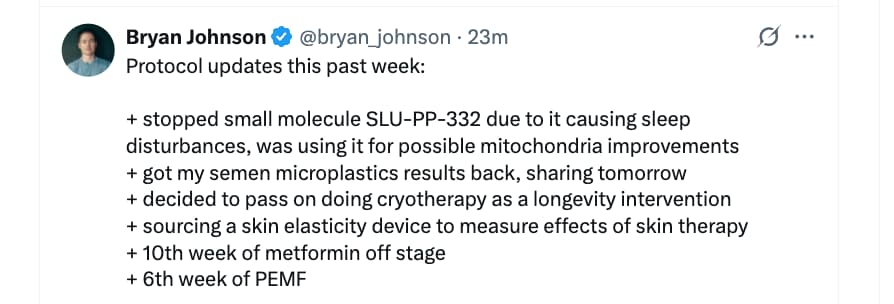
Source: https://x.com/bryan_johnson/status/1980375520719311334
Any idea what dose of SLU Brian was taking?
Since reportedly this molecule is not bioavailable when swallowed, I would love some real world anecdotal evidence as to efficacy in humans and if so, how was it administered.
The guest in this video talks a bit slowly, but does provide good information on SLU-PP-332. I continually wanted him to speed up. I tend to be a bit hyper so I had to watch it in two different sessions.
(@RapAdmin Edit: Full CGPT Video Summary / Analysis below:)
Executive Summary
This episode centers on SLU (almost certainly SLU-PP-332, an ERR agonist “exercise mimetic”) and how to use it rationally rather than chasing extreme doses. Anthony’s core position: there is no human clinical data on SLU; all guidance is extrapolated from animal studies plus anecdote, so the only sensible approach is minimal effective dose, careful monitoring, and strong biological foundations (mitochondrial, circadian, metabolic).
He argues that starting around 100 µg/day and titrating based on objective and subjective markers (DEXA/InBody, breath RQ devices, blood glucose/CGM, training performance) is defensible, and that some individuals see robust fat-loss at sub-mg doses. In contrast, milligram–hundreds of milligram protocols have no mechanistic justification and may create long-term risks: mitochondrial overdrive, ROS, fragmented mitochondria, angiogenesis drift, and insulin resistance–like carbohydrate handling.
The discussion then zooms into mitochondrial bioenergetics (complex I–IV flux, NAD/NADH, membrane potential, ROS, calcium handling) to explain why high SLU doses can cause brain fog: neurons are ATP-hungry, easily stressed by ROS and redox imbalance, and dependent on dopamine and acetylcholine synthesis, both impaired when the ETC is overdriven and glucose utilization is constrained.
A long practical vignette with Drew’s own dosing (100 µg → 2 mg → 4 mg) illustrates the bell-curve response: substantial fat-loss and fatigue resistance up to ~2 mg, but debilitating afternoon brain fog at 4 mg, only partly “rescued” by high-dose L-carnitine and +200 g/day carbohydrates. Anthony uses this to argue against stacking compensatory polypharmacy just to tolerate an unnecessarily high SLU dose.
Finally, he introduces urolithin A as a strategic co-intervention: a mitophagy and biogenesis modulator (via PINK1/Parkin and PGC-1α) that can “clean up” stressed mitochondria and improve the quality of the mitochondrial pool, making SLU’s exercise-mimetic signal safer and more productive.
Full summary here:
1 Like
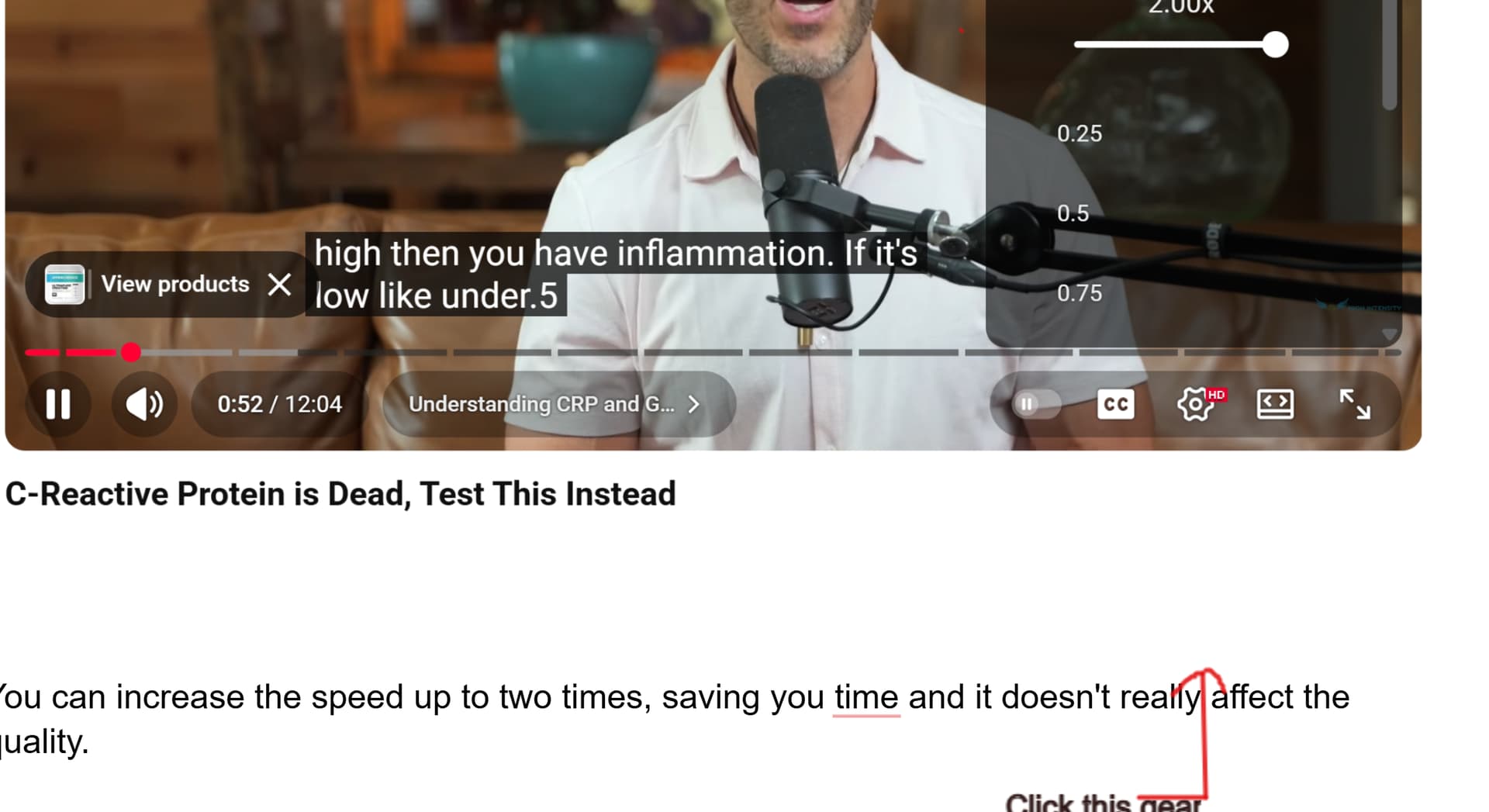
"You can speed up a YouTube video using the built-in playback speed controls, which are available on the desktop website, mobile app, and most other devices. For desktop users, there are also useful keyboard shortcuts. On a computer (website) Navigate to the video you want to watch.Hover over the video player and click the Settings gear icon (()) in the bottom-right corner.Click on Playback speed.Select a preset speed, such as 1.5x or 2x, or click Custom for more granular control.
2 Likes
I do see a number of people claiming to benefit from it. Here is a case I read recently: https://www.reddit.com/r/Narcolepsy/comments/1jyjujg/slupp332_has_changed_my_life_zero_sleep_attacks/
"I’ve been experimenting with peptides and research compounds for a while now—mostly to manage inflammation, energy, and muscle building, which are all so much harder with narcolepsy. Recently, I started taking a compound called SLU-PP-332 (orally, in tablet form), and for the first time since developing Narcolepsy Type 1 six years ago… I haven’t had a single sleep attack.
Let me give some context: •I normally have 5–10 sleep attacks a day. •I can’t drive more than 10–15 minutes. •I can’t read, watch TV, or sit still without falling asleep. •Even eating—especially carbs—knocks me out for at least 15 minutes, if not hours. (I’m not insulin resistant or diabetic) •Even with 200mg of modafinil twice a day, I still fall asleep after workouts or meals.
But with SLU-PP-332, it’s like I’m functioning like a normal person again: •I can drive more than 15 min •I can eat infinitely without crashing. •I can work out and or take a super hot shower without needing a 3-hour nap. •I get tired like a regular person, not like I’m collapsing into a coma. •I’ve been completely off caffeine, modafinil, and all meds this past week—just to see what SLU-PP332 can do on its own—and it’s been insane."
I took a long break from SLU-PP-332, now I’m going to restart taking it.
I will note when I took it originally if it was too close to bed time it interrupted sleep, so I can see how someone with narcolepsy would benefit.
Never mind Sloop. Go down to you nearest gene-editing lab, have them insert a mutation into your myostatin, and walk out with “The Hercules Gene.”
1 Like
Full story available at link below:
“A blessing and a curse” is how Harry Aikines-Aryeetey describes the genetic quirk that means his body carries more muscle mass than the average human.
The 37-year-old was in his mid-20s and competing as a 100m sprinter for Great Britain when a team doctor became curious about his miraculous ability to recover from injuries and how little muscle mass he would lose when out of action. After conducting some blood tests, the Team GB doctor sat Aikines-Aryeetey down in his office and asked: “Have you ever heard of a myostatin deficiency?”
He had not, but everything the doctor said next made complete sense: the pictures he had seen of himself as a four-year-old with bulging biceps, the speed and power he was able to produce from a young age — all of it tallied with what the doctor said about him lacking myostatin, a protein which circulates in the blood and normally acts to limit muscle growth.
Se-Jin Lee is a US-based professor who discovered myostatin in 1997 after he and a group of colleagues had bred mice each lacking a different protein. Most died, but mice bred without the GDF-8 protein not only survived but became “freak show rodents…” as David Epstein described them in his book The Sports Gene, “They had double muscle.” Lee’s group named GDF-8 and its protein myostatin.
Full story: The mystery of the ‘Hercules gene’ – the blessing and curse of sports stars
1 Like
This compound in it’s current form is not effective. If any one wants to dispute that they can go talk to the people at Saint Louis University who have clearly stated that.
5 Likes
Thanks for sharing. It is good to get first hand experiences.
1 Like
This guy claims despite claims that SLU-PP-332 not being bioavailable that it just works.
Hundreds of people swear by the stuff for fat loss and muscle gain. Is it possible that your formulation doesn’t work but others do? Do you have a link to the Saint Louis University reference you mentioned?
1 Like
I’ve posted it before, not sure where at the moment. I was in an article. Lots of evidence to this if one wants to read the studies.
Here is the reason there are no human trials for this compound. It is not orally bioavailable. Simple as that.
Also I’ve posted on this phenomenon…
Hundreds of people swear by the stuff for fat loss and muscle gain
It’s called the placebo effect and. influenced by a bias called “the expectation bias” not to mention the highly paid shills and vendors who only care about making a buck. I’ve revealed the financial side of this as well. When you can buy something for 0.00013 and sell it for 1000 times that, it attracts interesting characters willing to do and say anything.
slu-pp-332 why are there no human trials.pdf (323.1 KB)
1 Like
For those of us still interested in SLU-PP-332, an exercise memetic, and have accepted the fact it is not bio-available orally, there is some good news.
SLU-PP-332 dissolved in a DMSO / alcohol / PEG solution, is still not considered orally bioavailable and only used as an IP injection in mice.
As the developers of SLU-PP-332 have stated, in that form it was basically a tool/proof of concept to evaluate a new ERR formula. There was no intention of using it in it’s present form for human trials as the only way it could possibly work, IP (Intraperitoneal Injection), is not a viable product for humans.
Here is a bit of info on the latest news on SLU-PP-915 a derivative that is orally bio-available. This has been demonstrated in mice by comparing the IP injection results of this compound against the oral results and it appears to provide equal results. Probably with an oral dose adjustment vs the IP injection.
The oral dose required for the effect is moderately high (not micrograms like the "Bro’s have been hyping for the completely non-bioavailable 332 version) but would be easily taken orally. The potential human dose may range from 40mg to evaluate safety and may need to be titrated up to an HED multiple of 1.6mg/kg to 3.2mg/kg for humans.
With this HED, at a body weight of 64kg, the dose may range from 100mg up to 200mg.
SLU-PP-915 - Oral dose in mice.pdf (302.7 KB)
SLU-PP-915_first_published_study.pdf (1.3 MB)
1 Like
When will you and your family of test subjects begin clinical trials?
As soon as I can find some 
1 Like