Joseph
September 26, 2026, 4:14pm
#1
Talk to any young athlete , and they’ll know about creatine.
It’s one of the most popular supplements for improving muscle recovery and preserving muscle mass – used by gym junkies around the world.
Now, new research adds to tentative evidence that creatine may benefit the body and brain even without exercise.
Creatine may not directly cause fat loss, but initial findings suggest it may stall the loss of muscle mass, even without resistance training.
The supplement could even have benefits for memory and cognitive function.
The recent study was published in the Journal of the International Society of Sports Nutrition
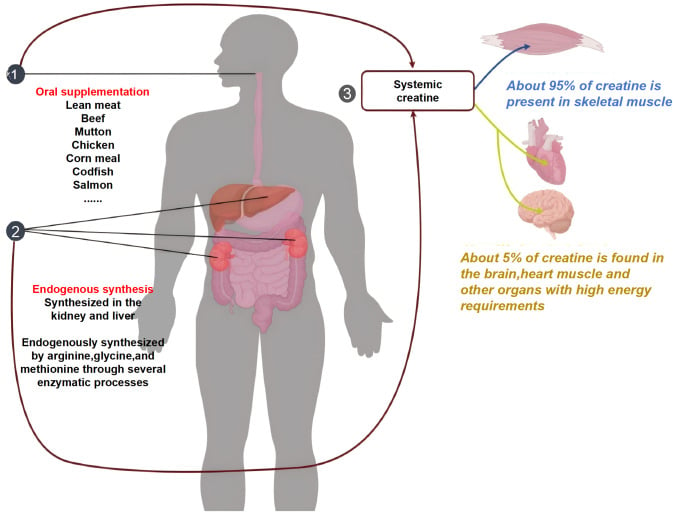
Composition of the total creatine pool in the body and distribution of creatine in the body. (Zhang et al., PeerJ , 2025)
The trial included 64 sedentary adults, aged 45 to 65, who were randomized to take either a placebo or a high dose of daily creatine (10 grams) for 12 weeks.
Neither researchers nor participants knew who was taking what.
The entire article;
https://www.sciencealert.com/popular-supplement-increases-strength-even-without-exercise-study-shows
8 Likes
https://www.tandfonline.com/doi/full/10.1080/15502783.2026.2716273
AI summary
Overview & Objective The study evaluated the effects of 12 weeks of creatine monohydrate (CrM) supplementation 10g/day, divided into 2*5\g/day) with or without a structured exercise and hypo-energetic diet intervention in middle-aged and older adults (ages 45–65). The goal was to determine whether CrM could maintain or increase muscle mass, improve strength, support fat loss, and enhance cognitive function and health markers in aging populations.
Study Design & Participants
Design: A randomized, double-blind, placebo-controlled, parallel-group trial.
Participants: 64 healthy, sedentary adults completed the 12-week study (mean age $54.5\pm6.2$ years; 40 females, 24 males).
Intervention Groups: Participants selected whether to participate in an exercise/diet program and were then randomized into one of four groups:
NoEx + PLA: No exercise/diet + Placebo (maltodextrin)
NoEx + CrM: No exercise/diet + Creatine Monohydrate (10g/day)
Ex + PLA: Resistance/aerobic exercise + energy-deficit diet (300-500 kcal/day) + Placebo
Ex + CrM: Resistance/aerobic exercise + energy-deficit diet (300-500\kcal/day) + Creatine Monohydrate (10g/day)
Key Findings 1. Body Composition
Lean Mass Accretion: CrM supplementation increased lean tissue mass both with exercise (+1.27kg) and without exercise (+1.1\kg}) compared to placebo groups, which showed slight losses.
Enhanced Fat Loss: While exercise and dieting reduced total fat mass across exercise groups, the Ex + CrM group experienced a significantly greater reduction in body fat percentage (-3.24%) than Ex + PLA (-1.87%), NoEx + CrM (-0.42%), or NoEx + PLA (-0.42%).
Visceral Fat: Exercise groups showed significant reductions in android fat, gynoid fat, and visceral adipose tissue (VAT) mass, volume, and area.
2. Physical & Training Adaptations
Strength & Endurance: CrM supplementation significantly improved 1-repetition maximum (1RM) bench press and leg press strength, as well as muscular endurance.
No Exercise Benefits: Interestingly, CrM alone without exercise increased 1RM strength compared to the NoEx + PLA group.
Aerobic Capacity: Time to exhaustion during treadmill testing was enhanced in CrM groups, though peak oxygen uptake (VO2peak) did not differ significantly between groups.
3. Cognitive Function & Memory
Memory & Processing Speed: CrM positively impacted selected cognitive domains:
NoEx + CrM: Improved delayed correct responses on Word Recall (short-term memory) and improved episodic memory accuracy on Word Recognition tasks.
Ex + CrM: Showed faster reaction times during Picture Recall and Choice Reaction Time tests, suggesting improved decision-making and cognitive processing speed.
Subjective Memory (MAC-Q): CrM users reported better recall for names, purchased items, and past events.
Exploratory Note: Individual cognitive outcomes were exploratory, as performance across tests like the Stroop Task and Corsi Block Tapping showed no uniform main effects across all domains.
4. Clinical & Health Biomarkers
Glycemic Control & Blood Lipids: CrM supplementation reduced glycosylated hemoglobin (HbA1c) levels (even in the non-exercise group). The NoEx + CrM group also demonstrated favorable baseline shifts in triglycerides, HDL, VLDL, and total cholesterol-to-HDL ratios.
Renal Function: Serum creatinine experienced a small, expected increase in CrM-supplemented groups (<0.16mg/dL), leading to a slight calculated eGFR drop. However, all values remained well within normal clinical limits (>60mL/min/1.73 m).
Safety & Tolerability: Supplementation was well-tolerated with no difference in self-reported adverse events (e.g., headaches, dizziness, or gastrointestinal issues) between placebo and creatine groups.
Conclusion Daily supplementation with 10g of creatine monohydrate over 12 weeks—with or without an exercise and diet program—effectively helps middle-aged and older adults maintain/build muscle mass , enhance strength , and support cognitive processing and memory . When paired with a resistance training and weight-loss diet intervention, CrM significantly accelerates body fat percentage reduction while preserving lean tissue mass.
Wha’ts unique about this study:
This is not the first study to demonstrate strength gains from creatine supplementation without exercise. Prior literature in older adults and clinical populations has previously shown that short-to-medium-term creatine intake can modestly improve muscle strength, isometric force, and functional task performance independently of structured resistance training.
What makes this specific study unique relative to previous research includes:
Evaluation of Middle-Aged Adults alongside Older Adults: Most prior non-exercise creatine trials focused primarily on older populations (aged 65 and older) or clinical groups (e.g., sarcopenic, frail, or patient populations). This study targeted healthy, sedentary middle-aged to older adults (ages 45 to 65).
4-Arm Simultaneous Intervention Design: It directly compared creatine against placebo across two distinct conditions simultaneously: a completely sedentary non-exercise group versus a group undergoing a structured resistance and aerobic exercise routine paired with an energy-deficit diet.
High Maintenance Dosing Schedule: Rather than utilizing a traditional short 5-day loading protocol followed by a low maintenance dose (3 to 5 g/day), this study administered a sustained higher daily dose of 10 g/day (split into two 5 g doses) across the entire 12-week intervention period.
Comprehensive Multi-System Assessment: It simultaneously evaluated changes across four distinct domain categories within a single study population: body composition (via DXA scans), physical strength/endurance, cognitive processing and memory performance, and clinical blood biomarkers (such as HbA1c and lipid profiles).
Simultaneous Caloric Restriction Evaluation: It specifically assessed whether creatine supplementation could preserve lean mass and strength while actively undergoing a dietary energy-deficit intervention (-300 to -500 kcal/day) combined with exercise.
4 Likes
Joseph
September 27, 2026, 4:36pm
#3
Bottom line…
Take 10mg per day, a “no-brainier”.
What are you going to wait for?
“If you wait until you are ready, it is almost certainly too late.” ~Seth Godin
1 Like
For those of us that are seniors, we know that the legs are the first to go. You can buy creatine and HMB together but there is a supplement made with HMB and other supplements just for leg strength, and at 78, it has helped me immensely. The formula was founded by Dr. Tracy Gapin and called “Muscle Defense”. It’s made by Apex Labs in Great Britain and you can buy it from the official site but it is less expensive on E-Bay. As far as Creatine goes, it is recognized that German Creatine is superior. Look for the word “Creapure” which is a trademark of Alzchem Trostberg Gmbh. One brand is Nutricost on Amazon.
3 Likes
Raquel
October 3, 2026, 11:49am
#5
Joseph, regards brain, I don’t remember if it was with you that while back I mentioned that so far evidence points that when a significant benefit is found, it is stronger in women. Here, the cognitive battery was mostly null at the multivariate level. The positive lines were selected, unadjusted contrasts that the authors themselves called “exploratory”. Brain creatine was not measured.
Chun et al. know the literature… Am I the only one frustrated to see they never split cognition by sex, in a sample of 40 women and 24 men?!
1 Like