https://bmjmedicine.bmj.com/content/5/1/e001513
I am on my mobile ATM I may add an ai analysis to this later. They are interesting, but not surprising things. Exercise is good for health, but you can overexercise.
https://bmjmedicine.bmj.com/content/5/1/e001513
I am on my mobile ATM I may add an ai analysis to this later. They are interesting, but not surprising things. Exercise is good for health, but you can overexercise.
People who combine different types of exercise - such as running, cycling and swimming - seem to live longer than those with less varied workouts
Many sportspeople do a mixture of exercises to boost their performance. Now there’s evidence that this cross-training could extend their lives, too.
An analysis of two studies that followed people for more than 30 years has found that those who did a variety of activities were 19 per less likely to die of any cause during that time than those who were just as physically active but whose exercise was less varied.
“If the total amount of physical activity is kept constant, you will get additional benefits from doing a mix of physical activities,” says Han Han at Harvard University. But studies of this kind can’t establish cause and effect, she says, so the findings are suggestive rather than definitive.
Most exercise studies focus on the intensity or overall amount of physical activity, rather than the variety. Those that have looked at different exercise types tend to compare aerobic with strength exercises.
Han and her colleagues instead looked at nine kinds of mostly aerobic activities: walking; jogging (defined as a pace slower than 6.2 minutes per kilometre); running; cycling outside or on an exercise bike; climbing stairs; swimming laps; rowing or callisthenics (where you use your body weight as resistance, such as squats or pull-ups); tennis, squash or racquetball; and weight or resistance training.
The team got data on the activities of 70,000 women and 41,000 men between 1986 and 2018 from the Nurses’ Health Study and the Health Professionals Follow-Up Study, both done in the US. Study participants were asked to fill in questionnaires every two years detailing their physical activities.
The researchers then looked for associations between people’s activities and their chance of dying from any cause during the study period. People with illnesses that would have affected their ability to exercise were excluded.
The team found that, with all these exercise types, people seemed to reach a point of diminishing returns, in terms of a lower risk of dying during the study period, if they did more than a few hours a week.
Read the full article: Cross-training may be the key to a long life (New Scientist)
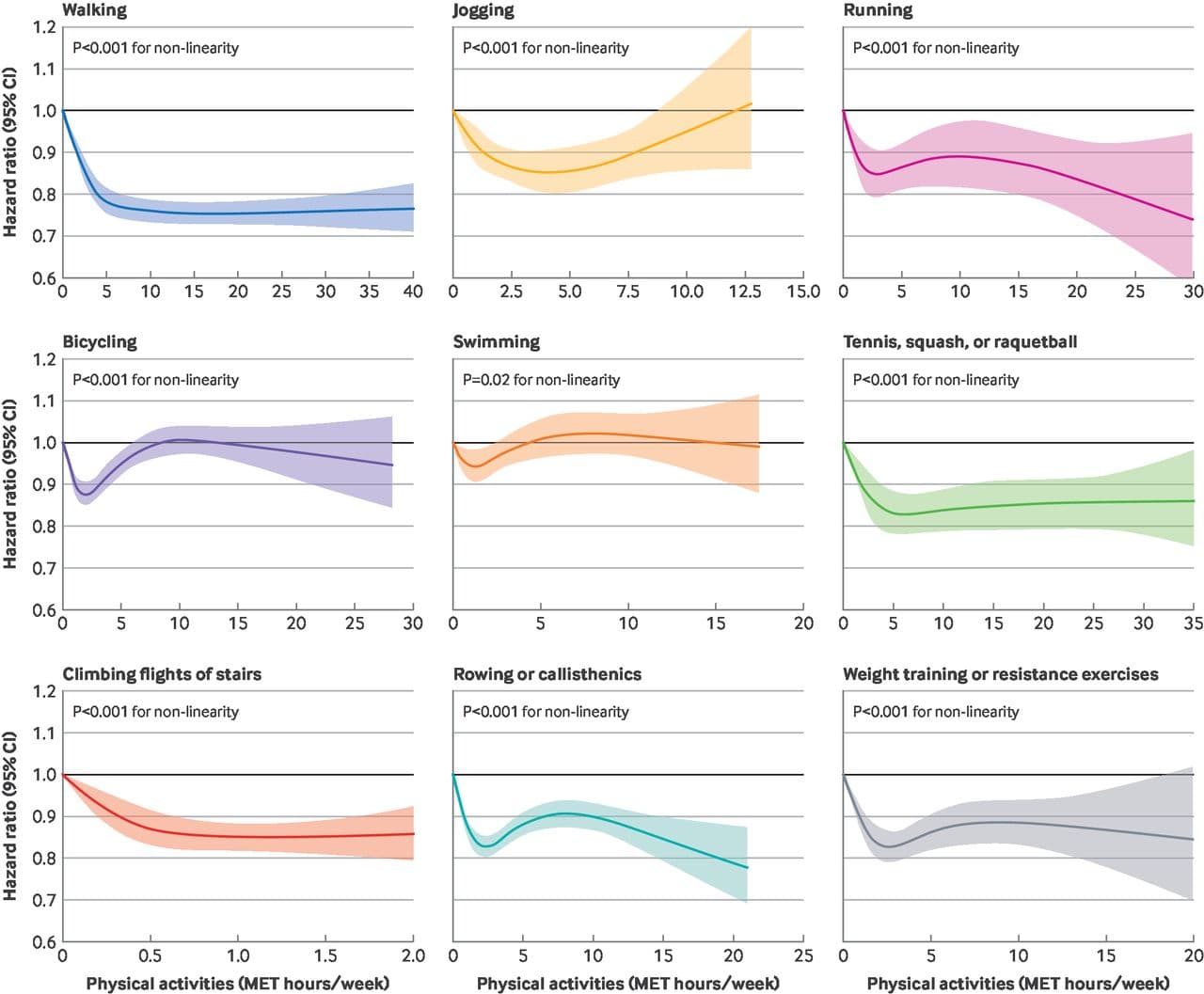
Good paper, the key chart is:
The reduction in the risk of all cause mortality seemed to plateau at about 0.75 MET hours/week for climbing flights of stairs, 5 MET hours/week for tennis, squash, or racquetball, 7.5 MET hours/week for walking, and 7.5 MET hours/week for weight training or resistance exercises. For swimming, bicycling, and jogging, inverse associations with all cause mortality were apparent up to about 2.5, 7.5 and 9 MET hours/week, respectively; beyond these thresholds, the associations were no longer significant. For running and rowing or callisthenics, a sharp reduction in risk was seen up to about 3 and 2.5 MET hours/week, respectively, followed by a continued, although slower, decline with higher activity levels.
nformation about lower-intensity exercises (yoga, stretching, toning) was asked starting from 1992 in NHS. The median values (in MET-hour/week) within each group (Group 1 to 4) are 0, 0.3, 1.4, and 4.3. […] For specific activities in the Nurses’ Health Study, lower intensity exercise was associated with lower all cause mortality, especially for cancer mortality (both Ptrend=0.001; online supplemental table 7).
And for variety:
Compared with the reference group, participants ranked highest for both total physical activity level and variety had 21% lower mortality (95% CI 0.76 to 0.82; figure 4). With further adjustment of total physical activity levels within each group, in the highest group the hazard ratio decreased to 0.75 (95% CI 0.72 to 0.79; online supplemental table 9).
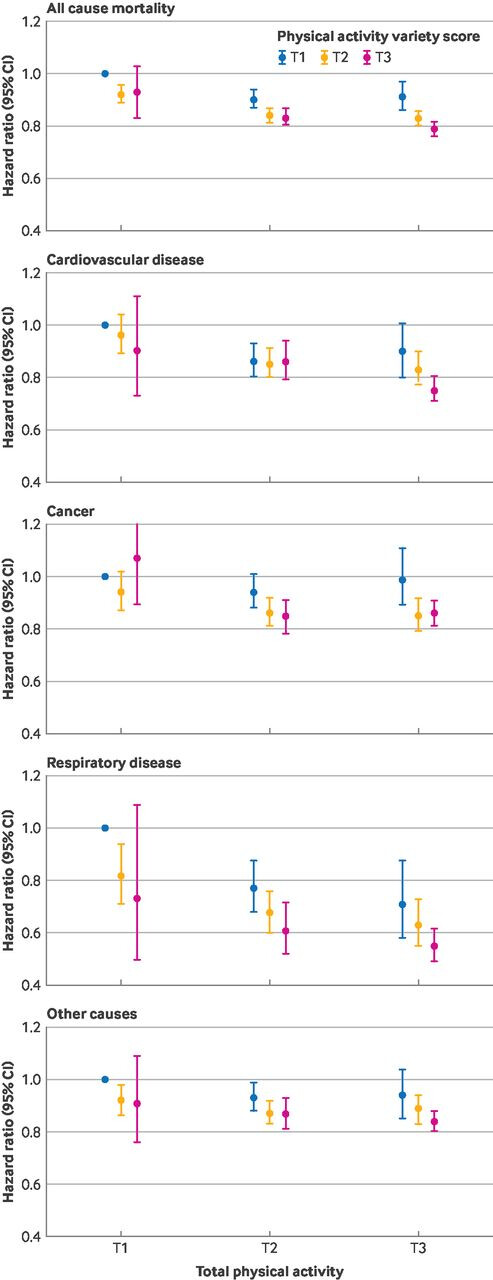
I asked ChatGPT and Gemini, they roughly agree that the above optimum levels mean:
So 25% all-cause mortality reduction with the above weekly schedule?
Still, the inverse associations for swimming, bicycling, and jogging are weird. Walking and running are good but somehow jogging would be bad? For bicycling, I think they excluded active commuting and “focused on long term leisure time bicycling”. Could it be road accidents and falls? Although they included “stationary machine”. Swimming: a mystery.