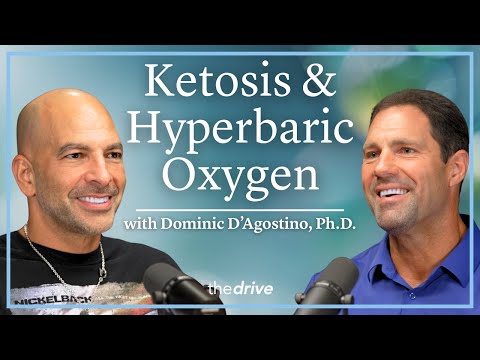
The ketogenic diet, ketosis, and hyperbaric oxygen: weight loss, cognition, cancer, and more
AI summary:
Based on the transcript provided featuring Dom D’Agostino and Peter Attia, here is the summary and analysis.
A. Executive Summary
In this episode of The Drive, Peter Attia and Dr. Dom D’Agostino discuss the evolution of the ketogenic diet from a niche epilepsy treatment to a broad metabolic therapy for neurodegenerative diseases, cancer, and performance enhancement. D’Agostino details his background in Navy-funded research on oxygen toxicity seizures, which identified ketones as a neuroprotective fuel source superior to glucose in extreme environments.
The conversation pivots to the practical application of ketosis. D’Agostino argues against the “low protein” dogma of early ketogenic diets, advocating for high protein intake to prevent sarcopenia, especially in aging populations. He provides a critical analysis of exogenous ketones, distinguishing between first-generation esters (effective but potentially toxic or unpalatable) and modern ketone salts (balanced electrolytes, racemic mixtures).
Crucially, the dialogue covers the “metabolic therapy framework” for Glioblastoma Multiforme (GBM) and Alzheimer’s disease. D’Agostino posits that while standard of care for GBM fails, a “press-pulse” strategy targeting glucose and glutamine alongside ketosis shows promise in pre-clinical models. He concludes with an update on Hyperbaric Oxygen Therapy (HBOT) for TBI and the emerging use of ketogenic therapies for psychiatric disorders like anorexia and schizophrenia.
B. Bullet Summary
- Original Research Context: D’Agostino’s interest in ketones originated from Department of Defense (DoD) research into preventing oxygen toxicity seizures in Navy SEALs using closed-circuit rebreathers.
- Epilepsy Efficacy: The ketogenic diet renders ~66% of drug-resistant pediatric epilepsy patients responsive; ~33% achieve complete seizure control.
- Protein Misconceptions: Standard ketogenic advice often restricts protein too severely. D’Agostino recommends higher protein (up to 1g/lb or ~2.2g/kg) to maintain muscle mass, noting that gluconeogenesis rarely kicks one out of ketosis in active individuals.
- Ketone Biometrics: Blood testing remains the gold standard. Breath acetone meters have improved (e.g., Keto Air), but urine strips remain imprecise.
- Carnivore Diet: Viewed clinically as a strict elimination diet beneficial for autoimmune disorders (e.g., vitiligo, RA) rather than a magic metabolic hack; it functions as a subset of the ketogenic diet.
- 1,3-Butanediol Risks: This alcohol-based ketone precursor can elevate liver enzymes and cause intoxication (resembling ethanol toxicity) at high doses required for therapeutic ketosis.
- Racemic Ketone Salts: D’Agostino advocates for racemic salts (containing both D- and L-BHB). While D-BHB is oxidized for fuel (ATP), L-BHB acts as a signaling molecule (suppressing NLRP3 inflammasome, epigenetic modulation).
- Energy Toxicity: Exogenous ketones should not raise levels significantly above 2-3 mmol/L in the presence of high glucose, as this can cause counter-regulatory insulin spikes and acidic blood pH (energy toxicity).
- Alzheimer’s Mechanism: The brain exhibits glucose hypometabolism (Type 3 Diabetes) decades before cognitive decline; ketones bypass this defect as they use a different transporter (MCT) and pathway.
- Cancer Strategy: For Glioblastoma, a “Press-Pulse” strategy is proposed: maintain a Glucose-Ketone Index (GKI) of 1-4 (Press) and intermittently use drugs to block glutamine/glucose (Pulse).
- Lack of Cancer RCTs: Despite strong mechanistic and animal data, no Randomized Controlled Trials (RCTs) yet prove the metabolic therapy framework extends survival in human GBM patients.
- Psychiatric Applications: Emerging trials (funded by the Baszucki Group) suggest ketogenic efficacy in bipolar disorder, schizophrenia, and paradoxically, anorexia nervosa (by reducing hedonic food anxiety).
- Hyperbaric Oxygen (HBOT): Likely effective for acute TBI/concussion (first 48-72 hours). Evidence for chronic/old TBI is evolving, with a major DoD sham-controlled study currently underway at USF.
- Actionable Supplementation: Electrolyte-bound ketone salts (e.g., Keto Start) mitigate the “keto flu” (caused by natriuresis) and provide a non-insulin-spiking fuel source.
D. Claims & Evidence Table
| Claim | Evidence Provided | Assessment |
|---|---|---|
| Ketogenic diet controls drug-resistant epilepsy. | Cited historical Mayo Clinic data (1920s) and modern clinical stats: 2/3rds of drug-resistant pediatric patients respond. | Strong (Consensus medical fact). |
| 1,3-Butanediol causes liver stress/intoxication. | D’Agostino’s lab data showing elevated transaminases; Attia’s anecdotal experience; mechanistic analogy to ethanol metabolism (alcohol dehydrogenase pathway). | Strong/Mechanistic (Biochemically sound). |
| Metabolic therapy (Keto + Drugs) extends survival in Glioblastoma (GBM). | Citations of Thomas Seyfried’s work; animal models showing tumor suppression; anecdotal case reports. Explicitly noted lack of RCTs. | Speculative/Pre-clinical (Unproven in humans via RCT). |
| Racemic Ketone Salts (D+L BHB) offer superior signaling. | Mechanisms cited: L-BHB persists longer in plasma and inhibits NLRP3 inflammasome/HDACs better than D-BHB (which is rapidly burned). | Strong (Supported by mechanistic literature). |
| Anorexia Nervosa responds to Ketogenic Diet. | Cited ongoing studies by Guido Frank (UCSD) and others; anecdotal reports of remission potentially due to altered neuropharmacology/hedonic response. | Emerging/Counter-intuitive (Needs robust trial data). |
| High protein intake kicks you out of ketosis. | D’Agostino refutes this based on personal data (eating ~220g protein/day) and metabolic flexibility in active individuals. | Context-Dependent (True for sedentary, false for active/metabolically flexible). |
E. Actionable Insights
- Prioritize Protein Over Fat Ratios: If using a ketogenic diet for body composition or longevity, do not restrict protein to 0.8g/kg. Aim for ~1g per pound of body weight (or ~2.2g/kg) to prevent muscle loss, using fat only to fill remaining caloric needs.
- Mitigate “Keto Flu” with Electrolytes: The transition to ketosis causes sodium excretion (natriuresis). Supplement with sodium, potassium, and magnesium—ideally bound to ketone salts (e.g., Keto Start)—to bridge the energetic gap and prevent fatigue.
- Target GKI for Therapeutic Outcomes: For managing cancer or seizures, use a Glucose Ketone Index (GKI) of 1–4. For general health/weight loss, simple carbohydrate restriction and mild ketosis (0.5–1.0 mmol/L) are sufficient.
- Avoid High-Dose 1,3-Butanediol: For longevity and liver health, avoid relying on high doses of 1,3-butanediol or “jet fuel” esters that induce intoxication. Stick to ketone salts or MCT oil blends.
- Acute Concussion Protocol: In the event of a concussion, immediate implementation of a ketogenic state (via exogenous ketones) combined with Hyperbaric Oxygen Therapy (if accessible) within the first 72 hours may be neuroprotective.
- Use CKM or Blood Testing: Urine strips are inaccurate for long-term use. Use a Continuous Ketone Monitor (CKM) or finger-stick blood meter (e.g., Keto Mojo) to correlate specific foods with ketone inhibition.
- Strategic Fasting: Instead of chronic caloric restriction, use situational fasting (e.g., during travel, high cognitive demand work, or inflammation flare-ups) to reset metabolic parameters and lower inflammation.
H. Technical Deep-Dive
1. The Biochemistry of Racemic Ketone Salts (D- vs. L-BHB)
Most commercial ketone research focuses on the D-isoform (R-3-hydroxybutyrate) because it is the primary substrate for ATP generation via the TCA cycle. However, D’Agostino highlights the utility of Racemic mixtures (DL-BHB) found in specific salts.
- Metabolism: D-BHB is rapidly oxidized by tissues (heart, brain, muscle), causing plasma levels to spike and drop quickly. L-BHB is not a direct fuel substrate; it must be isomerized or metabolized slowly.
- Signaling: Because L-BHB lingers in the plasma (slower clearance), it acts as a potent signaling molecule. It functions as a Histone Deacetylase (HDAC) inhibitor (increasing FoxO3a expression for stress resistance) and suppresses the NLRP3 Inflammasome (a multiprotein oligomer responsible for activation of inflammatory responses).
- Conclusion: While D-BHB provides energy, the L-isoform provides the anti-inflammatory and epigenetic “drug-like” benefits of ketosis.
2. Oxygen Toxicity & Ketone Neuroprotection
- Mechanism of CNS Oxygen Toxicity: High partial pressures of oxygen (Hyperoxia) increase Reactive Oxygen Species (ROS), which deactivate the enzyme Glutamic Acid Decarboxylase (GAD).
- The Seizure Pathway: GAD is responsible for converting Glutamate (excitatory) into GABA (inhibitory). When ROS inhibits GAD, Glutamate accumulates and GABA depletes, leading to hyperexcitability and seizures.
- Ketone Intervention: Ketosis increases the production of Adenosine (neuroprotective) and preserves GABAergic tone, effectively raising the threshold for seizures even in the presence of high oxidative stress.
I. Fact-Check Important Claims
-
Claim: Standard American Diet (SAD) produces a GKI of 40-50, while therapeutic ketosis is 1-4.
- Verification: Accurate. A typical non-diabetic glucose level is ~90-100 mg/dL (~5.0-5.5 mmol/L). On a SAD, ketones are ~0.1 mmol/L. GKI = Glucose/Ketone = 5.5/0.1 = 55. Therapeutic ketosis targets Glucose ~3.5 mmol/L and Ketones ~3.5 mmol/L, yielding a GKI of ~1.
-
Claim: No FDA indications for Hyperbaric Oxygen in TBI.
- Verification: True. There are 14 FDA-approved indications for HBOT (e.g., wound healing, decompression sickness, carbon monoxide poisoning), but Traumatic Brain Injury (TBI) is not currently one of them, making its use “off-label.”
-
Claim: NAD precursors (NR/NMN) have largely failed in clinical trials for longevity.
- Verification: Mostly True. While animal data is robust, human trials for NR/NMN have shown bioavailability issues and inconsistent results regarding meaningful clinical endpoints (e.g., muscle insulin sensitivity, longevity biomarkers), though some safety and minor metabolic benefits have been observed. D’Agostino suggests stabilized NAD formulations may be required.
Here is the comparison table of the specific Ketone Salt brands and their electrolyte compositions based on the available data.
Ketone Salt & Electrolyte Brand Comparison
| Brand | Product | BHB Amount | BHB Form | Electrolyte Profile (Per Serving) | Key Features |
|---|---|---|---|---|---|
| Audacious Nutrition | KetoStart | 10 g | Racemic (D+L) |
Total Electrolytes: ~1,000 mg (Balanced mix of Sodium, Potassium, Calcium, Magnesium) |
• Formulation: Designed by Dr. Dom D’Agostino. • Racemic: Contains L-BHB for signaling (anti-inflammatory) & D-BHB for fuel. • Ratio: Higher BHB load (10g) with a balanced electrolyte spread to prevent GI distress. |
| KetoLogic | Keto BHB | 6 g | goBHB® (Typically Racemic) |
Sodium: 510 mg Calcium: 260 mg Potassium: 200 mg Magnesium: 75 mg |
• Sodium-Heavy: Relies heavily on sodium for the salt bond. • Lower BHB: Contains nearly half the BHB of KetoStart per serving. |
| Perfect Keto | Exogenous Ketone Base | 11.3 g | goBHB® (Racemic) |
Sodium: ~600–900 mg* Calcium: ~600 mg* Magnesium: ~350 mg* (Exacts vary by flavor) |
• High Mineral Load: Often uses a split of Calcium/Magnesium/Sodium salts. • Warning: High Calcium/Magnesium content can cause GI distress in some users compared to sodium-balanced formulas. |
| Prüvit | Keto OS NAT | Proprietary (Est. 7–9g) | Fermented D-BHB (R-Only) |
Sodium: Unlisted (Proprietary) Calcium: Unlisted (Proprietary) Magnesium: Unlisted (Proprietary) |
• Proprietary Blend: Does not disclose exact electrolyte or BHB amounts. • Form: Uses “Naturally Fermented” D-BHB (Bio-identical), lacking the L-isomer found in racemic salts. |
| LMNT | Recharge | 0 g | N/A (Electrolytes Only) |
Sodium: 1,000 mg Potassium: 200 mg Magnesium: 60 mg |
• Electrolyte Standard: Often used alongside ketones or for “Keto Flu” mitigation. • No Ketones: Strictly for hydration/mineral replenishment. |
Analysis of Composition
-
Racemic vs. D-BHB:
- KetoStart (Audacious) and Perfect Keto use Racemic salts (D+L). As Dom noted, this provides the D-isoform for immediate fuel (ATP) and the L-isoform as a signaling molecule (lowering inflammation/oxidative stress) that lingers in the blood longer.
- Prüvit markets “Bio-identical” D-BHB (R-isoform only). While this mimics the ketone body produced by the liver for fuel, it misses the potential signaling benefits of the L-isoform discussed in the interview.
-
Electrolyte Load & “Keto Flu”:
- KetoStart and LMNT mimic a similar ~1g electrolyte load, but KetoStart attaches those electrolytes to actual Ketones (BHB).
- KetoLogic relies heavily on Sodium (510mg) and Calcium but has a lower total BHB dose (6g), which may be less effective for therapeutic ketosis compared to the 10g+ doses found in KetoStart or Perfect Keto.
-
Transparency:
- Audacious, KetoLogic, and LMNT are generally transparent about their “Amount Per Serving.”
- Prüvit uses a “Proprietary Blend” model, making it impossible to know if you are consuming enough BHB for a therapeutic effect or if the salt load is dangerously high for salt-sensitive individuals.
 Nutricost Keto BHB – best ketone delivery: Racemic (D + L)
 goBHB Clean Energy – mild, clean, but weak: Racemic (D + L)
 Perfect Keto – too mineral-heavy, inefficient: Racemic (D + L)

 I pretty much stopped listening to PA as I felt his interests and guest quality had moved away from my interests, so I have not listened to this episode. If the quality has gone up, I might revisit his podcast.