Personal scientists love to track biomarkers over time, watching for changes that might signal a need to adjust diet, supplements, or lifestyle. But here’s something professionals know but rarely acknowledge: the precision we assume in lab results simply isn’t there .
This week we’ll explore the surprisingly wide allowable error margins in standard blood tests, and what this means for those of us who track trends.
Back in PSWeek250904 we mentioned the best deal in blood testing: as low as $142 for a comprehensive 100+ biomarker lab draw available through SiPhox and LabCorp. That offer is unfortunately no longer available —SiPhox has since decided to focus exclusively on at-home tests—but hopefully some of you, like me, got yours in time.
As long-time readers know, I’ve done regular at-home blood testing with SiPhox (PSWeek221117), phlebotomist-drawn tests from LabCorp (PSWeek240125) and Quest, a whole series with Function Health (PSWeek240912), and various at-home cholesterol tests (PSWeek250213).
But how much can I trust these results?
The CLIA Reality Check
My new lab report says my testosterone is 830 ng/dL and my triglycerides are triglycerides of 63 mg/dL. Both are considered excellent numbers for my age, but there’s a huge caveat: I must assume the values are accurate . That seems reasonable: after all, these results come from regulated medical laboratories using sophisticated equipment.
But the federal regulations governing lab accuracy are far more permissive than you’d expect .
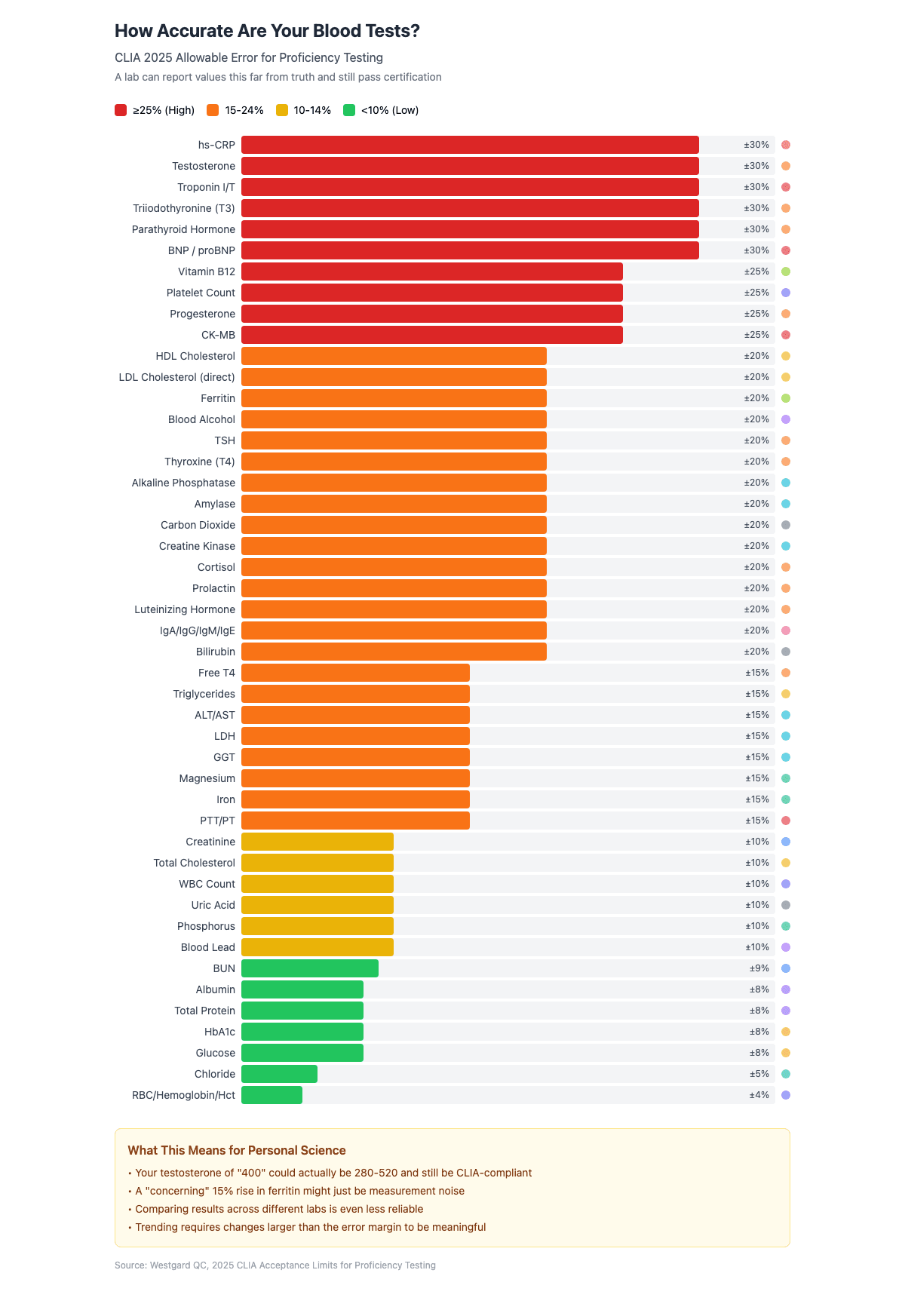
The Clinical Laboratory Improvement Amendments (CLIA) set the standards US labs must meet. This table from Westgard QC shows allowable variance for proficiency testing that took effect January 1, 2025:
If my testosterone had been slightly lower, say 400 ng/dL, the actual value could be anywhere from 280-520 and the lab would still be CLIA-compliant. That’s a range spanning “clinically low” to “perfectly normal.”

Read the full article: Personal Science Week - 260122 Trends - by Richard Sprague