Peptides / Bioregulators

I didn’t think you were, but I’m still not going to reveal my suppliers :slight_smile:

My main supplier does not carry it. I will check next week with my secondary supplier.

If they have it, I’ll let you know a price but it will be raw powder, it’s the only format I carry.

1 Like

Thank you.

And that is a N-1 result. Not terribly reliable for general application as I may be an outlier, if I was part of a RCT with many participants.

@Steve_Combi, I was interested in knowing if you think that NMN lengthens telomeres, and do you think that Epitalon shortens telomeres?

I don’t think anyone, myself included disputed the connection of telomere length and longevity.
A more important point (to me at least) would be, which substances/supplement are believed to lengthen them and which ones shorten them.

1 Like

Thanks mate!

1 Like

Sorry that was not directed to you I meant to use my own quote as a follow up.

1 Like

I know that many people don’t think this type of measurement is important, here is a study that indicates it is. Telomere length is a strong indicator of mortality.

The question remains, in healthy people is there a long term benefit in reducing mortality risk using interventions of any kind to maintain telomere length?

In conclusion, shorter age-adjusted LTL was associated with long-term mortality in hospitalized older adults and interacted with frailty, with its prognostic value being evident in individuals without frailty but attenuated in those with established frailty. These findings support the potential relevance of telomere length as a biomarker of biological heterogeneity and vulnerability in late life and highlight the importance of integrating molecular aging markers with the assessment of clinical geriatric constructs. Future studies should investigate whether combining telomere-based measures with multidimensional frailty assessments can improve prognostic accuracy and inform personalized approaches to care in older populations.

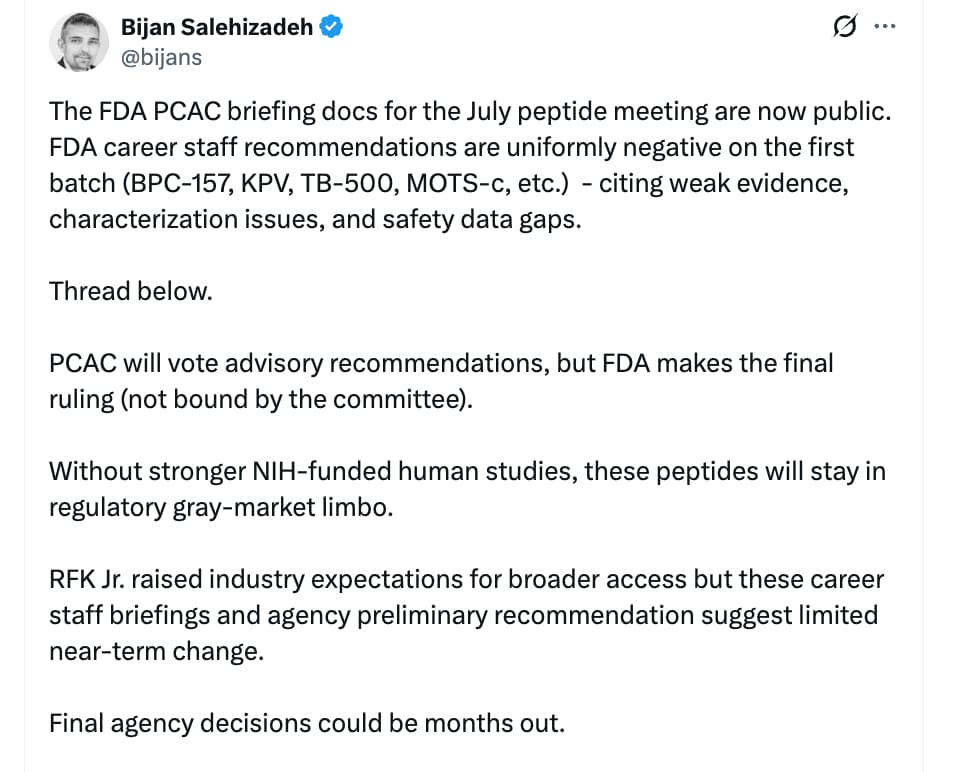
The grey market may live on…

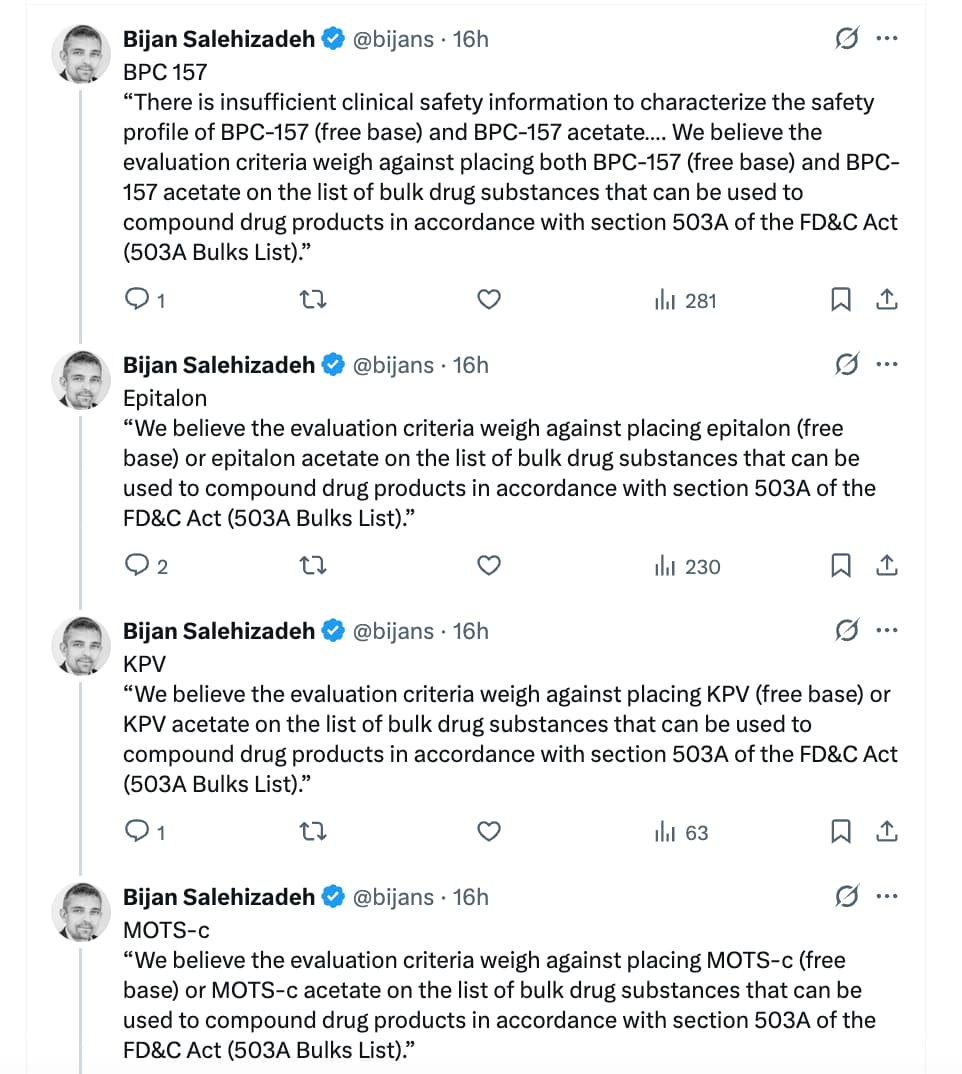
Source: Bijan Salehizadeh on X: "The FDA PCAC briefing docs for the July peptide meeting are now public. FDA career staff recommendations are uniformly negative on the first batch (BPC-157, KPV, TB-500, MOTS-c, etc.) - citing weak evidence, characterization issues, and safety data gaps. Thread below. PCAC" / X

3 Likes

Correct decision for each of these, as there are no phase 3 (or even phase 2) data behind them.

Peptides that have phase 3 data behind them, like HGH, SS-31, GLP1s are another matter entirely.

2 Likes

Ipamorelin + CJC 1295 noDAC
400mcg + 250mcg
5 nights a week, Sun - Thu - with short breaks (1 week) every 3 or 4 months for 3 years.

That has been my hGH stimulating program for an extended period of time. About 2 months ago I took a 6 week break. Not intentional, more out of laziness :slight_smile:

You know, the mechanic that doesn’t have time to fix his own car LoL!

When I started using the Renpho Morpho 8 lead scale a few months ago, I posted on my VAT (visceral adipose tissue) number as being 3 - this is not accurate compared to DEXA and CT but it will show a trend.

Without any other changes to my routine, in about a week my VAT increased to 4, I didn’t think much of that, still pretty low. But trending up so it got my attention. No change in my body weight, still 144 - 146 on a daily basis, for the past 2 years. I was a bit puzzled.

Two weeks into my abstinence, I noticed my sleep was not as consistent, with more waking up (4 to 5 times a night) and harder to get back to sleep. This is very unusual for me, my typical is 1 or 2 times a night and immediately going back to sleep. I thought maybe I’m experiencing what many do as they age, crappy sleep.

Didn’t like it. Even upped my dose of DSIP but it didn’t make a difference in the waking up thing, but the higher dose did bump my Delta sleep to a higher number, so this is now my new nightly dose 600mcg. Would not have found that without this “encouragement” to fix my newly poor sleep.

Three weeks in I was noticing more pain in my left hand, the one with a bit of arthritis. This was more annoying than the other 2 as it was all day long.

I didn’t immediately connect those changes to the Ipa+CJC program but I know that hGH has a positive effect on those 3 items. So I decided to dance with the one that brung me :slight_smile:

We restarted our IPA+CJC nightly routine again, now at 8 “on” nights 5 + 3

Within the first 8 “on” nights, all back to “normal”, sleep is good again, VAT went back down to 3 after 5+2 nights and my arthric pain is significantly diminished and back to pre-break.

The interesting thing to me is how quickly the benefits diminished and how quickly they came back.

We all adapt to our new normal, when annoying things go away. We typically don’t dwell on past pain and suffering, we start living life doing the things we enjoy doing and some of things we didn’t enjoy LoL!

As the saying goes, you don’t know what you’ve got until it’s gone.

Almost forgot HAPPY CANADA DAY!!
1 Like

Thanks for this.

1 Like

Is Canada still a country? Oh, I forgot Happy Canada day LOL

We will be a country long after the US empire falls like all empires do. Just ask Ray Dalio :slight_smile:

Interestingly for every empire that has fallen, the world goes on and new empires arise. I figure it will China’s turn to give the empire thing a go…

2 Likes

RiteAid is now gearing to sell peptides with no human data behind them. They must know something about the upcoming fda decision that we don’t.

1 Like

This seems like a reasonable middle ground:

The smarter path is a practical middle ground: create a way for selected, widely used peptides to be made available under strict oversight by licensed pharmacies that meet federal and state quality, sourcing, and sterility standards. Patients would access them only through a licensed clinician who: evaluates the individual patient’s needs and risks using professional judgment; provides clear, balanced information on what is known and not yet known from available studies, animal data, and real-world use; and ensures ongoing monitoring and reporting of outcomes.

This framework should not and would not replace full FDA approval pathways, nor suggest that compounded versions equal rigorously tested, manufactured drugs. It would simply recognize reality and channel it toward safer, more transparent practices. Compounded medications would need to carry explicit disclaimers, and clinicians would document informed patient decisions.

Such a system delivers multiple benefits. First, it reduces immediate harm by replacing rogue online products with quality-controlled ones. Second, it generates real-world evidence: Structured oversight and outcome tracking can help build the safety and efficacy data these compounds currently lack. Third, it respects patient autonomy while restoring the role of clinicians as guides rather than bystanders.

Many patients already arrive at doctors’ offices asking about peptides they discovered on social media or wellness sites. Providers need better tools and guidance to respond effectively.

1 Like

Paywall. What’s the middle way?