I have used local BPC injection for shoulder or knee pain 5 times the last 2 years. A friend a mine who is 59 and still lifting heavy also uses it with succes if he has local inflammation / pain. A colleague used the capsules for biceps tendinitis and also recovered faster then he did before. If you look how many “famous” people admit to using it, I think if you buy it from a reputable source, you shouldn’t worry to much about trying it.
3 Likes
The Peptide Tsunami is still building…
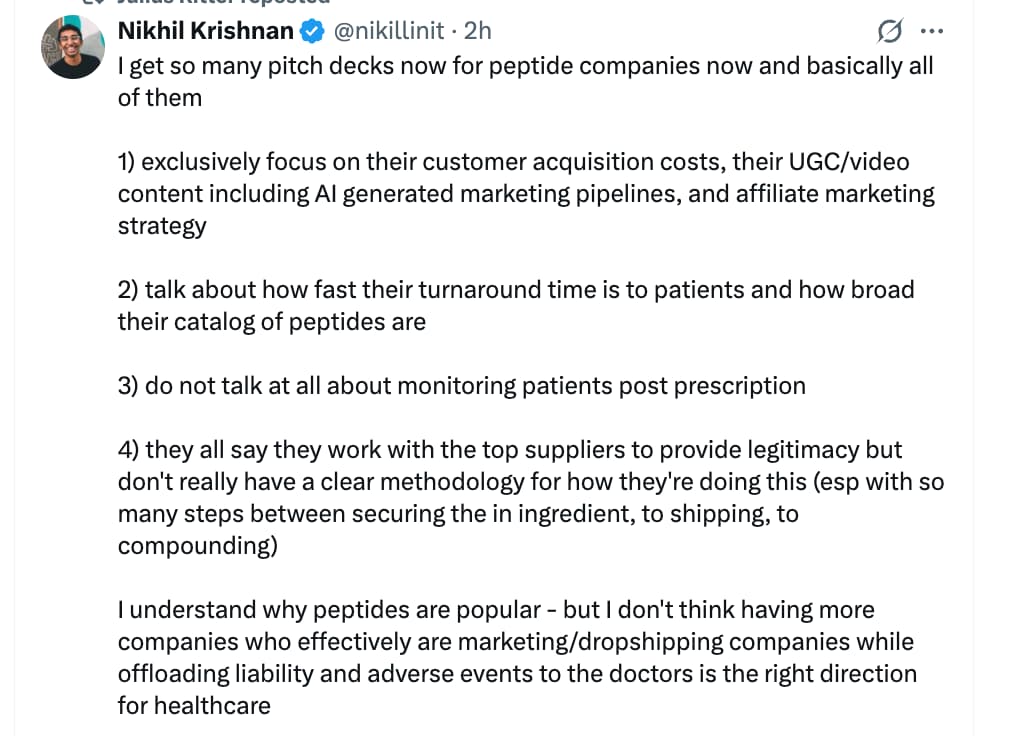
Source: https://x.com/nikillinit/status/2046290906274574378?s=20
2 Likes
Are these companies partnering with compounding pharmacies, or are they trying to turn into pharmacies? What is their liability plan for selling substances with only preclinical data behind them ?
Generally I think they are just contracting with the compounding pharmacies. Not sure on the exact legal positioning but I think they are hiding behind the doctors and their insurance.
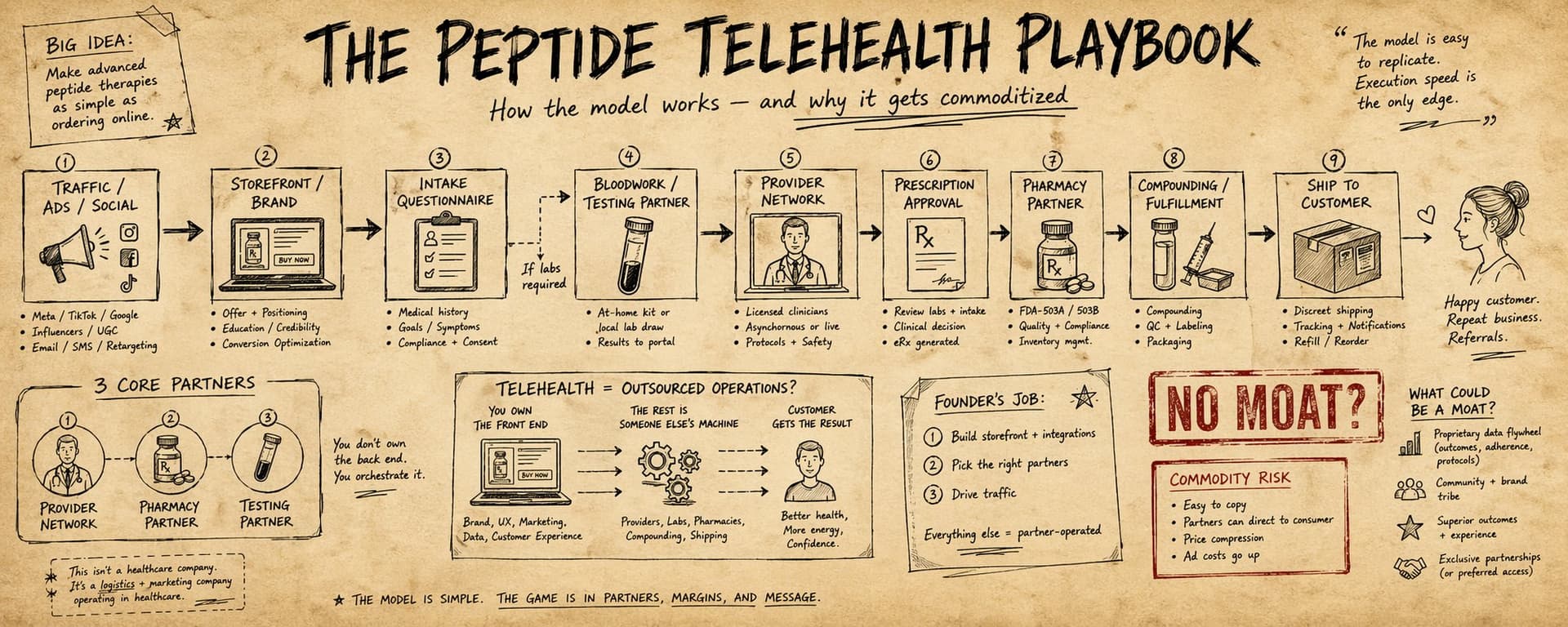
Effectively many of them will be just marketing companies, subcontracting most of the business and technical operations to others.
1 Like
Injectable Peptides Are the Latest TikTok Wellness Fad. Doctors Are Worried. (WSJ)
Jaime Garcia injects five different peptides into her body that she gets from a doctor and a telemedicine company.
The 44-year-old Los Angeles resident says the peptides have helped with myriad symptoms she has long struggled with due to a disorder of her autonomic nervous system. “It’s been life-changing,” she says of the four months she has been on the regimen.
Injectable peptides like BPC-157 and TB-500 are all the rage in Los Angeles and other places where wellness is an increasing focus. Testimonials flood TikTok and other social-media sites.
There is just one largely overlooked reality: Many of the substances have been largely illegal since 2023, when the Food and Drug Administration removed 19 peptides from a list of drugs that compounding pharmacies could make.
That could change. The FDA is convening panels later this year to discuss lifting restrictions to allow compounding pharmacies to make 12 of the peptides.
So what are peptides anyway?
Peptides are short chains of amino acids that can play roles in regulating hormones, releasing neurotransmitters and repairing tissue.
The peptides in question are synthetic ones. There are a few FDA-approved peptides, such as the popular GLP-1 weight-loss drugs. Other drugs are approved for specific conditions but are sometimes prescribed off-label for muscle mass and immune health, among other things.
The popularity of injectable GLP-1 drugs like Wegovy and Zepbound has made injecting drugs more mainstream and accepted, say doctors, contributing to the popularity of peptides.
What about the popular peptides all over social media, like the Wolverine Stack?
Injectable peptides that aren’t FDA approved include BPC-157, TB-500 and CJC-1295, commonly taken for gaining muscle, speeding up injury recovery, reducing inflammation, and general antiaging properties.
“They’re really just unapproved illegal drugs,” says Paul Knoepfler, a professor of cell biology and human anatomy at UC Davis School of Medicine.
Many patients want to know if such peptides can help them recover from musculoskeletal injuries or heal faster after surgery, says Dr. Alexander Weber, chief of sports medicine at the University of Southern California.
Weber’s response to peptide questions is simple. “As a physician these are non-FDA regulated, non-FDA approved injectables so the conversation I have with patients always starts with that,” says Weber. “I don’t prescribe these medications. We have no long-term clinical data.”
Weber, Dr. Cory Mayfield, chief resident at USC orthopedic surgery, and other researchers recently published a study in the American Journal of Sports Medicine where they reviewed the literature on popular injectable peptides. They found only one poorly done trial in humans.
Some of the animal studies showed promise but never advanced, says Mayfield.
Full story: Injectable Peptides Are the Latest TikTok Wellness Fad. Doctors Are Worried. (WSJ)
2 Likes
Big shots
At the invite-only California Peptide Club, ‘not for human consumption’ is a provocation.
The AGI House, in San Francisco’s hilly Twin Peaks neighborhood, is a mansion with an expansive view of the Golden Gate Bridge and the hills of Marin, seven bedrooms, and a toilet on the main floor so modern that it includes written instructions on how to operate. It houses technologists working to accelerate artificial general intelligence, and hosts events that bring together people working toward this mission. But on April 12, the house was reserved for another potentially world-altering development: peptides.
More than 100 people arrived for the California Peptide Club, an invite-only gathering to discuss the substances that have become synonymous with self-optimization. Attendees included several clinicians who prescribe peptides, a peptide manufacturer, the founder of a longevity DAO, a Stanford researcher, and dozens of people who identified as “peptide curious,” searching for either the resources or confidence to build their own “stacks.” Another 300 had been waitlisted. “Creating the allure of getting invited to the house is actually one of the priorities,” says Julius Ritter, the event’s organizer and the president of the AGI House.
Interest around peptides has been surging. In April, Google searches for the word “peptide” overtook “pickleball.” Joe Rogan takes peptides; so does Jennifer Aniston. The phrase “Chinese peptide dealer” has become a meme, creating a sense of superiority among those who are pepped-up. For those who are not, it can feel like being locked out of the world’s greatest party, where everyone is getting hotter, smarter, and better.
Ritter, 24, started the California Peptide Club to widen this circle. His peptide journey began several years ago, when blood tests revealed that his testosterone levels were “in the bottom one percent of men my age,” he says. Medication helped somewhat, but not completely. Then he learned about peptides and decided to experiment with CJC-1295 and Ipamorelin, a combination used to stimulate growth hormone production. “I was the only one in my friend group doing it,” he says. “My roommates made fun of me. They were like, ‘Julius, join the guys in the Tenderloin, injecting yourself in the butt.’”
His results were underwhelming, but a different stack — BPC-157, SS31, Ipamorelin, Tesamorelin, and IGF-1 LR3 — made him feel great. Still, information about peptides was scattered; anyone starting a protocol had to be comfortable with a fair amount of risk and self-experimentation without complete data. A community of people could make it easier to compare notes.
My roommates made fun of me. They were like, ‘Julius, join the guys in the Tenderloin, injecting yourself in the butt.’"- Julius Ritter, president of the AGI House
On Sunday, Ritter welcomed people into the AGI House to do just that. This being San Francisco, guests were asked to leave their shoes in a pile at the door. At the entrance stood a pair of black mannequins, which Ritter had adorned with togas — to create a Greco-Roman aesthetic — and had stuffed their outstretched hands with insulin syringes.
Many attendees I spoke to seemed curious but cautious about taking peptides. One woman told me she was too scared to inject GHK-Cu, a copper peptide known for its beauty benefits, but she had started using a topical version in her moisturizer. (Her skin was, indeed, luminous.) Another woman told me she wanted to see more research on popular peptides before trying them, but had already started giving herself injections of NAD+, a coenzyme associated with improved energy and anti-aging. “It’s actually kind of fun,” she said of stabbing herself with the tiny needle.
The event began with Ritter disappointing everyone by announcing that this was not an injection party. Then he asked how many people had taken peptides. Half the room, or about 50 people, raised their hands. And how many people had injected themselves with a research-only peptide, one labeled “not for human consumption”? Every hand stayed up.
While some peptides, such as insulin or GLP-1s like Ozempic, are legal and can be obtained with a doctor’s prescription, most fall into a regulatory gray zone and can be sold only as “research” chemicals. These vials of powder usually come from compounding pharmacies, or research labs in China. This could change in the coming months. On Wednesday, three days after the peptide event, Robert F. Kennedy Jr., the Secretary of Health and Human Services, announced that he would reclassify a dozen peptides that were previously banned, including BPC-157 for recovery, Semax for cognitive enhancement, and, for some reason Melanotan II, a peptide that helps people tan. But for now, the semi-illicit nature of peptides can make using them feel like a science experiment, or actually just doing drugs. How do you reconstitute the vial of powder? Where do you buy insulin needles? If you’re not working with a doctor, how do you find the right protocol?
Sunday’s event was intended to answer some of those questions with a series of presentations by experts, or at least people who had been messing around with these substances for a few years. There were testimonials of lives improved in all kinds of ways: A functional medicine practitioner named Awais Spall said peptides had spared him from taking opioids to treat muscle pain. Alex Ellis, a former frozen yogurt store owner who now runs an event called BioHack Miami, swore by a cognitive-enhancing peptide called Semax: “an absolute game-changer.” Grace Liu, who prescribes peptide stacks to athletes and business leaders, shared the protocols she had designed for several clients, and suggested certain peptides, like Selank (for improving mood) and Epitalon (for better sleep), could be used by just about anyone.
It was difficult to tell where anecdotal evidence ended and medically-backed data began — in part because there isn’t much. It was also difficult to tell who was a doctor and who was simply comfortable creating peptide protocols. This seemed to be a broader problem, as one attendee told me: He had sought the advice of a doctor in creating his own peptide stack, and later learned that the doctor was actually an ophthalmologist.
Between talks, Ritter invited everyone to compete in a Kahoot quiz about peptides for a chance to win a peptide mini fridge, along with reconstitution syringes, injection syringes, and alcohol prep pads — a complete starter kit, peptides sold separately. (The winner worked in peptide manufacturing and didn’t want it, so the prize went to the runner-up, a founder of a prop tech startup.) Later, Ritter asked for a volunteer to demonstrate how to self-inject Retatrutide, a weight loss drug that’s become popular in tech circles. A French woman jumped onstage and offered a tutorial on reconstituting the powder with bacteriostatic water, loading an insulin syringe with the desired dose, and then injecting it into her flesh. Dozens of people raised their phones to film it.
Ritter, who plans on hosting the California Peptide Club monthly, told me that he is “trying to figure out the legality” around offering injections at future gatherings. There might be a table with, say, vials of BPC-157 for people to sample. “People actually like the syringe, because it feels like you’re hacking yourself,” he said. “And if you’ve done it once, you’re like, wow, this is actually really cool.”
Still, he worried about reputational damage if anything went wrong. Last summer, at a Las Vegas event called Revolution Against Aging and Death Festival, two women who received peptide injections at a booth were later hospitalized in critical condition, requiring the use of ventilators. Even when injected correctly, peptides can cause side-effects like nausea or skin irritation in the short term, and a few have been linked with cancer risks in the long term. Peptides of unknown provenance can cause even bigger problems: If you’re ordering a vial from a research lab in China, it’s hard to be certain of its purity, its concentration, or its impact on your body.
Indeed, risks were not a main topic of conversation at the California Peptide Club — an oversight Ritter brought up to me in the days following the event. “I think we did many things well, but what we didn’t do, we didn’t take a step back from the accelerationist mindset. Like, hey, what are some of the risks? What do you have to be careful about?”
Risks weren’t among the takeaways of the attendees I spoke to. Before I left the event, I chatted with an early-stage venture capitalist, who was enthused by the prospect of starting his own protocol. He had torn his ACL and the recovery was grueling; now, he thought he should’ve just injected BPC-157. It seemed so obvious, he told me. Next time, he wouldn’t be so cautious.
Arielle Pardes is a reporter in San Francisco covering the business and culture of technology.
Source: Inside San Francisco's Hottest Peptide Club - Business Insider
2 Likes
This looks to be the big trend in peptides market:
1 Like
Do I have negative responses because I’m a skeptic?
I have spent many hundreds of dollars and poked myself with too many injections to count on several of the more popular peptides and as I previously noted, the only one that did anything was tirzepatide.
At this point I am more skeptical than ever.
If you want to pay for a possible placebo effect that’s fine.
I bought from companies that were “reputable” and most of their products scoring at least a “B”.
I’m feeling a little curmudgeonly tonight 
10 Likes
Couldn’t have said it better myself. Exactly my Experience.
Peptides are a scam (97% of the more than 30 I tried. The 3% that worked is GLP1 which do work but you have to carefully follow guidelines, or you end up losing a lot of muscle and some fat)
The absence of a moat is a big thing in healthcare more generally.
It could be argued that rapamycin is part of the same trend. the trend towards self-prescribing, ordering from India, bypassing traditional gatekeepers, and doing our own research. This trend, augmented by AI, won’t make doctors obsolete, but it will give the patient more freedom, independence, and privacy.
In my view, this is nothing less than a revolution in medicine.
2 Likes
This is my biggest concern about the Grey Market. Quality and testing has to improve significantly if this market wants to remain viable…
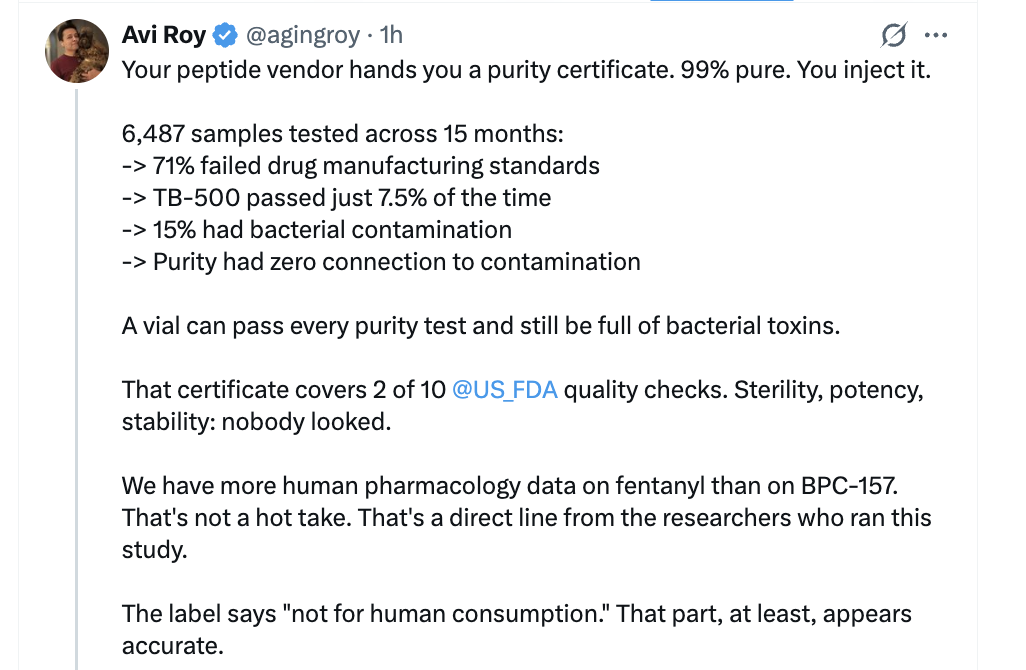
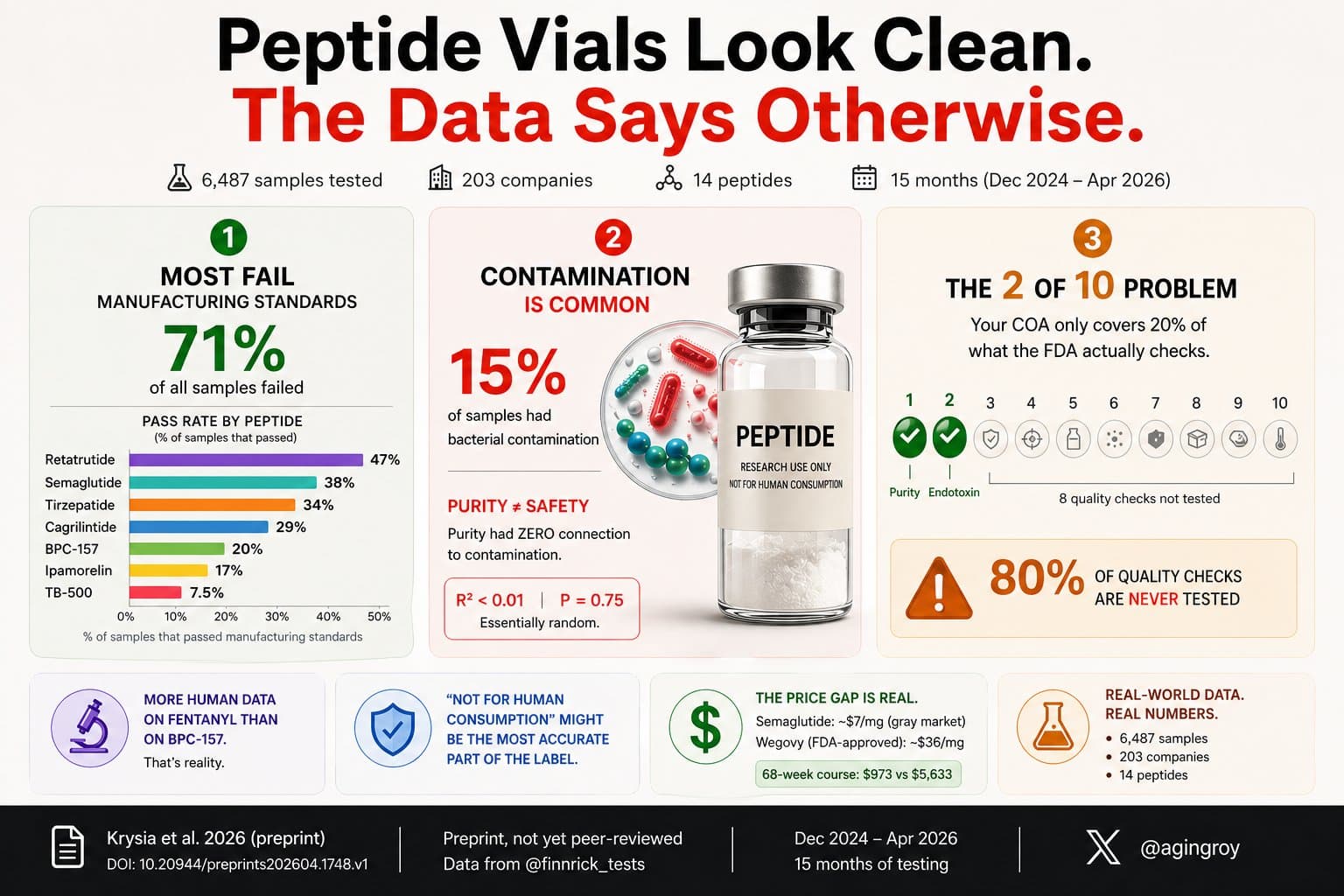
Paper with details: https://www.preprints.org/manuscript/202604.1748
2 Likes
AI Summary
This research paper evaluates the quality and cost of “gray market” research peptides—preparations sold directly to consumers for self-administration—compared to regulated alternatives.
Objective and Scope
The study analyzed 6,441 peptide samples across 14 different compounds (such as BPC-157, semaglutide, and tirzepatide) using a large, publicly available independent testing dataset from Finnrick Analytics[cite: 11, 30, 42]. [cite_start]The goal was to assess purity, measured abundance (accuracy of the dose on the label), and endotoxin contamination.
Key Findings
- Widespread Quality Failures: Depending on the standards applied, between 41.6% and 71.1% of samples failed to meet basic quality criteria.
- Dosing Inaccuracy: While the median measured abundance was 101.8%, there was significant variability; some peptides like BPC-157 and tirzepatide showed considerable within-class variability in dosing accuracy.
- Purity Issues: Several peptides demonstrated notably low purity, particularly TB-500 (median 97.29%) and CJC-1295 (median 98.49%).
- Identity Failures: Roughly 2.4% of samples (156 reports) did not contain the stated peptide at all[cite: 55, 80, 147]. [cite_start]TB-500 had the highest identity failure rate, with one in ten samples not containing the compound.
- Contamination: Measurable endotoxin contamination was found in 15% of tested samples.Crucially, the researchers found no correlation between a sample’s purity and its endotoxin levels, meaning high purity does not guarantee safety from bacterial toxins.
Cost Comparison
The study confirmed that gray market peptides are significantly cheaper than FDA-approved versions, though the cost gap varies wildly:
- Tirzepatide: FDA-approved Zepbound was estimated to be 72.8% more expensive than gray market equivalents for a full treatment course.
- PT-141: The FDA-approved version was 3850% more expensive than gray market preparations.
Summary of Failure Rates by Standards
The study compared samples against two different sets of pharmaceutical standards:
- Compounded Standards (90–110% dose, 98% purity): 41.6% failed to meet these basic criteria.
- Manufactured Standards (95–105% dose, 99.5% purity): 71.1% failed to meet these high-stringency benchmarks.
Conclusion
The authors conclude that many gray market peptides used for performance and sports medicine fail basic quality benchmarks. While third-party testing provides some transparency, it captures only a small fraction of the safety profile required for drugs intended for human injection.
2 Likes
Not surprised by these results, and I found the report a little alarmist for the people that bother testing their peptides.
First, about the Widespread Quality Failures. The quality benchmarks are:
- Compounded Standards (CS) : 90–110% dose, 98% purity
- Manufactured Standards (MS): 95–105% dose, 99.5% purity)
OK, I’ll go through all these points:
- Widespread Quality Failures: So if you bought a kit of tirzepatide 30mg, and using the CS standard, you would expect between 27-33mg per vial. Good news: grey vendors have almost the same guarrantee (90% fill, 98-99% purity), and will refund or reship if your test proves that they have your vial is underfilled, or doesnt meet the purity standard. So, this isn’t an issue.
- Dosing Inaccuracy: Of couse there was wild variability, they compared vials accross batches/vendors, and not within batches/vendors. Vendor V1 of batch B1 might have 60mg+/-5mg, while vendor V2 of batch V2 might have 60mg+/-1mg. It’s annoying, but there is no safety concern here.
- Purity Issues: this is precisely why people pay for tests. When fill or purity comes under vendor guarrantee, the vendor refunds or reships.
- Identity Failures: See point above. Wrong peptides occasionally get sent. This is a vendor issue, and they will refund ord reship.
- Contamination (endotozins): this makes more sense. First, the report is right that there is no relationship between endotxin levels and purity, because they are 2 different things. The levels found were between 0.5 and 40 EU/via. Sounds high, but if you read USP<85>, you’ll get an idea of what is considered high: for injections, the limit is 5 EU/kg/hour. So if you had a 70kg person, the limit for them would be 5x70 = 350 EU per hour. That’s a pretty high limit. Also, keep in mind that this limit depends on the dose of the injection, which often is not be the whole vial. So if you have a vial with 60 EU for a 30mg vial, and your dose is 10mg, then your endotoxin amount for that dose is 20 EU, and your limit is 20x5x70kg = 700 EU.
So, not much new from this report to people used to buying grey peptides, and that bother testing.
4 Likes
While these concerns are valid, I find it hard to believe the claim that 15% had bacterial contamination. That is a lot and should have shown up on reddit, glp1, mesorx, telegram, whatsapp groups etc. I have NEVER run across a case of someone saying they got an infection or any issue for that matter. There are plenty cases saying that they didn’t feel any benefits but to this day I have yet to see one person post that they got sick. This of course doesn’t mean it has never happened, rather that I haven’t seen it posted out there. Therefore, it’s got to be very rare, much rarer than 15% unless the bacteria were harmless, which I believe we come in contact to millions of those daily.
2 Likes
I doubt that the risk with peptides is any higher than it is with generic drugs from India.
Why do you think that?
The major Indian pharma companies have many drugs that pass the FDA and are sold in the USA. They are Huge Multibillion corporations with well refined quality control systems (perhaps used less for drugs sold only in India and the 3rd world). And, they are occasionally (less frequently than I’d like to see) visited by FDA inspectors and its identified when they fail inspections (though I’m sure the miss many, as the FDA has to pre-alert the Indian pharma to visits).
Some peptides companies in China are probably as good as the Indian pharma, but identifying them is extremely hard, if not impossible, and the size and quality control rigor required for developing, and manufacturing FDA and European-approved generic drugs is a high hurdle.
It’s pretty easy for anyone to look up the major Indian pharma companies Generally Good Indian Pharma Companies. and access FDA reports on quality, or violations, and know what drugs have gone through the FDA approval process. Try to do that for the Peptide companies you are familiar with…
2 Likes
China makes the ingredients for Indian pharmaceuticals–probably some of the same companies sending peptides here. And the understaffed FDA rarely makes inspections. Independent testing labs say that 10-15% of drugs imported from India are contaminated in some way.
Yes “China makes the ingredients”… they are called the “Active Pharmaceutical Ingredients” or APIs - yes that is true. But there are thousands of pharma and chemical and peptide companies, but only a small subset of the largest China API manufacturers are the ones that provide most of the ingredients to the major pharma in India.
And all the major India pharma that sell generics to the USA (most generics sold in the USA are manufactured in India today… and generics are the majority of the pharma market by volume by a long shot.
I’m not saying India is perfect - I’m just saying generally India pharma is a lot less opaque and more validated than some random Peptide company that is likely just one of 6 different tiers of middlemen who have handled the peptide, know nothing about it really, and don’t care about the quality…
We’ve discussed this issues with the Indian companies, such as here: Ordering All meds from India - #9 by RapAdmin
Be sure to read this article to understand the state of the Peptide reseller world: ‘I wouldn’t dare take these drugs’: how China supplies untested peptides to the west (Financial Times)
3 Likes
You need to research the suppliers, focusing on quality with verifiable COA data. I like to search Peptides in Trustpilot.com for reviews as a first step as well.