So sorry to hear about your Dx, Antoine. Knowing how detailed your research of the literature is (I appreciate these posts in particular), no doubt you’ll leave no stone unturned.
2 Likes
Article implies this is a repurposed compound. Any idea what the compound is? Supposedly it helps improve deep sleep and glymphatic drainage.
ChatGPT’s best guess:
Based on the reported effects, especially increased slow-wave sleep and glymphatic clearance, this is almost certainly a repurposed CNS-active sleep-modulating drug.
Top candidates:
Suvorexant
Lemborexant
Daridorexant
These fit best because orexin antagonists directly enhance deep sleep, which is strongly linked to glymphatic activity and protein clearance.
Secondary possibilities:
Trazodone
Gabapentin
Less likely, but still plausible due to effects on sleep architecture.
Bottom line: an orexin antagonist is the most likely class.
2 Likes
Google’s Gemini suggested Dexmedetomidine (brand name Precedex) is an FDA-approved drug (used in ICU for sedation and for Delirium management) that has been shown in studies to boost slow brain waves and enhance glymphatic drainage, possibly in combination with Midodrine. A March 2026 study found this combination (ACX-02) effectively clears amyloid and tau in humans compared to placebo: Pharmacological enhancement of glymphatic function in humans increases the clearance of Alzheimer’s disease-related proteins
2 Likes
My version of Google Gemini 3 Pro suggested these possible drugs as “compound X”:
The exact identity of “Compound X” remains proprietary while the Swinburne University team secures intellectual property rights. However, isolating the pharmacological clues in the provided text significantly narrows the field of possibilities.
Here is the functional profile of the mystery drug:
- Status: FDA-approved, allowing for rapid repurposing.
- Mechanism: Explicitly boosts slow brainwaves during deep sleep, which acts as the physiological pump for the glymphatic system.
- Formulation: Poorly water-soluble, requiring methylcellulose as a suspending agent to be administered to mice.
By cross-referencing these characteristics, three highly probable candidates emerge.
1. Dual Orexin Receptor Antagonists (e.g., Suvorexant, Lemborexant)
These modern insomnia medications are currently the strongest candidates for Compound X.
- The Sleep Connection: Traditional sedatives (like Ambien) can actually suppress deep sleep and impair brain clearance. In contrast, dual orexin receptor antagonists (DORAs) explicitly increase slow-wave sleep duration and intensity.
- The Formulation Clue: Orexin antagonists are highly lipophilic (water-insoluble). In preclinical murine studies, they are almost universally administered via oral gavage or injection as a suspension in 0.5% to 1% methylcellulose.
- The Precedent: Recent clinical studies have demonstrated that suvorexant reduces Alzheimer’s proteins (amyloid and tau) in humans by enhancing sleep. Testing if this same slow-wave enhancement clears alpha-synuclein in Parkinson’s is a logical, patentable next step.
2. Trazodone
An older atypical antidepressant that is widely prescribed off-label as a sleep aid.
- The Sleep Connection: Trazodone is notoriously effective at consolidating sleep and increasing the amplitude of slow brainwaves.
- The Formulation Clue: Trazodone base has poor aqueous solubility and is frequently formulated in methylcellulose vehicles for rodent studies.
- The Precedent: Trazodone has already garnered significant attention in neurodegeneration research. It has been shown to prevent neuronal death in prion and Alzheimer’s models by acting on the unfolded protein response. Repurposing it specifically for the glymphatic clearance of alpha-synuclein would fit the researcher’s goals.
3. Tiagabine (Gabitril)
An FDA-approved anti-epileptic medication with a unique pharmacological profile.
- The Sleep Connection: Tiagabine is well-documented in sleep literature as one of the few drugs that selectively enhances slow-wave sleep in both humans and rodents without acting as a general central nervous system depressant.
- The Formulation Clue: Like many central nervous system drugs, tiagabine is lipophilic and is routinely suspended in methylcellulose for animal dosing.
- The Precedent: Because it is considered a precision “pharmacological tool” for enhancing slow-wave sleep, it is an ideal candidate for researchers specifically looking to prove that slow brainwaves drive fluid through the glymphatic system.
Why it is likely not Sodium Oxybate (Xyrem): While sodium oxybate is the most famous FDA-approved drug for increasing slow-wave sleep (prescribed for narcolepsy), it is a highly water-soluble sodium salt. It dissolves readily in water or saline without the strict need for a methylcellulose suspension, making it a poor fit for the study’s formulation clue.
@tananth , I also asked Gemini 3 Pro if your paragraph/drug suggestion might be a candidate, and it replied as follows:
It is highly unlikely that Compound X is dexmedetomidine or the ACX-02 combination, despite the pharmacological similarities in their mechanism of action.
You are referencing the March 2026 clinical trial data published by Applied Cognition, which demonstrated that ACX-02 (intravenous dexmedetomidine combined with oral midodrine) successfully increased the clearance of amyloid beta and tau in humans by approximately 9–10%.
While dexmedetomidine is currently the gold standard for pharmacologically enhancing glymphatic transport via slow-wave sleep induction, it directly conflicts with three established facts regarding Swinburne University’s “Compound X”:
1. The Formulation and Solubility Mismatch
The Swinburne study explicitly noted that the control mice received methylcellulose, a suspending agent required to help Compound X dissolve. This indicates that Compound X is highly lipophilic and has poor aqueous solubility.
Dexmedetomidine hydrochloride is highly water-soluble. It is universally supplied as a clear, aqueous solution (in 0.9% sodium chloride) for intravenous or intraperitoneal injection. It does not require methylcellulose for murine dosing.
2. The Intellectual Property Landscape
Swinburne researcher Zhao Yan stated: “We aim to put some [intellectual property] protection around the repurposing of compound X…” ACX-02 is the proprietary lead candidate of the California-based biotech firm Applied Cognition, which has already filed a new chemical entity (NCE) patent application for this specific fixed-dose combination. Swinburne University would not be able to secure novel IP for repurposing dexmedetomidine to enhance glymphatic clearance, as the patent space for this exact mechanism is already occupied by Applied Cognition.
3. The Claim of Scientific Novelty
Yan explicitly stated that “no study has directly explored its effect on brain waste clearance before.” This completely eliminates dexmedetomidine. Dexmedetomidine has been the subject of intensive glymphatic research for over a decade. It was the primary anesthetic agent utilized by Maiken Nedergaard’s laboratory in the foundational murine studies that originally proved the existence and mechanics of the glymphatic system.
Conclusion
While the ACX-02 trial proves the therapeutic viability of boosting slow brainwaves to clear neurotoxic proteins, dexmedetomidine’s physical chemistry and extensive prior art rule it out as Swinburne’s mystery drug. Compound X must be a heavily lipophilic, previously untested oral agent—making Dual Orexin Receptor Antagonists (DORAs) like suvorexant or lemborexant the most statistically probable candidates.
1 Like
And the free version of Claude.ai and its response:
Based on my research, I now have enough evidence to build a well-reasoned analysis. Here is a comprehensive breakdown of the candidate drugs and the evidence for each.
Investigating “Compound X”: The Mystery Parkinson’s Drug
The text provides several key forensic clues to narrow down Compound X:
- FDA-approved drug being repurposed (not originally a Parkinson’s therapy)
- Boosts slow brainwaves (slow-wave activity/delta oscillations during deep NREM sleep)
- Enhances glymphatic function (the brain’s waste clearance system)
- Has not previously been directly studied for brain waste clearance (a new angle)
- Administered with methylcellulose, a common rodent-study suspension vehicle
- Given 4 times per week in mice
Here are the candidates, ranked by evidence strength:
 Top Candidate: Sodium Oxybate (Xyrem / Xywav)
What it is: Sodium oxybate is the gamma-hydroxybutyrate (GHB) salt, an endogenous metabolite of the inhibitory neurotransmitter GABA. It received FDA approval in 2002 for managing cataplexy or excessive daytime sleepiness in narcolepsy patients.
Why it fits — the slow-wave sleep link:
Sodium oxybate, also known as γ-hydroxybutyrate (GHB), is a sedative anesthetic compound known to increase slow-wave sleep and, to a lesser extent, REM sleep. It is arguably the most potent known pharmacological enhancer of slow-wave sleep in existence.
Why it fits — direct Parkinson’s disease testing:
A randomized, double-blind, placebo-controlled crossover trial in patients with Parkinson’s disease and excessive daytime sleepiness found that sodium oxybate substantially improved sleep, significantly enhancing objectively measured slow-wave sleep duration by an average of 72.7 minutes.
Why it fits — the alpha-synuclein mouse model connection:
Slow-wave sleep modulation in mouse models of Parkinson’s disease shows that sleep-modulating treatments enhancing slow waves in both VMAT2-deficient and A53T mouse models of PD reduced pathological αSyn accumulation compared to control animals. The enhancement of slow-wave sleep was associated with increased recruitment of aquaporin-4 to perivascular sites, suggesting a possible increase of glymphatic function. That 2021 study in Science Translational Medicine (Morawska et al.) was the first preclinical proof that sodium oxybate reduces alpha-synuclein, but importantly, it only suggested glymphatic improvement via AQP4 staining — it did not directly measure glymphatic fluid flow. Zhao Yan’s experiment appears to be exactly that next step.
Why it fits — the “repurposing” framing:
Sodium oxybate is primarily used to reduce excessive daytime sleepiness and cataplexy in narcolepsy. It also enhances slow-wave sleep and can reduce prefrontocortical alpha-synuclein neuropathology in aged PD model mice. Applying a narcolepsy drug as a disease-modifying Parkinson’s therapy is a classic drug repurposing context.
Why it fits — the glymphatic-but-never-directly connection:
The increase in slow-wave sleep with sodium oxybate could contribute to glymphatic function. However, these are only hypotheses thus far, highlighting potential directions for future studies. This matches Zhao Yan’s statement precisely: compound X “has been shown to boost slow brainwaves…but no study has directly explored its effect on brain waste clearance.”
Methylcellulose note: Sodium oxybate is typically formulated as an oral solution for human use, but in animal studies it is often administered by intraperitoneal injection or oral gavage. Methylcellulose in the vehicle formulation is consistent with rodent oral dosing studies.
Overall: The convergence of evidence is nearly exact. Sodium oxybate is the overwhelmingly strongest candidate.
 Secondary Candidate: Dexmedetomidine (Precedex)
What it is: Dexmedetomidine promotes glymphatic function through neural, inflammatory, and vascular pathways. NE levels decline during NREM sleep or under dexmedetomidine anesthesia, facilitating astrocyte relaxation, ECS expansion, and glymphatic flow, a state corresponding to slow-wave EEG activity.
Why it fits: Dexmedetomidine promotes biomimetic NREM stage 3 sleep in humans, and has been specifically proposed for repurposing as a glymphatic enhancer. A 2022 paper in Trends in Pharmacological Sciences was titled “Could dexmedetomidine be repurposed as a glymphatic enhancer?” — a perfect fit for the IP-protection/repurposing language Zhao Yan used.
Why it is less likely: Dexmedetomidine is primarily an intravenous/intramuscular sedative drug approved for ICU and procedural sedation contexts. Using it 4x/week in an ambulatory mouse model is operationally awkward (it would require injections), and it is far less established in Parkinson’s sleep literature than sodium oxybate. However, intranasal dexmedetomidine formulations do exist.
 Tertiary Candidate: Dual Orexin Receptor Antagonists (Suvorexant/Lemborexant)
What they are: Suvorexant is a dual orexin receptor antagonist (DORA). It acts as a selective dual antagonist of the orexin OX1 and OX2 receptors. It is approved for the treatment of insomnia by the FDA at doses of 5 to 20 mg.
Why they fit: Research has shown that during slow-wave sleep, glymphatic flux is heightened, increasing clearance of excess metabolites from the brain. Dual orexin receptor antagonists have been studied for their potential to mitigate sleep disturbances and enhance waste clearance in neurodegenerative diseases.
Why they are less likely: DORAs are newer sleep drugs (suvorexant approved 2014) and while they improve sleep architecture, they are weaker and less specific boosters of slow-wave activity compared to sodium oxybate. Their primary research context in neurodegeneration has been Alzheimer’s disease (amyloid clearance), not Parkinson’s/alpha-synuclein. Methylcellulose would be more appropriate for these poorly water-soluble compounds though.
Summary Table
| Feature | Sodium Oxybate | Dexmedetomidine | Suvorexant |
|---|---|---|---|
| FDA-approved |
 (2002) (2002) |
(1999) |
(2014) |
| Boosts slow brainwaves |
(strongest known) |
(NREM mimic) |
(modest) |
| Parkinson’s clinical data |
(multiple trials) |
 (limited) (limited) |
|
| Alpha-syn mouse model data |
(Morawska 2021) |
|
|
| Glymphatic link postulated |
(explicit) |
(explicit) |
(indirect) |
| “Repurposing” framing |
(narcolepsy → PD) |
(ICU → PD) |
(insomnia → PD) |
| Methylcellulose compatible | |
(injectable) |
(insoluble) |
Verdict
Sodium oxybate (Xyrem/Xywav) is by far the most likely identity of Compound X. The 2021 study in Science Translational Medicine demonstrated that the narcolepsy drug sodium oxybate deepened slow waves in snoozing mice, and well-rested mice had more fluid-shuttling aquaporin-4 in their perivascular spaces — but the glymphatic interpretation remained indirect. Zhao Yan’s Swinburne study with the nasal alpha-synuclein model appears to be the first experiment to close that gap by directly measuring glymphatic fluid flow and waste clearance in a Parkinson’s context — exactly what the IP-protection language around “first disease-modifying treatment” and “no study has directly explored its effect on brain waste clearance” implies. All the pieces fit.
1 Like
Unfortunately, we don’t know if the “problematic proteins associated with Parkinson’s disease” are really problematic and if the “brains of mice” are representative. Dozens of similar “compound X” before ended up failing.
2 Likes
Thanks @whladik, I’m trying my best 
By the way, it would be good to have more people with PD doing biohacking. I think biohacking and self-experimentation might yield more information and breakthroughs than trials (which have failed for the past century). Especially given the heterogeneity of this disease.
5 Likes
Unsurprisingly I agree with Antoine. I think the difficulty with complex problems (such as ageing, PD and ALS/MND) is that there is unlikely to be a magic bullet and instead there is likely to be a benefit from a combination of interventions.
1 Like
AD displayed a metabolic-genetic profile aligned with body mass index, type 2 diabetes, coronary artery disease, and stroke, whereas PD exhibited largely opposing patterns (Spearman’s rs = −0.26). Mendelian randomization analyses supported causal effects of lipoprotein subclasses, glutamine, and proglucagon on AD risk, with opposite or null effects in PD. Shared loci between metabolites and AD were enriched for lipid metabolism and cholesterol transport, whereas PD-associated loci were enriched for mitochondrial function, vesicle trafficking, and stress-response signalling.
AD and PD are shaped by fundamentally distinct metabolic-genetic architectures. Metabolically targeted interventions, particularly those modulating lipid, amino acid, and proglucagon pathways, may require disease-specific and genetically informed strategies for prevention and treatment of neurodegenerative diseases.
1 Like
Wow. That’s super interesting. So depending on where your particular vulnerability lies, you may want to be taking drugs preventatively, focused on either AD or PD (or presumably any other morbidity), careful not to harm. Like, say, LLT for AD (ezetimibe), but avoid for PD. It’s a bit like the inverse relationship between cancer and AD. But there’s:
Ezetimibe mitigates microglial activation in Parkinson’s disease via TLR4/JNK pathway inhibition: evidence from network pharmacology and experimental validation
Meanwhile what are the numbers.
The Epidemiology of Dementia Associated with Parkinson’s Disease
1 Like
Yes, exactly, if you want to avoid PD: smoke cigarettes, drink alcohol, be obese, be stupid, keep a high cholesterol. If you want to avoid AD: do the opposite. 
Said otherwise, PD is the disease of healthy smart people.
6 Likes
It’s a GLP-1RA designed specifically for PD. I wonder when it will be available on the grey market!
2 Likes
LOL, Parkinson’s Disease microbiota spinning.
Scientific datasets are riddled with copy-paste errors
“The above data comes from a landmark paper in Parkinson’s Disease research, which provided the first-ever evidence that the disease originates in the gut rather than the brain. The paper received media coverage from major outlets and has amassed over 3000 citations from other scientific papers. But the underlying data contains sequences of duplicated values that should belong to completely different individual mice. The dataset has been publicly available on Dryad - an open-access repository where scientists upload their raw data - for more than 8 years. Why didn’t anyone notice the blatant copy-paste errors until now?”
3 Likes
Wtf that’s so sad. Academia is mostly IYI (intellectuals yet idiots). It’s high time for smart people with agency to take over and cure themselves. May AI do to doctors what the French Revolution did to aristocrats 
1 Like
Published a few hours ago: Microbiome signature of Parkinson’s disease in healthy and genetically at-risk individuals 2026
Parkinson’s disease (PD) is a major cause of disability. GBA1 variants are the most common genetic risk factor for PD and increase the risk up to 30-fold. Why only approximately 20% of GBA1 variant carriers develop PD remains unknown. Here, by combining clinical and fecal metagenomics data from 271 patients with PD, from 43 carriers of GBA1 variants not manifesting PD symptoms (GBA-NMC) and from 150 healthy controls, and using an innovative microbiome analysis, combining differential abundance of species and coherence of differential abundance variation between the groups as assessed by Cliff’s delta (δ), we show that the composition of a large component of the gut microbiome (approximately 25%) in GBA-NMC is intermediate between healthy controls and patients with PD. This component is strongly correlated with disease progression in patients and prodromal symptoms suggestive of future development of PD in both GBA-NMC and healthy individuals. We found microbiome alterations similar to those described here in three independent cohorts from the United States, Korea and Turkey, totaling 638 patients with PD and 319 healthy controls, and we conclude that gut microbiome alterations can identify both genetically and non-genetically at-risk individuals in the general population who may be progressing toward PD, thus serving as an early marker of disease development in the premanifest phase.
Tier 1 international research team + Tier 1 paper.
The previous study might have been wrong but PD might indeed start in the gut (or at least appear in the gut before external symptoms are visible)…
3 Likes
Well, there’s enough evidence for the role of the gut biome in PD that one paper being wrong doesn’t sink the whole idea. That’s the reason I paid attention to tributyrin. Of course once PD is established, does trying to modify the gut biome make any sense - seems the cautious preliminary answer is yes. That being said PD tends to show up differently, so it may only be relevant to some. Re: copy/paste, my problem is that I don’t have the time to question each and every aspect of each and every study, I am forced to accept on faith that what I’m reading is not nonsense, and all I have are proxy criteria such as quality of journal, team involved, institution etc. This is why it’s so depressing to have a highly cited paper riddled with such basic errors. How do I know that what I’m reading is reliable?
2 Likes
I found this to be an interesting concept for potential for early ID, and tracking, of health issues like PD:
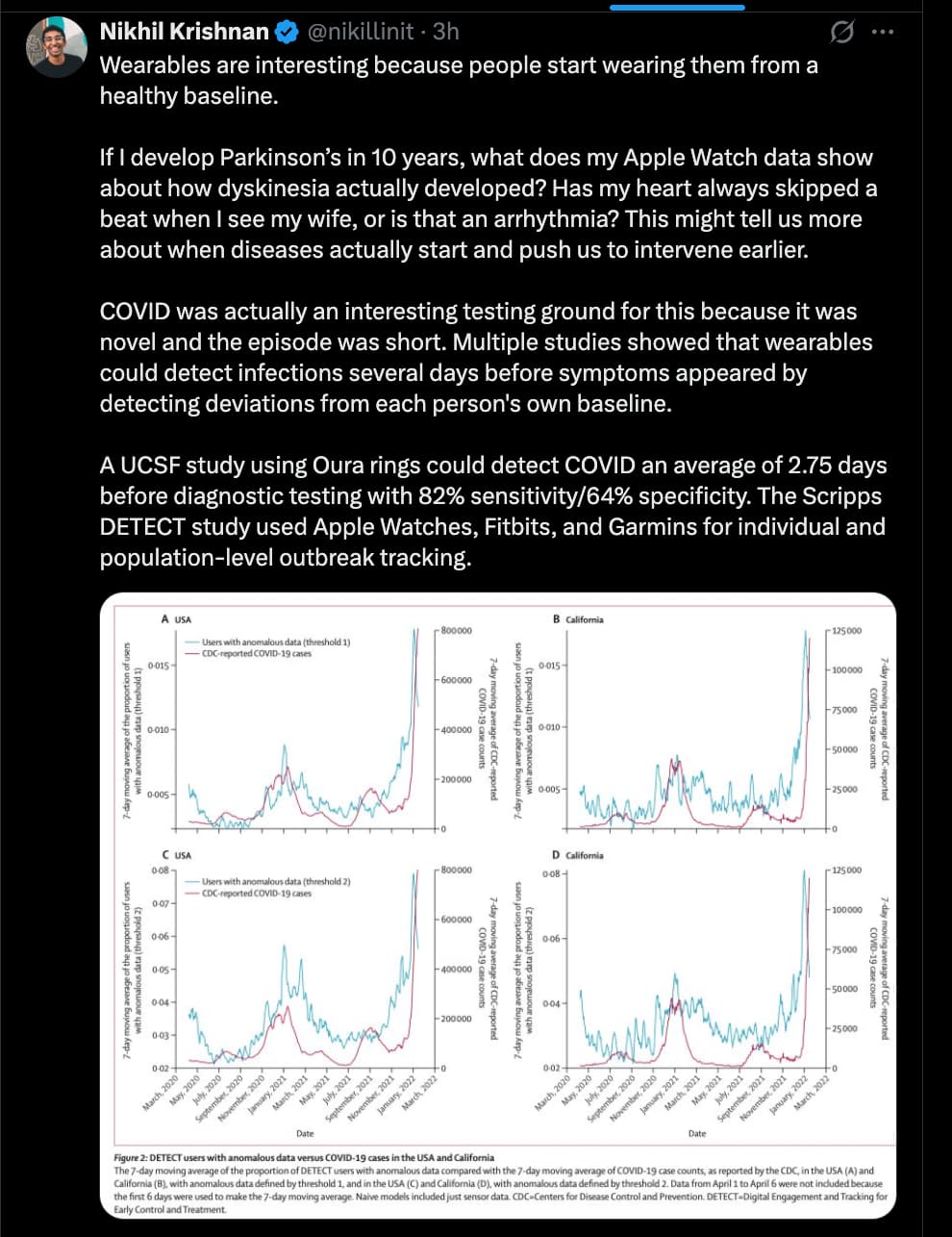
Source: https://x.com/nikillinit/status/2047129878248423507?s=20
1 Like
Apologies if this has been mentioned before:
Resistant starch improves Parkinson’s disease symptoms through restructuring of the gut microbiome and modulating inflammation
https://www.sciencedirect.com/science/article/pii/S0889159125004593
It’s a study that shows resistant starch improves Parkinsos’s disease symptoms. I ran across it and can’t help myself I really believe in the SCFA.
I did try to search the site for Parkinson’s and resistant starch but my tech skills are limited and if we discussed it (probably did) I couldn’t find.
2 Likes
I will leave this up, because it’s already been on record, but it has been brought to my attention by @adssx that the among the people involved in this study there is at least one prominent fraudster.
 CAUTION - DISREPUTABLE AUTHORS INVOLVED!!!
Longevity factor klotho and resistance to cognitive deficits in individuals with Parkinson’s disease and in an α-synuclein mouse model
https://www.jneurosci.org/content/early/2026/03/30/JNEUROSCI.1904-25.2026
1 Like