Parkinson's disease

Yes, interesting, but looks like dose dependency might give us a clue? For empa, the low dose 10mg gives 0.64 vs 0.33 for 25mg. Then there’s the weird cana 3.0. But all the CI are nutty at the high end. Directionality? At least you could say there is some indication if escalating the dose gets you better OR, means it’s doing something, no?

Aging Immune Networks Linked to Parkinson’s Progression

1 Like

A druggable link between the angiotensin receptor 1 and α-synuclein pathology revealed in scalable human cellular models of Parkinson’s disease

UCSF

We uncover AGTR1 as a key regulator of α-synuclein transcription and aggregation in human iPSC-derived mDA neurons, and AGTR1 inhibition as pro-survival in human iPSC-derived 2D and 3D neurodegenerative models of mDA neurons. These findings position inhibition of AGTR1 as a promising therapeutic strategy for PD neuroprotection.
When testing the neuroprotection of another widely used AGTR1 inhibitor, Telmisartan, we observed that it did not match that of Candesartan or Valsartan. Specifically, in 2D cultures exposed to CBE, Telmisartan appeared to have a detrimental effect on neuronal survival (Fig. S10A). In contrast, it showed a dose-dependent protective effect against rotenone-induced toxicity at higher concentrations (≥ 50 µM; Fig. S10B). Notably, in the 3D model, telmisartan exhibited one of the most robust protective effects against rotenone among the sartans tested (Fig. S10C–E). It is worth noting that, in addition to inhibiting AGTR1, telmisartan also acts as a partial agonist of peroxisome proliferator-activated receptor gamma (PPARγ). These discrepancies may reflect this property of telmisartan. Tolerance of telmisartan differs between 2 and 3D systems, with long-term exposure in 2D cultures potentially leading to increased toxicity, while the 3D assembloid model may better buffer such effects. Alternatively, telmisartan may exert context- or stressor-specific effects (e.g., preferential protection against mitochondrial stress induced by rotenone). These observations require further mechanistic investigation to better understand the differential effects of sartans on mDA neuroprotection.

2 Likes

Wow, great find. And again, we see the problematic nature of using mice as models in PD - from the paper:

“Comparative snRNA-seq analysis of human and mouse brains revealed species-specific differences. In humans, the PD-vulnerable TH⁺SOX6⁺CALB1⁻ DA neuron subtype expressed AGTR1 but not AGTR2, whereas the corresponding mouse population lacked AGTR1a/b and expressed AGTR2 (Fig. S2C-D; Fig. S3C-D). Given AGTR1’s pro-degenerative role and AGTR2’s neuroprotective role in DA neurons [35], these differences highlight the limitations in using mouse models to study AGTR1-mediated mechanisms, emphasizing the value of human-based in vitro platforms.”

“Additionally, the source of Renin in the brain has been subject to controversy. While mouse brain cells show little to no Renin expression [24], human Renin expression is found in the Choroid plexus and MSN neurons. Human SNpc astrocytes express AGT, the precursor to AGTR1’s ligand, and our human mDA platform, incorporating neuron-glia interactions, mirrors these human-specific RAAS dynamics, particularly the AGTR1-AGT axis in the nigrostriatal pathway. While it is encouraging that similar findings have been found in mice models where MPTP-induced increase of α-Syn aggregation was mitigated by sartans and in AT1-KO mice [56] we believe that our findings highlight the need for human in vitro models to identify neuroprotective strategies that accurately reflect PD pathogenesis and ensure therapeutic relevance.”

It is always interesting to see how these agents are with regard to BBB penetration. Interesting - from the paper:

“While candesartan exhibits better BBB permeability than other sartans, its brain penetration remains suboptimal, as evidenced in a recent clinical trial [78].”

Looking at the 2D/3D issue I come back to something that I’ve been mulling over on and off for quite some time - is it just completely insane to use more than one ARB at the same time, adjusting the doses not to exceed a combined max? So for example in this context candesartan for 2D and telmisartan for 3D.

I was thinking about ARB combos for telmisartan + olmesartan, because olmesartan does not cross the BBB (and notably they did not test olmesartan in this paper). But then again, despite not crossing the BBB, olmesartan is associated with robust lowering of dementia risk (even better than telmisartan). My main fascination with olmesartan is that it’s more effective for BP lowering and uniquely lowers ACM.

2 Likes

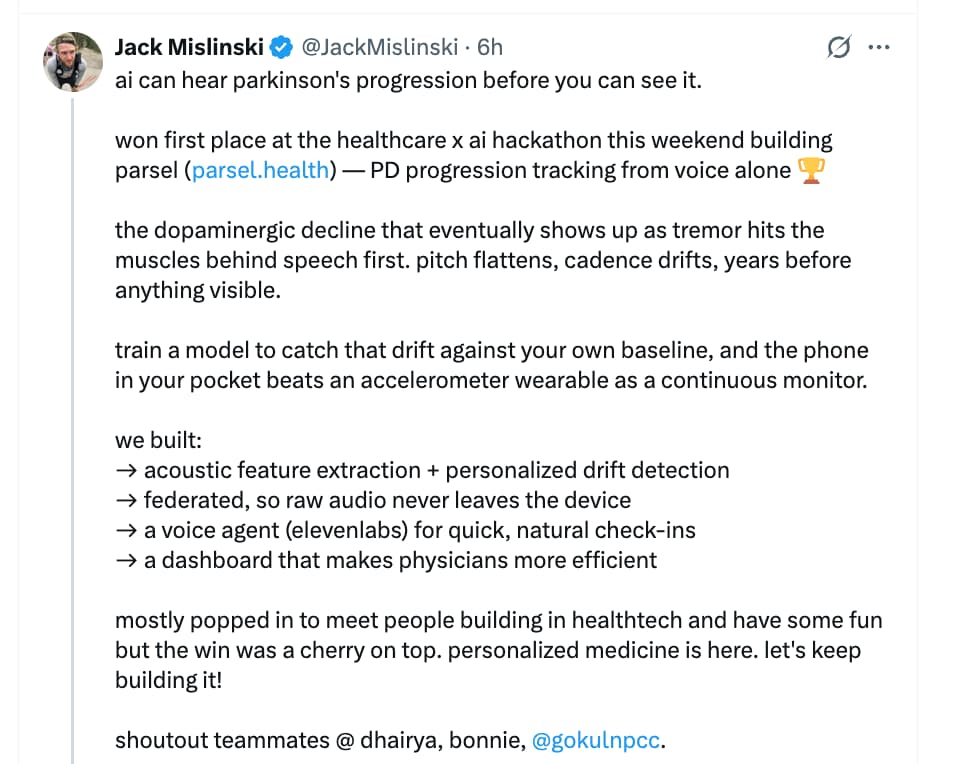
Source: Jack Mislinski on X: "ai can hear parkinson's progression before you can see it. won first place at the healthcare x ai hackathon this weekend building parsel (https://t.co/onX0T3lZl2) — PD progression tracking from voice alone 🏆 the dopaminergic decline that eventually shows up as tremor hits the https://t.co/NDpUfTswm3" / X

1 Like

This is a trash Chinese team, institution, model, and publication - so, all around trash. But they are harping on lycopene, which has been identified before in the context of PD, so just in case there’s any fire in all this smoke, I’m posting this. FWIW, I already have been supplementing with 20mg lycopene daily #kitchen-sink.

CAUTION: likely trash!

Neuroprotective Effects of Lycopene in Parkinson’s Disease Mice: Potential Modulation of DAT/SLC6A3-Mediated Dopaminergic Pathway

https://www.mdpi.com/2072-6643/18/14/2234

1 Like

First I’ve heard of CO2 inhalation as a treatment for any neurodegenerative condition. I’m always ready to be surprised.

2 Likes

Well, this is not a shock at all. First of all, targeted hypoxia is a well known intervention in NDD conditions, which is what CO2 is doing as one modality. But also there is the well known fact that cigarette smoking is associated with beneficial effects on PD. For a long time people thought it must be the nicotine, but that never panned out in multiple attempts, and more recently researchers have focused on the CO2 component of cigarette smoking - there’s your inhalation! - and the resulting transient mild hypoxia. Bottom line, far from being in some way new and exotic, CO2 in the context of NDD amelioration has a long history and is an active area of research.

2 Likes

So hypercapnia occurs in type 2 respiratory failure, you don’t have to be hypoxic. Cigarette smoking does result in increased carbon monoxide, not carbon dioxide with is what is the issue with hypercapnia. The problem is that one can get CO2 narcosis and stop breathing - we see if in the ER and ICU with some frequency.

1 Like

Researchers have reported that inhibition of 15-hydroxyprostaglandin dehydrogenase was shown to protect neurons and improve motor function in mouse models of Parkinson’s disease in findings that could support repurposing of drugs currently under development

https://www.labmate-online.com/news/laboratory-research-news/126/breaking-news/enzyme-blocking-drugs-show-promise-against-parkinsons-brain-damage/68078

Full paper that is the subject of this writeup:

Inhibiting 15-PGDH restores redox homeostasis and confers neuroprotection in Parkinson’s disease

https://www.sciencedirect.com/science/article/pii/S2213231726002843?via%3Dihub

1 Like
1 Like

Leucine and whey?

For decades, researchers have focused on finding elaborate ways to get more drugs across the BBB. Montara Therapeutics is taking an alternative approach. Rather than simply trying to force more drugs into the brain, the company is using the BBB to its advantage to achieve brain-selective pharmacology, allowing drugs to remain active in the brain while preventing their activity elsewhere in the body.

The strategy recently attracted approximately $1 million in funding from The Michael J. Fox Foundation (MJFF), which will support the development of a brain-selective mTOR therapy for Parkinson’s disease. More broadly, however, Montara’s approach represents an exciting opportunity to revive promising drug classes that have long been abandoned because of dose-limiting peripheral toxicities.

https://www.drugdiscoverynews.com/what-if-the-blood-brain-barrier-is-the-solution-not-the-problem-17407

1 Like

The Alpha-Synuclein Reckoning: Why Parkinson’s Biggest Drug Bets Keep Failing, and What Is Quietly Still Standing

This is a narrative review, not a new experiment. Nine authors from Zhejiang Cancer Hospital and the Chinese Academy of Sciences catalogue roughly 40 clinical trials and dozens of preclinical studies aimed at slowing Parkinson’s disease rather than masking its symptoms. Their central observation is bleak and useful: every large, well-funded attempt to attack alpha-synuclein, the misfolded protein at the centre of Parkinson’s pathology, has failed. Cinpanemab, prasinezumab and minzasolmin all missed their primary endpoints. One drug, venglustat, made patients measurably worse. The authors argue the failures are not proof the targets are wrong but proof the trials were designed badly: no genetic stratification, treatment started too late, and a motor rating scale as the primary endpoint that cannot separate a symptom being masked from a disease being slowed. The surviving signals are modest and come from unglamorous places, chiefly repurposed diabetes drugs and cell replacement.

For thirty years the story of Parkinson’s research has been the same story: find the toxic protein, remove the toxic protein, stop the disease. That story has now been tested at scale, and it has not held up.

This review assembles the wreckage. Cinpanemab, a monoclonal antibody against alpha-synuclein, was tested in 357 early-stage patients and showed no benefit at 72 weeks. Prasinezumab, in 316 patients, missed its primary endpoint at 52 weeks. Minzasolmin, a small molecule designed to stop the protein misfolding in the first place, was tested in 450 patients and its extension study was terminated in December 2024 for lack of benefit. Venglustat, aimed at a lysosomal enzyme pathway, did not merely fail; patients on the drug deteriorated faster than those on placebo, and their neurofilament light levels, a marker of neuronal damage, went up.

The authors’ diagnosis is that these trials asked the right question of the wrong people at the wrong time. None of them selected patients by genotype. Parkinson’s is not one disease. Roughly 5 to 10 percent of patients carry a GBA1 mutation and tend to decline faster; about 1 percent of sporadic cases carry the LRRK2 G2019S variant, which raises kinase activity two to three fold and appears to drive damage through lysosomal failure rather than protein clumping. Giving an anti-aggregation antibody to an unselected population dilutes any real effect into statistical noise. The venglustat data make the point vividly: patients with mild GBA1 mutations got substantially worse while those with severe mutations showed no difference, meaning the same drug had opposite consequences in two subgroups enrolled as though they were one.

The second problem is timing. Neurons are dying years before a tremor appears. By the time a patient meets diagnostic criteria, a large fraction of the substantia nigra is already gone. Treating that patient is repair work, not prevention.

What survives is quieter. GLP-1 receptor agonists, the diabetes and obesity drugs, have produced small but repeatable motor signals across four separate trials. Stem cell grafts have produced early open-label improvements in twelve patients. Neither is a cure, and the review is honest that both remain unproven.

Actionable Insights

Almost nothing here translates into something you can do tomorrow, and any report suggesting otherwise is overselling. Three points survive scrutiny.

First, metabolic health is the only lever in this paper with a plausible causal chain and a real-world magnitude. Diabetics carry roughly a 38 percent higher risk of developing Parkinson’s, and among diabetics, those on GLP-1 drugs had about 23 percent lower Parkinson’s incidence than those on a comparator drug. These are observational associations, not proof, but the direction is consistent.

Second, the drug effects themselves are small. Across the GLP-1 trials, the treated group ended up about 3 to 5 points better on a 132-point motor scale. Expressed as a standardised effect size, that is roughly 0.4 to 0.6, meaning a typical treated patient does better than about 67 to 74 percent of untreated patients. That is a real but partial shift, with enormous overlap between the groups. Critically, the definitive phase 3 exenatide trial found nothing at all.

Third, do not self-experiment on the basis of this review. The ambroxol and nicotinamide riboside results everyone cites are uncontrolled, involved 17 and 30 people respectively, and cannot distinguish drug effect from placebo, practice effect, or regression to the mean.

Context and Source

  • Open access paper: Progress in Disease-Modifying Therapies for Parkinson’s Disease
  • Authors: Shuyuan Zhang, Gang Shao, Bin Wu, Liang Xia, Lei Wang, Liwen Li, Kai Jin, Yangfan Zou, Caixing Sun
  • Institutions: Zhejiang Cancer Hospital, Hangzhou; Hangzhou Institute of Medicine (HIM), Chinese Academy of Sciences; Zhejiang Sci-Tech University
  • Country: China
  • Funding: National Natural Science Foundation of China (No. 82373842)
  • Journal: Aging and Disease, Volume 17, Number 5, pages 2490 to 2508, October 2026.
  • Article type: Review. Received 18 May 2025, revised 3 September 2025, accepted 4 September 2025.
  • Impact evaluation. The impact score of this journal is 9.6, evaluated against a typical high-end range of 0 to 60+ for top general science journals, therefore this is a Medium impact journal.
1 Like

I searched this thread, but found no mention of cannabinoids, ie. cannabis. I will present a short summary of the effects.

While the discovery that cannabis (specifically THC and CBD) promotes hippocampal neurogenesis is scientifically promising, current evidence does not support the conclusion that this equates to a cure for Parkinson’s disease (PD).

The relationship between neurogenesis and PD is complex, and the “curative” potential remains theoretical rather than proven. Here is a summary of the findings:

1. Neurogenesis vs. The Core Pathology of Parkinson’s

Parkinson’s is primarily defined by the death of dopaminergic neurons in the substantia nigra (a part of the midbrain), not the hippocampus.

  • Different Brain Regions: While cannabis-induced neurogenesis occurs in the hippocampus (critical for memory and mood), PD pathology destroys cells in the substantia nigra (critical for movement). Generating new neurons in the hippocampus does not automatically replace the lost dopamine-producing cells in the substantia nigra.
  • Limited Migration: There is currently no robust evidence that new neurons generated in the hippocampus can migrate to the substantia nigra and functionally integrate to restore motor control.

2. The State of Hippocampal Neurogenesis in PD

Research indicates that hippocampal neurogenesis is actually impaired or altered in Parkinson’s patients, contributing to non-motor symptoms like depression and cognitive decline.

  • Potential Benefit: By promoting hippocampal neurogenesis, cannabis might alleviate these non-motor symptoms (depression, anxiety, cognitive fog) and improve quality of life.
  • Not a Motor Cure: Improving hippocampal health does not directly address the primary motor symptoms (tremors, rigidity, bradykinesia) caused by substantia nigra degeneration.

3. Neuroprotection vs. Neurogeneration

Current research distinguishes between generating new neurons (neurogenesis) and protecting existing ones (neuroprotection).

  • Neuroprotection Evidence: Preclinical studies (in cells and rats) show that CBD and THC have strong antioxidant and anti-inflammatory properties that can protect remaining dopaminergic neurons from further damage. This could theoretically slow disease progression, but it is not a “cure” that reverses existing damage.
  • Clinical Gap: Despite promising animal data, human clinical trials have not yet demonstrated that cannabis stops or reverses the neurodegenerative process in humans. A 2026 systematic review concluded that while cannabinoids may offer symptomatic relief, there is no conclusive evidence of disease-modifying (curative) effects in patients.

4. Recent Clinical Findings (2025–2026)

Recent trials highlight the gap between biological potential and clinical reality:

  • Symptom Management: Studies confirm cannabis can help with sleep, pain, and psychosis (specifically CBD), but effects on motor symptoms remain inconsistent.
  • No Cure Demonstrated: A 2026 meta-analysis of randomized controlled trials found that cannabinoids did not significantly improve motor symptoms or halt disease progression compared to placebo.
  • Safety: While generally safe, high doses of THC can worsen cognitive function and balance, posing risks for PD patients.

Conclusion

The fact that cannabis causes hippocampal neurogenesis suggests it could be a valuable adjunct therapy for managing non-motor symptoms (like depression) and potentially offering neuroprotection to slow decline. However, it is not currently considered a cure because:

  1. It does not regenerate the specific dopaminergic neurons lost in the substantia nigra.
  2. Human trials have not yet shown it stops or reverses the disease’s progression.
  3. The neurogenesis observed is in a different brain region than the primary site of PD damage.

/end AI.

I would also refute the claim that cannabis doesn’t affect motor skills since this has already been documented for everyone to see in this video. I suppose it remains inconsistent; maybe something to do with the entourage effect or the carboxylation state of the compounds.

Cross posting, SS-31, The Peptide That Peels Parkinson’s Rogue Protein Off Cell Membranes

2 Likes

From the recent interview with Alex Colville:

1 Like

Parkinson’s Rates Are Surging. Is Exposure to Poisons to Blame?

To Caroline “Carlie” Tanner, MD, PhD, a neurologist and epidemiologist specializing in movement disorders, it’s no surprise that Parkinson’s disease was first referenced in England in 1817, at the height of the Industrial Revolution when cities were cloaked in smoke and soot.

Today, smoke and soot have given way to more insidious, less visible toxicants. Research shows that exposure to toxicants destroys neurons, including those that produce dopamine, a neurotransmitter that facilitates smooth, balanced movement. Years later, patients developed Parkinson’s symptoms, including tremors that evolve into immobility, cognitive and mood changes, and difficulty swallowing.

Tanner’s groundbreaking population studies have quantified the risks of these toxicants and have highlighted the role of environmental triggers. Her research was instrumental in the Paraquat Prevention Act introduced in the U.S. House of Representatives in June 2026 and the phasing out or banning of other toxicants.

We asked Tanner, whose research is supported by the National Institutes of Health (NIH), about the upsurge.

How much have Parkinson’s cases increased in recent years and why?

From 1990 to 2021, global Parkinson’s disease cases have increased from approximately 3 million to nearly 12 million.

There’s no doubt that toxicants are contributing to the upswing. True, some portion of the increase can be explained by improved diagnostics and disease recognition. Also, people are living longer and reaching the age when they are most vulnerable to Parkinson’s disease — over 50, with peak diagnosis between 60 to 69.

It’s important to note that these are estimates. We don’t have a good system for reporting Parkinson’s disease in most countries and we lack long-term data.

What role do toxicants play in Parkinson’s?

Years ago, genetics and aging were believed to be the underlying causes of Parkinson’s disease. The impact of toxicants became clear in 1983 when a group of drug users rapidly developed Parkinson’s after injecting themselves with a synthetic heroin, biologically similar to paraquat, an herbicide, now proven to increase Parkinson’s disease risk. Today, Parkinson’s disease is believed to be the combined effects of toxicants, age, genetic makeup, and behaviors like diet and exercise.

Our 1989 study in China, when the country was rapidly developing, found that residents who lived in areas where they were exposed to toxicants like weedkillers, pesticides, and industrial solvents, had a higher rate of Parkinson’s than those in rural villages who grew wheat and raised pigs.

https://www.ucsf.edu/news/2026/08/432396/parkinsons-rates-are-surging-exposure-poisons-blame