Parkinson's - A deep dive into genetic pathways for actionable insights

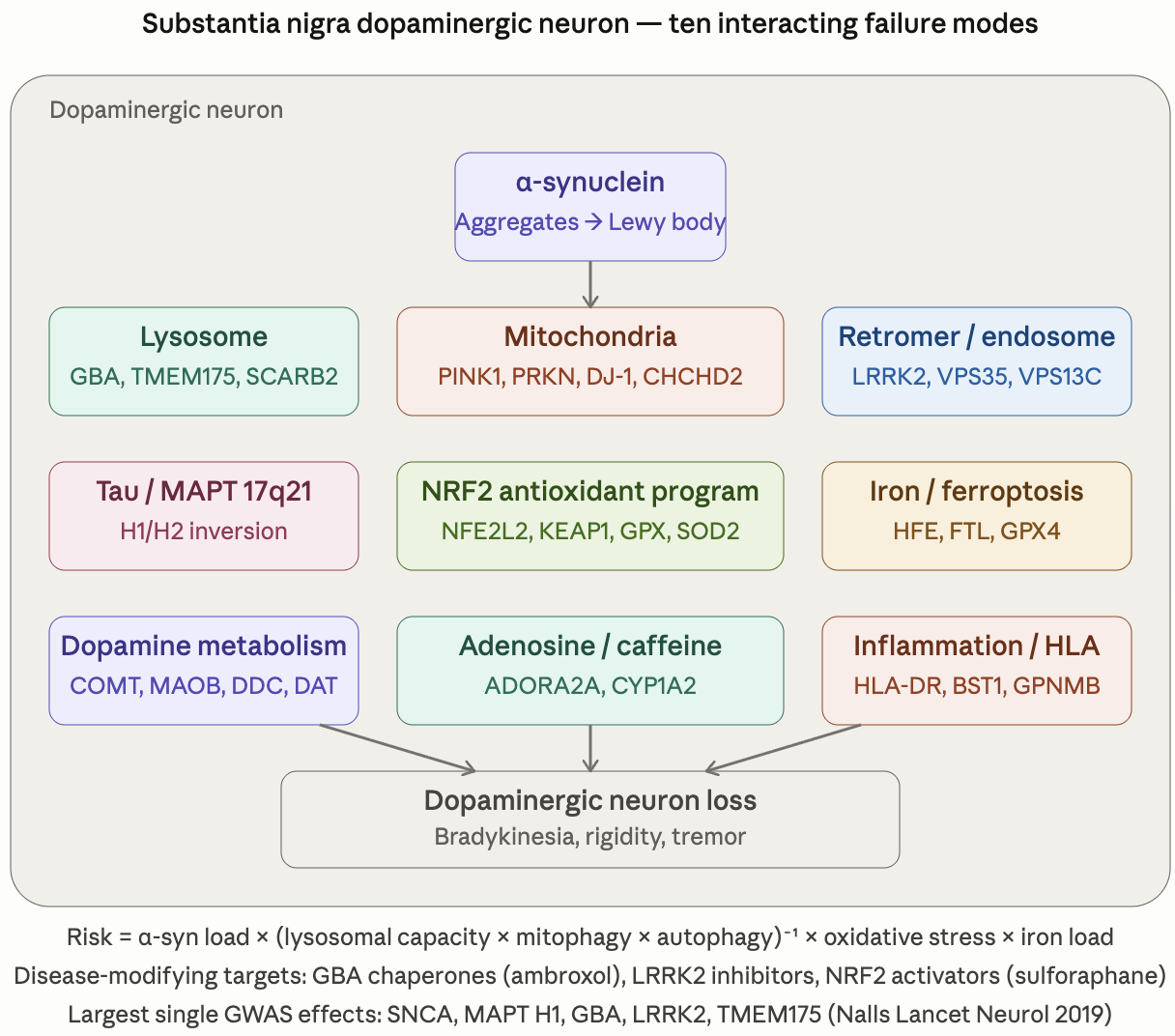
I’m continuing my deep dives into the genetic pathways to get actionable insights as the previous ones have been incredible precise and useful. This time I’m looking at the Parkinson’s related genetic pathways.

Here is the general description of the pathways and their variants. I will put the finding about my own genome below it as an example of what useful and actionable insights you can get.
Parkinson_Disease_Genetic_Pathway_Reference.pdf (681.0 KB)

The pdf report above is valid for everybody but here is the summary of the findings I get when I apply it to my own genome.

Parkinson’s Disease Genetic Report — Top actionable findings

Cumulative integrated PD risk approximately at population baseline to mildly elevated (estimated common-variant PRS ~50th–65th percentile, ~1.0–1.2× population baseline lifetime risk). No high-impact rare/Mendelian PD variants detected. The dominant risk axis is the recurring NRF2 / glutathione keystone (already actively addressed). The dominant favorable feature is the apparent MAPT H2/H2 protective haplotype (PSP/CBD risk substantially below population baseline). Existing supplement and medication regimen is well-aligned with the genetic profile.


1. NRF2 keystone confirmed across THREE reports — sulforaphane stack is mechanistically optimal (highest priority)

NFE2L2 rs6721961 G/G (homozygous risk) + rs2706110 C/C (homozygous risk) + rs35652124 C/T (het). Same rs6721961 G/G called in Inflammation/Immune and Glycation reports. Plus GSTP1 105V/V + 114V/V double homozygous (glutathione conjugation impairment) and NQO1 *2 heterozygous. Action: continue Avmacol Extra Strength BID + NACET 100 mg AM / 200 mg PM + glycine 6 g. Form and dose are correct — no change. Independently supported by the PD literature now (Bento-Pereira Med Res Rev 2021; Jazwa Antioxid Redox Signal 2011).

2. MAPT H2/H2 protective — largest favorable finding

All six independent H1-tagging MAPT SNPs (rs1052553, rs17649553, rs8070723, rs393152, rs242557, rs2435207) PLUS both flanking 17q21 inversion tags (KANSL1 rs17563986, CRHR1 rs17689882) are homozygous reference — most parsimoniously H2/H2 (population frequency ~4% in Europeans). Per-allele PSP OR ~0.18, PD OR ~0.7. Action: informational only; no intervention. Optional: confirm with phased haplotype analysis (shapeit) if preferred — the chance of all six H1 tags being hom-ref by chance in an H1-carrier is vanishingly small, but formal phasing is reassuring.

3. All Mendelian / high-impact PD variants ABSENT — major favorable

Hom-ref for: LRRK2 G2019S (rs34637584), LRRK2 R1441C (rs35870237), LRRK2 non-coding rs76904798, VPS35 D620N (rs188286943), GBA1 N370S/L444P/E326K/T369M, SNCA A53T/A30P/E46K/H50Q/G51D, PINK1 Q456X/G411S, PRKN R275W/D394N coding, CHCHD2 T61I, SMPD1 L302P. Action: none. Caveat: SNCA duplication/triplication and PRKN exonic CNVs are not detectable from short-read SNP VCF; not clinically indicated to pursue absent family history of early-onset PD.

4. SNCA risk haplotype heterozygous (not homozygous) — modest

SNCA rs356182 HET + rs356219 HET + rs2737029 HET (one risk allele each at three tag SNPs in linkage disequilibrium). Top common-variant PD GWAS signal but at heterozygous level (per-allele OR ~1.32). Action: none specific. Rapamycin (autophagy/α-syn clearance) and doxycycline (α-syn aggregation modulation) in current regimen are mechanistically aligned. Note: the heterozygous rs356182 G/A genotype does not predict tremor-predominant phenotype (that finding was specific to G/G homozygotes; Cooper Mov Disord 2017).

5. Pesticide G×E susceptibility profile — minimize modifiable exposure

GSTP1 105V/V (rs1695) + 114V/V (rs1138272) double homozygous + NAT2 *5 slow-acetylator homozygous (rs1801280 C/C) + SLC11A2 (DMT1 iron/Mn) homozygous (rs422982) = textbook Menegon-Lancet-1998 pesticide-PD G×E susceptibility configuration. Action: test private well water if applicable; rinse non-organic produce; avoid organophosphate lawn treatments and welding/manganese fume exposure. No supplement change required (selenium 100 µg/d in Momentous Multi already supports GPX4).

6. Coffee/caffeine — continue moderate intake (1–4 cups/d)

ADORA2A partial-protective haplotype: rs5751876 HET + rs5760423 HET + rs2298383 HET (the strong rs3032740 functional variant is hom-ref, so A2A receptor density is at baseline). CYP1A2 *1A/*1F (rs762551) C/A heterozygous = intermediate metabolizer. Coffee–PD inverse association is the most replicated environmental neuroprotection signal (Hernán Ann Neurol 2002; Ascherio Lancet Neurol 2016; Grade A). Action: continue current intake.

3 Likes

Great methodology, thanks for sharing your research! Still, given that most cases are idiopathic (as said in the report) and that alpha-syn aggregation is still a hypothesis, I’m not sure PD is the best candidate for actionable insights based on genes (contrary to other diseases).

1 Like

I agree but still it’s useful to know that I’m more susceptible to pesticides. I was already trying to avoid them but I will be even more cautious now. I also do need to fix that NRF2 blockage that is showing up in so many of those reports.

1 Like

Seconding the alpha-syn mess. I posted a paper on the alpha-syn weird sex-based discrepancy in AD, and tau pathology. I bet it’s a much more complicated story, and I would not hang my hat on big alpha-syn PD explanatory power.

How do you know that “fixing” that is beneficial? For instance I have genetically high homocysteine but all I read about interventions concluded that it was useless except for stroke risk reduction (e.g. What are your homocysteine levels? What have you done to reduce it? Why isn't it part of PhenoAge or aging.ai clocks? - #156 by adssx ). Maybe it’s the same for NRF2? There’s also the question of the intervention chosen: does it work? Are there trade-offs?

2 Likes

Good question. I asked in the context of my specific blockages.
BTW I’ve started taking Avmacol ES and increased NACET to 300mg. We’ll see if that helps.

The NRF2/Glutathione Bottleneck: Consequences and Mitigation

NRF2 (encoded by NFE2L2) is the master transcription factor that, under oxidative or electrophilic stress, dissociates from its cytoplasmic repressor KEAP1, translocates to the nucleus, and drives transcription of roughly 250 antioxidant response element (ARE) genes — including the rate-limiting glutathione synthesis enzymes GCLC and GCLM, plus NQO1, HMOX1, GPX, SOD2, and the GSTs.

Your specific stack hits glutathione homeostasis at every life-cycle step:

Step Variant Effect
Transcriptional drive (master regulator) NFE2L2 rs6721961 hom (-617 C>A promoter) ~30–60% reduced inducible NRF2 promoter activity (Marzec FASEB J 2007; Cordova 2016)
Substrate supply CTH rs1021737 hom Reduced cystathionine γ-lyase → less cysteine for GSH synthesis
Recycling (GSSG→GSH) AKR1B1 rs759853 hom Polyol-pathway NADPH consumption → reduced GSH regeneration
Utilization (conjugation) GSTP1 rs1695 hom + GLO1rs1049346 hom Reduced phase II conjugation; methylglyoxal detox competes for GSH
Quinone arm NQO1 rs1800566 het (P187S) Reduced enzyme stability/activity

This is not a single “weak link” — it’s a structural shortage at every node simultaneously. That has three downstream consequences with strong mechanistic and clinical evidence:

1. Disease-axis convergence across multiple organ systems. NRF2-deficient phenotypes are independently linked in human and animal data to:

  • NeurodegenerationNRF2 deletion accelerates dopaminergic loss in MPTP/rotenone/α-synuclein models (Chen PNAS 2009; Bento-Pereira Med Res Rev 2021); rs6721961 A allele associated with PD risk in pesticide-exposed cohorts (von Otter BMC Med Genet 2010).
  • Cardiometabolic disease — accelerated AGE accumulation, endothelial dysfunction, insulin resistance.
  • Inflammation — uncoupled NLRP3 inflammasome, sustained NF-κB tone.
  • Skin/hair aging — premature graying, accelerated photoaging.

2. Reduced inducible response to oxidative stress. Acute ROS load from exercise, infection, drug metabolism, or inflammation normally triggers a transcriptional surge. With homozygous low-NRF2, that surge is blunted — meaning the adaptation to repeated stress (mitohormesis) is shallower, and recovery is slower.

3. Higher dependence on exogenous support. Because the ceiling of endogenous GSH synthesis is genetically lowered, your steady-state pool depends more on substrate availability (cysteine, glycine) and on bypass activators (KEAP1-modifying compounds like sulforaphane) than it would in a reference genotype.


Where Avmacol ES at 4/day fits

Avmacol Extra Strength delivers ≥35 mg glucoraphanin plus active myrosinase from mustard seed per capsule. The myrosinase is the key — without it, glucoraphanin is poorly converted to sulforaphane in the human gut (variable gut-microbial myrosinase, ~10% conversion). With added myrosinase, conversion to bioactive sulforaphane is roughly 35–40%.

At 4 caps/day = ~140 mg glucoraphanin → ~50 mg sulforaphane equivalents, you are at the upper end of the 30–60 mg range used in the cardiometabolic/oxidative-stress randomized trials (Sedlak Mol Neuropsychiatry 2018; Ahn Free Radic Biol Med 2022). This is mechanistically the single most genotype-aligned supplement in the regimen because sulforaphane works post-transcriptionally — it covalently modifies KEAP1 cysteines (Cys151, Cys273, Cys288) to release whatever NRF2 protein is made, partially bypassing the reduced promoter activity. Don’t change this.

One caveat from the published data: the COPD trial (Wise PLOS One 2016) at 25 and 150 µmol sulforaphane for 4 weeks failed to induce NRF2 target genes in alveolar macrophages — pharmacokinetic absorption was confirmed but tissue-level effect was inconsistent. This is part of why the NRF2/GSH approach is best thought of as a multi-pronged stack rather than relying on any single agent.


Other interventions to consider (discuss with your physician)

Per your project’s Integrated Regimen Analysis and the cross-report convergence, these are the highest-leverage additions ranked by mechanistic fit. Your current stack already includes glycine 6 g, NACET 100+200 mg, taurine 6 g, ergothioneine 20 mg, olive leaf, CacaoVia, d-limonene, and PQQ — so several boxes are already checked. The gaps:

High priority

NACET dose increase to 300–600 mg/day total (or add NAC 600 mg). Across your reports this is repeatedly flagged as the rate-limiting cysteine supply step against a four-fold glutathione bottleneck. The ceiling of GSH synthesis is set by intracellular cysteine availability; NACET (ethyl ester) crosses membranes more readily than plain NAC (Giustarini Pharmacol Res 2012). A landmark older RCT in older adults (Sekhon-Loodu Aging Cell 2022; Kumar Clin Transl Med2021) showed cysteine + glycine supplementation restored RBC glutathione to young-adult levels and improved multiple biomarkers of oxidative stress within 2 weeks.

Moderate priority

Bioavailable curcumin 500–1000 mg/day (Meriva, phytosome, or BCM-95). Dual-action: NRF2 activator (independent of the KEAP1-cysteine mechanism, partly via Michael acceptor and partly via epigenetic NRF2 derepression) AND NF-κB inhibitor. Phytosome forms achieve 20–30× the serum levels of unformulated curcumin (Cuomo J Nat Prod 2011).

Trans-resveratrol 150–300 mg/day. SIRT1 activator → NRF2 acetylation/nuclear localization; also an AKR1B1 inhibitor (relevant to your polyol-pathway GSH drain). Note timing relative to rapamycin (mTOR/sirtuin crosstalk). Evidence for resveratrol-driven NRF2 activation is well-established in vivo (Truong Curr Opin Toxicol 2018).

Riboflavin (B2) 25–50 mg/day, ideally as R5P. FAD cofactor for NQO1 (you’re het) and a key cofactor for the thermolabile MTHFR C677T enzyme. Your whole-blood B2 of 206 µg/L is mid-range, not optimal. Low-cost, low-risk.

Selenium 100–200 µg/day (verify Momentous Multi content first; usually present at ~100 µg). Cofactor for the entire glutathione peroxidase family — without selenium, GPX activity collapses regardless of GSH availability. Especially relevant given GPX4 het.

Lower priority / situational

Liposomal or S-acetyl glutathione 250–500 mg/day as direct GSH supplementation. Use as an additional tool if oxidative-stress markers (8-OHdG, 4-HNE, GGT trend) remain elevated despite precursor optimization. The bioavailability case for direct GSH is genuinely improved in liposomal/S-acetyl forms versus older oral GSH preparations (Schmitt Redox Biol 2015).

Manganese 2–5 mg/day. Direct cofactor for SOD2 (you’re het). Often present in multis; verify before adding.


Lifestyle levers (free, evidence-based, and additive)

  • Cruciferous vegetables daily — broccoli sprouts (the highest sulforaphane source by weight), kale, watercress, arugula. The Avmacol covers the standardized dose; whole foods add isothiocyanate diversity (PEITC, BITC) that work on the same KEAP1-Cys pathway.
  • Aerobic exercise ≥150 min/week moderate. This is the strongest non-pharmacologic NRF2 inducer in human RCTs (Done Redox Biol 2017). It also hits mitohormesis directly — even with a blunted ceiling, the integral over a lifetime of training is large.
  • Limit acute oxidant exposures that disproportionately tax this genotype: pesticide exposure (your GSTP1 V/V + V/V + NAT2 slow + SLC11A2 hom is the textbook G×E profile for pesticide-PD susceptibility), high-heat charred foods (AGE load), well-water nitrates, and prolonged unprotected UV.
  • Sleep consistency. The glymphatic clearance window during slow-wave sleep is when CNS oxidative load is most efficiently exported.

What to monitor

  • GGT trend — most accessible peripheral readout of glutathione turnover.
  • RBC or whole-blood glutathione — direct measurement (Doctor’s Data, Genova). Useful as a before/after benchmark if you alter the precursor stack.
  • hs-CRP trend — already at 0.60 mg/L, which is excellent. Keep in mind this is the integrated downstream readout that the NRF2/GSH axis influences via NLRP3/NF-κB.

What I don’t get is “Variant in pathway → Pathway is impaired → Supplement fixes it → PD risk/progression improves.”

It’s mechanistically attractive, but is it more than hypothesis-generating? Do those SNPs prove you have a functional deficiency in the brain? If so, will sulforaphane supplementation fix that deficiency in the brain? Is supplementation safe long-term? How do you measure the efficacy of the intervention? Many PD researchers looked at this pathway (e.g., The Transcription Factor Nrf2 as a Target to Reduce Neurodegeneration and Neuroinflammation in Parkinson's Disease | Parkinson's Disease ), 20y later: nothing? So I assume it’s a dead end. Given the positive outcome bias, we won’t find that data.

Some also looked at the NRF2 activator RTA-408 (Omaveloxolone) for PD and AD. I don’t think there’s been much progress either: https://www.alzdiscovery.org/uploads/cognitive_vitality_media/Omaveloxolone_(drug)_UPDATE.pdf

1 Like

FWIW, I asked ChatGPT 5.5 “Any Mendelian randomization that could confirm that sulforaphane supplementation might lower PD risk?”, it said no but gave some negative evidence:

1 Like

Activators and Inhibitors of NRF2: A Review of Their Potential for Clinical Development

" The most successful NRF2 activator to date is the fumaric acid ester dimethyl fumarate (DMF) (BG-12 or Tecfidera, from Biogen) that has been approved in 2013 by FDA for relapsing-remitting multiple sclerosis (MS) [5255]. Previously, DMF was authorized for the treatment of psoriasis [56]. DMF was shown to reduce the number of peripheral T cells, CD8+ cells being more sensitive to DMF than CD4+ cells [57, 58]. DMF also reduces total B lymphocyte counts, especially memory B cells, along with a decrease in granulocyte-macrophage colony-stimulating factor, IL-6, and TNF-α production, leading to an anti-inflammatory shift in B cell responses [59, 60]. The DMF-induced activation of NRF2 in the central nervous system was described in the MS mice model of experimental allergic encephalomyelitis [61]. In this model, DMF-dependent NRF2 activation correlated with an improvement in the clinical course of MS, favored axon preservation, and increased astrocyte activation. These beneficial effects of DMF did not occur in NRF2-null mice, hence indicating that DMF was acting mainly by targeting the NRF2 pathway. DMF is mostly converted to monomethyl fumarate (MMF) by intestinal esterases, and only a small fraction is found in blood conjugated with glutathione [62]. Therefore, an oral formulation of a monomethyl fumarate (MMF) derivative, diroximel fumarate (2-(2,5-dioxo-1-pyrrolidinyl)ethyl ester; ALKS-8700; Alkermes) which exhibits improved bioavailability and efficacy, is currently under phase III trial for MS [63, 64]. However, the biological effects of these fumaric acid esters are not fully characterized and KEAP1/NRF2-independent effects are being described. For instance, it has been reported that DMF and MMF activate the nicotinic receptor hydroxycarboxylic acid receptor 2, which is expressed in immune cells and gut epithelial cells, resulting in NRF2-independent anti-inflammatory responses [65]."

1 Like