This is insane. You can throw most senescent cell research and supplements such as fisetin into the garbage. Glad I never fell for the hype.
The Anti-Aging Supplement Everyone Took Never Worked
I. Executive Summary
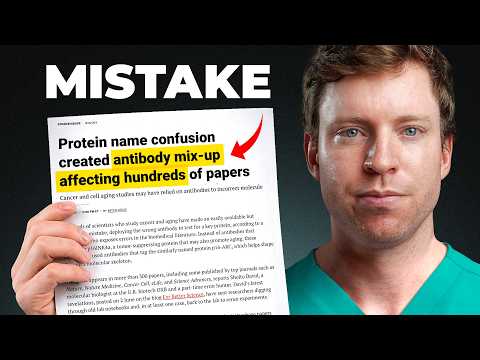
The longevity and anti-aging scientific landscape is currently facing a profound replication crisis rooted in systemic reagent cross-reactivity and nomenclature failures. An independent methodological audit conducted by scientific whistleblower Sholto David revealed that over a decade of peer-reviewed literature investigating cellular senescence relies on fundamentally compromised observational data. Specifically, out of 334 surveyed longevity papers published in elite journals such as Nature, Nature Medicine, and Cancer Cell, 312 inadvertently utilized commercial antibodies that target the wrong protein. Due to automated search indexing optimization in major reagent catalogs, investigators seeking antibodies for the established senescence biomarker p16-INK4a (encoded by the CDKN2A gene) inadvertently purchased and deployed antibodies specific to p16-ARC (encoded by the ARPC5 gene). The latter is an abundant actin-cytoskeleton scaffolding protein with absolutely no mechanistic functional role in cell-cycle arrest, aging, or tumor suppression. Consequently, a massive body of literature asserting the correlation between “zombie” cell accumulation and distinct disease states was mapping structural scaffolding rather than true cellular aging.
While this reagent failure does not invalidate the foundational biology of senescence—which was previously confirmed via antibody-independent transgenic mouse models utilizing promoter-driven genetic suicide loops—it severely undermines the observational framework upon which the commercial senolytic supplement industry was established. Small-molecule translation has completely decoupled from rigorous experimental validation. Preclinical enthusiasm for the plant-derived flavonoid fisetin, sparked by unblinded, single-site rodent evaluations in 2018, has been definitively dismantled by high-fidelity testing. The National Institute on Aging’s Interventions Testing Program (ITP), utilizing a multi-site, blinded framework in genetically diverse mouse cohorts, demonstrated that oral fisetin exerts zero statistically significant benefit on median survival or lifespan extension. Furthermore, direct quantitative PCR transcript analysis confirmed that fisetin fails to downregulate true tissue Cdkn2a mRNA expression. This bench-level failure mirrors recent clinical data: the premier randomized, double-blind, placebo-controlled human trial of oral intermittent fisetin in patients with knee osteoarthritis showed zero therapeutic efficacy. Across all primary endpoints, including patient-reported pain indices, physical performance parameters, and direct MRI-mapped joint cartilage integrity, fisetin failed to outperform a placebo. Commercial supplement marketing has fundamentally outpaced clinical truth.
II. Insight Bullets
- Nomenclature Confounding: Researchers systematically muddled p16-INK4a (the critical cyclin-dependent kinase inhibitor driving senescence) with p16-ARC (an actin-related protein 2/3 complex subunit 5 involved strictly in cytoskeleton architecture), as detailed by David, 2026.
- Catalog Algorithm Failures: Automated indexing in dominant commercial antibody catalogs (e.g., Abcam, Santa Cruz) placed the irrelevant p16-ARC antibody (product code ab51243) as the premier search result for the query term “p16”.
- Widespread Reagent Misordering: Due to a critical lack of basic sequence verification and datasheet validation, hundreds of high-profile laboratories purchased and deployed the incorrect scaffolding reagent for over a decade.
- Scale of Literature Pollution: Out of 334 peer-reviewed longevity and aging papers audited, 312 papers (93.4%) were discovered to have utilized the wrong antibody, invalidating their main observational metrics.
- Peer-Review Blind Spots: Systemic editorial and reviewer oversight permitted this foundational methodological error to propagate unchecked through high-impact journals including Nature, Nature Medicine, and Cancer Cell.
- Cognitive Bias and Data Fitting: The fact that multiple papers using the incorrect antibody successfully reported expected variations in “p16” signaling highlights a widespread tendency for investigators to construct matching narratives around highly flawed data.
- Foundational Resiliency: The underlying biological concept of cellular senescence remains scientifically sound, as the classic replicative ceiling (“Hayflick Limit”) established by Leonard Hayflick in 1961 does not rely on modern antibody affinity assays.
- The Carrel Chicken Heart Hoax: Alexis Carrel’s historic 30-year “immortal” chicken heart culture—which long misled scientists into believing normal cells divide indefinitely—remains an anomalous artifact driven by unrecognized nutrient culture contamination.
- SASP Pathogenicity Validated: Judith Campisi’s characterization of the Senescence-Associated Secretory Phenotype (SASP) remains verified; senescent cells actively secrete a destructive cocktail of pro-inflammatory cytokines that degrade contiguous tissues.
- The “Zombie” Metabolic Profile: True senescent cells do not undergo quiescent apoptosis; they remain highly metabolically active, causing chronic localized tissue irritation and accelerating aging phenotypes.
- Antibody-Independent Validation: Jan Van Deursen’s historic transgenic mouse models (INK-ATTAC) circumvented antibody errors by engineering a promoter-specific genetic suicide loop driven directly by the Cdkn2alocus.
- Definitive Proof-of-Concept: Bypassing antibody staining entirely, genetic ablation models conclusively proved that removing true senescent cells expands healthspan and extends median lifespan in animal models.
- The Senolytic Catalyst: The coinages of the term “senolytics” by James Kirkland in 2015 triggered massive, premature commercial capitalization on unvalidated small-molecule plant flavonoids.
- Fisetin Preclinical Hype: Early single-site rodent data published in 2018 demonstrated outstanding senescent cell clearance, which launched thousands of consumer supplement brands before multi-site validation occurred.
- The ITP Gold Standard: The National Institute on Aging’s Interventions Testing Program (ITP) provides unyielding validation by conducting parallel, blinded longevity experiments across three independent testing sites using genetically diverse UM-HET3 mice.
- Fisetin Lifespan Disproof: Subjected to the strict rigor of the ITP, oral fisetin demonstrated absolutely zero statistically significant lifespan or survival benefit in either male or female mouse cohorts, as reported by Fight Aging, 2023.
- qPCR Mechanistic Deconstruction: Bypassing corrupted antibody assays, the ITP deployed quantitative PCR (qPCR) to track tissue Cdkn2a mRNA directly; the data confirmed oral fisetin failed to reduce senescence markers in the liver, kidney, or brain.
- Deceptive Pilot Studies: Early human single-arm pilot studies for consumer flavonoids only monitored baseline toxicity/safety and lacked control arms, which marketing teams weaponized as proof of functional efficacy.
- Knee Osteoarthritis RCT Deficit: The first rigorous Phase I/II randomized, double-blind, placebo-controlled human trial assessing intermittent oral fisetin dosing in 74 individuals with knee osteoarthritis yielded completely negative results.
- Objective Joint Outcomes Failure: Fisetin failed to demonstrate any clinical or statistical superiority over placebo across patient-reported pain indices, physical performance measures, or structural joint cartilage preservation quantified via objective MRI T2 relaxation mapping, as published by the Orthopaedic Research Society, 2025.
- Pharmacokinetic Bioavailability Barriers: Pure unformulated oral flavonoids like fisetin possess extreme hydrophobic constraints and undergo rapid, aggressive systemic clearance, preventing active parent compounds from sustaining therapeutic thresholds in targeted tissues.
- Primacy of Non-Pharmacological Interventions: Rigorous clinical data indicates that regular physical exercise successfully modulates upstream cellular senescence markers natively, bypassing the translational gaps and safety blind spots that plague current small-molecule supplements.