I always thought it was the plaque reducing the diameter of the arteries which then increases blood pressure. But it is a self-reinforcing negative cycle as each begets the other.
I don’t know what the research says. My own experience has quite volatile blood pressure because when I apply a systemic change to mitochondria the homestatic feedback system in the cardiovascular system needs to adjust and that does not happen instantenously.
Also the vasodilation that occurs with drinking reduces arterial blood pressure quite substantially and this also then causes the homeostatic feedback system to adjust whilst the acetate is systemic and then it has to readjust when the acetate has gone (in around 2 days).
I would think, therefore, it is not the reduction of the diameter that matters so much, but the reduction in elasticity. I do think this will have an effect, but also higher BP can cause further endothelial problems.
I would be interested in reading any papers on this.
1 Like
My N=1 is a decade ago, I had a CAC of almost 500, so it’s sure to be higher now, and I have good blood pressure.
Perhaps this means I have plaque but decent elasticity?
That may be true.
1 Like
Here is a list of the causes of high blood pressure:
Biological Etiology of Hypertension
Essential hypertension (comprising 90–95% of clinical cases) does not have a singular biological cause. It is a polygenic, multifactorial syndrome driven by the dysregulation of interacting neurohormonal, vascular, and renal systems. Secondary hypertension (5–10% of cases) has discrete, identifiable etiologies, such as primary aldosteronism, pheochromocytoma, or renal artery stenosis.
Core Pathophysiological Mechanisms
Current clinical and scientific evidence identifies several primary, interacting biological drivers in essential hypertension:
-
Endothelial Dysfunction and eNOS Uncoupling: The healthy endothelium regulates vascular tone via the production of nitric oxide (NO) by endothelial nitric oxide synthase (eNOS). In hypertension, elevated oxidative stress (reactive oxygen species, ROS) depletes tetrahydrobiopterin (BH4), a crucial eNOS cofactor. This leads to eNOS uncoupling, where the enzyme produces superoxide instead of NO, creating a pro-inflammatory, pro-thrombotic, and vasoconstrictive state.
-
Renin-Angiotensin-Aldosterone System (RAAS) Overactivation: Chronic upregulation of the RAAS pathway leads to excessive Angiotensin II production. Angiotensin II is a potent vasoconstrictor that also stimulates aldosterone secretion (driving renal sodium and water retention) and activates NADPH oxidase, further exacerbating oxidative stress and endothelial dysfunction.
-
Sympathetic Nervous System (SNS) Hyperactivity: A disturbed basal sympathetic tone, originating in the hypothalamus and influenced by cortical signaling, drives elevated resting peripheral resistance and cardiac output.This is often the most consistently observed abnormality in the early development of essential hypertension.
-
Vascular Remodeling and Arterial Stiffness: Chronic mechanical stress and low-grade systemic inflammation lead to structural changes in resistance arteries. This includes vascular smooth muscle cell (VSMC) hypertrophy, extracellular matrix (ECM) alteration (collagen deposition, elastin degradation), and increased vascular stiffness, which creates a positive feedback loop sustaining high blood pressure.
Scholarly Debates and Knowledge Gaps
- The Initiating Event: A major ongoing debate in cardiovascular pathology is whether essential hypertension originates fundamentally as a renal defect in sodium excretion (the Guytonian hypothesis) or as a neurogenic disorder driven by central sympathetic overdrive.
- Data Needed: Full elucidation of the condition requires longitudinal multi-omic data (genomic, metabolomic, and proteomic) to track the exact sequence of molecular events that precede clinical blood pressure elevation in asymptomatic humans. Current animal models fail to fully replicate the complexity of human polygenic essential hypertension.
Longevity Implications and Actionable Pathways
Chronic hypertension accelerates biological aging by inducing vascular cellular senescence, driving mitochondrial dysfunction in VSMCs, and precipitating end-organ damage (renal failure, cognitive decline, cardiac hypertrophy). Intervening in these specific biological pathways is critical for extending human healthspan and lifespan.
Targeted molecular interventions include:
- Restoring eNOS Coupling: Compounds that replete BH4 or enhance NO bioavailability (e.g., L-citrulline, high-nitrate dietary protocols) can theoretically reverse early endothelial dysfunction and lower the trajectory of vascular aging.
- RAAS Inhibition with Pleiotropic Effects: Angiotensin II Receptor Blockers (ARBs), specifically Telmisartan, not only block RAAS but also act as partial agonists of PPAR-γ. This dual action improves insulin sensitivity and reduces vascular inflammation, offering actionable longevity benefits beyond simple hemodynamic control.
- Downregulating Systemic Inflammation and ROS: Interventions targeting upstream oxidative stress—such as specific mitochondrial antioxidants or Nrf2 activators—may prevent the initial oxidative trigger that uncouples eNOS and initiates vascular remodeling.
4 Likes
Thanks @RapAdmin I’m thankful that the longevity interventions I’ve adopted have brought my SBP down from 120-130 to 100-110. Any further reduction is dangerous (risk of passing out) IMHO (and based on personal experience!)
4 Likes
Methotrexate has been a staple treatment for rheumatoid arthritis for decades, valued for its ability to calm an overactive immune system and reduce painful joint inflammation. Now, researchers say it may deliver an unexpected bonus that matters far beyond the joints: lower blood pressure, a change that could translate into meaningful protection against heart attacks and strokes for some patients.
https://scitechdaily.com/common-arthritis-drug-found-to-lower-blood-pressure-and-boost-heart-health/
Yeah, the issue is, if your taking everything, from telmisartan, to glps, to jardiance, to statins, high dose glycine, high dose melatonin (I think I read somewhere that melatonin, my favorite molecule, which actually counteracts certain bp meds, may actually be modulatory which I hope is true), to whatever could possibly lower your bp, and your stack is thick both with prescription and supplements, its hard not to get down to that level…
For me when I wake up I’m there in the 90s/60s (which seems to be my lowest bp reading in a day).
The obvious answer is to cut back the telmisartan, but I have a light CKD 2 disease and its recommended for that, as well as the fact that its highly sedative (for me, telmisartan 80 is highly sedative though I see no one else mentioning this), and it helps me sleep and getting off it would dysregulate that for a bit im sure. As well as the fact that there is more literature for the longevity of high dose telmisartan potentially
Don’t know what to cut off really…
The things I’ve passingly read is hypotension is at issue when you start having side effects like dizziness, and that some healthy athletes function with hypotension, so I’m kind of hoping the lower the better if there are no issues, but thats not a streamlined thought.
1 Like
I think if you are feeling sleepy from the BP meds, it could be due to the low BP caused by those meds. I feel sleepy when my BP gets too low as well. It may not be a good thing.
1 Like
Not sure thats it, as, at least for me, my bp is highest at night before bed (maybe as the telmisartan wears off for the day) when I take the telmisartan and it takes a few/several hours for the telmisartan to start lowering my bp significantly, while the sedating affect is immediate. But, from a cursory look on the internet maybe it isn’t a typical side affect…Maybe my biology?
Finally the profession is catching up on this…
‘How Low Can You Go?’ The Shifting Guidelines for Blood Pressure Control
The number doctors use to demarcate hypertension keeps going down, a trend applauded by many experts, who point to studies linking high blood pressure and dementia.
The Sprint trial found that intensive treatment aimed at bringing the systolic number below 120 reduced the risk of heart attacks, strokes, other cardiovascular illnesses and overall mortality so substantially that the investigators stopped the study early.
It was unethical, they decided, to deny half the trial participants the benefits of intensive treatment. The 2017 guidelines, therefore, recommended medication for those with a systolic blood pressure over 130.
The most recent revisions, issued late last year, encourage still tighter control. They call for patients at cardiovascular risk to strive for systolic readings below 120, and they also call that target “reasonable” even for those who are not at high risk. Readings considered normal not so long ago are now defined as hypertension.
…
To Dr. Supiano, recent studies in the United States and in Chinathat show cognitive benefit for the lower readings “have tipped the scales” for older adults. “What’s good for the heart is good for the brain,” he said, calling those findings “a lever to get people to pay more attention to their blood pressure. They may not want to live longer, but they want to hold on to their cognition longer.”
Read the full story: "How Low Can You Go?’ The Shifting Guidelines for Blood Pressure Control (NYT)
5 Likes
That would only be locally (i.e. around the site of arterial plaque where the blood is suddenly forced to squeeze through a narrower space). It’s definitely a factor for health, but it doesn’t explain somebody getting a 145/100 on a standard BP measure of the brachial artery.
A better explanation is systemic vascular resistance. If you think about all the vessels in your body after the heart, they get smaller and smaller and the surface area gets larger and larger before they all re-collect back into veins and go back to the heart. If you have a lot of resistance in the circuit, the heart has to work a lot harder.
I was at a cardiovascular conference recently and they are VERY focused now on blood pressure. I think the issue of atherogenic lipoproteins is more or less “solved” now (if people will just get tested and take the medication). We have a ton of tools available. So I learned that hypertension is now the NUMBER ONE driver of poor health, and from talking to a bunch of the physician scientists, they all seem to say lower is better as long as you don’t pass out.
Shockingly, blood pressure also increases inflammation. I thought “what the hell”, but it’s true, and there’s enough good-quality research on it there’s enough to write a nature reviews cardiology paper about it: Immune and inflammatory mechanisms in hypertension - PubMed
There’s even Mendelian randomisation showing links between BP and lymphocyte numbers: White Blood Cells and Blood Pressure: A Mendelian Randomization Study - PubMed
So yeah, personally I’m targeting a resting BP of ~105/70 or thereabouts. (In context, I’m 39, fairly active etc).
6 Likes
This makes a lot of sense. Lipoproteins can be brought down easily with interventions like drugs even in old people. Blood pressure on the other hand differs in that, while it can be reduced drastically with drugs, it is also influenced by vascular stiffness, which is something that cannot be fixed with drugs and is important for aging.
2 Likes
I believe that lowering your BP to optimal levels isn’t a huge issue. Through my med and supplement stack I have successfully reduced my BP to low levels (sometimes too low) without taking a med specifically treating BP.
1 Like
That’s true. Weight loss also works very well at reducing it, even in people that aren’t overweight.
2 Likes
I’m not a cardiologist, but I believe it’s not that simple. I think for mild hypertension or optimising your 125/85 down to 110/70 it’s probably no big deal. But there are a lot of people out there walking around with stubborn 150/100 despite being on cocktails of drugs. You’ve got the cardiac output side and the vascular resistance side, which include influences of the renin-angiotensin system, sodium intake, sympathetic nervous system activity (stress, fight/flight etc), arterial stiffness, vasoconstriction/dilation etc. And people can have different “types” of hypertension - maybe sensitive to sodium, or stress levels, or due to arterial stiffness, or due to kidney issues etc.
There’s even a term called “resistant hypertension” which is where people are still >130/80 despite being on 3 therapies. Lipoproteins are a biochemical problem mostly, whereas hypertension includes a bunch of physical things, hormones, nervous system input etc.
Good job I’m not a cardiologist having to worry about this stuff hehe.
5 Likes
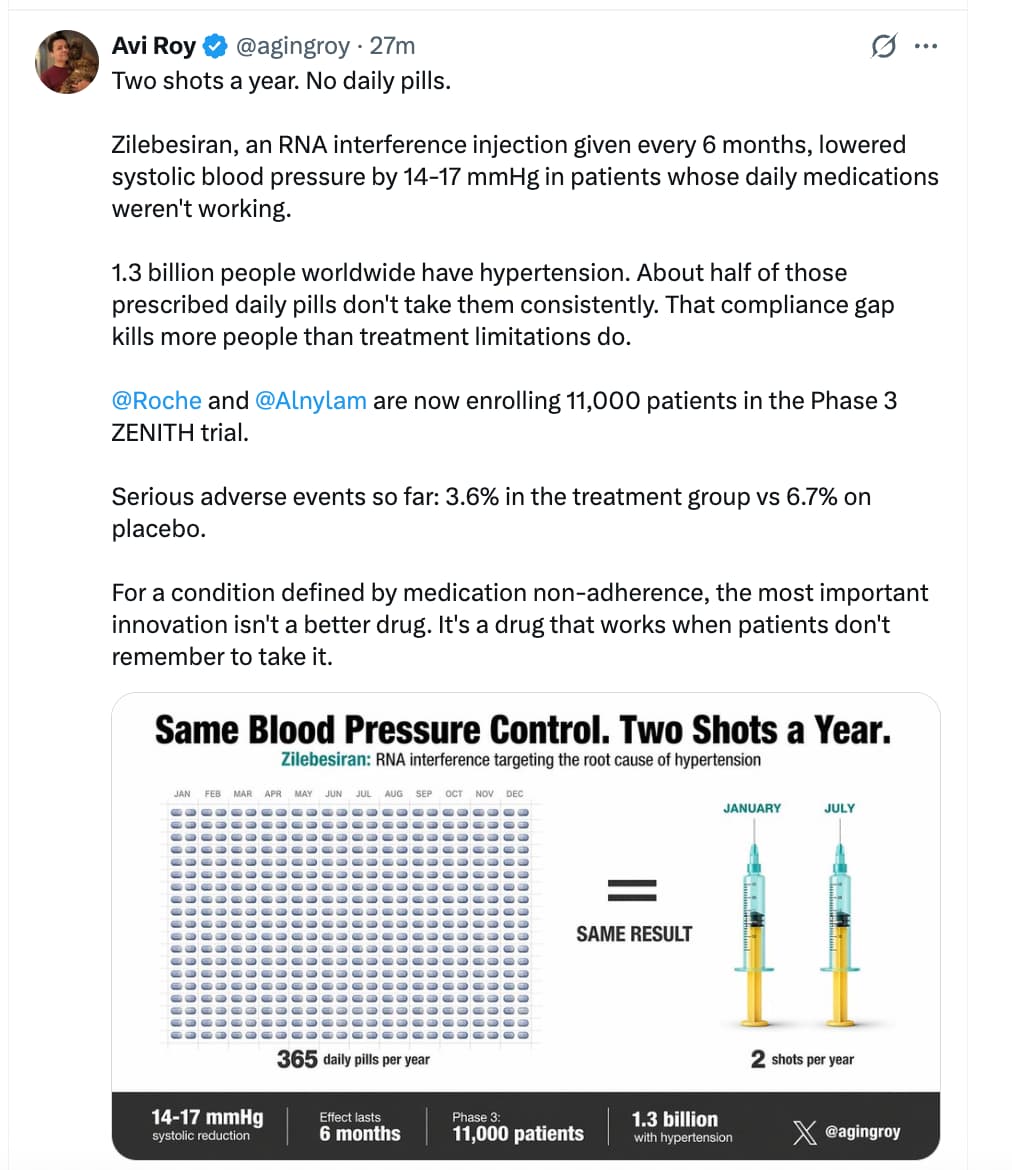
This sounds great but I might worry if a shot like that would lower my blood pressure too much and then I’m screwed because the half-life is so long
2 Likes
To add to this, I’ve been trying to get off telmisartan, extremely slowly, but it heavily affects my sleep.
Since I’ve been on reta and lost weight, I’ve been bordering on hypotension. I can get 90/60 readings in the day, so who knows what it can tail to at night… every time I’ve measured its been around that reading though…
It’s a combo of everything - lowering my bp. Reta/statins-ezetemibe/jardiance/telmisartan 80 and the rest of my lengthy stack.
telmisartan is the one thing I’ve been trying to kick to balance this, but its affecting my sleep even attempting to dose down - this has been a heavy sedative for me.
On top of that, is there proof we should care about hypotension if the symptoms aren’t there? Telmisartan is another healthy substance. I guess Bryan Johnson reports 87/49 readings at times during the day
So a person’s BP is impacted by MANY factors …
- vascular resistance side, which include influences of the renin-angiotensin system, - sodium intake,
- sympathetic nervous system activity (stress, fight/flight etc),
- arterial stiffness,
- vasoconstriction/dilation etc.
And stress indeed!!
1 Like