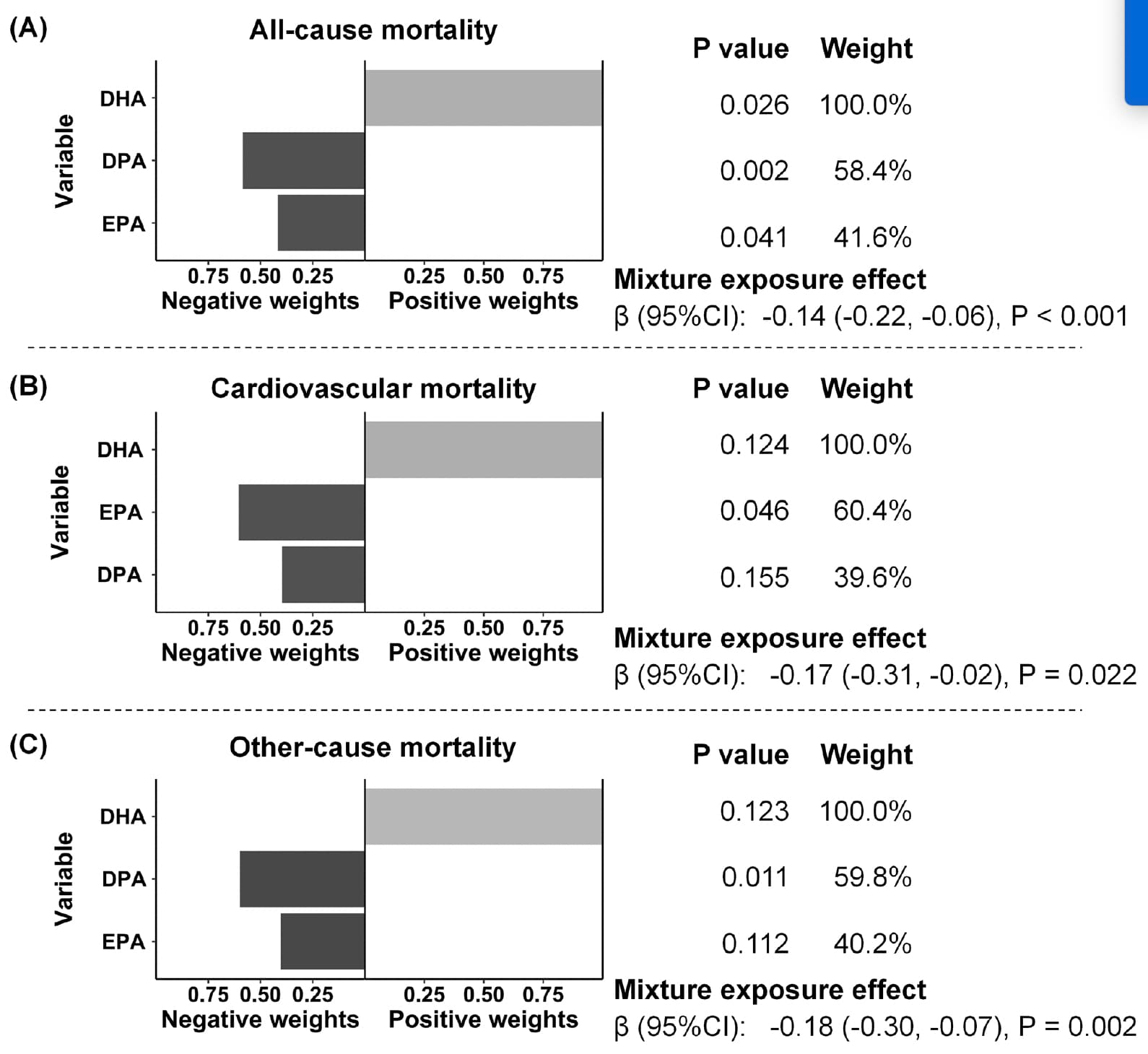
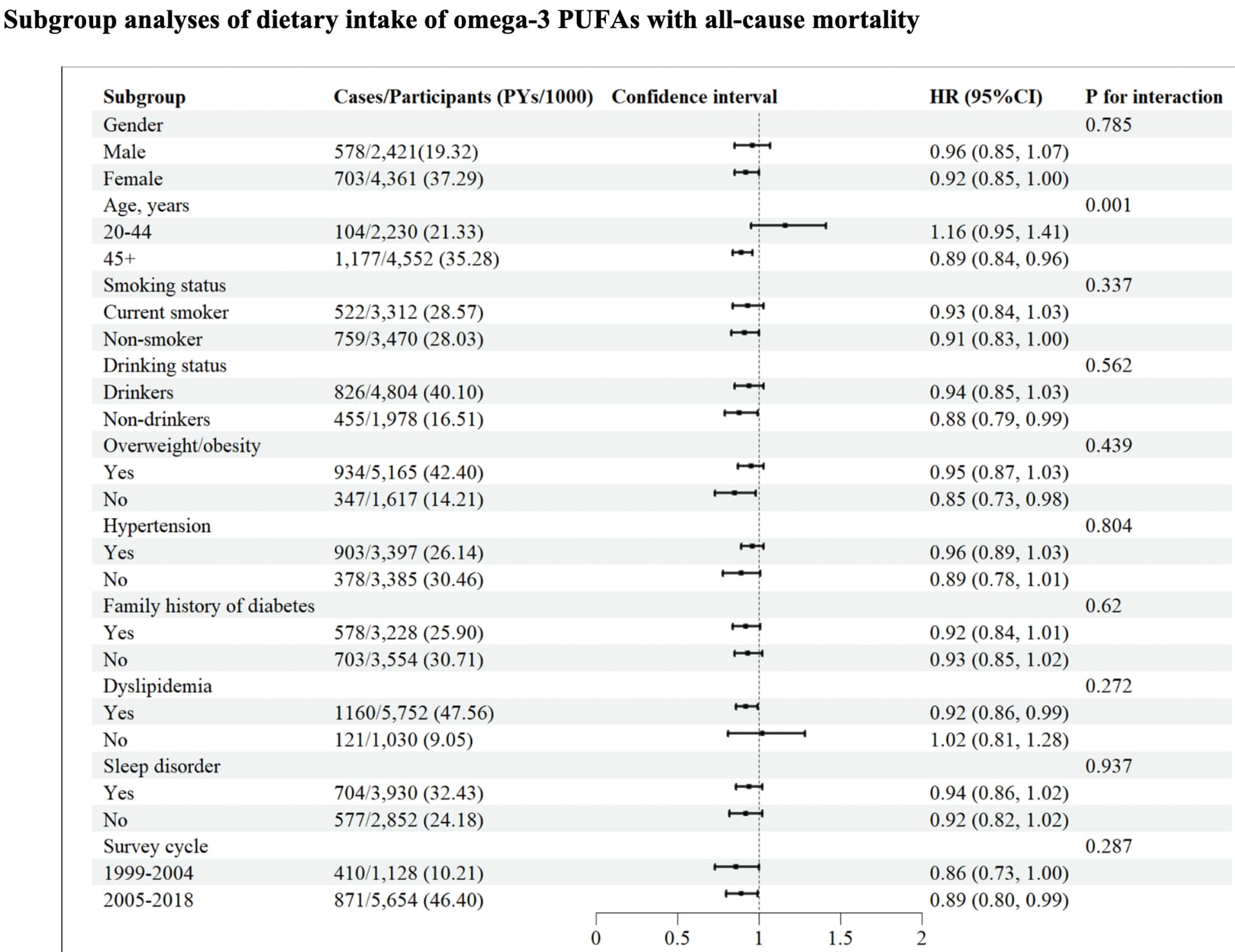
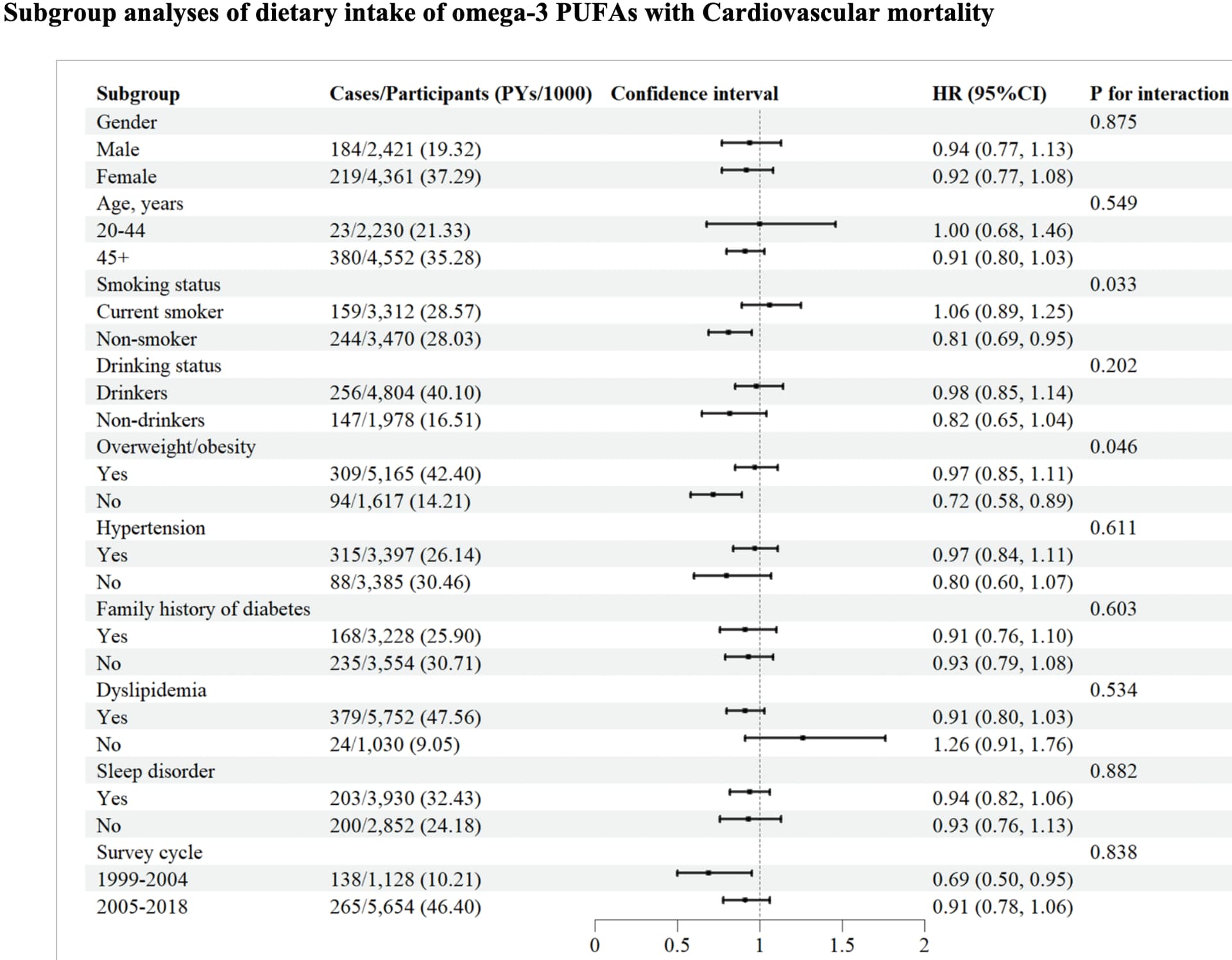
This NHANES analysis has shown that DHA is associated with depression in American adults (OR = 0.996, 95% CI 0.993–0.999, P = 0.014). Bidirectional MR analysis demonstrated a significant causal relationship between DHA and depression in the European population (OR = 0.9, 95% CI 0.84–0.97, P = 0.006).
They say that “Three multivariate regression models were constructed: crude, unadjusted; model 1, adjusted for age, gender, and race/ethnicity; model 2, adjusted for age, gender, race/ethnicity, education, RIP, BMI, smoking, and alcohol consumption.” So obviously we want the results of model 2, but in the abstract, they only give the result of model 1 (“OR = 0.996”), whereas in the text they note “It is important to note, though, that the association between the two was not statistically significant in Model 2, but the trend remained. For this result, similar to the study by Wang et al. [22], they also observed that the association between plasma DHA and depression did not persist after controlling for all potential confounding factors.” The model 2 found OR = 0.998, 95% CI 0.995–1.001, P= 0.11) That’s not professional. It makes me doubt the rest of the paper…
They don’t cite the VITAL-DEP trial that showed increased depression with EPA + DHA but cite other small trials that align with their conclusion that DPA is protective: shows a lack of intellectual honesty
Adding to the discussion. A few years ago I discovered that my supplement EPA (500) + DHA (250) made my heart ache, then I read that indeed EPA can cause Afib so I switch to DHA (500)+ EPA (250) and the pain stopped.
I have been taking this DHA supplement for years and forgot about all my initial concerns. A couple weeks ago the bottle run out and I took again the EPA one and my heart start aching again.
I’m writing this post because a part of the heart pain coming back I am happier, more motivated, hornier and I feel like I have been living in a fog for years. Is either the less DHA or the extra EPA.
I’ve been suffering from some pretty annoying dry and sticky eye (meibioum gland dysfunction), with no obvious trigger. But funnily enough, my opthamoligst recommended taking fish oil supplements. And then it occurred to me - I had stopped taking them for a while, partly based on this thread.
I’m now using some steroid drops, artificial tears, warm compress eye masks etc, which are improving things, and I’m also restarting fish oil. I got two products:
Nordic Naturals ProOmega 2,000: I take only 1; thus 560 EPA + 435 DHA
Nordic Naturals ProDHA Spectrum: I take only 1; thus 360 EPA + 845 DHA, plus “FloraGLO” Lutein and Zeaxanthin
The latter obviously including some extra goodies to hopefully assist with eye function.
I’ve never noticed any change in mental state from starting, stopping, or changing dose of fish oil
Metoprolol is the magic pill for afib for me. You can buy from India. Seems dumb to cause a problem with a pill, then take another pill to fix it. But it is done and don’t argue with what works.
In a double-blind, randomized, placebo-controlled trial conducted at 26 sites in Canada and Australia, we assigned adult patients receiving maintenance hemodialysis to daily supplementation with fish oil (4 g of n-3 polyunsaturated fatty acids [1.6 g of EPA and 0.8 g of DHA]) or corn-oil placebo.
That’s a pretty hefty dose
1228 participants underwent randomization; 610 were assigned to the fish-oil group and 618 to the placebo group.
Decent sized study IMO
During 3.5 years of follow-up, the rate of serious cardiovascular events was significantly lower in the fish-oil group than in the placebo group (0.31 vs. 0.61 per 1000 patient-days; hazard ratio, 0.57; 95% confidence interval [CI], 0.47 to 0.70; P<0.001).
Massive reduction!
The hazard ratio for cardiac death was 0.55 (95% CI, 0.40 to 0.75); for fatal and nonfatal myocardial infarction, 0.56 (95% CI, 0.40 to 0.80); for peripheral vascular disease leading to amputation, 0.57 (95% CI, 0.38 to 0.86); for fatal and nonfatal stroke, 0.37 (95% CI, 0.18 to 0.76); and for a first cardiovascular event or death from any cause, 0.73 (95% CI, 0.61 to 0.87).
All looks very encouraging.
The patients obviously being rather sick, on hemodialysis, is a major factor. But this still looks like a very strong signal for fish oil being cardioprotective.
I asked a colleague of mine (nephrologist) what he thought, and he remarked that it almost looks too good to be true. The cardiovascular event curves start to separate pretty much immediately after the randomisation. Makes you wonder whether the effect is by anticoagulation, because something like modulating atherosclerosis would presumably take a much longer time to occur.
For the corn oil question, presumably we have data on MACE in this sort of patient, since it’s a known clinical problem, and it would be relatively easy to compare the expected MACE vs the corn oil group.
Saudi RCT, 64 people, 500 mg EPA + 250 mg DHA, three months: “Significant improvements were observed in the intervention group regarding stress, anxiety, depression, sleep quality, and memory outcomes (p < 0.001 for PSS, GAD-7, PHQ-9, PSQI, and EMQ)”
I’m not sure that we can trust the above when we have VITAL-DEP that found increased risk of depression: US RCT, 18,353 people, 465 mg EPA + 375 mg DHA, “median treatment duration was 5.3 years”.
Unless 50% DHA and DHA <= 250 mg is good (Saudi) but EPA/DHA <= 2 OR DHA > 250 mg (VITAL-DEP) is bad. Would be amazing to have a trial of EPA only vs DHA only vs EPA+DHA 1:1…
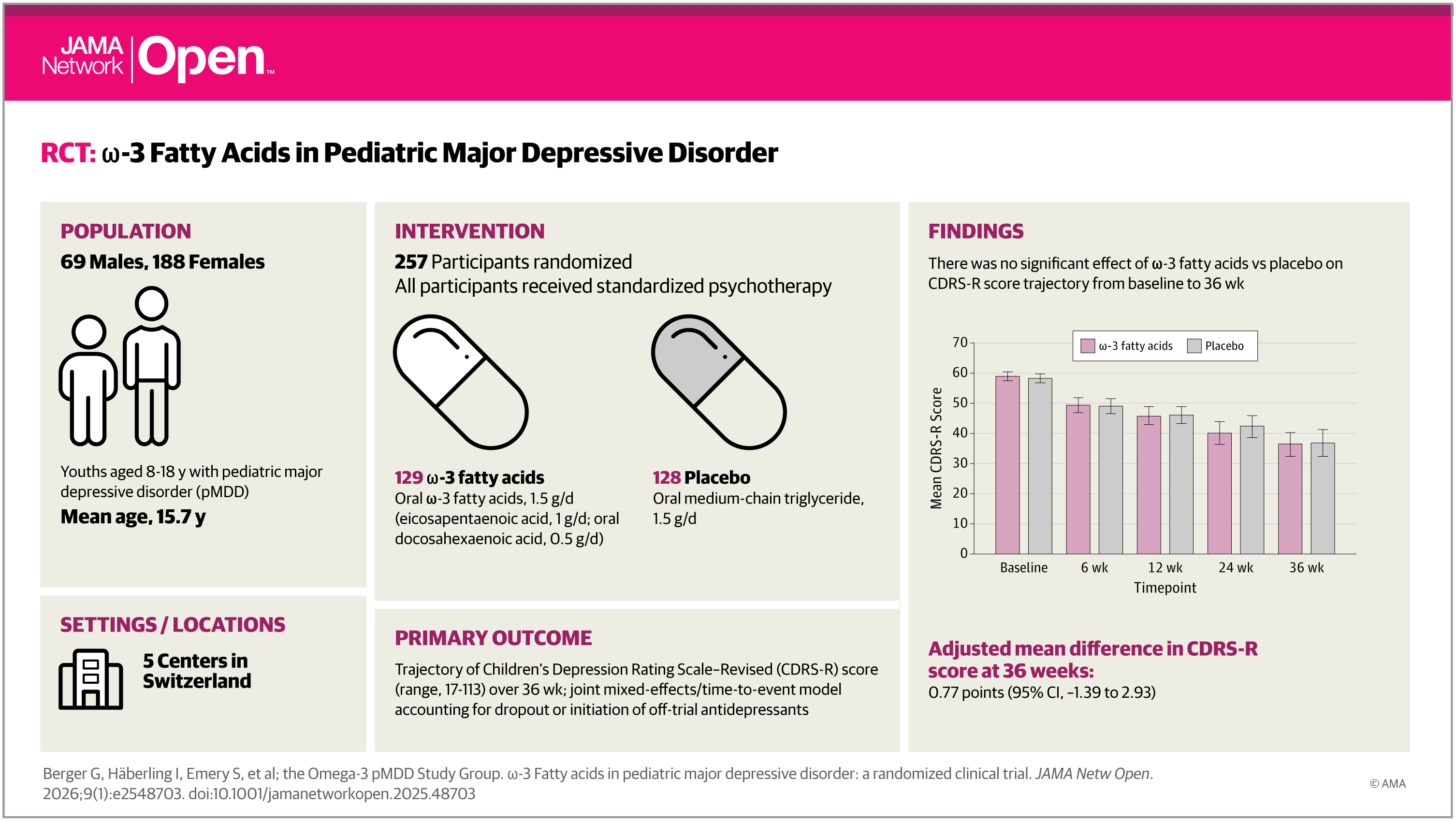
remission occurred at 36 weeks in 30 of 94 ω-3 recipients (31.9%) vs 37 of 90 (41.1%) placebo recipients (all differences were nonsignificant)
EPA plus DHA levels expressed by the ω-3 index rose by a mean (SD) of 4.33% (1.54%) and 4.88% (2.38%) at 12 and 36 weeks, respectively, in the ω-3 arm, confirming adherence.
Our analysis showed no evidence that the ω-3 index moderated treatment efficacy for pediatric MDD.
In this RCT that included help-seeking children and adolescents with moderate-to-severe MDD receiving professional multimodal treatment, we found no evidence that ω-3 supplementation provided benefit compared with placebo. Furthermore, ω-3 supplementation neither reduced antidepressant use nor conferred protection against suicidality.
So at least here in a pediatric setting, omega 3 supplementation doesn’t cause depression (although remission rate was higher in the placebo group… but not statistically significant) like in VITAL-DEP despite 500 mg DHA but with 2x EPA.
Right - pediatric setting. The physiology of a still developing body is different enough, that I usually don’t relate it to my own health. As a matter of fact, at 67, I am soon in another physiological state, where a ton of stuff that is relevant to 25-55 year olds stops being relevant to me (including drug and supplement dosing and effect). But of course it’s interesting to those who have kids. I remember when I was 8-12 years old and would visit my maternal grandfather at his place in the countryside, he would always be telling me to eat fish (which was frequently served by my grandmother especially for me and my brother) “because it is good for the brain”. That was back in the 60’s. When thinking back I’m rather surprised, because I thought the idea that eating fish is good for the developing brain was a much later phenomenon, but apparently not (or my grandfather thought it up by himself, I don’t know).
My grandma told me that her parents were already telling her that about cod liver oil. Gemini tells me that the belief that fish is good for brain health started in the mid 1800s based on a scientific error.