AI Summary
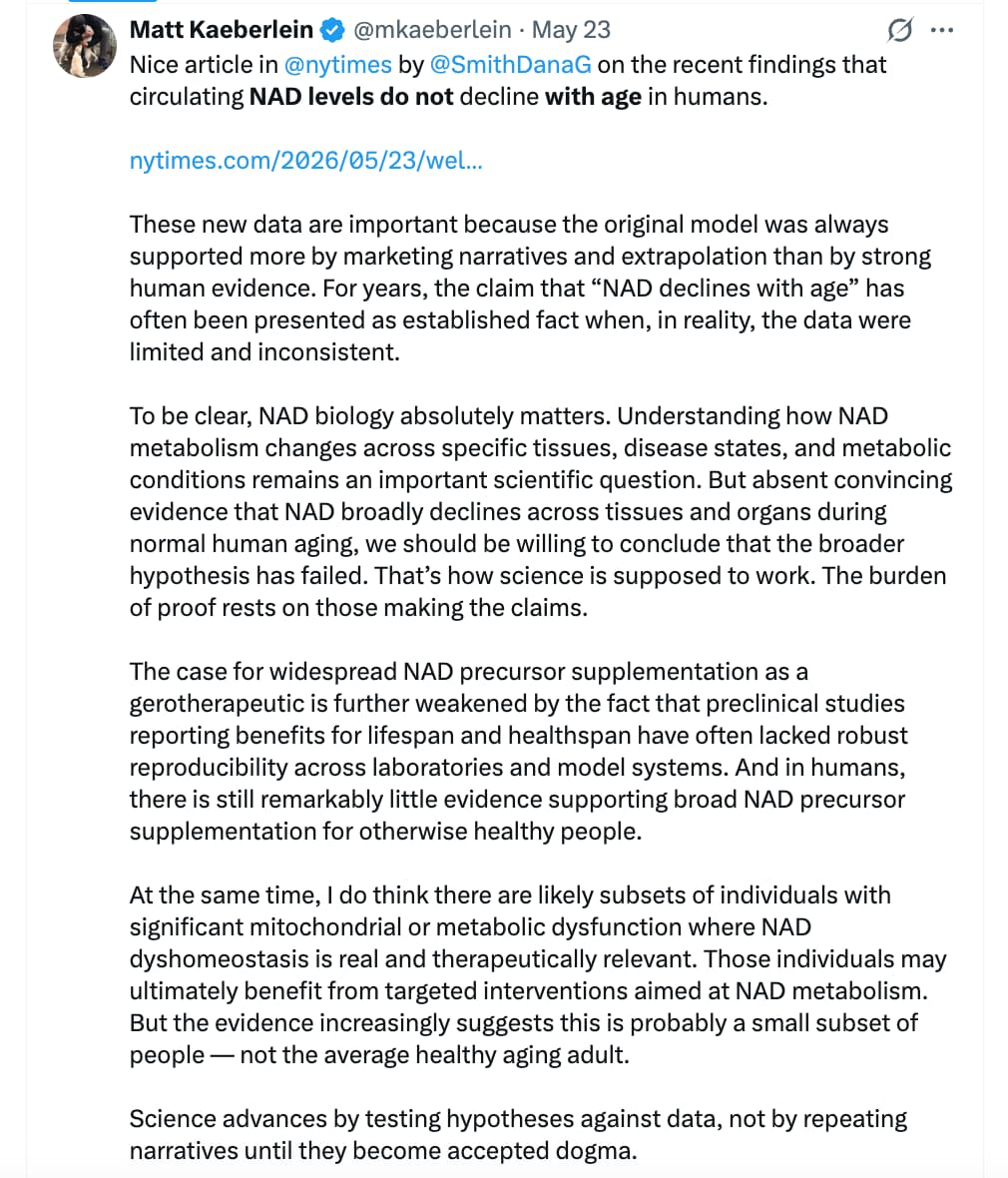
For over a decade, the longevity sector has operated under a foundational paradigm: systemic nicotinamide adenine dinucleotide (NAD+) levels relentlessly decline with chronological age, necessitating aggressive supplementation with precursors like nicotinamide riboside (NR) or nicotinamide mononucleotide (NMN). This landmark study systematically dismantles that baseline assumption in humans. By engineering a highly precise ultra-high-performance liquid chromatography coupled with high-resolution mass spectrometry (UHPLC-HRMS) assay, the investigators proved that human whole-blood NAD+ concentrations remain remarkably stable across the lifespan and are entirely unaffected by healthy lifestyle alterations, including elite endurance training or intensive exercise regimens in frail cohorts.
The paper exposes a methodological blind spot in prior human longevity research. NAD+ undergoes rapid degradation when whole blood is frozen or thawed without immediate metabolic quenching. The historic “age-related declines” recorded in literature were largely artifacts of pre-analytical sample handling errors rather than true biological phenomena. When blood cells freeze, they rupture and unleash active degradation enzymes; unless a chemical quenching agent like methanol is applied immediately at the time of collection, the NAD+ pool rapidly vanishes.
While the study establishes that oral NR supplementation does successfully force a robust elevation in blood NAD+ levels, it alters how we view the biomarker itself. Whole-blood NAD+ is not a biological clock, nor is it a proxy for metabolic fitness or everyday physical degradation. It is a tightly regulated intracellular homeostatic pool.
Study Design Specifications
-
Type: Human Clinical Cohort Study and Randomized Controlled Trial Interventions (Cross-sectional and Longitudinal).
-
Subjects: Over 300 human human subjects distributed across 7 distinct, independent validation cohorts:
-
Cross-Sectional Aging Cohort: Young adults (<30 years) vs. Older adults (>60 years).
-
CardioHT Cohort: Age-stratified adults (28–73 years) at elevated cardiovascular risk.
-
ELITE Cohort: Elite master athletes vs. age/sex-matched sedentary controls.
-
Leiden Longevity Study (LLS): Long-lived familial cohorts aged 63–87 years.
-
TEAMS Trial: Frail older adults randomized to a 3-month exercise regimen $\pm$ protein-rich diet.
-
MEJNES2019 Trial: Frail older adults subjected to a 6-month multimodal lifestyle/nutritional intervention.
-
Twin-Pair NR Supplementation Cohort: Monozygotic twins undergoing a 5-month randomized, double-blind oral NR escalation protocol ($1000 mg/day) serving as a positive control.
Mechanistic Deep Dive
The study addresses NAD+ homeostasis primarily through the lens of cellular compartmentation and pre-analytical biochemistry. The human whole-blood NAD+ pool is fundamentally an intracellular phenomenon sequestered inside erythrocytes and leukocytes; cell-free plasma features NAD+ concentrations 50 to 100 times lower, dropping below reliable quantification limits.
[Fresh Whole Blood] ───> (Freezing Without Quenching) ───> Erythrocyte Lysis ───> Enzyme Activation ───> Rapid NAD+ Degradation (Artifact)

[Fresh Whole Blood] ───> (+ Methanol/Acid Quenching)   ───> Enzyme Denaturation ───> Intact Intracellular NAD+ Core (Stable with Age)
From a longevity pathway perspective, the stability of whole-blood NAD+ across decades suggests that the enzymatic equilibrium driven by the salvage pathway—namely Nicotinamide Phosphoribosyltransferase (NAMPT)—and standard degradation by sirtuins (SIRT1/2), PARPs, and CD38 maintains an exceptionally rigid set-point in hematopoietic tissues [Confidence: High]. This implies that systemic vascular aging, mitochondrial dynamics in circulating blood cells, and baseline immune-cell activation (cGAS-STING pathways) do not exhaust the total systemic blood pool as heavily as rodent tissues imply.
Crucially, the paper highlights that organ-specific aging priorities remain decoupled from whole-blood metrics. While the hematopoietic compartment preserves its NAD+ baseline, this does not disprove local, age-driven tissue depletion within fixed post-mitotic organs such as skeletal muscle, the myocardium, or brain parenchyma, where CD38 expression upregulation or local inflammation may exhaust NAD+ pools locally without modifying the highly buffered circulating blood volume.
Novelty
Prior to this paper, the dogma dictated that human blood NAD+ steadily depreciated over chronological time. This paper alters our understanding by demonstrating that:
- Chronological age does not dictate baseline whole-blood NAD+ concentrations in humans [Confidence: Elite].
- Standard lifestyle modifications (elite physical training, protein diets, multimodal frailty protocols) fail to shift the whole-blood NAD+ set-point [Confidence: High].
- Methodological handling choices (unquenched freezing) create a false mirage of age-driven degradation. Immediate methanol denaturation or acidic extraction is mandatory to stop artifactual ex vivo degradation.
Critical Limitations
-
Translational Compartmentation Gap: The biggest limitation is that the matrix evaluated is exclusively whole blood. Erythrocytes lack mitochondria; their NAD+ metabolism is heavily restricted to glycolysis and salvage pathways. Consequently, whole-blood stability cannot be generalized to metabolic tissues like liver, deep visceral fat, or skeletal muscle.
-
Absence of Plasma Flux Dynamics: Because cell-free plasma levels sat below the assay’s limit of quantification, the study could not determine whether extracellular NAD+ or its breakdown products (nicotinamide, NMN) exhibit age-associated fluctuations.
-
Static Phenotyping vs. Kinetic Flux: The study evaluates static pools of NAD+. It provides zero information regarding NAD+ consumption/synthesis kinetics (flux). It remains entirely plausible that an older individual maintains identical static blood concentrations to a younger counterpart but undergoes a far higher or lower rate of turnover to preserve that equilibrium.
Claims Verification & Evidence Hierarchy
Claim 1: Human whole-blood NAD+ levels do not significantly decrease with age.
-
External Verification: Evaluated against external population cohorts like the Jidong community study . This larger human observational study ($n=1,518$) showed that while minor downward trends appeared in males during mid-life, the drop largely flattened after age 50, and females showed absolutely zero statistical variance across age brackets.
-
Hierarchy of Evidence: Level C (Validated across multiple distinct, independent multi-national human cohorts within this paper and corroborated by independent external epidemiological data).
-
Translational Uncertainty: None for blood; high translational gap if generalized to parenchymal organs.
Claim 2: Intensive lifestyle or exercise interventions fail to alter whole-blood NAD+ levels.
-
External Verification: Controlled clinical trials tracking metabolic adaptions to exercise confirm that local tissue changes (e.g., muscle NAMPT upregulation) occur independently of baseline circulating blood concentrations.
-
Hierarchy of Evidence: Level B (Directly verified via longitudinal randomized controlled trials within this paper: TEAMS trial and MEJNES2019 trial cohorts).
-
Translational Uncertainty: Confirmed human outcome data.
Claim 3: Unquenched freezing of whole blood samples causes acute artifactual ex vivo NAD+ loss.
-
External Verification: Long-established analytical biochemistry literature confirms that nucleotides are highly labile. Ruptured red cell membranes expose intracellular nucleotides to active nucleosidases and glycohydrolases unless immediately denatured by organic solvents or strong acids.
-
Hierarchy of Evidence: Level A (Definitively proven via multiple technical replication experiments, internal validation steps, and analytical mass-spectrometry controls).
-
Translational Uncertainty: None. This is a hard chemical/enzymatic law.
Claim 4: Oral Nicotinamide Riboside (NR) supplementation significantly increases human whole-blood NAD+ pools.
-
External Verification: Strongly supported by multiple human RCTs and meta-analyses exploring NAD+ precursors .
-
Hierarchy of Evidence: Level B (Verified through the paper’s internal twin-pair NR longitudinal escalation trial and extensively replicated in external clinical trials).
-
Translational Uncertainty: None. Target engagement via oral delivery is human-validated.
FAQ
1. If human whole-blood NAD+ levels do not decline with age, why do mouse tissues show an unambiguous, steep age-related drop?
-
Answer: Mice possess fundamentally different metabolic rates, cell turn-over kinetics, and enzyme expression profiles. Crucially, mouse studies typically evaluate harvested solid organs (liver, skeletal muscle, brain tissue) where local inflammation and CD38 expression skyrocket with age. Human whole-blood consists mostly of erythrocytes, which lack nuclei and mitochondria and operate under entirely different, highly isolated homeostatic constraints.
2. Can we definitively conclude from the data that skeletal muscle and liver NAD+ levels do not drop in aging humans?
-
Answer: Absolutely not. This study’s boundaries stop at the vascular wall. Whole blood is a transport and immunological matrix. Deep organ tissue biopsies are required to ascertain if human solid-tissue parenchyma exhibits local age-dependent NAD+ depletion. This remains an unresolved unknown in this specific paper.
3. If an athlete or healthy person takes oral NR and doubles their blood NAD+ levels, does that extra NAD+ actually perform any useful biological work inside the red blood cells?
-
Answer: It is unclear. Because mature red blood cells rely purely on anaerobic glycolysis for energy production, over-saturating their baseline NAD+ pool might provide zero functional or performance-enhancing benefit. The extra NAD+ might simply sit in the intracellular pool until the cell is recycled by the spleen.
4. Does the study suggest that previous clinical trials showing health benefits from NR or NMN are invalid?
-
Answer: No. It simply changes the mechanism of explanation. Benefits observed in trials (such as enhanced insulin sensitivity or reduced vascular stiffness) are likely driven by localized tissue transformations, altered extracellular signaling molecules, or shifts in secondary metabolites, rather than the correction of a systemic, blood-wide shortage.
5. How exactly does unquenched freezing destroy NAD+, and why didn’t previous high-level labs notice this?
-
Answer: Freezing without an organic solvent or acid allows cells to slowly lyse. Upon thawing, internal cellular enzymes like CD38 and NAD+ glycohydrolases mix instantly with their substrates before the sample can be analyzed. Previous labs often utilized commercial colorimetric or enzymatic cycling kits on stored biobank samples, unknowingly measuring degraded remnants rather than living baselines.
6. Is there an upper limit to how much oral NR the human body can absorb before it creates toxic clearance byproducts?
-
Answer: Clinical trials tracking dose escalations up to $2000mg/day show that while the compound remains safe and well-tolerated, the vast majority of the excess molecule is heavily methylated by the liver and rapidly excreted in urine as MeNAM. The liver acts as an effective, high-capacity clearance filter to prevent systemic toxicity.
7. Could an alternative hypothesis explain the data—for instance, that older people have higher numbers of specific blood cells that artificially mask an actual per-cell NAD+ decline?
-
Answer: Yes. Changes in the complete blood count (such as shifts in the myeloid-to-lymphoid ratio or variations in hematocrit) occur routinely during aging and systemic inflammation. Because the paper evaluates bulk whole-blood volumes, a structural shift toward cell types that happen to hold higher baseline NAD+ concentrations could theoretically mask a simultaneous decline occurring in another cell subset. Future studies must deploy single-cell sorting to completely rule out this confounding factor.