There are a few diverging representations of the facts in this discussion.
I’m saying physical activity – especially types that increase VO2max, musculature, bone health, balance, agility, and more extend both health and life span. One common tendency I am objecting to is the reification of lifespan as if it were something more than a hypothetical construct (see above). I object not as an intellectual exercise but because it adds little value to posit an invisible function that sets out how long we will live – a lifespan clock if you will. While we may eventually discover such a master regulatory mechanism of this type, if we stick to science, we must acknowledge that we have found nothing resembling it. Moreover, what we have learned through scientific investigation points strongly in the other direction, namely: we all die of something and that something was the terminus bookend of our lifespan. From this it follows that any intervention that forestalls one or more thangs that kill us is therefore life extending. Moreover, beyond the broad notion of physical activity, we see the accumulation of considerable evidence suggesting that structured activities, such as those that that build VO2max, bone health, musculature, balance, circulation, and which optimize metrics such as BP, lipids, BG, HRV and RHR may delay and may in some cases eliminate some of the diseases and life events that kill us.
[None of this is takes a position on maximum aggregate human lifespan which, so far, the evidence suggests no intervention has moved, certainly not physical activity or rapamycin for that matter.]
I’m sympathetic to your underlying intuition but not the research inferences. At this extreme tail of the distribution the causal weighting shifts hard from behavior to genotype, and exercise probably does very little to determine who among the already-genetically-elite reaches 110 versus 105. Barzilai’s Longevity Genes Project is the last cohort one would cite to show exercise doesn’t matter. Why? Because its entire founding rationale is that these people reached extreme age despite pedestrian (even harmful) health behaviors. In addition, as any researcher should know, measurement of this type is close to worthless at that age. Supercentenarian and centenarian activity data are almost entirely retrospective self-report, frequently proxy-report (children or caregivers recalling the subject’s habits from decades earlier), often collected at an age with high rates of cognitive impairment, and referring to a lifetime of exposure compressed into a single recalled characterization. More importantly, this position mistakes a survival filter for a null effect. If exercise lowers ACM across the middle of the distribution, its effect is to move people into old age who would otherwise have died in their 60s, 70s, or 80s (cardiovascular death, T2D complications, the whole mid-distribution hazard load) – where the bodies are (sorry :)). By the time you’re looking at 100+, everyone present has already cleared those hazards by whatever means.
Enough of the weeds, I say. We are all pioneers of a sort in this group, making the best decisions we can to balance risk and reward, calibrating our N=1 “experiments” to emerging research, sharing our successes and failures, and hopefully having a great time in the experimenting.
A 32 minute session of squats with a 45 lb weight vest is simply mind boggling (I did a search through some of your posts and couldn’t locate the description, but did see a ton of great posts you’ve made). It does sound like the total volume of exercise time you do is “up there” so to speak at 264 minutes per week between the running/squatting. It’s really great for someone who doesn’t like exercise. The odds of you taking a hit longevity wise is minimal at most and might possibly be non-existent…
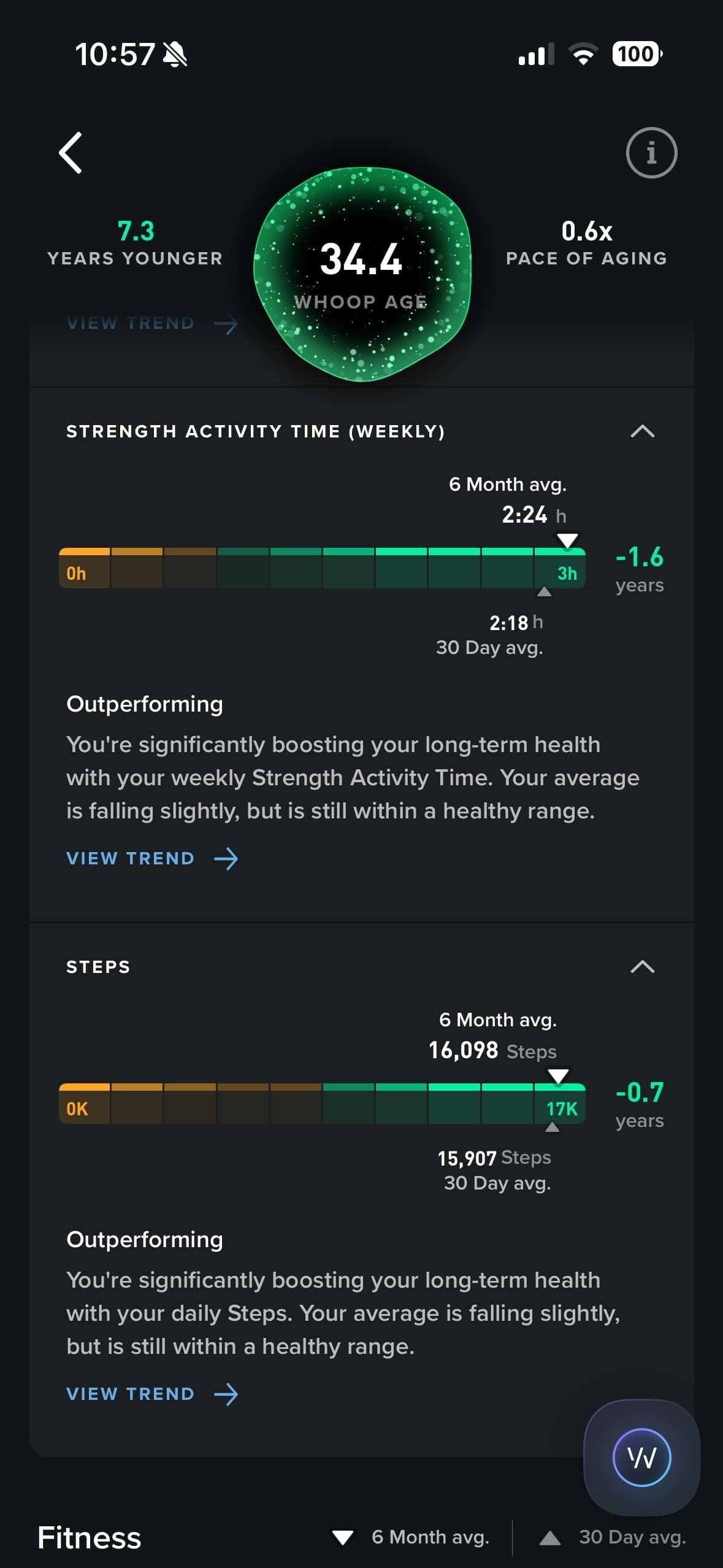
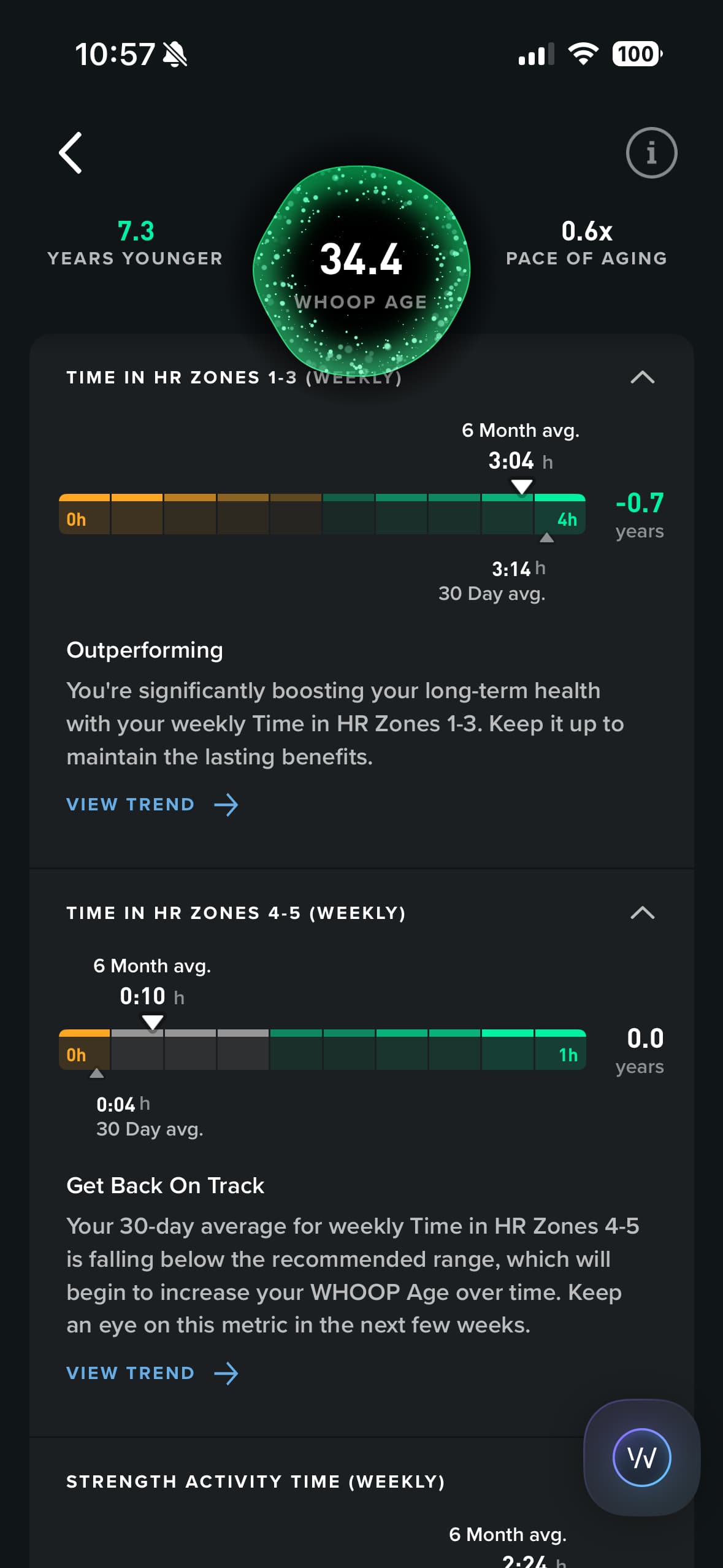
I happen to be at the other end of the spectrum in that I love exercise and almost wish I was a high-level Ironman triathlete or marathoner but this isn’t in the cards for me for a few reasons (though there was a time when I did A LOT of endurance training). At any rate, I double checked my Whoop and I do move a great deal with my stats as follows:
~3 hours per week of zone 2 cardio (swim, bike, run, elliptical, assault bike, stairmaster, rowing machine, cross country skiing, etc… basically something different every session to train different motor patterns)
~5-10 minutes per week of max effort work (heart rate 160+ BPM)
~2 hours per week of “strength training”
~16 000 steps per day
I am hopeful that this exercise will help me maintain the QOL that so many people here speak of. I have a few things going my way longevity wise and one super major risk factor going against me.
The geroscience hypothesis is, as precisely as I understand and can concisely phrase it, that old animals’ lifespan is limited by a handful of phenomena (“aging”), and that resolving diseases downstream of aging has very limited expected benefit, since it would simply shift the proximate cause of death to one of the other age-related diseases. You seem to be articulating the opposite view here. What evidence sways you in that direction?
I like your clean expression of the gero hypothesis @Lost. I have found myself wondering about its merit on many occasions. I still do. Let me unpack your question and restate points I have made elsewhere but perhaps less clearly that I should have.
First, you framed this as though I owe evidence against the geroscience hypothesis, but the hypothesis as you’ve stated it – that resolving downstream disease has limited benefit because mortality would simply shift to the next age-related cause – is a non-falsifiable as-stated research program’s organizing conjecture, not an established result to which one can offer counterevidence. Its central prediction is counterfactual (what death “would” do), which moves it out of the realm of near term falsification and makes it something one would or would not decline to assume.
That could be a complete answer but it is not the scientific logic that moves me. Before we get to what does, I want to be clearer that I don’t actually hold the view you’re casting as the opposite. The naive position that aging is just the arithmetic sum of discrete diseases, curable one at a time is wrong, and the geroscience people are right to reject it; competing-risk substitution is real and well-demonstrated.
What sways me is a distinction your framing conflates. There is strong and growing evidence that interventions acting on shared upstream biology move many age-related endpoints at once. Exercise is arguably the cleanest case of this generalization (there are others) in simultaneously shifting all-cause mortality, glucose regulation, vascular disease, and cognitive trajectory (and more). Notice that it is not too much of a stretch to interpret this and related generalizations as evidence for the geroscience premise that common drivers exist. I have stated that. But it is also something we can do now, with a measurable effect size in humans. That is the hard evidence I weigh heavily.
The geroscience hypothesis in its ambitious form asks me to weight something else: that aging has a master-clock architecture – a discrete, modifiable central control variable – such that intervening on it yields benefits categorically beyond what these pleiotropic interventions already deliver. That may/could be true and I think I might be glad if it were but such a finding should be greeted with both optimism and concern. Today, however, It is a conjecture about the causal structure of aging, it is not an observation, a regularity, or a generalization therefrom. Therefore, any conjecture about the expected benefit of treating downstream disease is inferred – inference heaping – from that conjecture rather than measured empirics.
In sum I guess (much more could be said in response) I’m not articulating the opposite of the geroscience hypothesis. I’m declining to discount a demonstrated present effect on the strength of an unproven and possibly nonexistent future mechanism. If and when a modifiable master clock is identified and shown to do what the strong hypothesis promises, I’ll reweight all of the variables accordingly. Until then, what we can measure and manage with increasing precision outranks what a single model says we can’t usefully do.