Move More, Live Better: The RCT Evidence That Exercise, Not Pills, Is the Only Proven Healthspan Lever So Far

The important aspect of all of this is today’s conditioning. It declines with age.

Inability to do more than 2 watts of exercise output per kg body weight for 45 mins, with an ergometer means lower healthspan for most people. Being at the threshold for lower healthspan means that threshold will be reached with age. That could be the difference of being able to walk up some stairs eventually. Likewise inability to do overhead press of +20 kg means the threshold to open a cabinet and place some plates above the head will be reached at an earlier age.

Measuring exercise over a total population isn’t that relevant, everyone is their own patient. If someone’s weakness is overhead strength then that’s important to fix. People’s risks differ and equalizing everyone with different occupations, habits, physiology, etc, isn’t relevant. It’s like treating cholesterol from the median without recognizing the larger impact from treating the high outliers either in lipids or risk.

I’m not sure whether not being able to walk up stairs or place items in cabinets impacts lifespan, but it sure doesn’t help, regardless of the impact on healthspan.

4 Likes

Yes, of course the benefits of exercise don’t stack well. And I have no real disagreements with all that you say.

And exercise has a J shaped longevity curve.

The vast majority of Americans don’t do enough exercise for longevity or health span.

And I guess I often come down in these debates in regards to populations. Whether it is statin use, red meat or sugar consumption or exercise.

I can’t imagine hating exercise. But that is me. I think one should try various forms to find something they enjoy. My SIL has done a million things because she tires of whatever it is after 6-12 months. Currently though, she wickedly enjoys pickleball.

I don’t need to tell you how good VO2 max is at predicting longevity and you don’t get there by avoiding sitting. I’d rather be out hiking than just avoiding sitting when I’m 80.

1 Like

This cannot be true, except perhaps if one trivializes the benefits of vigorous exercise by reducing them the rate of change on a few metrics. Consider as a few counterexamples: bone density, cardiac remodeling, arterial collateralization, lung adaptation, VO2max, glucose sinking capacity of striated muscles. I’m not quite sure how to describe it but after decades of competitive distance running, I have hard performance data showing that my exercise capacity continued to improve well into my 40s, before leveling off. Subjectively, In retrospect, the first few weeks or even months of developing new exercise capacity are trivial when compared to looking back over a year or more. All of the many lifelong serious exercisers I know will tell you that 12 weeks is an insufficient time span over which to judge the most material impacts. As I recall, Attia says that he tells deconditioned new patients to expect a three year ramp up.

2 Likes

And yet, it is true. I don’t want to repeat myself, I wrote it all in my orevious post. You are missing the point - I am talking from the point of health - avoidance of disease - and longevity. As I said repeatedly. Sedentary behavior is associated with greater burden of disease and shorter lifespan. Avoiding that behavior through either extreme of the spectrum (1) breaking up periods of inactivity with non-exercise activities like standing up at the low end or (2) vigorous exercise at the high end is sufficient to avoid extra burden of diseases and premature death. The vigorous exercise doesn’t buy you more life over just avoiding sedentary behavior. But there is one qualifier. Exercise, and the more of it (up to a point) lowers your risk of premature death (mortality) from many diseases like CVD, diabetes etc. if you are prone to them - if you are not, there is no mortality benefit (do you feel lucky?), exercise provides a reserve in case of many diseases that are not genetic, but for example communicable or infectious - you are more likely to survive them. Exercise shields you from many challenges - a fall for example is more survivable.

But in order to not just repeat myself, I’ll add this, admittedly more extreme statement: you will live longer without exercise. OK, this needs heavy qualification. Calorie Restricted animals, live longer the more restricted they are - at the high restriction end they remain “healthy” (no disease), but introducing exercise cuts their lives short because it removes calories they can’t spare (due to extreme restriction). Now, obvious qualifiers: does CR work in humans, can humans stand such extreme levels of CR in practice, is free living outside of lab conditions at that level of CR possible (for example virus/bacteria burden), is such extreme level of CR compatible with any QOL worth living. I did highish medium level CR (for me - around 1300 cal/day) for 8 years, and it was fine physically and mentally, but ultimately not sustainable for practical and social reasons (very demanding lifestyle). I had brilliant biomarkers (except high LDL - likely gene driven) and my PCP at the time pronounced me the healthiest 40 yo he’s ever seen, with labwork of a teenager. We see that CR has that effect on humans (CALERIE study) - whether that leads to a longer life, we can’t prove. But that’s still only CR30-40 in my case (CR25 in CALERIE study) and not the CR60-70 that rodents in labs are hitting. I don’t think I could get close to that level. But the fact remains that extreme CR delivers extreme max lifespan, and exercise prevents (is life shortening) achieving that. Practical? No. But it also remains true, that if you keep your calories under control (including very mild CR) and good quality, and remain active, you don’t need exercise for health and longevity.

And yes, more exercise - while not giving you more lifespan - will continue accruing benefits in endurance, exertion capacity, strength, skill (like tennis etc.) and so on. That’s your point - and 100% true. But again, while minimal exercise will not give you those advantages of more exercise, it most assuredly will allow for the same lifespan and disease avoidance as vigorous exercise (unless you have vulnerabilities like being prone to CVD, diabetes etc. in which case vigorous exercise is protective, minimal exercise not as much).

5 Likes

Seems like everyone is talking about lifespan effects of exercise here, when the study is only talking about healthspan.

And of course, “exercise” in the study is being used nebulously, and mostly seems to cover aerobic exercise.

1 Like

The crux of our disagreement @CronosTempi. I’m not missing your position. I have been read in on the data since the data was being developed and I communicate with people in this field. My view – perhaps one we can debate further when time permits – is that the counterarguments and empirical data show this position – even if correct, which is challenged in the literature and I believe it is not – is badly distorted by an artificial cutoff and other methodological problems. I’ll get back to all of this but put one set of data out there that should give pause.

A large cohort of sedentary people who adopt light activity will, by construction, land at roughly the population-average VO2max for their age. A great deal of VO2max data tells us this because light activity doesn’t cross the training threshold that would push them into the upper percentiles. With that in mind, an honest test of the “moving a little is good enough” model should be reflected in ACM by VO2max data. If that gap is small, then light activity and avoiding sedentary life should demonstrate a small gap. If that gap is large, then “good enough” concedes a substantial survival cost, and the light activity model is really a minimal floor, not the better part of the benefit curve. So, what do we see? Mandsager/Cleveland Clinic (~122,000, treadmill-measured, 2018) is probably the cleanest large dataset. Their strata, referenced to the top tier, show the elite vs. above-average comparison ~20% lower mortality than merely above-average, and above-average vs. below-average around 0.5. Kokkinos’s veteran cohorts and the general fitness literature converge on ~10-15% lower all-cause mortality per 1-MET increment across the usable range. A median 75th percentile ≈ 1–1.5 MET ≈ 10-20% lower ACM. A median 90th percentile ≈ 2–3 MET ≈ 20–35% lower ACM. Those are not rounding errors. They are the same order of magnitude as the entire exercise-vs-inactive effect we started this whole conversation with. This is one of several forms of evidence that the “light activity is good enough” model took a (poorly measured) time slice a out of a larger distribution.

2 Likes

Let’s start with a few truisms. There are no - and cannot be for purely practical reasons - any RCTs showing life extension effects of exercise levels in humans (as is true of nutrition and other impractical/unethical lifelong RCTs). All we have is mortality benefit studies - one of which you have cited (PMCID: PMC6324439). That leaves us with population observation studies and studies in animals.

There are no animals studies which show exercise benefits on lifespan. There are however multiple studies showing no benefit of exercise on lifespan, though pretty consistent benefits on healthspan. There are even studies showing the opposite - exercise shortening lifespan, and not only in circumstances of extreme CR (see yt video below).

Here is an example of one such exercise vs lifespan vs healthspan study:

Life-long spontaneous exercise does not prolong lifespan but improves health span in mice

This is the general consensus about exercise and lifespan vs healthspan, summed up in the observation that “exercise does not extend the survival curve, but squares it”. So basically, if you have a group of animals who don’t exercise, you will have them gradually die all along the timeline, with only a subset making it to max lifespan; whereas with exercise, you will have many fewer deaths along the timeline and the majority making it to max lifespan. But they do NOT extend beyond that - only genuinely max life extending interventions like CR, rapmycin and the like accomplish that. From animal studies we observe a strong effect of exercise on healthspan and no effect on lifespan.

Any study in humans showing longer survival for increasingly fitter individuals is simply recording something that I have flagged repeatedly: exercise lowers premature mortality risk. With increasing levels of exercise you have ever lower risk of premature mortality. However we can look at effect sizes as you do. What accounts for relatively large effects from lowest to highest exercise levels? Humans in studies are not animals. There are tons of confounding factors. So great are the confounders that one can ask whether exercise confers any benefit at all (see yt video).

But the biggest factor is that in human populations, exercise is a compensatory factor for a host of health adverse behaviors and variables such as diet, substance use, work conditions etc. Take two groups of people with the same SAD diet and health habits and exercise one of them and all of a sudden you have exercise compensate for a number of these (including calorie surplus which is almost universal). No wonder you have large effect sizes between those who have crap diets and unhealty lifestyles who are driven to premature death and those who compensate for those problems with exercise (even discounting healthy user bias), with exercise having salutary effects on a huge number of variables including compensating for poor sleep. With animals, you remove most of these deleterious factors and the compensatory impact and suddenly the effect sizes (on healthspan) are much more modest between no exercise and high exercise.

Now do the reverse. Take humans and put them on a good diet, with good health habits (sleep etc.), slim, not overeating, not abusing drugs and not genetically unfortunate (congenital diseases as well as medical vulnerabilities such as CVD and T2DM) - this group of active (i.e. not sedentary) non-exercising people will survive to the oldest old in large numbers just as mice do and exercise - regardless of VO2Max - will not extend that lifespan (although again, exercise will further lower premature mortality risk). That’s the distinction you are likely not accounting for - like for biohackers on this site, who are already optimizing health, most likely dropping exercise levels (i.e. maintaining just the bare minimum) will leave them no worse off wrt. longevity (although again, with higher mortality risk).

Further illumination is provided by population lifespan studies. Despite the general health of a population being pretty questionable, you still don’t have elite athletes (highest VO2Max) outlive the general population by more than 2-3 years in most studies and 4-8 years in some (country dependent - less advantage 2-3 years - in coutries with long life expectancy and more - 4-8 years - in countries with short life expectancy). That doesn’t say much for exercise - odds are, you can get those 2-3 years with much lower exercise levels (and VO2Max), but dialing in the commonsensical rest, diet, sleep, no drugs etc.

To sum up: if you are the average slob out there or have an unfortunate genetic burden, by all means exercise to the point of lunacy, it’ll do you a world of good and allow you to live longer and better. But if you are a responsible health oriented person in good health (most on this site), you can do with much lower levels of exercise and be none the worse for it.

Then there are conflicting studies even regarding premature mortality risk reduction with more exercise vs less exercise (like the Copenhagen jogger study where truly low miles and surpisingly slow tempo handily outperformed(!) ACM vs more miles and greater speed… so not only is more exercise not better, it is worse for ACM!). Then there are studies showing no disadvantage of very intense exercise and even advantages vs low exercise. And so it goes, none definitive proof.

I could go on and on about all this, but there are alas always time limitations (and so I am not going to comment in detail about the study you referenced), but there is a genuinely rewarding watch you might want to look at, one which is stuffed with reference studies that are quite illuminating (I encourage anyone interested in the topic to give this a look). The studies mentioned around 4 minutes in will blow your mind! Only 7 minutes long!

2 Likes

I really appreciate the detailed responses you’ve included in this thread. My question is, what’s your “exercise” routine look like, or more broadly speaking your “active/non-sedentary” behavior?

I’m a little confused by the responses here. Almost seems like the group is saying exercise is not that beneficial? Or are you only referring to impact on longevity?
As of right now, there is essentially nothing proven to increase longevity. The best you can do is prolong health span and assume that will increase life span. There’s no doubt that exercise is one of the best ways to increase health span. I would rank exercise, diet, and prevention above any supplement.

2 Likes

There are many indications that exercise doesn’t extend lifespan. I would certainly argue that it extends healthspan depending on how you define healthspan.

The main reason that I go to the gym and exercise is to maintain fitness and mobility.

I do not want to be a burden on anyone else for my care. Regular exercise and fitness keep me independent.

Resistance/weight training in middle age will give you some muscle reserve that will help you delay frailty from sarcopenia, which will occur sometime despite taking rapamycin. This also applies to cardio fitness: ride bikes, hike, play tennis, etc. You definitely want to build up some muscle reserve; this seems especially important in men. Oddly, some papers that I have read say strength is more important than actual muscle mass.

A recent extreme example of someone who lived a reasonably long time without exercise is Martha Lilliard, who lived in an iron lung until she was seventy-eight. The story doesn’t indicate exactly how she died, though it appears she outlived several iron lung machines.

Heavy resistance training at retirement age induces 4-year lasting beneficial effects in muscle strength: a long-term follow-up of an RCT

The Predictability of Frailty Associated with Musculoskeletal Deficits: A Longitudinal Study

Midlife Cardiorespiratory Fitness and Healthy Aging: An Observational Cohort Study

Martha Lillard, last US polio patient using iron lung, dies at 78 in Oklahoma

1 Like

This is an important discussion but it is hampered by the nature of key terms.

Lifespan,” “healthspan,” and “life extension” are not empirically demarcated quantities but interpretive categories imposed on a single underlying variable: observed time-to-death and time-to-morbidity in a population. The boundary that supposedly separates “reaching one’s natural lifespan” from “extending life” presupposes a fixed, individual-specific endpoint that no measurement identifies – it is a counterfactual, not an observable. Consequently, calling an intervention that lowers all-cause mortality a mere “restoration to normal lifespan” rather than “life extension” is not an empirical finding but a prior classification masquerading as one: it assumes the very ceiling whose existence and location are in question. Because that ceiling is unobservable and population-relative rather than fixed and person-specific, the lifespan/life-extension boundary cannot function as an anchor against which data are adjudicated; the data describe a continuous distribution of realized outcomes, and where one draws “natural” versus “extended” within it is a stipulation applied after the fact.

Most of here know or can see this confusion exemplified in the ITP rapamycin studies. In one round I can recall, the oldest male mouse was a control, thereby jumping into the muddy waters of contestable interpretations even though the 90th percentile control males lived longer. This is one example behind the reason I continue to suggest that understanding research necessitates understanding the area not under the curve as well or better than the covered area. Walking away with generalizations based on significance testing will in mislead in some way.

On activity and longevity: in the aggregate, non-sedentary people will live longer and have a longer health span than sedentary people, and within non-sedentary people, high activity people (exercise, job, hobby, etc.) will live longer and have a longer health span than those who do just enough to stay above the sedentary line. These extensions of health and life will trace back to many different causes specific to the individual (no T2D, no falls, zest for life and friends, perfused brains). Regardless of claims to the contrary, it is not sensible to claim knowledge of whether this added time is merely living a normal life or extending it.

2 Likes

Well, in animals, the data is pretty clear. We do have max lifespans in rats and mice. In both various lab strains (including very long lived Ames dwarf) and wild type. And at least the lifespan is not in dispute - healthspan is a different matter, where indeed the criteria are somewhat fuzzy.

At least in mice, rats and other animal models, we can run experiments and say for example: no matter the diet composition or exercise regimen, there are no mice that exceed X number of days. Ergo, exercise does not extend max lifespan - as non-exercised mice can also reach that exact max lifespan (though with lower odds - hence lower numbers). Meanwhile in CR for example, we have mice substantially exceeding that max lifespan. Since all controls, no matter the diet composition and exercise modalities fall substantially below that extension, the marker and definition is pretty clear cut. We do know what max lifespan is for these animal models.

What about humans? Well, obviously we have no lab studies. All we have are population data - clearly that’s not an RCT, so there are limitations.

One way of approaching this, would be to look at the populations of the oldest old. Centenarians and in particular supercentenarians. That still doesn’t tell us what the max lifespan is, but it allows us to look at the natural experiments of for example exercise.

There are scientists who research centenarians from the point of view of health and longevity. Nir Barzilai is a prominent example. He has logged many factors such as diet and exercise and done stats on them.

If exercise was life prolonging - never mind max lifespan as we have not established that, only guessed at it in humans - we would expect regular exercisers to be overrepresented in Nir Barzilai’s cohorts. And furthermore, if more exercise were better, we’d expect the most extreme exercisers to be all bunched up together in the supercentenarian cohort. But something very strange happens on the road to exercise valhalla. Centenarians and supercentenarians exercise habits are no different than the general population. This is a very unexpected result. In fact, for fans of lifestyle interventions in general there are very weak signals if any (diet, substance abuse, activity levels, sleep patterns etc.). It seems, that at the extreme end of human aging (up to now) genes really take over - these people didn’t survive where others fell because they exercised more, ate better and drank and smoked less. Sobering.

Now, perhaps in a controlled lifelong RCT studies we’d see different results, but the Nir Barzilai research seems to indicate that’s not very likely. What it seems to show is that extreme longevity (110+) is heavily gene dependent and lifestyle really cannot get you there - whereas the 80-90, maybe even 100 is more elastic, where diet exercise and such non-gene interventions might pull you along… obviously folks on this site also hope that medications can do the same (and some even dream that pharmaceuticals might push you to where only genes can take you 110+).

Exercise meanwhile is tapped out longevity-wise. We are not going to discover a splendid new way of exercising where it suddenly takes us to longevity extremes. Drugs - there is more hope, simply because we are discovering new drugs that might move the needle. Exercise max effects are known. Drugs are still terra incognita, hence hope (although I personally don’t think odds are great - only genetic engineering and redesign might).

2 Likes

I do squats with a 45lb weight vest twice a week (Mon, Thurs) - each session is 32 minutes long, non-stop, ass to grass, and a very structured modality divided by 5 minute segments (one of which is 5 minutes jumping squats) - I described it in detail elsewhere in some thread. It is very intense.

I also jog 4 times a week (Mon, Tue, Thur, Fri), each session is 50 minutes long, tempo is moderate zone 2 with brief semi-HIIT spells twice a week (Mon, Fri).

The remaining three non-jogging days (Wed, Sat, Sun), I walk at my natural pace (pretty brisk - I’m the fastest natural walker I know) for 30-40 minutes.

However, oddly I think the foundation to my physical functionality regimen is my dental-associated exercise. Four times a week (Mon, Tue, Thur, Fri), I brush my teeth very, very, carefully with an electric brush and a manual brush (the remaining three days, just electric brush of normal duration). The secret sauce is: before breakfast I do it for 12 minutes (6 electric, 6 manual) standing on the toes of one foot, leg bent at the knee, while twisting my body left and right as far as it will go for the entire 12 minutes. Very, very difficult - took me years to fully master without losing balance. Before bed, again, on those days, I do 12 minutes (6 electric and 6 manual) this time on one leg, no twisting but pumping up and down with my toes (calf workout) 6 minutes and 6 minutes up and down with my thighs so partial squats (all on one leg). I alternate on days so that both legs get exactly the same exercise. I do all brushing with my non-dominant (left) hand. Brain, muscle-CNS, muscle, bone, balance, foot, calf, thigh. All in service of preserving mobility.

I avoid sitting for more than 30 minutes. All phone calls pacing about my study (which is large enough for sufficient movement) reading on an ipad while pacing etc. I tried writing while walking on a treadmill, but found it not practical.

I hate exercise. I try not to let that time go to waste. So when jogging, walking or squatting, I listen to lectures, podcasts and yt videos. That’s the only time I watch yt videos (squatting), but it’s plenty. I also do stuff like - practice/learning in foreign language while walking/jogging.

I used to also do exercise snacks, like 2 minute squats thoughout the day, but found that with my intensive squatting sessions twice a week, these were too much impact on my joints/tendons - so gave it up.

Is it perfect. Hardly. No upper body exercise to speak of. Extensive lower body effort - focus mobility. I am unwilling to sacrifice more time to optimize my exercise regimen - I’ll take the hit, if any (which I believe is zero for my health and longevity). YMMV.
1 Like

There are a few diverging representations of the facts in this discussion.

I’m saying physical activity – especially types that increase VO2max, musculature, bone health, balance, agility, and more extend both health and life span. One common tendency I am objecting to is the reification of lifespan as if it were something more than a hypothetical construct (see above). I object not as an intellectual exercise but because it adds little value to posit an invisible function that sets out how long we will live – a lifespan clock if you will. While we may eventually discover such a master regulatory mechanism of this type, if we stick to science, we must acknowledge that we have found nothing resembling it. Moreover, what we have learned through scientific investigation points strongly in the other direction, namely: we all die of something and that something was the terminus bookend of our lifespan. From this it follows that any intervention that forestalls one or more thangs that kill us is therefore life extending. Moreover, beyond the broad notion of physical activity, we see the accumulation of considerable evidence suggesting that structured activities, such as those that that build VO2max, bone health, musculature, balance, circulation, and which optimize metrics such as BP, lipids, BG, HRV and RHR may delay and may in some cases eliminate some of the diseases and life events that kill us.

[None of this is takes a position on maximum aggregate human lifespan which, so far, the evidence suggests no intervention has moved, certainly not physical activity or rapamycin for that matter.]

2 Likes

Completely agree. So tired of all the talk of clocks. Maximize health and hope for the best.

2 Likes

I’m sympathetic to your underlying intuition but not the research inferences. At this extreme tail of the distribution the causal weighting shifts hard from behavior to genotype, and exercise probably does very little to determine who among the already-genetically-elite reaches 110 versus 105. Barzilai’s Longevity Genes Project is the last cohort one would cite to show exercise doesn’t matter. Why? Because its entire founding rationale is that these people reached extreme age despite pedestrian (even harmful) health behaviors. In addition, as any researcher should know, measurement of this type is close to worthless at that age. Supercentenarian and centenarian activity data are almost entirely retrospective self-report, frequently proxy-report (children or caregivers recalling the subject’s habits from decades earlier), often collected at an age with high rates of cognitive impairment, and referring to a lifetime of exposure compressed into a single recalled characterization. More importantly, this position mistakes a survival filter for a null effect. If exercise lowers ACM across the middle of the distribution, its effect is to move people into old age who would otherwise have died in their 60s, 70s, or 80s (cardiovascular death, T2D complications, the whole mid-distribution hazard load) – where the bodies are (sorry :)). By the time you’re looking at 100+, everyone present has already cleared those hazards by whatever means.

Enough of the weeds, I say. We are all pioneers of a sort in this group, making the best decisions we can to balance risk and reward, calibrating our N=1 “experiments” to emerging research, sharing our successes and failures, and hopefully having a great time in the experimenting.

2 Likes

A 32 minute session of squats with a 45 lb weight vest is simply mind boggling (I did a search through some of your posts and couldn’t locate the description, but did see a ton of great posts you’ve made). It does sound like the total volume of exercise time you do is “up there” so to speak at 264 minutes per week between the running/squatting. It’s really great for someone who doesn’t like exercise. The odds of you taking a hit longevity wise is minimal at most and might possibly be non-existent…

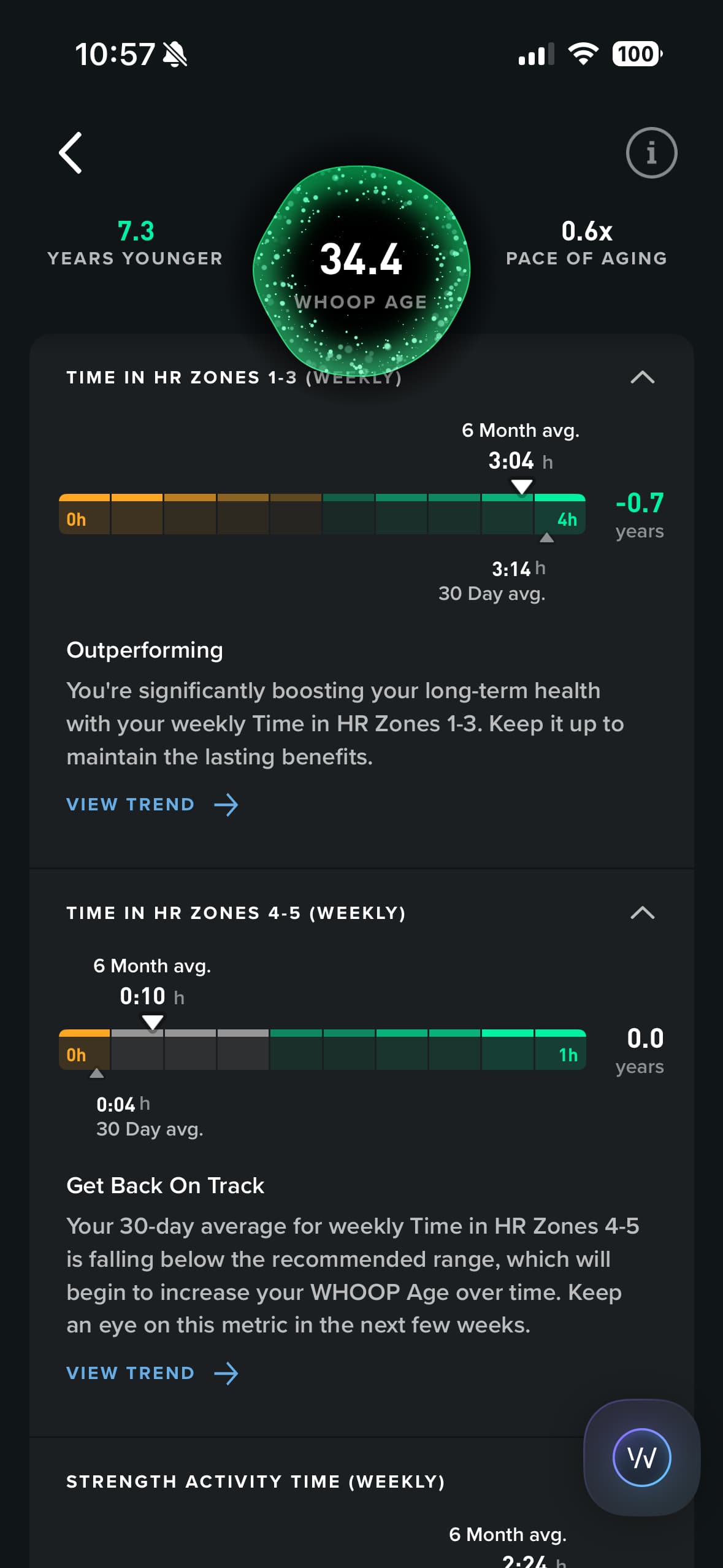
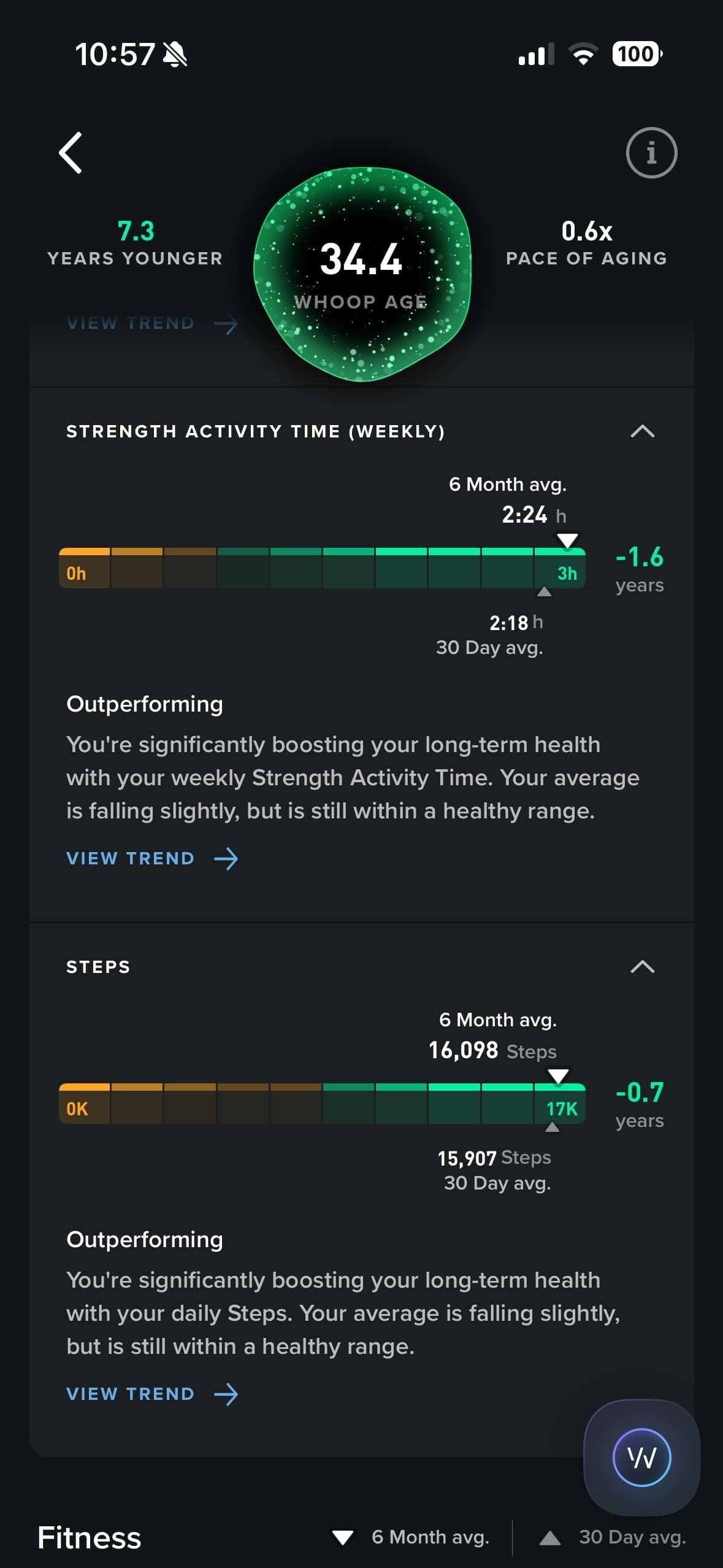
I happen to be at the other end of the spectrum in that I love exercise and almost wish I was a high-level Ironman triathlete or marathoner but this isn’t in the cards for me for a few reasons (though there was a time when I did A LOT of endurance training). At any rate, I double checked my Whoop and I do move a great deal with my stats as follows:

  • ~3 hours per week of zone 2 cardio (swim, bike, run, elliptical, assault bike, stairmaster, rowing machine, cross country skiing, etc… basically something different every session to train different motor patterns)
  • ~5-10 minutes per week of max effort work (heart rate 160+ BPM)
  • ~2 hours per week of “strength training”
  • ~16 000 steps per day

I am hopeful that this exercise will help me maintain the QOL that so many people here speak of. I have a few things going my way longevity wise and one super major risk factor going against me.


One place I described this is in this post, though I did it in greater detail elsewhere, don’t remember where.

1 Like

The geroscience hypothesis is, as precisely as I understand and can concisely phrase it, that old animals’ lifespan is limited by a handful of phenomena (“aging”), and that resolving diseases downstream of aging has very limited expected benefit, since it would simply shift the proximate cause of death to one of the other age-related diseases. You seem to be articulating the opposite view here. What evidence sways you in that direction?

1 Like

I like your clean expression of the gero hypothesis @Lost. I have found myself wondering about its merit on many occasions. I still do. Let me unpack your question and restate points I have made elsewhere but perhaps less clearly that I should have.

First, you framed this as though I owe evidence against the geroscience hypothesis, but the hypothesis as you’ve stated it – that resolving downstream disease has limited benefit because mortality would simply shift to the next age-related cause – is a non-falsifiable as-stated research program’s organizing conjecture, not an established result to which one can offer counterevidence. Its central prediction is counterfactual (what death “would” do), which moves it out of the realm of near term falsification and makes it something one would or would not decline to assume.

That could be a complete answer but it is not the scientific logic that moves me. Before we get to what does, I want to be clearer that I don’t actually hold the view you’re casting as the opposite. The naive position that aging is just the arithmetic sum of discrete diseases, curable one at a time is wrong, and the geroscience people are right to reject it; competing-risk substitution is real and well-demonstrated.

What sways me is a distinction your framing conflates. There is strong and growing evidence that interventions acting on shared upstream biology move many age-related endpoints at once. Exercise is arguably the cleanest case of this generalization (there are others) in simultaneously shifting all-cause mortality, glucose regulation, vascular disease, and cognitive trajectory (and more). Notice that it is not too much of a stretch to interpret this and related generalizations as evidence for the geroscience premise that common drivers exist. I have stated that. But it is also something we can do now, with a measurable effect size in humans. That is the hard evidence I weigh heavily.

The geroscience hypothesis in its ambitious form asks me to weight something else: that aging has a master-clock architecture – a discrete, modifiable central control variable – such that intervening on it yields benefits categorically beyond what these pleiotropic interventions already deliver. That may/could be true and I think I might be glad if it were but such a finding should be greeted with both optimism and concern. Today, however, It is a conjecture about the causal structure of aging, it is not an observation, a regularity, or a generalization therefrom. Therefore, any conjecture about the expected benefit of treating downstream disease is inferred – inference heaping – from that conjecture rather than measured empirics.

In sum I guess (much more could be said in response) I’m not articulating the opposite of the geroscience hypothesis. I’m declining to discount a demonstrated present effect on the strength of an unproven and possibly nonexistent future mechanism. If and when a modifiable master clock is identified and shown to do what the strong hypothesis promises, I’ll reweight all of the variables accordingly. Until then, what we can measure and manage with increasing precision outranks what a single model says we can’t usefully do.

3 Likes