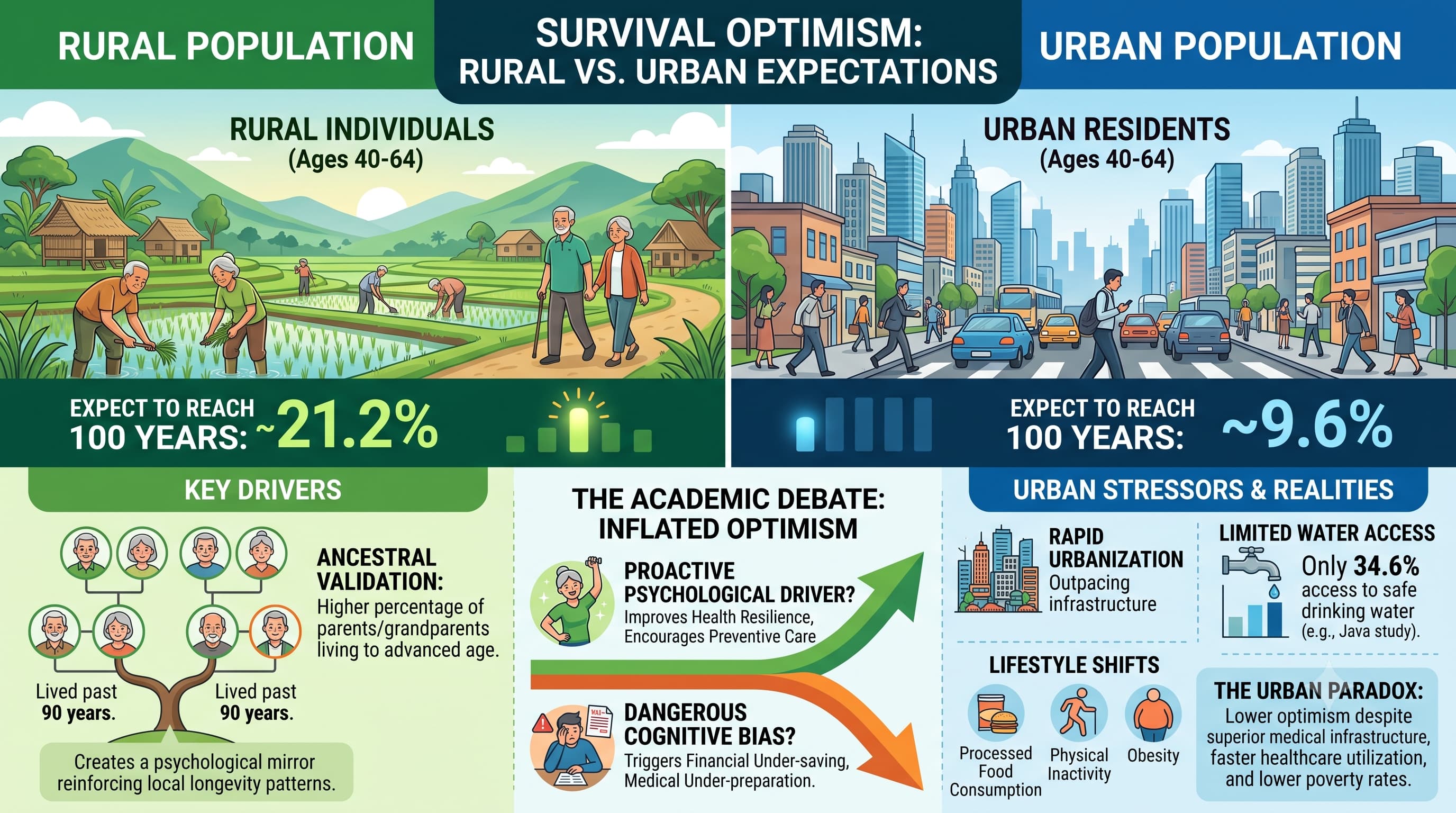
A cross-sectional analysis of 1,199 adults in Java, Indonesia, demonstrates that rural populations anticipate significantly longer lifespans and healthspans than city dwellers, despite facing greater socioeconomic disadvantages. The study reveals that both populations systematically overestimate their survival metrics relative to official actuarial lifetables, driven by localized cultural mirrors and distinct behavioral anchors.
Longevity is as much a psychological construct as it is a biological milestone. Subjective life expectancy (SLE) and subjective healthspan expectancy (SHE) serve as critical cognitive frameworks that dictate how individuals plan for retirement, invest in preventive medicine, and navigate biological decline. The Healthy Longevity (HELO) survey investigated these perceptions across Java, Indonesia, evaluating a cohort of 1,199 individuals structurally split between rural and urban ecosystems.
The data exposes a profound geographic divergence: rural individuals hold far more optimistic views of their future survival than their urban counterparts. Among adults aged 40 to 64, nearly 21.2% of rural respondents expect to cross the centenarian threshold, compared to a mere 9.6% of urban residents. This uncalibrated optimism persists despite the fact that urban environments typically boast superior medical infrastructure, faster healthcare utilization, and lower poverty rates.
The study highlights that rapid urbanization has outpaced municipal infrastructure—leaving only 34.6% of the urban Javanese population with access to safe drinking water—while driving systemic lifestyle shifts toward processed food consumption, physical inactivity, and obesity. These combined stressors heavily depress urban health expectancies.
Conversely, rural survival optimism appears heavily reinforced by ancestral validation: rural cohorts reported a substantially higher proportion of parents or grandparents living past 90 years. This environment creates a psychological mirror where local longevity patterns warp individual expectations.
This introduces a crucial academic debate: does inflated survival optimism act as a proactive psychological driver that improves health resilience, or does it operate as a dangerous cognitive bias that triggers financial under-saving and medical under-preparation?
The primary knowledge gap remains unresolved: because the study lacks longitudinal tracking, additional data is required to determine whether these elevated expectations manifest as real-world clinical longevity or function purely as a culturally insulated illusion.
Actionable Insights
Modifying subjective longevity expectations requires deliberate engagement with specific metabolic baselines that serve as cognitive anchors for long-term health planning. The data demonstrates that following a balanced diet and tracking body weight are the most effective cross-contextual tools for increasing long-term health optimism.
For clinicians and biohackers, the specific effect sizes underscore the practical strength of these habits:
- Balanced Diet Intake: Adhering to a balanced diet displays a powerful correlation with highly advanced longevity expectations. In rural cohorts, a balanced diet exhibits an age-adjusted odds ratio (OR) of 1.81 (95% CI: 1.31–2.50) for expecting to live past 100 years. In urban environments, this dietary habit maintains a strong positive correlation with an OR of 1.52 (95% CI: 1.11–2.10).
- Routine Weight Monitoring: Actively monitoring body weight acts as an essential health anchor in urban settings, yielding an age-adjusted OR of 1.38 (95% CI: 1.07–1.77) for expecting centenarian survival.
- Sleep and Exercise Optimization: For rural cohorts, securing adequate sleep and regular exercise are primary defenses against low healthspan expectations, significantly reducing the probability of anticipating a healthspan that ends under 60 years.
Context
- Open Access Paper: Expected lifespan and healthspan among rural and urban individuals in Java, Indonesia
- Institutions: Department of Human Movement Sciences, Vrije Universiteit Amsterdam (Amsterdam, The Netherlands); Health Sciences Faculty, Jenderal Soedirman University (Jawa Tengah, Indonesia); NUS Academy for Healthy Longevity, Yong Loo Lin School of Medicine, National University of Singapore (Singapore).
- Journal Name: GeroScience
- Impact Evaluation: The impact score of this journal is 5.6, evaluated against a typical high-end range of 0–60+ for top general science, therefore this is a High impact journal.