I haven’t found a specific Microbiome thread, but I thought my experience could prove interesting.
Happy to have this joined to another thread if that makes more sense,
In 2019 I had my gut microbiome sequenced by The American Gut Project out of UCSD.
Since then, The American Gut Project recast itself as the The Microsetta Initiative.
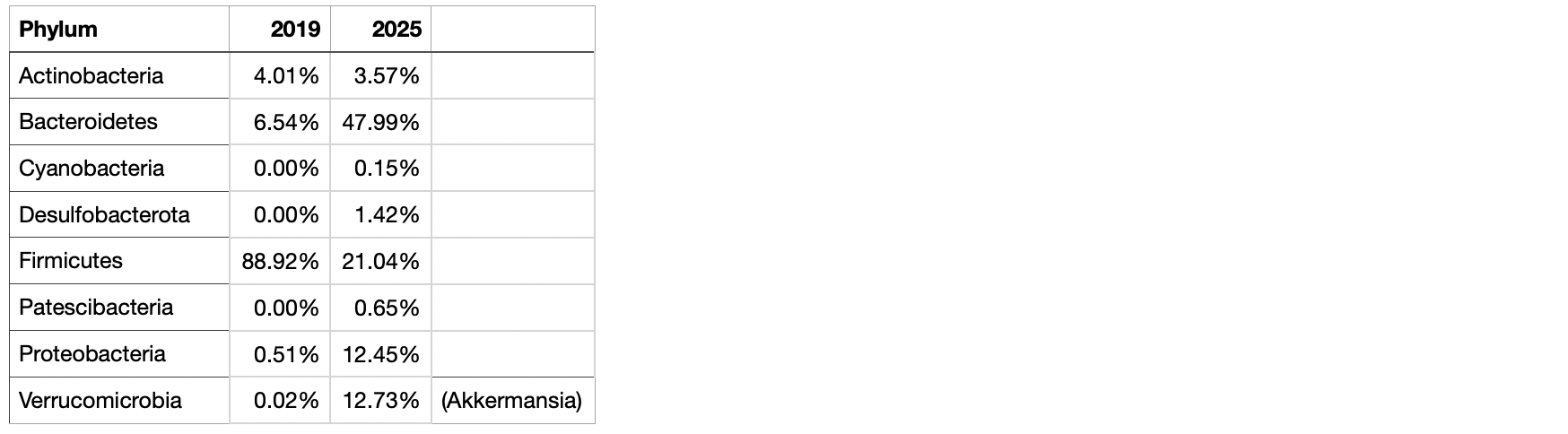
I recently had a second sequencing done. Phylum level comparison between the 2 sequencing in following table.
Same lab.
Same sequencing technology.
Significantly more diversity at this Phylum level and lower levels.
Biggest change in massive dysbiosis of Firmicutes 88.92% to 21.04%.
Increase in Bacteriodetes 6.54% to 47.99%
Maybe too basic, but typically:
- Firmicutes = bad (especially at high percentages)
- Bacteriodetes = good
I think this shows that one can meaningfully change the gut microbiome.
Autoimmune issues
I’ve struggled with autoimmune issues including psoriasis and seasonal allergies, which began hitting me 43 years ago following a few massive courses of broad spectrum antibiotics. The antibiotics saved my life, but left me something unwelcome.
Since then every time I’ve had to taken broad spectrum antibiotics my autoimmune issues have gotten worse.
I’ve recounted across a number of threads things I have done in hope of rebalancing my microbiome.
Prebiotic fiber: I currently take high doses of prebiotic fiber, including:
- Inulin 2 table spoons (late afternoon)
- Psyllium husk powder 2 table spoons (late afternoon)
- Potato starch (resistant starch) 2 table spoons (early afternoon).
- Beta Glucan looking to add this.
Big reset at the end of 2019
In August of 2019 I had a massive psoriasis flare up covering 85%-90% of my skin surface.
Rheumatologists and dermatologists expected me to just get infections from the breaks in the skin and die.
As I had a long history of respritory infections biologics immune suppressors didn’t make sense.
I tried to arrange a fecal transplant in the UK, but couldn’t get it together.
I worked with Anthony Azar, MD on something as close to fecal transplant as we could do. This comprised:
- My 1st microbiome sequencing identifying the Firmicutes dysbiosis this took 6 weeks to get back.
- Colon prep as one would do for a colonoscopy
- Antibiotics targeting the Firmicutes dysbiosis
- 2nd Colon prep following the course of antibiotics
- Prebiotic fiber + probiotics
Over the course of the 2-3 weeks of this treatment the psoriasis disappeared.
I haven’t had significant seasonal allergies since.
The psoriasis reappeared after I banged up my toe and got an infection that required antibiotics.
The most recent sequencing came after the infection resolved.
Not certain if I’ve got other issues or if 21.04% Firmicutes level still causes issues or susceptibility triggered by the antibiotics.
Maybe gut permeability (hence my interest in beta gluons)
Maybe Bifidobacterium supplements
Thoughts, as always appreciated.
