The prices are frequently very compelling in medical tourism (e.g. going to Mexico, India, Turkey, etc. for medical procedures) but the risks are much more difficult to quantify.
What is the best way to identify these types of risks (other than just following the news)?
In early 2023, a rare but deadly form of meningitis began appearing across the United States, especially among patients who had undergone cosmetic surgery at two clinics in Matamoros, Mexico, a city across the border from Texas.
The U.S. Centers for Disease Control and Prevention issued a notice to alert doctors in May, and they began finding dozens of confirmed and probable cases across the U.S., especially in Texas, as well as in Mexico. Patients who had been to the two clinics were notified that they may have been exposed to the fungus.
There is as much risk here in the US as I have found abroad. Many years ago a doctor in Virginia compounded my back issues with his surgery…went to a doctor recommended in Mexico City and he fixed my back, about 35 years ago, no issues since. I recently had an implant gone very bad that I received in the US, caused me all sorts of grief and a lot of infection. Just returned from Colombia where I got excellent dental care and they cleaned up the infection, will be going back for implants. I’m an American, born and raised, but unfortunately Americans seem to live with the idea that we have the best…that really is relative to the doctor and to his training and experience. I always laugh when I tell a fellow American that I had work done in Mexico, Thailand, Costa Rica or Colombia, it never ceases to get a look that says why would you go to substandard places and take such risks? I’m only saying that it has worked for me…my horror stories happened in the US, overseas is so far so good. And I paid a LOT less for the same treatment. Do your due diligence but please realize that the US does not have the corner on the market of good doctors. Overseas is also a good option if you are not adequately covered here in the US. If you need extensive dental work, let’s face it, here it is prohibitively expensive and not covered to the extent needed by any insurance. Don’t let news on one bad clinic somewhere dictate your decision, there’s enough information available now so you can find out enough information on any place you want to get work done, if there isn’t, then don’t go there. Hope this helps some of you, I really needed extensive dental work done from my failed implant, if I would have done it in the US where I live, I could kiss my retirement goodbye. That’s my 2 cents for now…or two pesos…or two baht…
Why more foreigners are seeking health care in China
The growth of medical tourism is making locals uneasy
Foreigners visiting China often gush over the country’s high-speed rail and glittering skylines. Its creaky medical system, though, gets less praise. So Amie, a British woman, caused a stir online last month with a glowing video review of a public hospital in Beijing. With persistent stomach pain, and facing a long wait to see a doctor in Britain, she went to China, where she had once lived. Tests, diagnosis and treatment were quick and cost some 2,800 yuan ($400). Even including the air fare, that was still less than she would have had to pay at a private hospital at home, she said. After Amie’s video went viral on Chinese social media, other foreigners chimed in with their own stories of cheap and efficient care in China.
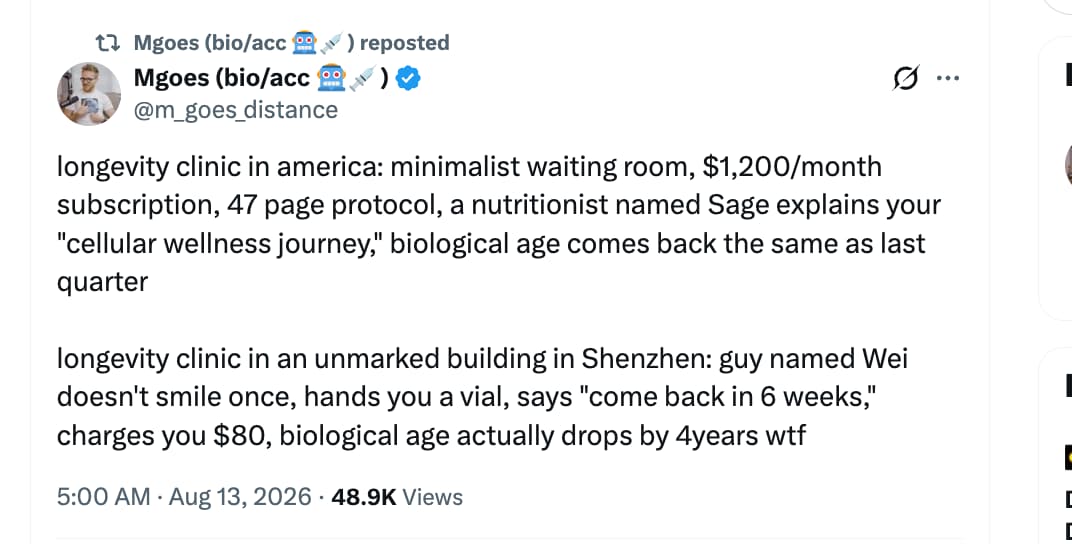
A decade ago officials set a target for China to become an “internationally competitive” destination for medical tourism by 2030 (as South Korea has become: wealthy Chinese often visit that country for complex treatments or cosmetic surgery). Now China is drawing a growing number of foreign patients. Last year its hospitals received nearly 1.3m of them, up almost 74% from 2022, according to Chinese media. China’s medical-tourism market is expected to increase from around $1.2bn in 2025 to $3.4bn by 2035, according to Market Research Future, a consultancy.
Many of China’s medical facilities are still shoddy, but in recent years its best hospitals have gained top-notch doctors and equipment. For some elective procedures such as laser eye surgery, they are world-class. They are also usually cheaper than Western hospitals. Many have English-speaking staff. And since 2023 China has fast expanded its visa-free entry scheme (last month it was announced that British visitors would be included). This makes it easier to drop in for a check-up.
Totally agree with this. The UK system is falling apart, and it’s easier than ever to fly abroad. In places like China, many of their hospitals are private and profit-driven, so they are more than happy to charge people for health checks, consultations, MRIs etc.
I think I’d be a bit wary of any sort of “proper” surgery, because you could potentially end up stuck there, unable to travel back etc. But if you’ve had stomach pain the NHS has you waiting months, flying to China for an endoscopy etc makes total sense IMO.
China Lures Foreign Patients With Cutting-Edge, Cheap Medical Care
Scientific breakthroughs, price and availability are making the country an increasingly attractive destination for patients from abroad seeking care.
Stuart Lye, 58, was living in New Zealand and on borrowed time — doctors had told him he had just three months to live in 2018, when he was diagnosed with high-risk myeloma. While years of treatment, including chemotherapy, stem cell transplants and drugs, had extended his life, his health was worsening and he’d run out of options at home.
He’d heard about CAR-T, a form of immunotherapy. But it’s not yet available commercially in New Zealand, and the clinical trials that are underway aren’t for his specific cancer. In the closest country where it’s accessible, Australia, the procedure could cost more than A$500,000 ($350,000).
Fortuitously, a fellow New Zealand patient who had received the treatment in China introduced Lye to a hospital in Shanghai and last year, after just 10 days of communication with the center, he and his wife decided to head abroad. Following seven weeks undergoing a clinical trial, his cancer was brought under control. The entire process, including hospital care and airfare, cost Lye about $65,000.
“Looking outside of New Zealand for CAR-T was my only option,” he said. “China was an easy choice as they are at the forefront in research and development, and the treatment is near a 10th of the cost of other countries.”
While traditional hotspots in the region such as Thailand, South Korea and Malaysia focus on services such as cosmetic surgery, IVF or physicals, China is trying to differentiate itself by providing some of the world’s most advanced procedures.
“There are two reasons why a patient travels for medical treatments: availability of advanced treatments and price,” said Victor Cao, operations director of Joyful Medical, an agency in Shanghai that connects international patients to advanced cancer therapies in China. “Chinese people used to travel overseas for treatments that were not available at home, but now tables have turned.”
Me too. I just came back from Los Algodones, where I spent seven thousand, including expenses, and saved five.
Prior to the trip, I had seen three American dentists in a year, and each one told me that I needed a different treatment. This is a chronic problem here, the recommendation of unneeded treatments or the most costly materials. It’s estimated that up to 75% of U.S. dentists engage in upselling.