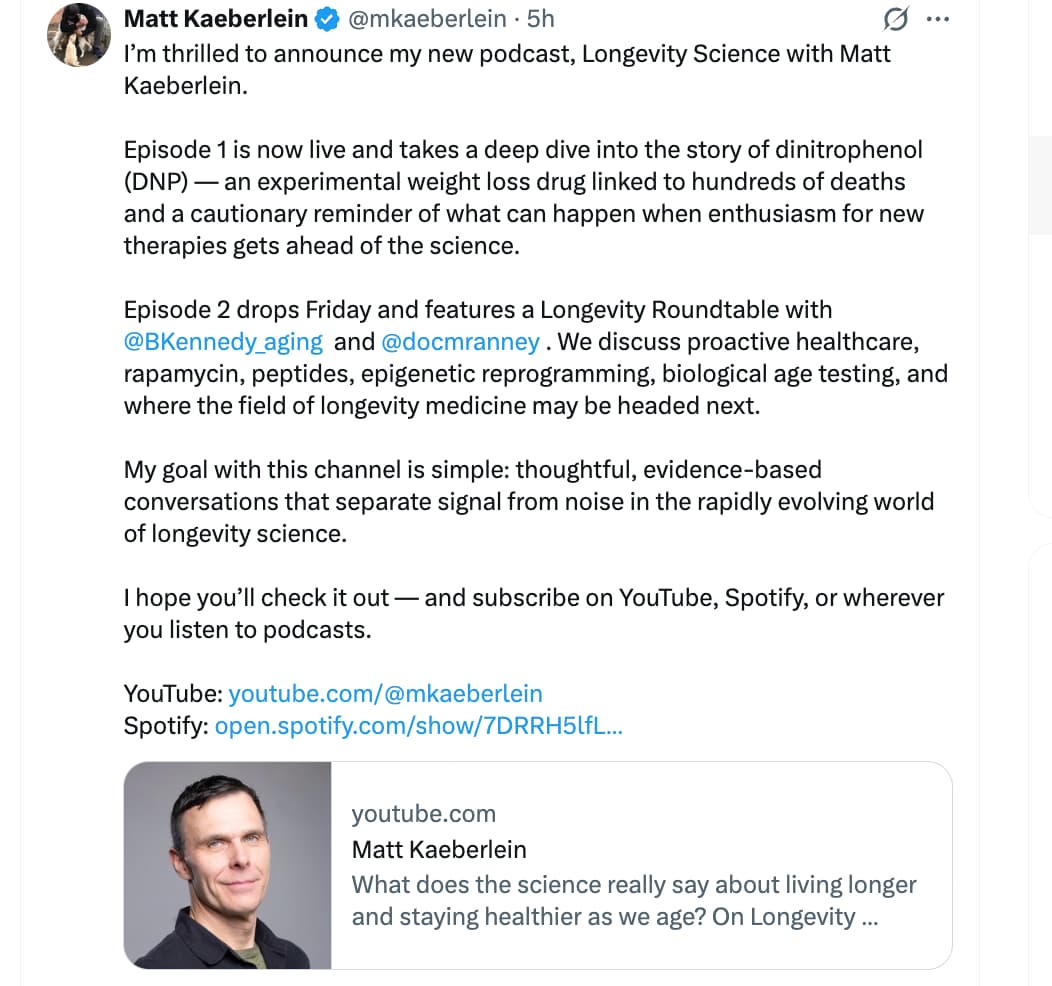
The Mitochondrial Activator that Killed Hundreds
I. Executive Summary
The video presentation by Dr. Matt Kaeberlein delivers a rigorous clinical critique of the contemporary longevity and functional medicine gray market, framing the premature prescription of unapproved, research-grade compounds as a reckless regression to pre-1938 regulatory vulnerabilities. The core thesis asserts that commercial enthusiasm and consumer demand for metabolic enhancement frequently outpace clinical validation, culminating in profound patient safety risks. This dangerous phenomenon is illustrated by a modern case where a licensed medical practitioner prescribed SLU-PP-332—a synthetic small-molecule pan-agonist of estrogen-related receptors (ERRα, ERRβ, ERRγ)—to a human patient for weight loss despite a complete deficit of human pharmacokinetics, safety profiles, or registered clinical trials.
To contextualize this physiological risk, the presentation establishes a historic parallel with 2,4-dinitrophenol (DNP), the original mitochondrial uncoupler. Discovered occupationally in French munitions factories in the 1910s, DNP’s capacity to induce profound weight loss was systematically commercialized in the 1930s by Stanford researchers led by Maurice Tainter. Mechanistically, DNP uncouples electron transport from oxidative phosphorylation by translocating protons across the inner mitochondrial membrane, bypassing ATP synthase. This forces futile lipid and glucose oxidation to sustain cellular ATP, transforming the chemical energy gradient into uncontrolled thermogenesis. Stanford investigators routinely dismissed early toxic fatalities as outliers resulting from excessive doses, allowing over 100,000 consumers to ingest the chemical.
The subsequent accumulation of severe systemic pathologies, including blinding cataracts, skin lesions, and lethal hyperthermia, forced the FDA to designate DNP as extremely dangerous in 1938. This specific crisis served as a primary catalyst for the 1938 Food, Drug, and Cosmetic Act, establishing pre-market safety testing mandates. Despite statutory bans, DNP underwent cyclical subterranean renaissances via Nicholas Bachinsky’s commercial fat-loss clinics in the 1960s and Dan Duchain’s bodybuilding underground in the 1980s. The clinical takeaway is absolute: manipulating core mitochondrial bioenergetics without robust, multi-phase human clinical data exhibits an unacceptably narrow therapeutic index. Modern practitioners who normalize novel research chemicals under a facade of “wellness optimization” mistake an absence of published human toxicity data for verified physiological safety, fundamentally violating the principles of informed consent.
II. Insight Bullets
- The Modern Practice Deficit: Licensed medical professionals are actively crossing legal and ethical boundaries by prescribing entirely unapproved, research-grade small molecules lacking any foundational human safety trials.
- SLU-PP-332 Translational Gap: The compound SLU-PP-332 is a synthetic non-peptide pan-agonist for the nuclear receptors ERRα, ERRβ, and ERRγ, with data restricted entirely to narrow rodent models (Billon et al., 2024).
- Mitochondrial Uncoupling Architecture: DNP functions by making the inner mitochondrial membrane permeable to protons, effectively short-circuiting the electrochemical gradient needed by ATP synthase to generate cellular energy currency.
- Thermodynamic Toxicity Pathophysiology: Because the uncoupling mechanism forces the cell to oxidize massive fat and sugar stores in a futile effort to maintain ATP levels, the excess energy is dissipated entirely as heat, provoking severe or fatal hyperthermia.
- The Tainter Dosing Fallacy: Historic Stanford data minimized low-dose fatalities by claiming a clean line existed between “therapeutic” and “excessive” doses, ignoring the unpredictable inter-individual metabolic volatility of uncouplers.
- Pre-1938 Structural Vulnerabilities: Prior to 1938, drug manufacturers faced zero legal requirements to demonstrate product safety before direct-to-consumer pharmacy commercialization, a framework mirrored by today’s online research chemical gray market.
- The 1938 Food, Drug, and Cosmetic Act Catalyst: Severe side effects from DNP, alongside the mass toxicities of Elixir Sulfanilamide, directly drove the passage of the foundational federal legislation governing modern pharmaceutical safety.
- The Bachinsky Commercial Exploitation: During the 1960s, Nicholas Bachinsky successfully institutionalized a subterranean network of weight-loss clinics treating over 17,000 patients with DNP, entirely bypassing sporadic FDA enforcement actions.
- Bodybuilding Black Market Integration: Following federal incarceration, Bachinsky influenced steroid promoter Dan Duchain, who rebranded DNP as the ultimate fat-loss chemical, embedding a lethal compound into modern fitness subcultures (Politi et al., 2011).
- BPC-157 Clinical Stratification: While BPC-157 features an expansive preclinical footprint across a decade of use by athletes, its therapeutic efficacy remains limited by an absence of high-powered human randomized controlled trials (RCTs).
- The “Wellness Blinder” Fallacy: Longevity subcultures routinely commit the logical error of treating a total absence of clinical toxicity documentation as positive evidence of user safety.
- Bioactive Scaling Realities: Research-grade small molecules interact with fundamental metabolic and genetic pathways with highly potent, multi-system kinetics that carry a radically higher catastrophic side-effect ceiling than standard nutritional supplements.
- Incretin Mimetic Obsolescence: The emergence of highly validated, highly effective GLP-1 receptor agonists with extensive human safety profiles renders the deployment of high-risk, unvalidated mitochondrial alterers clinically obsolete.
- Informed Consent Violations: Relying on social media influencers or unregulated gray-market suppliers for compound validation invalidates the core medical mandate of true, evidence-based informed consent.
IV. Actionable Protocol (Prioritized)
High Confidence Tier (Level A/B Evidence)
- Validated Metabolic & Weight Management Interventions: For patients seeking weight reduction or metabolic optimization, clinicians must utilize established lifestyle modifications or FDA-approved glucagon-like peptide-1 (GLP-1) receptor agonists. These pathways possess robust multi-center randomized controlled trials (RCTs) verifying human safety, therapeutic margins, and long-term cardiovascular outcomes (Wilding et al., 2021).
- Clinical Screening of Longevity Protocols: Rigorously audit any compound stacks recommended by functional medicine clinics. Prioritize therapies backed by complete Phase I/II safety data on ClinicalTrials.gov over animal-only abstractions.
Experimental Tier (Level C/D Evidence - High Safety Margins)
- BPC-157 for Localized Tissue Healing: If deploying Body Protective Compound-157 (BPC-157) for musculoskeletal, tendon, or gastric repair, acknowledge that current data is almost entirely preclinical (Józwiak et al., 2025). Efficacy in human populations relies on single-center case series and pilot studies rather than gold-standard RCTs.
- Purity & Sterility Mitigation: Because gray-market “research grade” peptides lack regulatory compounding oversight, they present severe risks of endotoxin contamination and variable purity. If utilized, source exclusively via verified compounding pharmacies subject to rigorous analytical validation (e.g., High-Performance Liquid Chromatography and mass spectrometry).
Red Flag Zone (Claims Debunked or Lacking Safety Data)
- Absolute Avoidance of SLU-PP-332: Human use of this compound is classified as Safety Data Absent. There is zero human pharmacokinetic data, zero toxicology screening, and no active clinical registry. It remains strictly a lab-grade tool compound; clinical use is highly irresponsible and illegal.
- Absolute Avoidance of 2,4-Dinitrophenol (DNP): Classified as Explicitly Dangerous. The compound possesses a razor-thin therapeutic index with zero active pharmacological rescue mechanism for acute hyperthermic crises. It causes irreversible cataracts, multi-organ failure, and death (Politi et al., 2011).
- Unapproved Peptide Injection Stacks: Avoid complex amalgams of unapproved novel peptides administered concurrently. Combining unvalidated signaling molecules creates unpredictable, synergistic off-target effects and systemic immunological risks.