Gemini Pro AI Summary and Analysis:
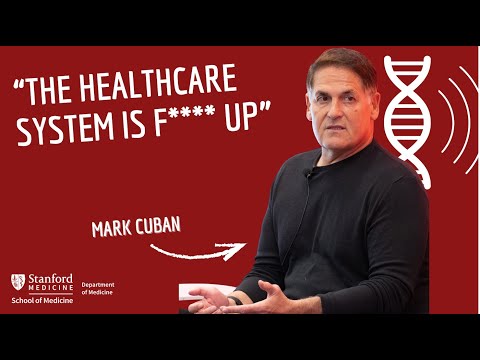
Here is the analysis and summary of the provided transcript featuring Mark Cuban at Stanford Medicine.
Executive Summary
In a candid discussion at Stanford Medicine, Mark Cuban dismantles the current economic structure of the US healthcare system, characterizing it as fundamentally broken due to misaligned incentives and opacity. Cuban argues that the leverage in healthcare has been entirely captured by large insurance companies and their vertically integrated Pharmacy Benefit Managers (PBMs). He posits that insurers design plans not for patient care, but to maximize their own financial “float” and push credit default risk onto providers (doctors and hospitals).
The core of Cuban’s thesis is that PBMs artificially inflate drug prices through “spread pricing,” rebate arbitrage, and “pay-to-play” formulary auctions that prioritize kickbacks over clinical efficacy. He cites specific examples where PBMs exclude cheaper, effective drugs (like specific GLP-1s) because manufacturers wouldn’t pay high enough rebates. His solution is the “Cost Plus” model: radical transparency where prices are determined by manufacturing cost plus a flat 15% margin and nominal fees, bypassing PBMs entirely. He urges healthcare providers and self-insured employers to engage in direct contracting to reclaim leverage from the “big insurance” oligopoly.
Bullet Summary
- The Insurance Leverage Trap: Insurance companies design plans to secure a sales funnel, then use that volume leverage to force providers into unfavorable contracts while offloading patient credit risk to the doctors.
- The “Float” Incentive: Pre-authorization delays are often financial tactics; insurers hold premium dollars longer to generate interest income (the float) before paying out claims.
- Vertical Integration Monopoly: The top insurers own the major PBMs, allowing them to control both the insurance plan design and the drug supply chain, creating a closed loop of price inflation.
- Spread Pricing: PBMs charge employers a higher price for a drug than they pay the pharmacy, pocketing the “spread” without the employer’s knowledge.
- Rebates over Efficacy: Formularies are auctioned to the highest bidder. Drugs are placed on insurance lists based on the size of the rebate paid to the PBM, not patient outcomes (e.g., the exclusion of Zepbound by a major PBM).
- The “Specialty Drug” Scam: Cuban argues that “specialty drug” tiers are often arbitrary classifications used to justify exorbitant markups on standard generics (e.g., Droxodopa marked up from ~$70 to ~$10,000).
- Data Blocking: PBMs refuse to share claims data with manufacturers or employers, preventing safety monitoring (adverse effects) and adherence tracking.
- Trust Equation: Cuban defines leadership and trust mathematically: Trust = Transparency / Self-Interest.
- Direct Contracting: The only way to break the PBM/Insurer hold is for hospital systems and large employers to sign direct contracts, bypassing the insurance middlemen entirely.
- Cost Plus Marketplace: Cuban is expanding beyond consumer drugs to hospital procurement (Cost Plus Marketplace) to address similar price gouging in sterile injectables and hospital supplies.
Claims & Evidence Table (Adversarial Peer Review)
| Claim from Video | Speaker’s Evidence | Scientific Reality (Best Available Data) | Evidence Grade | Verdict |
|---|---|---|---|---|
| “PBMs prioritize high-rebate drugs over cheaper options (e.g., Zepbound exclusion).” | Cites recent PBM formulary decision excluding Lilly’s Zepbound in favor of Novo’s product. | FTC Interim Report on PBMs (2024) confirms PBMs favor high-rebate drugs, often blocking biosimilars and cheaper generics. | A (Govt/Regulator Review) | Strong Support |
| “Specialty drug tiers are arbitrary and used to inflate prices.” | Anecdote of Droxodopa: $30k/quarter vs $73/month at Cost Plus. | While “Specialty” originally meant complex handling (cold chain), studies show many generics are shifted to specialty tiers solely for financial extraction. | C (Econ Analysis) | Plausible/Strong |
| “Pre-authorization is used primarily to delay payment and earn interest.” | Logical deduction based on financial incentives of holding premiums. | While delays benefit insurers financially, administrative inefficiency and cost-containment (utilization management) are also factors. Hard to prove “intent” to float cash as primary driver. | E (Expert Opinion) | Speculative / Mechanistic |
| “Cost Plus model significantly lowers patient cost.” | Cites Imatinib and chemotherapy examples. | Study in Annals of Internal Medicine (2022) found Medicare could save billions if it paid Cost Plus prices for generic drugs. | B (Comparative Analysis) | Strong Support |
| “Most Favored Nation executive order will drop drug prices 30-80%.” | Cites a tweet/rumor regarding incoming administration policy. | Historically, “Most Favored Nation” policies face massive legal challenges from Pharma. No implementation data exists yet to support the 30-80% figure. | E (Political Speculation) | Weak / Unknown |
Actionable Insights (Pragmatic & Prioritized)
Top Tier (High Confidence)
- Prescribe via Cost Plus: For patients on generic maintenance medications (statins, imatinib, etc.), prescribe directly to Cost Plus Drugs or similar cash-pay pharmacies to bypass insurance markups.
- Audit “Specialty” Classifications: If you run a clinic or practice, audit your “specialty” drug prescriptions. Many are standard generics that can be sourced cheaply outside of the PBM specialty tier.
- Demand Claims Data: If you are a self-insured employer or benefits manager, demand full ownership of your claims data in your PBM contract to audit for spread pricing.
Experimental (High Upside)
- Direct Contracting: Hospital administrators and private practices should actively seek direct contracts with local self-insured employers, offering “Cost Plus Wellness” rates to bypass insurance delays and denials.
- Hospital Procurement: Supply chain managers should test Cost Plus Marketplace for sterile injectables and standard hospital drugs to benchmark against current GPO (Group Purchasing Organization) pricing.
Avoid
- Rebate-Driven Formularies: Do not assume an insurance formulary represents the “best” clinical option; it likely represents the highest rebate. Always verify if a “non-preferred” drug is actually cheaper via cash-pay.
Technical Deep-Dive: The PBM Arbitrage Mechanism
Cuban outlines a specific financial engineering mechanism used by Pharmacy Benefit Managers (PBMs) to extract value. Understanding the jargon is critical to understanding the scam:
- WAC (Wholesale Acquisition Cost): The “List Price” set by the manufacturer.
- The Rebate Wall: PBMs control the “Formulary” (the list of covered drugs). To get on this list, manufacturers must pay a “Rebate” to the PBM. This incentivizes manufacturers to raise the WAC so they can offer a larger rebate.
- Spread Pricing:
- The PBM charges the Employer/Payer a specific amount for a drug (e.g., $100).
- The PBM pays the Pharmacy a lower amount (e.g., $80).
- The PBM keeps the $20 “spread.” This is often undisclosed to the employer.
- Vertical Integration: The top three PBMs (CVS Caremark, Express Scripts, OptumRx) manage ~80% of US prescriptions and are owned by or affiliated with major insurers (Aetna, Cigna, UnitedHealth). This allows them to steer patients to their own specialty pharmacies, effectively paying themselves while obscuring the true cost of goods.
Fact-Check Important Claims
-
Claim: Yahoo bought Broadcast.com for $5.7 billion.
-
Fact: True. Yahoo acquired Broadcast.com in 1999 for $5.7 billion in stock.
-
Claim: Cuban executed a “collar” trade to protect his wealth.
-
Fact: True. This is considered one of the most successful hedges in market history. Cuban bought put options to protect against a drop while selling call options to fund the purchase, locking in his value before the dot-com bubble burst.
-
Claim: PBMs force pharmacies to sell at a loss.
-
Fact: True. This is known as “DIR Fees” (Direct and Indirect Remuneration) or underwater reimbursements, which have contributed to the closure of thousands of independent pharmacies and the financial struggles of chains like Rite Aid and Walgreens.
-
Claim: Renee Hardy embezzled money from Micro Solutions.
-
Fact: True. Cuban has recounted this story consistently. An employee forged checks, nearly bankrupting his first company.