Making matters even murkier, a lot of the research geared toward finding those therapies has been subject to drastic cuts.The NIH is the largest funder of biomedical research in the world and has supported major scientific discoveries, including those that benefit longevity research. But in late March, HHS announced a “dramatic restructuring” that would involve laying off 10,000 full-time employees. Since Trump took office, over a thousand NIH research grants have been ended and the administration has announced plans to slash funding for “indirect” research costs—a move that would cost individual research institutions millions of dollars. Research universities (notably Harvard) have been the target of policies to limit or revoke visas for international students, demands to change curricula, and threats to their funding and tax-exempt status.
The NIH also directly supports aging research. Notably, the Interventions Testing Program is a program run by the National Institutes of Aging (a branch of the NIH) to find drugs that make mice live longer. The idea is to understand the biology of aging and find candidates for human longevity drugs.
The ITP has tested around five to seven drugs a year for over 20 years, says Richard Miller, a professor of pathology at the University of Michigan, one of three institutes involved in the program. “We’ve published eight winners so far,” he adds.
The future of the ITP is uncertain, given recent actions of the Trump administration, he says. The cap on indirect costs alone would cost the University of Michigan around $181 million, the university’s interim vice president for research and innovation said in February. The proposals are subject to ongoing legal battles. But in the meantime, morale is low, says Miller. “In the worst-case scenario, all aging research [would be stopped],” he says.
The A4LI has also had to tailor its lobbying strategy given the current administration’s position on government-funded research. Alongside its efforts to change Montana state law to allow clinics to sell unproven treatments, the organization had been planning to push for an all-new NIH institute dedicated to aging and longevity research—an idea that O’Neill voiced support for last year. But current funding cuts under the new administration suggest that it’s “not the ideal political climate for this,” says Livingston.
Despite their enthusiasm for O’Neill’s confirmation, this has all left many members of the longevity community, particularly those with research backgrounds, concerned about what the cuts mean for the future of longevity science.
“Someone like [O’Neill], who’s an advocate for aging and longevity, would be fantastic to have at HHS,” says Matthew O’Connor, who spent over a decade at SRF and says he knows O’Neill “pretty well.” But he adds that “we shouldn’t be cutting the NIH.” Instead, he argues, the agency’s funding should be multiplied by 10.
“The solution to curing diseases isn’t to get rid of the organizations that are there to help us cure diseases,” adds O’Connor, who is currently co-CEO at Cyclarity Therapeutics, a company developing drugs for atherosclerosis and other age-related diseases.
But it’s still just too soon to confidently predict how, if at all, O’Neill will shape the government health agencies he will oversee.
“We don’t know exactly what he’s going to be doing as the deputy secretary of HHS,” says Public Citizen’s Steinbrook. “Like everybody who’s sworn into a government job, whether we disagree or agree with their views or actions … we still wish them well. And we hope that they do a good job.”
There are very few people who are really opposed to improving health. The difficult parts are the questions of what to spend money on researching and the interplay with regulation.
I was referring to his potential influence over regulatory requirements for approval of new drugs and other interventions.
I don’t like the combination of cutting science research across the board (including longevity) , and loosening regulations for new drugs. Time may tell how this will turn out, and it’s hopefully for the best.
True, we don’t know how it will play out. If he’s a longevity enthusiast, as the article says, he would be closer to a typical member of this forum than to a traditional health bureaucrat.
Jim O’neil is definitely a longevity enthusiast; he attends many of the longevity meetings around the country and I’ve met him at one. He is Peter Thiel’s “go to guy” for all things longevity. We’ll see what sort of influence he has in the new administration…
It’s the best thing that this administration has ever done. Jim O’Neill has always been at the right side of everything far ahead of time - be it the Thiel Fellowship, psychedelic advocacy, and “right to try” laws.
He’s even tpot-adjacent, and maybe the most open-minded person in a long time in government.
I know that many Thiel Fellows (eg Chris Olah) also have very high opinion of him.
It’s complicated but we should start with optimism.
A hope? A chance.
[Bryan Johnson] met with Republican representatives from Pennsylvania, Tennessee and Texas as well as HHS Deputy Secretary Jim O’Neil and Michael Kratsios, the White House director of the Office of Science and Technology.
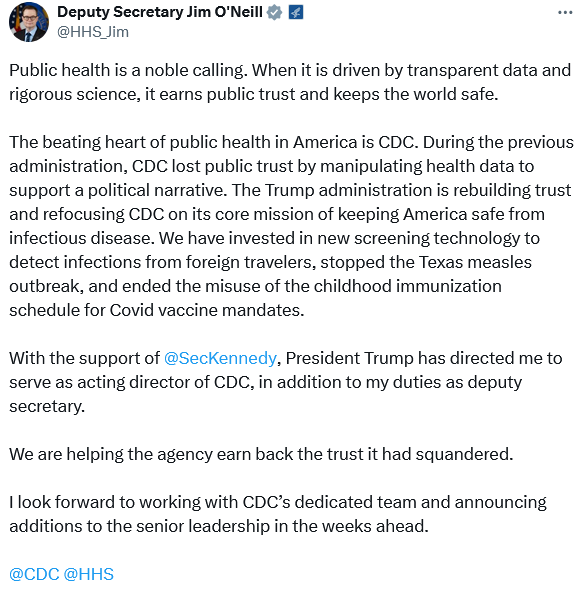
Was it on anyone’s bingo card that by 2025 an ex-CEO of SENS Research Foundation would be both the Deputy Secretary of the HHS, and the acting director of the CDC?
If that was the case, what would you expect in the coming years after that?
You shall know them by their fruits.
I have a view about the participants in Trump 2.0 that many of them mean well. Some like RFK (and Trump himself) don’t really understand the issues, but others do.
I looked up the biblical quote
Beware of false prophets, who come to you in sheep’s clothing, but inwardly they are ravenous wolves. You will know them by their fruits. Do men gather grapes from thornbushes or figs from thistles? Even so, every good tree bears good fruit, but a bad tree bears bad fruit. A good tree cannot bear bad fruit, nor can a bad tree bear good fruit. Every tree that does not bear good fruit is cut down and thrown into the fire. Therefore by their fruits you will know them.
There is, of course, a problem that proving that a particular intervention extends healthspan by say 10 years will take at least 10 years.
US deputy health secretary: Vaccine guidelines are still subject to change
In an exclusive interview, Jim O’Neill, who also leads the CDC, discusses vaccine schedules, dietary guidance—and being a longevity enthusiast.
Over the past year, Jim O’Neill has become one of the most powerful people in public health. As the US deputy health secretary, he holds two roles at the top of the country’s federal health and science agencies. He oversees a department with a budget of over a trillion dollars. And he signed the decision memorandum on the US’s deeply controversial new vaccine schedule.
He’s also a longevity enthusiast. In an exclusive interview with MIT Technology Review earlier this month, O’Neill described his plans to increase human healthspan through longevity-focused research supported by ARPA-H, a federal agency dedicated to biomedical breakthroughs. At the same time, he defended reducing the number of broadly recommended childhood vaccines, a move that has been widely criticized by experts in medicine and public health.
More support for longevity—but not all science
O’Neill said he wants longevity to become a priority for US health agencies. His ultimate goal, he said, is to “make the damage of aging something that’s under medical control.” It’s “the same way of thinking” as the broader Make America Healthy Again approach, he said: “‘Again’ implies restoration of health, which is what longevity research and therapy is all about.”
O’Neill said his interest in longevity was ignited by his friend Peter Thiel, the billionaire tech entrepreneur, around 2008 to 2009. It was right around the time O’Neill was finishing up a previous role in HHS, under the Bush administration. O’Neill said Thiel told him he “should really start looking into longevity and the idea that aging damage could be reversible.” “I just got more and more excited about that idea,” he said.
When asked if he’s heard of Vitalism, a philosophical movement for “hardcore” longevity enthusiasts who, broadly, believe that death is wrong, O’Neill replied: “Yes.”
The Vitalist declaration lists five core statements, including “Death is humanity’s core problem,” “Obviating aging is scientifically plausible,” and “I will carry the message against aging and death.” O’Neill said he agrees with all of them. “I suppose I am [a Vitalist],” he said with a smile, although he’s not a paying member of the foundation behind it.
As deputy secretary of the Department of Health and Human Services, O’Neill assumes a level of responsibility for huge and influential science and health agencies, including the National Institutes of Health (the world’s largest public funder of biomedical research) and the Food and Drug Administration (which oversees drug regulation and is globally influential) as well as the CDC.
Today, he said, he sees support for longevity science from his colleagues within HHS. “If I could describe one common theme to the senior leadership at HHS, obviously it’s to make America healthy again, and reversing aging damage is all about making people healthy again,” he said. “We are refocusing HHS on addressing and reversing chronic disease, and chronic diseases are what drive aging, broadly.”
Over the last year, thousands of NIH grants worth over $2 billion were frozen or terminated, including funds for research on cancer biology, health disparities, neuroscience, and much more. When asked whether any of that funding will be restored, he did not directly address the question, instead noting: “You’ll see a lot of funding more focused on important priorities that actually improve people’s health.”
O’Neill said that “ARPA-H exists to make the impossible possible in health and medicine.” The agency has a new director—Alicia Jackson, who formerly founded and led a company focused on women’s health and longevity, took on the role in October last year.
O’Neill said he helped recruit Jackson, and that she was hired in part because of her interest in longevity, which will now become a major focus of the agency. He said he meets with her regularly, as well as with Andrew Brack and Jean Hébert, two other longevity supporters who lead departments at ARPA-H. Brack’s program focuses on finding biological markers of aging. Hebert’s aim is to find a way to replace aging brain tissue, bit by bit.
Full article/interview: US deputy health secretary: Vaccine guidelines are still subject to change (MIT Tech Review)
Patriots in control.
You might not like his longevity program though…
When it comes to his own personal ambitions for longevity, O’Neill said, he takes a simple approach that involves minimizing sugar and ultraprocessed food, exercising and sleeping well, and supplementing with vitamin D. He also said he tries to “eat a diet that has plenty of protein and saturated fat,” echoing the new dietary guidance issued by the US Departments of Health and Human Services and Agriculture. That guidance has been criticized by nutrition scientists, who point out that it ignores decades of research into the harms of a diet high in saturated fat.
We can expect to see more nutrition-related updates from HHS, said O’Neill: “We’re doing more research, more randomized controlled trials on nutrition. Nutrition is still not a scientifically solved problem.” Saturated fats are of particular interest, he said. He and his colleagues want to identify “the healthiest fats,” he said.
“Stay tuned.”
Jim might be juiced up on PCSK9i or something.
It’s funny because I have the complete opposite lifestyle right now. (Though I’m intending to change). Low SFA, protein, exercise. High UPF.
Important priorities must exclude vaccines, diabetes, hiv, heart disease.
Actions over words.
Maybe longevity, HHS and Jim O’Neil are three words that don’t belong together as it been reported today that Jim is out. At least according to Politico and CNN.
Wow - that was fast. Bad news for the longevity goals he espoused: https://www.politico.com/news/2026/02/13/top-aides-to-rfk-jr-will-leave-posts-00780125
Fish rots from the head. Doesn’t matter who is downstream from that, if you are weak, they will corrupt you, if you are strong, they’ll get rid of you. The problem is at the top, and until that changes, only destruction will follow. The rot spreads.