https://x.com/i/status/2011491957730918510
That can perform an hour of work
Has anyone else used them
https://x.com/i/status/2011491957730918510
That can perform an hour of work
Has anyone else used them
Good article. Looks like it was created just before Claude Cowork was released yesterday as well. Cowork does much of what engineers were doing in Claude Code to process files but doesn’t require coding experience. It is only on their Max plan right now, but should be available to Pro plan customers shortly. The team created this tool in 10 days once they saw the market need.
Hmmm… Maybe too much to post?
I’ve actually done work in the field. I see little close to AGI.
Four thinkers get us close:
Some brief thoughts follow…
Thomas Cover fits into this landscape as the mathematician of Darwinian competence: he formalized why blind variation plus selection works so well, while remaining largely silent on knowledge, meaning, or explanation. That places him upstream of Dawkins and Dennett, partially aligned with Popper, and explicitly short of Deutsch.
A map of this intellectual landscape follows.
1. Thomas Cover: the mathematics of blind success
Thomas Cover’s work—especially Cover’s theorem—shows:
You do not need insight, understanding, or foresight to solve hard problems.
You need rich variation and a simple selection rule.
What Cover proved
This is Darwin’s algorithm expressed in geometry.
Cover explains why:
But he does not claim these systems understand anything.
2. Relationship to Dawkins: formalizing the Blind Watchmaker
Richard Dawkins explains conceptually what Cover shows mathematically.
| Dawkins | Cover |
|---|---|
| Random mutation | Random feature expansion |
| Natural selection | Loss minimization |
| Cumulative adaptation | Iterative convergence |
| Blind watchmaker | High-dimensional geometry |
Key alignment
Difference
Cover is Dawkins’s argument with equations.
3. Relationship to Dennett: competence without comprehension
Daniel Dennett takes Dawkins’s logic and applies it to minds.
Dennett’s key phrase:
“Competence without comprehension”
Cover supplies the technical foundation for this claim:
Dennett philosophically endorses this as enough to ground mind-like behavior.
Cover remains neutral:
So:
4. Relationship to Popper: selection without criticism
Karl Popper draws a sharp line: Selection creates adaptation.
Criticism creates knowledge.
Cover’s systems:
From a Popperian view:
Popper would say:
Cover explains how organisms and machines cope — not how they understand.
Thus Cover fits below the epistemic threshold Popper sets for knowledge.
5. Relationship to Deutsch: everything short of explanation
David Deutsch makes the strongest distinction.
Deutsch accepts:
But adds:
Explanatory knowledge is categorically different.
From Deutsch’s perspective:
| System | Status |
|---|---|
| Evolution | Blind adaptation |
| ML (Cover-style) | Scaled-up reaction |
| Human minds | Explanatory engines |
Cover’s work explains why non-explanatory systems can become extremely powerful — but also why that power stops short of understanding.
Deutsch would say:
6. The unifying picture
You can think of the four thinkers as describing layers of the same algorithm, with increasing epistemic demands:
| Thinker | What is explained |
|---|---|
| Cover | Why blind systems can perform |
| Dawkins | Why blind systems can look designed |
| Dennett | Why blind systems can seem mindful |
| Popper | Why some systems produce knowledge |
| Deutsch | Why explanation changes everything |
Cover sits at the base layer: the engine of success without understanding.
Thomas Cover shows why Darwinian processes can achieve extraordinary competence without insight; Dawkins popularizes this fact in biology, Dennett extends it to minds, Popper draws the boundary where knowledge begins, and Deutsch insists that explanation marks a genuine, world-altering discontinuity beyond anything Cover’s framework entails.
Deutsch has stated that no one can program AGI until they have an explanation of how it will work.
This seems at odds with the observed fact that natural selection evolved brains that can form make explanations.
**Hawkins’s theory **
Jeff Hawkins proposes that intelligence arises from:
- Each building independent predictive models of the world
- Distributed
This is a theory of how brains work, not primarily of epistemology or philosophy.
2. Relation to Dawkins: biological competence without foresight
Hawkins appears fully aligned with Richard Dawkins on the evolutionary side (Dawkins wrote and intro to Hawkins newest book):
- The neocortex exists as a product of cumulative natural selection
Where Dawkins stops at explaining how complexity arises, Hawkins continues into how that complexity is implemented in neural tissue.
Hawkins can be read as Dawkins applied to brains.
3. Relation to Dennett: competence without comprehension
Hawkins fits most naturally with Daniel Dennett:
Dennett’s slogan “competence without comprehension” could serve as a summary of Hawkins’s cortical columns:
Hawkins supplies a mechanism for Dennett’s philosophical claims.
4. Tension with Popper: models vs criticism
Here Hawkins begins to diverge from Karl Popper.
Popper’s key requirement for knowledge:
- Conjectures
Hawkins’s models:
Thus:
Hawkins’s brains adapt; Popper’s minds criticize.
5. Clear gap with Deutsch: explanation and infinity
The largest philosophical distance is from David Deutsch.
Deutsch’s defining criteria:
Hawkins’s system:
From Deutsch’s perspective:
Hawkins explains how adaptive intelligence works, not how explanatory knowledge arises.
Hence, Hawkins’s theory does not, on its own:
The moment has hit us for coding already. Next, general knowledge work (@reflection_ai). Teams of AI colleagues. Real world agents for robotic applications (@SkildAI). AI agents for chip design (@RicursiveAI). Legal agents (@Harveyaisol). Medicine (@EvidenceOpen).
Or it all might be Claude Cowork, Codex, etc. There might be a slight moat to finetune a model to improve domain specific intelligence, but that might be overtaken by a new model 3-6 months later.
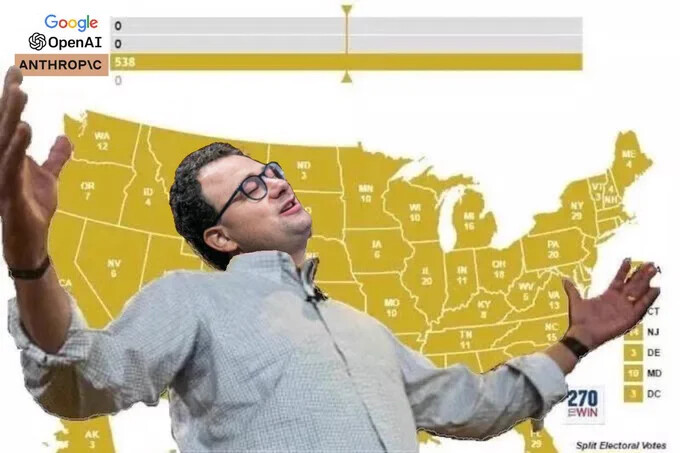
Unless they mean using a scaffold for Opus 4.5, but then someone else could create the scaffold on demand.
