These bulbs look interesting but they do not make near infrared light (NIR) which is what I’m after with my light panel and my NIR bulbs from NIRA.
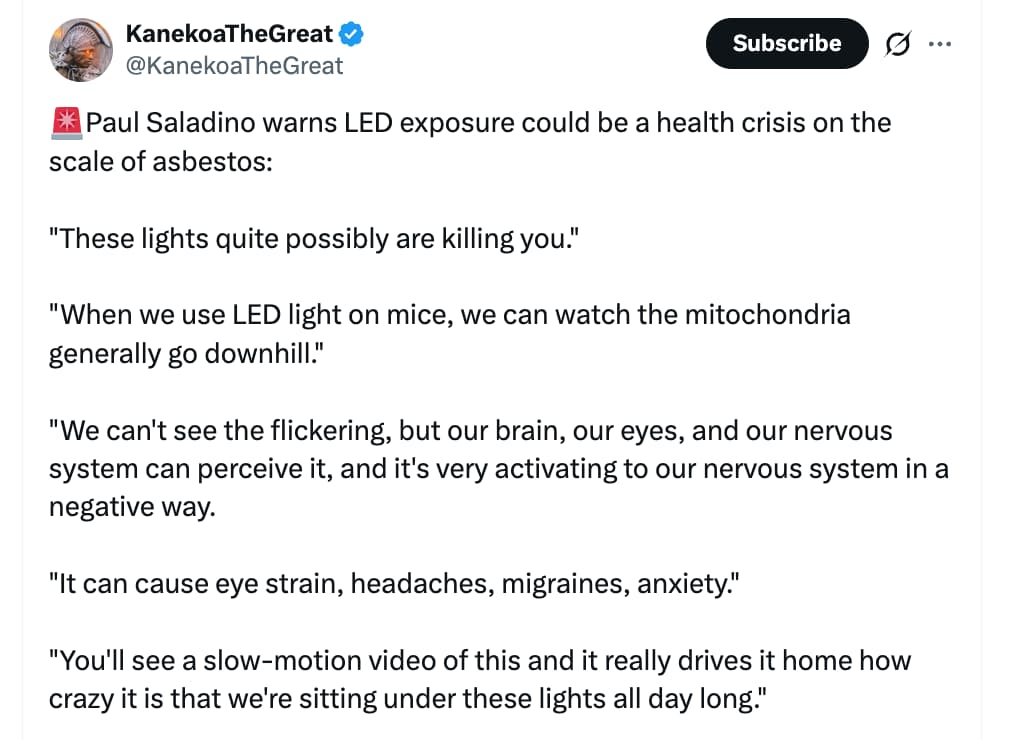
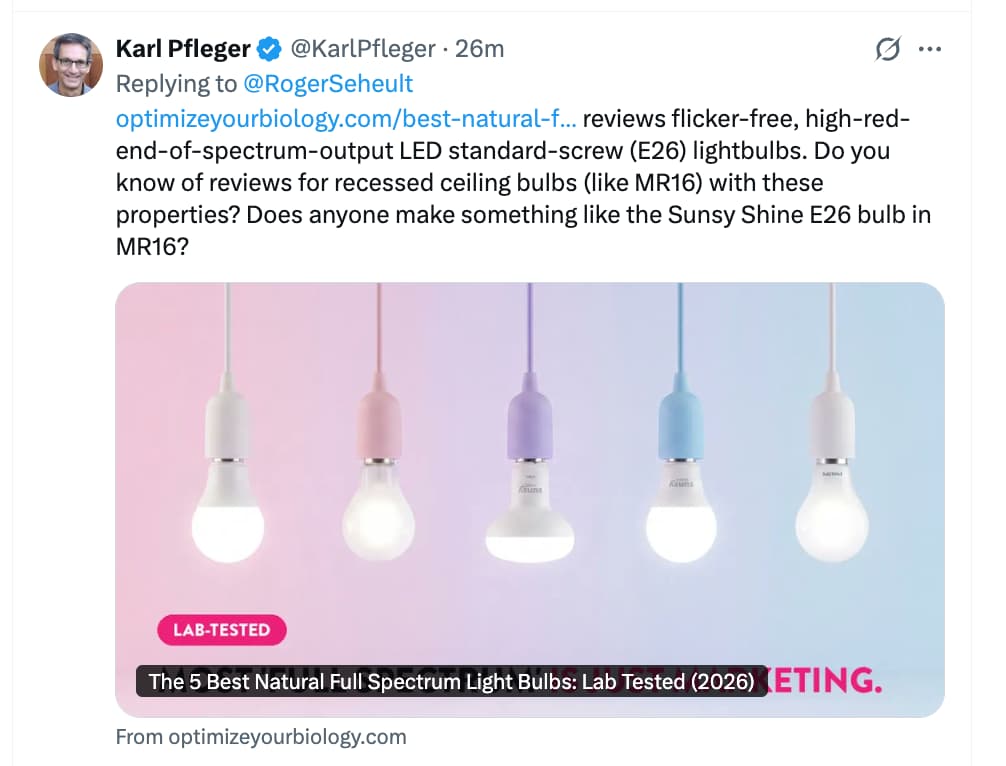
Source: Roger Seheult, MD on X: "Glad to see that this is gaining traction https://t.co/XFH6Bn9huY" / X
Surprising Fix for Eye Strain in LED Workspaces
I. Executive Summary
In this presentation, Dr. Roger Seheult of MedCram reviews a landmark study led by Dr. Glen Jeffery at University College London (UCL) (Jeffery et al., 2025). The investigation explores how modern commercial lighting—dominated by light-emitting diodes (LEDs)—impacts human visual performance and retinal bioenergetics. The central thesis posits that standard LED lighting engines undermine retinal function by omitting near-infrared (NIR, 700–1400 nm) wavelengths. Photoreceptor cone cells in the retina exhibit some of the highest mitochondrial densities in human tissue, utilizing high amounts of adenosine triphosphate (ATP) to maintain ion gradients and drive visual signal transduction. While traditional incandescent filaments emit broad-spectrum thermal radiation rich in NIR photons, energy-efficient LEDs restrict output to a narrow band of visible light (350–650 nm), starving retinal mitochondria of the longer wavelengths required to stimulate cytochrome c oxidase (Complex IV).
To evaluate whether supplementary near-infrared radiation mitigates LED-induced visual fatigue, researchers conducted a free-living trial involving 22 office workers stationed in an office building equipped with Low-Emissivity (Low-E) spectrally selective glass that reflects natural outdoor NIR radiation. Participants were randomized into two groups: a control group operating under standard LED overhead lighting, and an intervention group provided with a 60-watt desk-mounted incandescent lamp operated for two weeks. Color vision contrast sensitivity was assessed across Protan (red cone) and Tritan (blue cone) discrimination pathways.
Photoreceptor Structure and Inner Segment Mitochondrial Concentration. Source: ttsz / Getty Images
The intervention group demonstrated statistically significant improvements in color perception, lowering color discrimination error thresholds across both Protan and Tritan spectrums. Crucially, these visual performance gains persisted at 4-week and 6-week post-intervention follow-ups after the incandescent lamps were removed, suggesting that brief NIR supplementation induces sustained mitochondrial bioenergetic optimization or enzymatic remodeling rather than a transient acute stimulus. However, translational limitations remain: the trial’s cohort size was small (N=22), the intervention could not be double-blinded due to incandescent heat emissions, and regulatory energy efficiency mandates (e.g., US Department of Energy rules) continue to phase out consumer access to traditional incandescent bulbs.
II. Insight Bullets
- Retinal Mitochondrial Density: Retinal cone photoreceptors contain one of the highest concentrations of mitochondria in the human body, requiring substantial ATP production to drive phototransduction and ion pump homeostasis (Jeffery et al., 2025).
- Narrow-Spectrum LED Deficit: Commercial LED bulbs emit light restricted to a narrow visible band (350–650 nm), completely lacking the near-infrared (700–1400 nm) wavelengths inherent to natural sunlight and incandescent filaments.
- Mitochondrial Photobiomodulation Mechanism: Near-infrared photons penetrate deep into ocular tissue and are absorbed by cytochrome c oxidase (Complex IV), stimulating electron transport chain efficiency, oxygen consumption, and ATP synthesis (AIMS Biophysics, 2017).
- Architectural Infrared Deficits: Modern commercial buildings utilize Low-Emissivity (Low-E) window glass coatings that reflect up to 90% of ambient solar infrared radiation, creating indoor environments devoid of natural NIR light.
- UCL Office Worker Trial Design: The UCL study evaluated 22 office workers exposed to exclusive indoor LED lighting for over two years, comparing a 2-week desk-mounted 60W incandescent lamp intervention against unsupplemented controls.
- Significant Reduction in Color Error Thresholds: Supplementing LED workspaces with a 60W incandescent bulb significantly reduced color perception error thresholds across participants (Jeffery et al., 2025).
- Dual-Cone Pathway Adaptation: Incandescent supplementation restored visual performance in both Protan (red/long-wavelength cone) and Tritan (blue/short-wavelength cone) color discrimination pathways.
- Sustained Post-Intervention Gains: Visual performance improvements persisted for 4 to 6 weeks after removing the incandescent lamps, indicating long-term bioenergetic or protein remodeling rather than an acute, temporary effect.
- Free-Living Work Environment Efficacy: Unlike darkroom laboratory experiments, this trial demonstrated that unconstrained desk-lamp illumination in an open office environment produces measurable biological improvements.
- Age-Independent Visual Responsiveness: Both younger participants (mid-20s) and older office workers demonstrated reduced color discrimination error thresholds following NIR supplementation.
- Cytochrome c Oxidase Nitric Oxide Dissociation: Photobiomodulation via NIR wavelengths promotes the dissociation of inhibitory nitric oxide from cytochrome c oxidase, boosting mitochondrial respiratory turnover (AIMS Biophysics, 2017).
Spectral Emission Comparison Across Incandescent, Sunlight, and LED Sources. Source: Oleksandr Khoma / Getty Images
- Broad-Spectrum vs. Monochromatic Light: Incandescent lamps deliver a continuous blackbody spectrum spanning visible and infrared wavelengths (400–1500+ nm), yielding broader cone restoration than narrow single-peak LEDs (e.g., 670 nm).
- Metabolic Fatigue in Photoreceptors: Depriving retinal cone mitochondria of NIR photons under continuous LED lighting leads to localized bioenergetic fatigue, manifesting as dull color perception and visual strain.
- Regulatory Incandescent Phase-Outs: Department of Energy (DOE) energy efficiency mandates phase out general-service incandescent bulbs, forcing commercial and residential spaces toward narrow-spectrum LEDs.
- Consumer Exemption Workarounds: Specialized “rough service,” appliance, or vintage Edison filament bulbs remain exempt from energy bans, preserving access to full-spectrum 400–1500+ nm thermal light.
- Diurnal Response Sensitivity: Previous research by Jeffery’s laboratory confirms that morning exposure to red/NIR wavelengths yields superior retinal mitochondrial optimization compared to afternoon exposure (Shinhmar et al., 2021).
- Dimmer Switch Optimization Hack: Running a higher-wattage incandescent bulb (e.g., 100W) on a low dimmer setting extends bulb lifespan while delivering a high ratio of NIR-to-visible light.
- Circadian Protection Benefits: Incandescent bulbs emit low color temperatures (2700K or lower) without sharp 450 nm blue peaks, preventing evening melatonin suppression while supplying beneficial NIR.
- Lack of Double-Blinding in Thermal Trials: Incandescent bulbs generate radiant heat, making true double-blinding impossible in clinical trial settings.
- Public Health Implications for Workplace Lighting: Incorporating full-spectrum or NIR-supplemented lighting in windowless offices, hospitals, and schools could mitigate chronic visual fatigue and support ocular health.
IV. Actionable Protocol (Prioritized)
High Confidence Tier (Level A/B Evidence)
Protocols backed by peer-reviewed human clinical trials, ocular photobiology meta-analyses, and laboratory research.
-
Morning Natural Sunlight Photobiomodulation:
- Evidence Level: Level B Clinical Photobiology Evidence (Shinhmar et al., 2021).
- Protocol: Spend 10 to 20 minutes outdoors shortly after sunrise without sunglasses (never looking directly at the sun). Early morning sunlight provides high NIR-to-UV ratios that stimulate retinal mitochondrial function and anchor circadian rhythms.
-
Targeted 670 nm Deep-Red Retinal Therapy:
- Evidence Level: Level B Human Clinical Trial Evidence (Shinhmar et al., 2021).
- Protocol: Administer a single 3-minute session of low-intensity 670 nm deep-red light (diffuse, sub-sensory irradiance) once per week between 8:00 AM and 9:00 AM to improve color contrast sensitivity in aging eyes.
Experimental Tier (Level C/D Evidence)
Protocols derived from small-cohort preprints, free-living office pilot trials, or bioengineering consensus.
-
Supplemental Desk-Mounted Incandescent Workspace Lighting:
- Evidence Level: Level C Free-Living Pilot Trial (Jeffery et al., 2025).
- Protocol: Place a 25W to 60W incandescent desk lamp within your immediate field of view in LED-dominated workspaces. Keep the lamp illuminated during working hours to supply continuous NIR photons to the eyes and skin.
-
Dimmed Incandescent Bulb Optimization:
- Evidence Level: Level D Bioenergetic / Optical Consensus.
- Protocol: Install a high-wattage (75W–100W) rough-service or vintage filament incandescent bulb paired with a dimmer switch set to a low power setting. Dimming reduces visible light and thermal heat while maintaining output in the near-infrared spectrum.
Red Flag Zone (Safety Data Absent / High Risk)
Unverified, hazardous, or biologically flawed lighting practices.
-
Direct Eye Exposure to High-Intensity Heat Lamps or Uncalibrated NIR Lasers:
- Status: Severe Hazard / Safety Data Absent.
- Risk Assessment: Staring into high-wattage industrial heat lamps or uncalibrated infrared lasers risks thermal corneal burns, cataractogenesis, and permanent retinal phototoxicity.
-
Assuming Standard Commercial LEDs Provide Therapeutic Infrared Light:
- Status: Debunked Fallacy.
- Risk Assessment: Believing that bright white commercial LEDs deliver photobiomodulation benefits is biologically false; standard LEDs completely lack the 700–1400 nm wavelengths required for mitochondrial activation.
Produced by Gemini 2.0 Flash
The Best Red & Infrared Light Source(s) for Mitochondrial, Eye & Hormone Health

I. Executive Summary
In this presentation, Dr. Andrew Huberman addresses consumer inquiries regarding red and near-infrared (NIR) light therapy, evaluating whether commercial hardware is necessary for mitochondrial, ocular, and systemic metabolic health. Huberman posits that natural sunlight serves as the most potent, full-spectrum, and zero-cost source of photobiomodulation (PBM). Sunlight encompasses the complete visible spectrum alongside non-visible ultraviolet (UV), near-infrared (700–1100 nm), and far-infrared wavelengths. At low solar elevations (early morning and late afternoon), Rayleigh scattering preferentially scatters shorter UV and blue wavelengths through a thicker atmospheric column, yielding a higher relative proportion of longer red and NIR wavelengths. This optical window allows individuals to capture mitochondrial-stimulating photons with minimal concurrent ultraviolet radiation hazard.
Rayleigh Scattering Atmospheric Spectrum Filtering. Source: Dimitrios Karamitros / Getty Images
Mechanistically, photobiomodulation relies on photon absorption by mitochondrial chromophores, principally cytochrome c oxidase (Complex IV of the electron transport chain) (Jeffery, 2021). Red and NIR light absorption promotes nitric oxide dissociation, enhances mitochondrial membrane potential, increases adenosine triphosphate (ATP) synthesis, and modulates reactive oxygen species (ROS) signaling to reduce systemic inflammation (Masalkhi et al., 2023). While Huberman recommends a 15- to 30-minute daily exposure protocol over maximum culturally appropriate skin surface area, he emphasizes critical safety boundaries: monitoring the UV index to prevent photocarcinogenesis and strictly refraining from direct solar viewing to avoid irreversible retinal phototoxicity.
Critically, while natural sunlight provides broad-spectrum ambient photobiomodulation, it presents technical trade-offs compared to specialized light-emitting diode (LED) panels. Commercial medical-grade LED devices—such as those manufactured by Joovv, a disclosed financial sponsor of Huberman’s podcast—deliver concentrated, single-wavelength irradiance (typically 630–660 nm and 810–850 nm) at high energy densities (20 to 50 mW/cm²) without UV contamination or seasonal dependence (Dior x Lucibel Trial, 2023). While sunlight remains an accessible foundational practice for general circadian and bioenergetic support, targeted clinical applications—such as localized wound repair, deep joint treatment, or age-related retinal cone restoration—frequently require calibrated, high-irradiance artificial devices. Ultimately, consumers must separate foundational environmental photobiology from targeted clinical PBM dosing, prioritizing free solar exposure while reserving commercial panels for light-restricted environments or specific therapeutic deficits.
II. Insight Bullets
- Full-Spectrum Solar Irradiance: Natural sunlight serves as the primary, zero-cost source of broad-spectrum visible (400–700 nm), near-infrared (700–1100 nm), far-infrared, and ultraviolet radiation (Dior x Lucibel Trial, 2023).
- Rayleigh Scattering Atmospheric Filtering: Atmospheric scattering of light is inversely proportional to the fourth power of the wavelength. At low solar angles (sunrise/sunset), shorter blue and UV wavelengths scatter heavily, enriching relative red/NIR ratios (Mitochondrial Signal Transduction, 2004).
- Mitochondrial Chromophore Target: Photobiomodulation (PBM) relies on photon absorption by cytochrome c oxidase (Complex IV), stimulating respiratory chain electron transfer and cellular energy production (Masalkhi et al., 2023).
- Nitric Oxide Dissociation: Red and NIR photons induce the dissociation of inhibitory nitric oxide (NO) from cytochrome c oxidase, restoring oxygen consumption and ATP synthesis (Masalkhi et al., 2023).
- Retinal Photoreceptor Bioenergetics: Aged retinal cone photoreceptors possess high mitochondrial density; exposure to low-intensity 670 nm red light enhances ATP production and mitigates age-related visual decline (Arujo et al., 2015).
- Retinal Phototoxicity Hazard: Staring directly at the sun or high-intensity focused light sources causes thermal and photochemical damage to the retinal pigment epithelium, risking central scotomas (Jeffery, 2021).
- Systemic Surface Area Exposure: Bioenergetic benefits of solar PBM scale with exposed skin surface area, requiring culturally appropriate maximum exposure to optimize cutaneous photon capture.
- UV Index Autoregulation: Monitoring real-time UV index is essential to separate beneficial low-UV red/NIR exposure windows from high-UV periods that induce DNA pyrimidine dimers and erythema.
- Low Solar Elevation Safety Window: Sunlight exposure when the sun is near the horizon minimizes cumulative UV radiation while delivering therapeutic red and near-infrared wavelengths.
- Targeted LED Irradiance vs. Sunlight: Commercial PBM devices deliver concentrated single-wavelength power density (20 to 50 mW/cm²), whereas sunlight delivers lower per-wavelength power distributed across a continuous spectrum.
- Narrow-Band Spectral Precision: Artificial PBM panels utilize specific narrow peaks (e.g., 630 nm, 660 nm, 810 nm, 850 nm) optimized for tissue penetration depth, avoiding non-therapeutic spectral bands.
- Seasonal and Geographic Light Deficits: High-latitude winter environments and overcast weather significantly reduce ambient NIR solar irradiance, making targeted artificial light sources clinically relevant.
- Podcast Financial Disclosures: Commercial endorsements (e.g., Joovv sponsorship) highlight the necessity of distinguishing evidence-based photobiology from commercial brand promotion.
- Medical-Grade Panel Criteria: True medical-grade LED panels require independent irradiance testing, third-party EMF shielding, and specific joule-density delivery metrics rather than simple consumer branding.
- Red vs. Near-Infrared Depth Penetration: Red light (600–700 nm) is primarily absorbed in cutaneous epidermal/dermal layers, whereas near-infrared light (700–1100 nm) penetrates deeper into muscle, joint, and neural tissue (Fibroblast MMP Study, 2023).
- Biphasic Dose-Response Curve (Arndt-Schulz Law): Photobiomodulation exhibits a biphasic dose-response where insufficient light yields no effect, optimal energy density stimulates cellular repair, and excessive irradiance causes bioenergetic inhibition or ROS damage (Fibroblast MMP Study, 2023).
- Transient ROS Signaling: PBM induces low-level, transient reactive oxygen species (ROS) spikes that act as hormetic signaling cues to upregulate endogenous antioxidant defense systems.
- Circadian Phase Entrainment: Early morning sunlight exposure combines NIR mitochondrial activation with blue light melanopsin activation in intrinsically photosensitive retinal ganglion cells (ipRGCs) to anchor circadian rhythms.
- Endocrine and Metabolic Modulation: Cutaneous photobiomodulation modulates systemic inflammatory cytokines and local tissue metabolism, though direct human endocrine optimization requires further high-power RCT validation.
- Zero-Cost Accessibility: Sunlight provides an equitable, universally accessible biohacking modality that replicates foundational photobiological signaling without hardware expenditure.
IV. Actionable Protocol (Prioritized)
High Confidence Tier (Level A/B Evidence)
Protocols backed by clinical trials, systematic photobiology reviews, and established optical radiation safety guidelines.
-
Low Solar Elevation Photobiomodulation Protocol:
- Evidence Level: Level B Clinical Photobiology Evidence (Mitochondrial Signal Transduction, 2004).
- Protocol: Expose maximum culturally appropriate skin surface area to natural sunlight for 15 to 30 minutes daily during low UV index windows (early morning or late afternoon).
-
Targeted 670 nm Low-Intensity Retinal Photobiomodulation:
- Evidence Level: Level B Human Clinical Trial Evidence (Arujo et al., 2015).
- Protocol: Utilize a calibrated 670 nm diffuse red light source (8 to 10 mW/cm²) for 3 minutes in the morning 2 to 3 times per week to support aging retinal cone photoreceptor ATP production.
-
Real-Time UV Index Autoregulation:
- Evidence Level: Level A Public Health Consensus (PMC3263051).
- Protocol: Check local UV index data prior to solar exposure. Limit unshielded exposure when UV index exceeds 3 to avoid DNA damage, photoaging, and photocarcinogenesis.
Experimental Tier (Level C/D Evidence)
Protocols backed by small clinical pilot studies, in vitro mitochondrial assays, or commercial hardware specifications.
-
Targeted High-Irradiance LED Panel Therapy:
- Evidence Level: Level C Clinical Trial Evidence (Dior x Lucibel Trial, 2023).
- Protocol: Position a medical-grade dual-wavelength LED panel (630–660 nm red and 810–850 nm NIR) 6 to 12 inches from target tissue for 10 to 15 minutes per session (delivering 10 to 20 J/cm²). Utilize during winter months or in overcast geographical locations.