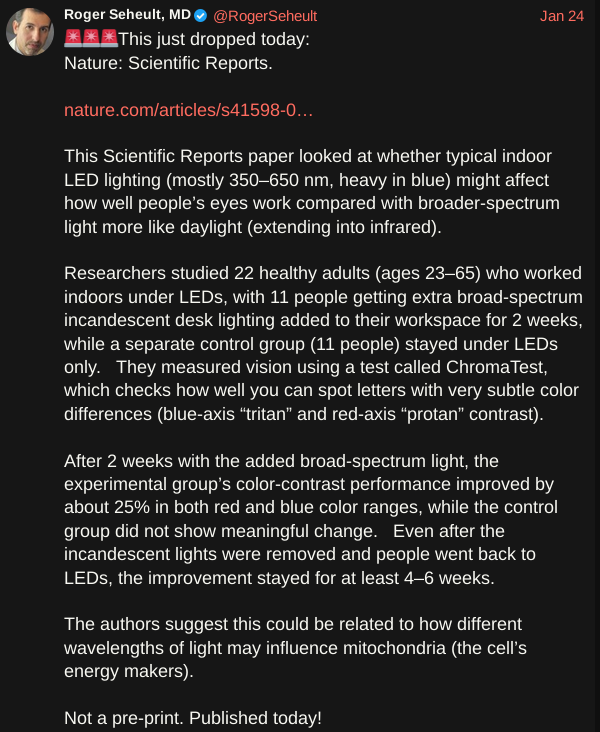
I haven’t looked into this yet. If true not that difficult or very expensive to use other light sources.
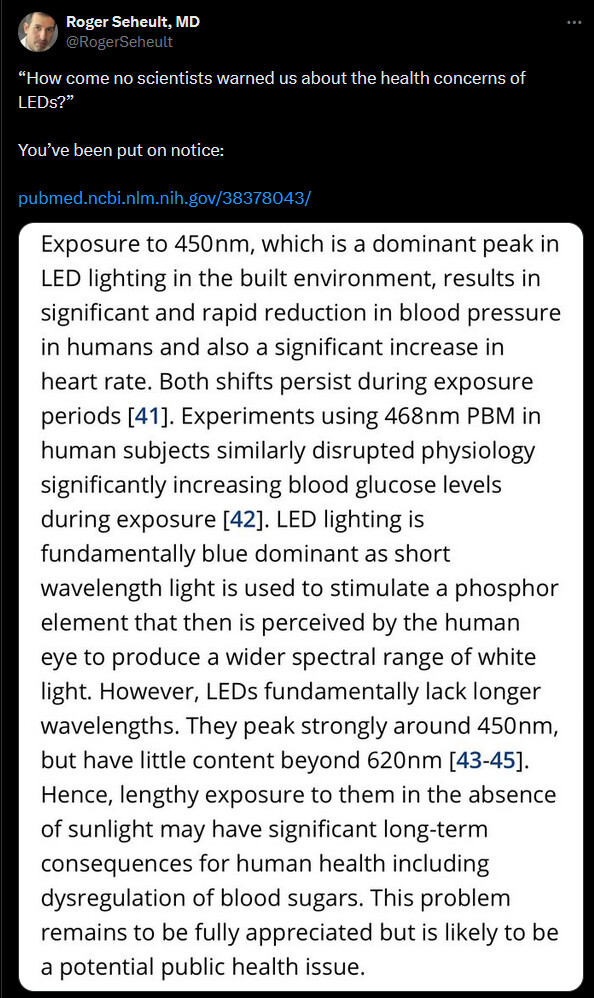
I haven’t looked into this yet. If true not that difficult or very expensive to use other light sources.
So, is it too much LED exposure or too little sunshine that is the problem?
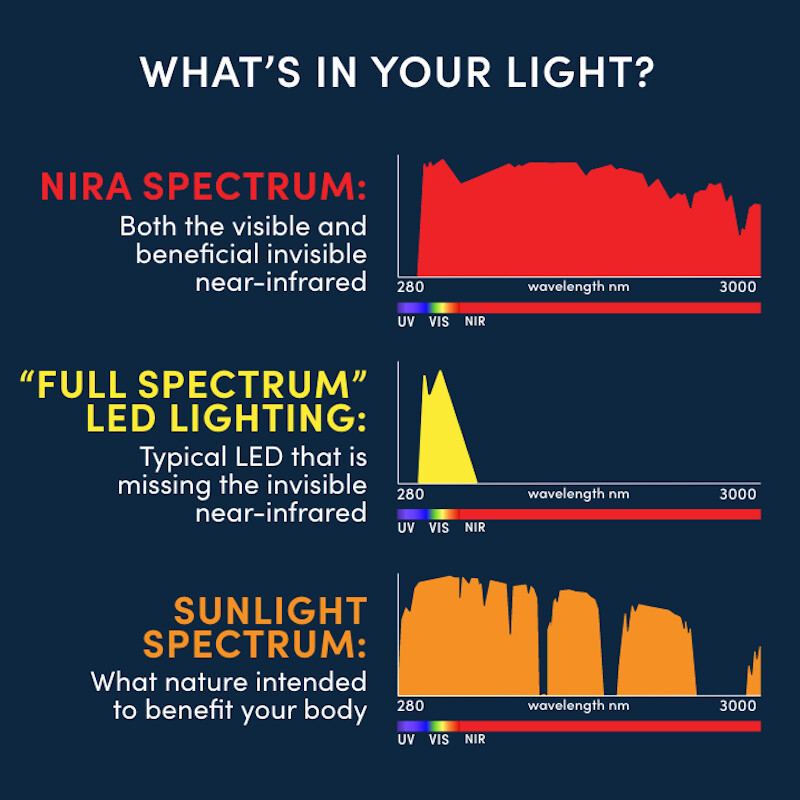
I interviewed Scott Zimmerman recently. He makes the Nira bulbs. He says to go outside to get full spectrum light but if you are stuck indoors, get as close to real full spectrum as possible. His bulbs use low power incandescent filaments for red and NIR wavelengths plus a LED for visible light.
The problem is a lack of red / NIR. LEDs don’t make it and windows block it.
Red / NIR cause mitochondria to make more ATP while blue wavelengths decrease ATP production. The blue is not bad unless it comes without red /NIR, which never happens in nature.
Episode coming out shortly.
I have changed my mind for now since incandescent light bulbs seems to emit UV.
I would need to be sure that a light source doesn’t emit UV or other harmful light to be sure to use it.
These are $27 per bulb?
Yes. With a 50,000 hour life that’s about 25-50 years and about $0.50-$1.00 per year. Might be worth it. I bought the lamp and a bulb to get the DC power (no flicker).
Dr. Mercola talked a lot about this several years ago. Recommended adding incandescent lights for more red and NIR which is healthier. Of course, getting outside for real broad-spectrum sunlight is even better.
There are tons of red/NIR light pads on the market (most are roughly 850nm and 450nm lights), and they are all made from LED light chips. Also I have amber bulbs (there’s no coating on the bulb, but it burns Amber), and those are LED. I have a red light reading light (which is pathetic, but that’s another story) from one of the anti-blue light places that’s also a non-coated LED-produced hue. LED can make red and infrared fine, though of course there’s more to the quality of light than its nm output.
So LEDs can and do make the red spectrum. I’m not sure what the reasoning is to use some incandescent for that part of the spectrum,
I find my response to lighting is complex. As a kid, CFLs always bothered me and caused pre-syncope in too great an amount (I hated shopping malls back when they were a thing because of how CFLs made me feel). LEDs tend to be somewhat less aggravating than those.
Full spectrum light seems to miss the mark for visually/neurologically sensitive people because it’s usually actually bluer than the standard CFLs,/LEDs, and the artificially manufactured blue seems to have a quality that disturbs when overabundant.
I have a couple of full spectrum incandescents in my closet that I couldn’t tolerate very well and so kept unscrewing and replacing from every place I tried to use them. (I usually do find incandescents superior, but apparently still only in a warmer hue.)
The glare or flicker of a soft white can cause problems for the eyes and neurological system but more subtly. I guess in this study, though, they must have been comparing a very harsh bright white office white to full spectrum light where the full spectrum was a little softer by dint of having some nuance.
Personally, although I have a tiny stash of incandescents, I’ve been transitioning to LEDs—just struggling to find non-flicking, non-buzzing, long-lived bulbs with pleasant hues. I’m not sure we’re saving the environment via LEDs considering how junky most bulbs prove to be.
I’d say that the argument goes the other way. If you can use an incandescent bulb to create a wide spectrum of light waves, why would you replace that with many, many LEDs of specific wavelengths or how would you decide which wavelengths are unnecessary? In other words, an incandescent bulb is easier and covers all the bases in one fell swoop.
Actually there’s no argument from me at all. I was just pointing out some facts. I prefer incandescent and, given how poorly designed most LEDs are, I’m not convinced we’re saving the environment by switching, but it is what it is.
The incandescents specifically marketed as full spectrum go really heavy on violets and blues and such and hurt my eyes/brain though.
Got it. I use the NIRA Lighting lamp which combines an LED for white light with an incandescent filament for NIR (low power incandescent for low visible light). I can turn off the LED if it feels bright or at night. I find all bright “white” light gives me a headache after a while.
To benefit from this NIRA lamp light do you have to be under the light (light goes down on you like in a table lamp)? Is there any benefit if used in a floor lamp (light is directed upward toward ceiling)? How do you use it, in what kind of lamp?
I use a table lamp that points directly on me about 2 feet away. (Actually 2 bulbs so 2x). The issue is the power of the lamp and the distance. When outside, the sun is powerful enough that 93 million miles is a good thing. You can get NIR benefit from cracking open the car window to let in NIR or sitting under a tree that reflects NIR. But my lamp is not powerful so I try to sit close to it for hours at a time (it is on my work desk). When I use my red /NIR light (more powerful) for 20 minutes a day, I place it directly on my skin. Overall the NIR desk lamp is probably a small thing but I do it every weekday for 8 hours with no effort or thought. Marginal gains including feeling like I’m doing something good for a $100 lifetime cost. If only I could say I only wasted $100 on supplements.
Thank you. It tells me that I won’t benefit from a NIRA lamp bc I wouldn’t sit under it at all. I would probably benefit from red/Nir light. Is it a red light panel that you use or a mat that you can put directly on your skin?
As it’s currently pretty cold here in Boston, I spend all my evenings in front of my wood stove.
Basically it’s around 10.5 fo 11.5 kilowatts! Vastly more than the milliwatts of the LED panels!
More detail below for those interested.
I use a mitoredlight desktop lamp. It was highly rated a few years ago. I didn’t know anything about the red / NIR panels when I got it. I got lucky. It has been used daily for 3 years. Dropped a couple times. Zero issues. Incredibly durable. I use it without thinking now; it’s a normal part of my morning routine. I use it on my feet (put my feet bottoms on the light panel) more than anything now a days. I used it in my shoulders for pain relief for a year until I didn’t have shoulder pain any longer. I love it.
I use red light/infrared quite a bit–mostly in pad form which could be more durable (alas).
Btw, for those looking for normal-priced lightbulbs and, also, for those like me who may mostly need warm white light, I’ve recently been getting Sylvania TruWave bulbs. And they seem good for the price point and certainly an improvement on the no name bulbs that are all over now. They make fairly similar claims to the fancy bulbs, and they are available in the whole range of whites. My Feit 3 way bulb which has a 90 CRI score also seems way better than the random brands I was trying to make do with before.
For me the real remaining lighting problem in my living situation is that my pale, sensitive eyes end up having light shining in them from in front when they do many, many times better if they can have light shining down on them from overhead and/or behind (preferably both). But my living situation just isn’t adjustable on that front.