Paper: Reversal of protein chemical aging by enzymatic deglycation
https://www.nature.com/articles/s41467-026-75141-2
An Enzyme That Un-Ages Your Proteins: Scientists Build the First Tool to Erase a “Permanent” Mark of Aging
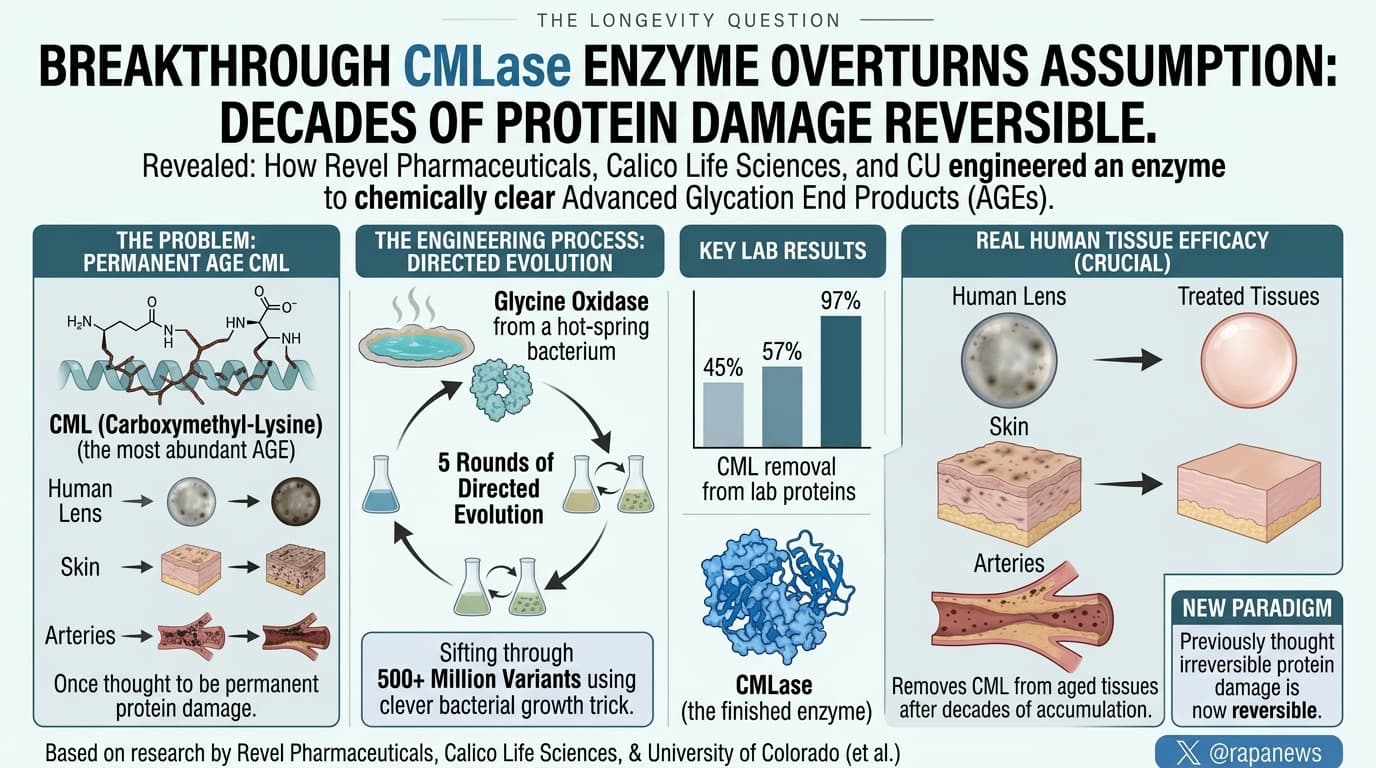
Researchers from Revel Pharmaceuticals and Calico Life Sciences engineered a novel enzyme, called CMLase, that chemically reverses one of the classic molecular scars of aging. The target is carboxymethyl-lysine (CML), a sugar-derived adduct that builds up over decades on long-lived proteins and was long considered permanent. Using directed evolution across more than 500 million enzyme variants, the team converted a bacterial glycine oxidase into a catalyst that snips CML off proteins and restores the original lysine. In test tubes and in donated human lens, skin, and artery tissue, CMLase removed roughly half to more than three-quarters of accumulated CML. This is a proof-of-concept for enzymatic repair of aged proteins, not a therapy, and no living animals or people were treated.
For decades, the accumulation of advanced glycation end products, or AGEs, has been treated as a one-way street. Sugars and reactive metabolites react with proteins, leaving behind sticky chemical adducts that stiffen tissue, drive inflammation, and cannot be undone. The most abundant of these, carboxymethyl-lysine (CML), sits on proteins that the body almost never replaces, such as the crystallins in the eye lens and the collagen in artery walls and skin. Because these proteins turn over so slowly, the damage compounds across a lifetime. CML also plugs into a receptor called RAGE, which switches on chronic inflammatory signaling. Blocking new AGE formation has been tried for years, but nothing could remove the CML already there.
This study changes that premise. The team took a bacterial glycine oxidase, an enzyme whose natural job has nothing to do with aging, and reasoned that its active site was chemically close enough to grab the glycine-like fragment of CML. They then ran the protein through five rounds of directed evolution, a laboratory version of natural selection, screening a cumulative half-billion variants using a clever bacterial growth trick that only let cells survive if their enzyme could clip CML off a peptide. The winning variant, CMLase, carries fifteen amino acid changes and a small deletion, and it does something no reported enzyme has done before: it removes CML from full-length, intact proteins and hands back the native lysine, along with harmless byproducts.
The headline result is that CMLase works on real human tissue that has aged naturally. In lens protein from a 64-year-old donor it cut CML by 45 to 78 percent depending on the measurement. In artery tissue from a 75-year-old it reduced CML staining by more than 70 percent, and in elderly skin by more than 55 percent, pushing skin back below the level seen in a 31-year-old.
The big idea is a shift in philosophy. Instead of only slowing damage, aging repair may become a matter of engineering enzymes to erase specific molecular scars. The authors are candid that this is a starting line. They showed the chemistry can be reversed, but not yet that reversing it restores tissue function or works inside a living body.
Actionable Insights
What the paper does reinforce is the causal importance of CML burden, and the practical corollary is prevention rather than reversal. Because the accumulated pool took decades to build and no approved tool removes it, the only lever an individual currently controls is reducing new AGE formation. The effect sizes worth internalizing are the tissue removal figures that show how much CML sits there to begin with: a 45 to 78 percent reducible pool in aged lens, greater than 70 percent in aged artery, and greater than 55 percent in aged skin. Roughly three-quarters of the CML in a 75-year-old artery is chemically addressable, which quantifies how large a target glycation is. Until a therapy exists, the evidence-aligned moves remain glycemic control, limiting dietary AGEs from high-heat cooked and processed foods, and avoiding smoking, all of which reduce the inflow that CMLase is being built to one day reverse. Treat this as a signal about where longevity medicine is heading, not as an intervention yet.
Context / Source
-
Full title: “Reversal of protein chemical aging by enzymatic deglycation.”
-
Institutions and country: Revel Pharmaceuticals Inc. (San Francisco, California, USA), Calico Life Sciences LLC (South San Francisco, California, USA), and the University of Colorado Anschutz Medical Campus, School of Medicine (Aurora, Colorado, USA). United States.
-
Journal: Nature Communications (2026), volume 17, article 5926.
-
Impact evaluation: The impact score of this journal is 15.7 (2024 Journal Impact Factor; CiteScore approximately 24.8), evaluated against a typical high-end range of 0 to 60+ for top general science journals, therefore this is a High impact journal.