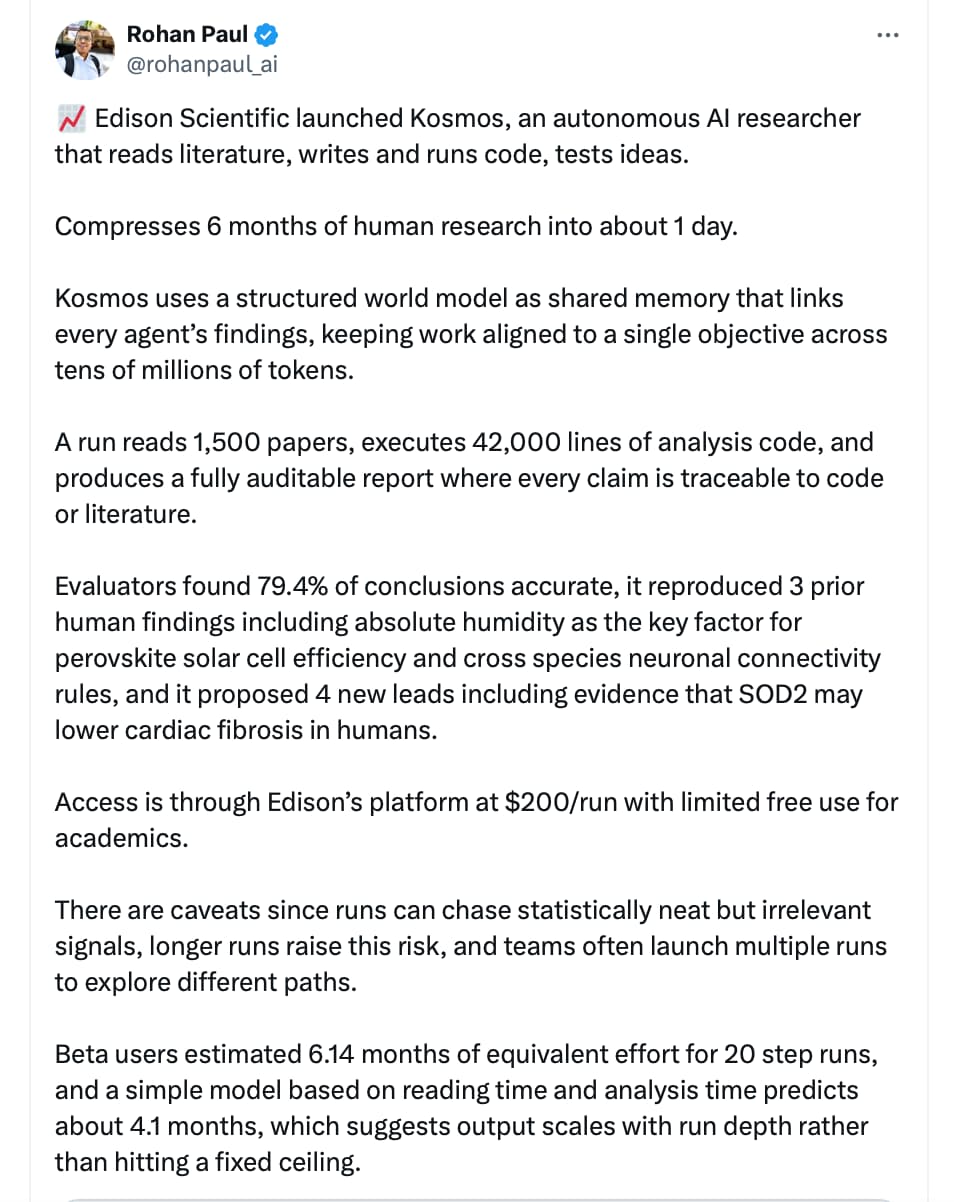
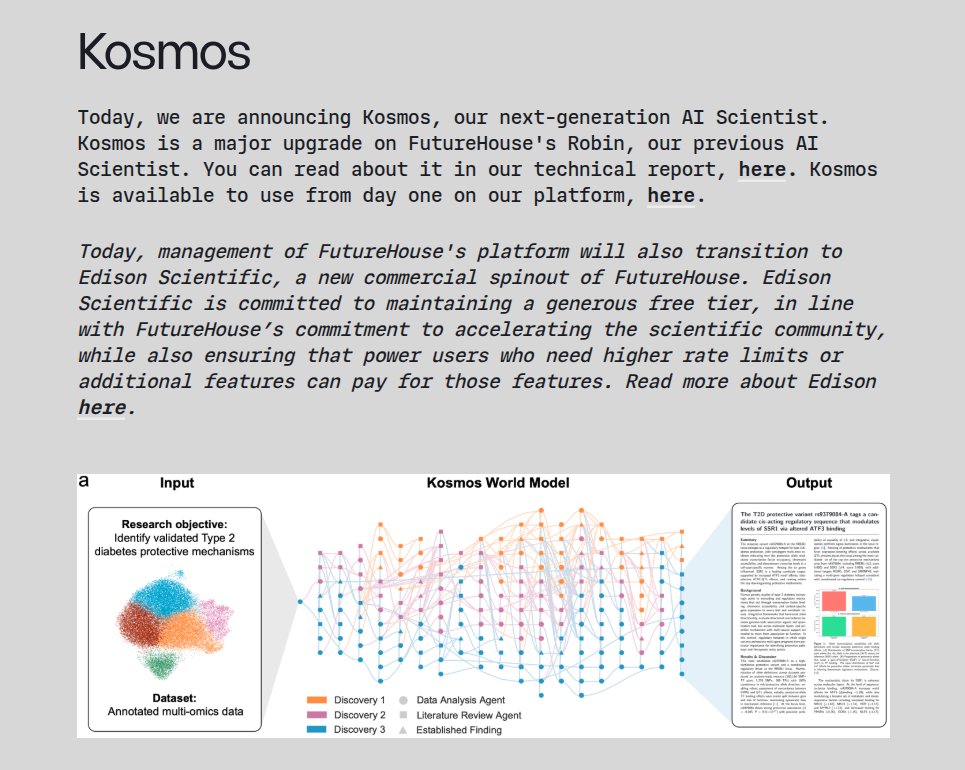
related K-Dense
it’s nice to stock up some prompts to use them in batch later…
https://app.k-dense.ai/share/session_20260119_113716_05b0fba1834d
This will be incredibly powerful but I suspect there is a real art to crafting an effective prompt.

[and he is one of the smartest MOST visionary people in the area, along with patrick hsu]
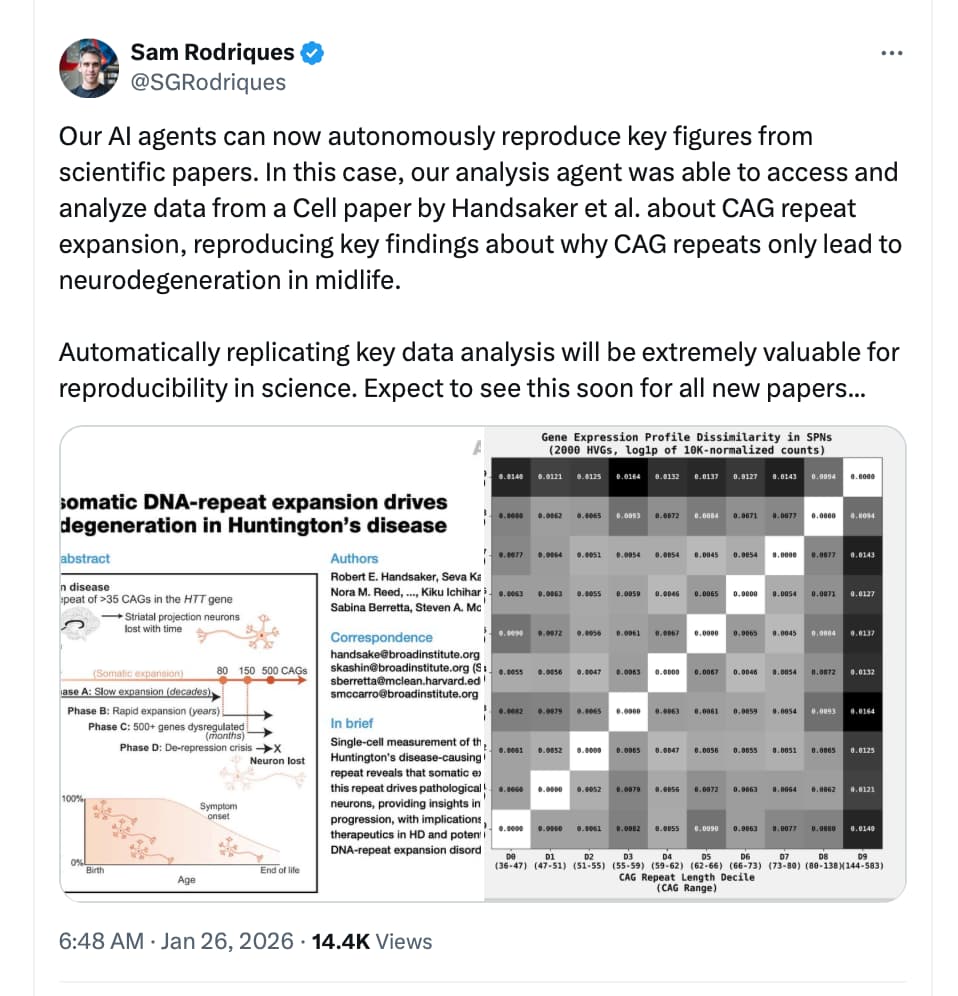
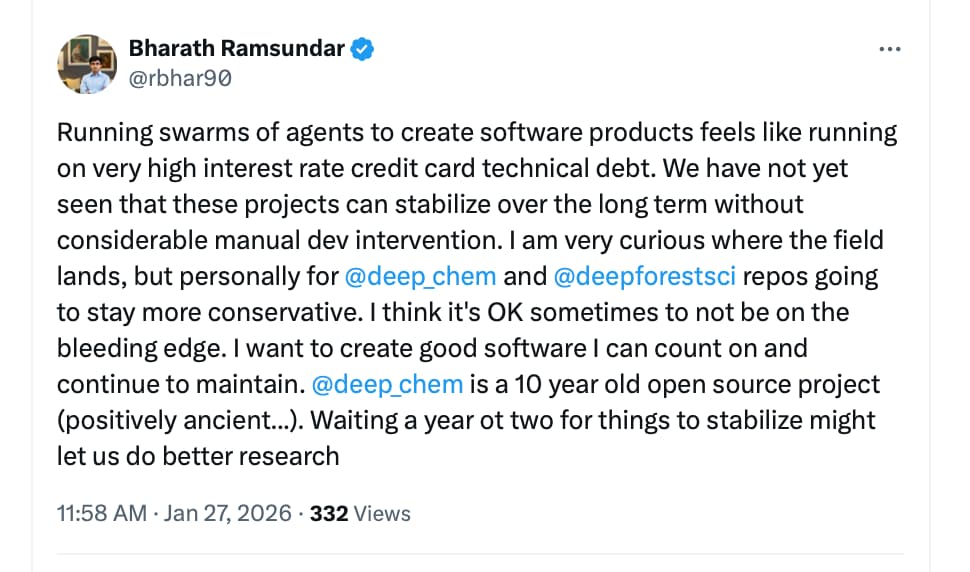
https://x.com/rbhar90/status/2016239480458657953
==
higher-order knowledge representations for agentic scientific reasoning: https://arxiv.org/pdf/2601.04878
AI has fundamentally changed coding and research, at least 5× faster.
Publishing papers alone matters less now.
The only real standard is: can your work be used to train or improve AI models?
Introducing Prism, a free workspace for scientists to write and collaborate on research, powered by GPT-5.2. Available today to anyone with a ChatGPT personal account: https://prism.openai.com
Speaking of Prism… I tried Prism a few days ago. It might be bad news for Overleaf as a company, but I’ll continue using Overleaf to write my papers.
Prism did a good job on some of my tasks. One was to take a kind of “pidgin LaTEX” that I sent in an email to a grader and turn it into a readable, presentable solution sheet that students could read. It worked very well, and made good stylistic decisions.
Next I asked it to create a “makeup exam” of problems similar to ones I gave before, and it did less well. It’s good at solving problems, but less good at extrapolating to come up with equally interesting problems in the same general area.
Addendum: It doesn’t do particularly well at writing solution sheets – it screws up a lot (maybe it uses an older GPT-5 model, like GPT-5.1 or something, as it missed almost every single problem, and even after I gave it hints!). I also tried to see if it would help with adding tags and metadata to LaTeX files to make them Title II accessibility compliant (a huge pain in ass right now in departments across the country!), and it nailed it for the first file, then failed with the second one. If OpenAI could just nail that one thing (making Latex documents Title II compliant), that would be a huge benefit, putting them ahead of Overleaf.
#ai4science
boltz
(dont forget latch.bio and DeepOrigin)
of these, which is most accessible for agents like those on beach.science?
Analemma
cause clearly more and more research in longevity will be done by automation/agents
Today we’re launching Orchestra — the world’s first Research IDE.
But let me tell you why this exists.
Research is an infinite game. Open-ended by nature, long-horizon by necessity. You’re constantly cycling between reading, brainstorming, executing, interpreting, and rethinking. Every step demands real depth. And the published papers tell a clean story — but the reality is months of dead ends, pivots, and scattered ideas that live in 14 browser tabs and Slack threads you’ll never find again.
I’ve lived this. And I kept asking the same question: every developer has an IDE — why don’t researchers?
Not another chatbot. Not another paper summarizer. A proper IDE — where you ask a research question, AI agents explore different directions simultaneously, experiments run on real GPUs, and a living canvas captures every hypothesis, dead end, and breakthrough along the way. You direct the research. The platform handles everything else.
Orchestra is the first platform where you direct AI agents the way a PI directs a lab. A project manager orchestrates your agents — they provision compute, run experiments, stream live metrics, and report back. You stay commander-in-chief while they execute in parallel.
We also open-sourced 86 AI research skills (6,000+
on GitHub) — from idea generation to RL training to distributed inference — because we believe expert knowledge shouldn’t be a privilege.
But this is just the beginning. We’re building the foundational platform for a future where humans collaborate with AI to push the frontier, AI agents collaborate with each other to explore at scale, and researchers everywhere collaborate across borders and disciplines. The next scientific breakthroughs won’t come from one genius in a lab. They’ll come from orchestrated intelligence — human and artificial, working together.
Curiosity shouldn’t be limited by infrastructure. Ideas shouldn’t wait for resources. We built Orchestra so that a student in a dorm room has the same research firepower as a world-class lab.
Because science belongs to the curious, not the privileged.
Website: https://lnkd.in/gRhFvsrf
Blog: https://lnkd.in/eSKXspci
Demo: https://lnkd.in/eJE-JwSg
If this resonates, please help us spread the word — a like or retweet on our launch tweet means the world to a small team: https://lnkd.in/ektK-QQv
Grateful to be building this with Jiachen (Amber) Liu, at Vercel Accelerator and Pear VC— surrounded by people who believe in what we’re doing.
We’re just getting started.
Aggh $800 in boltz credits expiring today in biomni what to do what to do
remember these new things (like claude and chatgpt and uber) are heavily subsidized at the beginning so make most use of them when you can
Introducing ScienceBuddy
with
(Muchen AI) as our joint R&D partner. How it works (Recursive-in-Recursive Self-Improvement): Instead of a static tool, ScienceBuddy uses two loops:
You help refine the agent’s skills and harness (Inner loop).
Read the paper: https://arxiv.org/abs/2609.17523
Star on GitHub: https://github.com/Gen-Verse/Scie