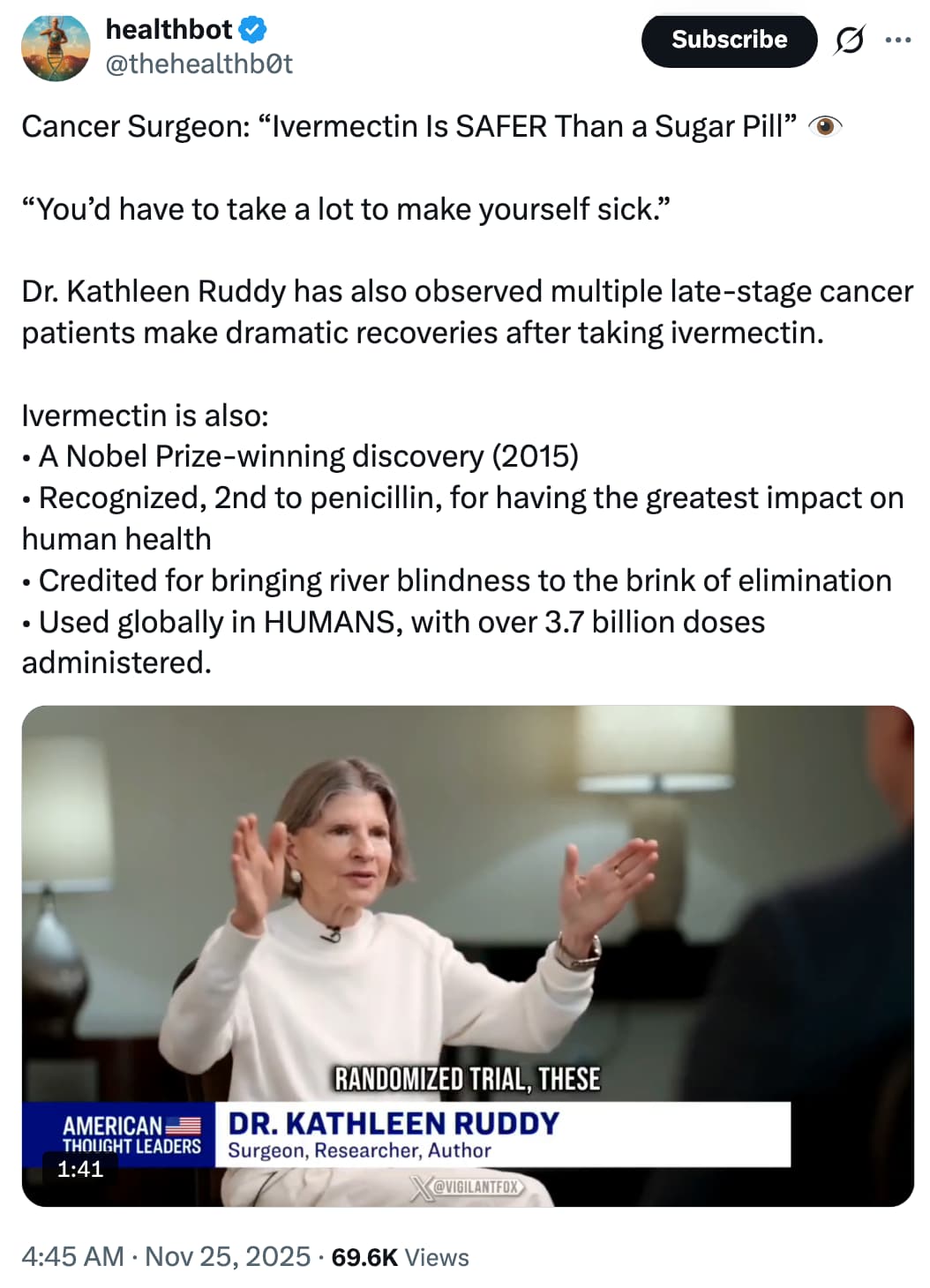
Sure, zero risk of serious side effects except those noted below:
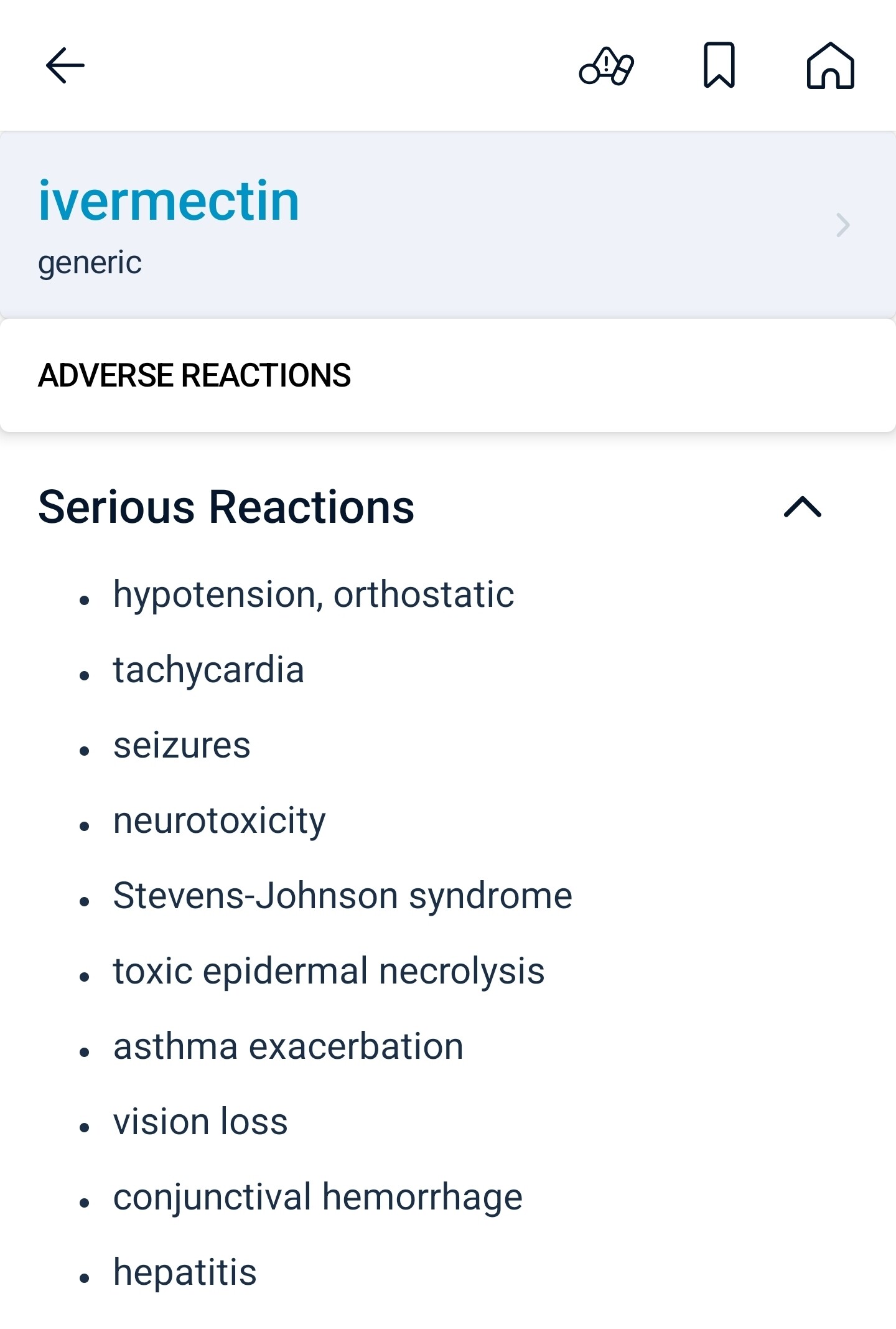
I very much agree with the advice “only use it if you need it”.
Sure, zero risk of serious side effects except those noted below:
I very much agree with the advice “only use it if you need it”.
Am also worried about taking out my good microbiomes?
Have not had that worry, here’s what the AI says:
Ivermectin appears to have minor and temporary effects on the gut microbiome, according to research. A study using a simulator of the human intestinal microbial ecosystem found that ivermectin did not cause significant dysbiosis or adverse effects when administered to healthy adults. Interestingly, the presence of soluble fiber in the diet seemed to protect the gut microbiota from ivermectin’s influence, even leading to an increase in short-chain fatty acid production.
There has also been speculation that ivermectin might promote bifidobacteria, potentially boosting immunity, but this hypothesis has been flagged for concerns and is under investigation.
When I had Covid, I drank a cup of bleach. It knocked out the virus and turned my poop white.
I took 12mg of IVM a day for years. Used it to keep from getting sick while traveling, gave me a mood boost/lowered anxiety, and made my face look younger. Hard to describe that last one.
I read something about it potentially impacting fertility. Took a sperm test and found I did show lower motility and count. So nixed it while I and the wife try and get pregnant
I would consider going back on it down the line.
This is an interesting topic to read if interested in Ivermectin;
Without getting into the politics of IVM, just a word of caution. It CAN cross the blood brain barrier if that barrier is ‘leaky’ which happens often with other infections, trauma, dysbiosis etc. And it can have major side effects once in the brain.
What helminth parasites are beneficial?
Helminths help with autoimmune issues so much that for many years now the evidence points toward them being actually coevolved benificial, period, and that a significant part of the autoimmune and autism epidemics in developed landa is based on us having pretty much removed them instead of, as is the natural state, all having a few. Look up “helminthic therapy”, e.g.
I’ve seen what Stevens-Johnson syndrome does, it’s not pretty and the 10 year old I saw every 2 weeks for 3 months succumbed to that that one.
It’s quite rare from what I under stood back then, late 80’s.
Lots of anti-parasitic drugs have anti-cancer benefits against tumors. The reason is that both parasites and cancer tumors surround themselves with a protective cyst like layer (biofilm) to evade the body’s immune system. Anti-parasitics are typically mild poisons that can penetrate those protective cyst like layer around the parasite and hence are likely to be able to penetrate a cancer tumor as well.
Certain non-parasitic infections (bacterial or viral) also produce biofilms around colonies of the bacteria or virus. For example, it was recently discovered that Artherosclerosis is actually caused by a bacterial colonization of the arterial wall (by a bacteria that is normally present in the mouth) that is protected by a strong biofilm, which prevents the immune system from clearing out the infection: instead the immune system keeps building a futile cholesterol plaque surrounding the biofilm. There is a hypothesis that long-covid is caused by a similar long term colony (pocket filled with Covid-19 virus) protected by a biofilm.
Another strategy for dealing with biofilms protecting invasive parasites or cancer tumors is to use enzymes that can selectively dissolve these biofilms : Examples are Lumbrokinase, Serrapeptase and Nattokinase.
PS: Note that I am NOT recommending anti-parasitics for cancer treatment : There is no evidence they are as effective as standard Chemotherapy drugs, let alone immune checkpoint drugs (if available) for your cancer type. Howevever, some OTC anti-parasitics for Malaria parasites (eg sweet wormwood leaf), are amazingly effective against many cancer tumors that share the high iron content of Malaria parasites that is targeted by sweet wormwood. Malaria parasites eat RBC ending up with high iron concentrations. Many cancer tumors have iron 100x to 1000x that of a norman human cell. High dose Vit C also is lethal for cells with high iron levels, since iron turns VitC into a pro-oxident. I am considering a 2-3 week annual course of sweet wormwood + Liposomal Vit C (500mg each per hour) as an Anti Cancer Prophylactic, maybe followed by another 2-3 weeks of DAV (Doxycycline, azithromycin, high dose VitC).
I’ve recently become a bit more than interested in biofilms 
Especially the oral/dental biofilm and the nasties that harbors. Fortunately it is very easy to get rid of this one. Brushing, flossing, etc will not do it. How your teeth feel after a good cleaning at the dentist is due to the biofilm being scraped off. That feeling of clean teeth goes away pretty quickly after the cleaning.
Mine now feel like I’ve had them cleaned every day, it’s kind of amazing. I will search to see if the compound I use has ben discussed on the forum.
What, pray tell, are you taking? Is it K2?
As a general policy I wouldn’t recommend following Bots on Twitter/X for health information, especially when they are quoting videos from Epoch Times and other extremely biased sources. Follow good scientists without obvious political biases. The strongly biased info providers are more interested in attention (with exagerated and unproven claims), and engagement than scientific accuracy. Clinicians that use anecdotal references without clinical study perspectives, are trying to persuade you, not provide good and balanced information.
Please don’t post things like this (which I consider “Junk Science”) here on this site. We’re focused on deep science discussions, not clickbait social media “doctors” with strong biases. It’s like the junk that Dr. Oz promotes - also “junk science” in my opinion. See: Medical claims on The Dr. Oz Show - Wikipedia
Here is an evaluation from CGPT5.1:
Here’s a claim-by-claim read on that post.
Verdict:
What the data actually show
Large-scale mass drug administration (MDA) programs for onchocerciasis and other neglected tropical diseases have given ivermectin to hundreds of millions of people with very low serious-adverse-event rates. Reviews and MDA safety analyses consistently describe it as “astonishingly safe” with a wide therapeutic index at standard doses.
However:
A sugar pill (placebo) is pharmacologically inert; its main risks are allergy to excipients or aspiration—not systemic toxicity.
Bottom line:
At approved doses ivermectin has an excellent safety record, but it is not meaningfully “safer than a sugar pill,” and you do not need absurd doses to get into trouble in all contexts (e.g., Loa loa, drug interactions, overdoses). The statement overshoots the evidence.
Verdict:
What the evidence says about ivermectin and cancer
An oncologist’s observation of “dramatic recoveries” in late-stage patients is inherently subject to:
Without controlled data, this is not credible evidence of efficacy.
Bottom line:
Her anecdotes might motivate clinical trials, but they do not justify promoting ivermectin as a cancer therapy. Presenting them as implicit proof is scientifically unsound.
Verdict:
In 2015, the Nobel Prize in Physiology or Medicine was awarded to William C. Campbell and Satoshi Ōmura for the discovery of avermectins, whose derivative ivermectin dramatically reduced the burden of river blindness and lymphatic filariasis.
The prize was technically for the discoveries leading to these drugs, not “for ivermectin itself,” but in casual terms it is reasonable to say ivermectin is part of a Nobel-Prize-winning discovery.
Verdict:
There are authoritative sources calling ivermectin:
But:
Bottom line:
The spirit—“ivermectin has had a huge global health impact”—is correct. The specific “2nd to penicillin” claim is a highly debatable slogan, not an established scientific fact.
Verdict:
Ivermectin (Mectizan), donated by Merck since 1987, has been central to onchocerciasis control and elimination programs:
That said, “brink of elimination” is region-specific: transmission has been interrupted in some countries, but onchocerciasis remains endemic in others and progress is uneven.
Bottom line:
It is fair to say ivermectin has been a primary driver of river blindness control and elimination in many countries, but the disease is not yet globally eradicated.
Verdict:
A 2019 research/advocacy article from ISGlobal noted that more than 3.7 billion doses of ivermectin had already been donated by Merck for neglected tropical disease control alone.
Since that figure predates several additional years of MDA campaigns, the cumulative human dose count by 2025 is likely higher.
Bottom line:
The order of magnitude (billions of human doses) is correct; “>3.7 billion doses” is reasonable, though now probably conservative.
Accurate or mostly accurate elements
Misleading / overstated elements
Net assessment
The post mixes solid facts about ivermectin’s antiparasitic achievements with:
Scientifically, ivermectin is:
The Epoch Times is consistently analyzed by media watchdog organizations and investigative journalists as having a Strong Right/Ultraconservative political bias and, in many cases, is characterized by low or mixed reliability due to its promotion of conspiracy theories and partisan content.1
The biases and related characteristics of The Epoch Times can be categorized into three main areas: Political, Ideological/Foundational, and Reliability Concerns.
 Political and Partisan Bias
 Ideological and Foundational Bias
 Reliability and Disinformation Concerns
Media analysts and investigative reports often cite the following issues regarding reliability:
In summary, the core biases of The Epoch Times are its intense opposition to the Chinese Communist Party and its strong alignment with the American political right, which has frequently resulted in the publication of hyper-partisan content and conspiracy theories, leading media analysts to rate its reliability as problematic.
Does Dr. Kathleen Ruddy seem to have any significant biases in her statements related to medical treatments?
Yes, Dr. Kathleen Ruddy appears to exhibit significant biases in her statements on medical treatments, particularly toward non-mainstream, unproven approaches for breast cancer and other cancers. These biases are evident in her strong advocacy for viral etiologies and repurposed drugs like ivermectin, often framed with anecdotal evidence, institutional criticism, and ties to groups associated with misinformation.
Dr. Ruddy is a board-certified breast surgeon trained at Memorial Sloan Kettering Cancer Center, with over 35 years of experience. She founded the Breast Health & Healing Foundation in 2008 to promote breast cancer awareness and research. Her work includes authoring The End of Breast Cancer: A Virus and the Hope for a Vaccine (2017), where she argues that viruses contribute to 40–94% of human breast cancers. While she has contributed to mainstream discussions on breast cancer disparities and survivorship, her recent statements increasingly focus on fringe theories and alternative therapies.
Viral Causation of Breast Cancer (MMTV/HMTV Hypothesis):
Promotion of Repurposed Drugs like Ivermectin for Cancer:
Ruddy’s biases align with a pattern of elevating unproven ideas over evidence-based oncology, potentially influenced by her foundation’s focus and personal anecdotes (e.g., her mother’s 35-year survivorship). While passionate advocacy can drive research, her statements risk misleading patients toward risky delays in care—e.g., a court case denied a patient’s bid for ivermectin at a hospital, citing threats to medical standards. Mainstream bodies like the American Cancer Society emphasize proven treatments, and experts urge caution on viral theories without causal proof.
In summary, while Ruddy’s expertise is legitimate, her treatment statements show a clear tilt toward speculative, low-evidence options, substantiated by associations with controversial networks and oversimplifications of complex science. Patients should consult oncologists for personalized, evidence-based advice.
Oh wow, never heard of that effect from DIM, but I think that’ll be in my Black Friday order this year! Thanks!
I would say Ivermectin would be beneficial if you happen to have a parasite that you are unaware of. I know people who have had this, so it’s not too uncommon.
Other than that case, I would wait for more data before trying it,
It is shown to be a pretty broad spectrum anti viral. Also this was just published, though it was done in 2021:
https://www.mdpi.com/1999-4923/17/9/1205
I have given this to my animals for years, taken it for years…John Campbell took it daily for months and had no side effects. It’s very safe. My brother in law, who is an MD lived in an apartment building where people had bedbugs. He took it daily for weeks so that if they bit him they would die. He was a missionary in Sierra Lione Africa for about 10 years so he knew all about it.
Having said all that, I have been sick (briefly like for a day) a couple times in the last few years since finding out about this very safe drug’s anti viral qualities. It did nothing for me. I guess it may have shortened the disease and I wouldn’t know, but really I felt it did nothing. My disease , whatever it was, was apparently not on the list.
Would it be worth running a cycle of ivermectin as a theoretical cleanse? What would that protocol be?