This study was led by a team from the Italian National Institute of Gastroenterology and integrated data from two large cohorts, MICOL and NUTRIHEP. A total of 4,869 participants from southern Italy were included, comprising 2,513 men and 2,356 women, with an average age of 51.5 years.
The research team used a validated food frequency questionnaire from the European Prospective Investigation into Cancer and Nutrition to record participants’ meat intake in detail. Poultry consumption was precisely categorized by weekly intake in grams into four levels: less than 100 g, 100–200 g, 201–300 g, and more than 300 g. The follow-up period lasted as long as 19 years (up to the end of 2024), accumulating 27,879 person-years of observation. During this period, 1,028 participants died, including 108 deaths from gastrointestinal cancers (such as liver, pancreatic, and colorectal cancers), providing a solid data foundation for the study.
Core Finding: The Higher the Dose, the Greater the Risk, Especially in Men
The most striking result of the study was the clear dose–response relationship between poultry intake and mortality risk.
Compared with those consuming less than 100 g of poultry per week:
- Those consuming 100–200 g per week had a 65% increased risk of gastrointestinal cancer mortality.
- Those consuming 201–300 g per week had a risk increased further to 111%.
- Those consuming more than 300 g per week had a 27% increased risk of all-cause mortality, and the risk of gastrointestinal cancer mortality surged substantially by 127%.
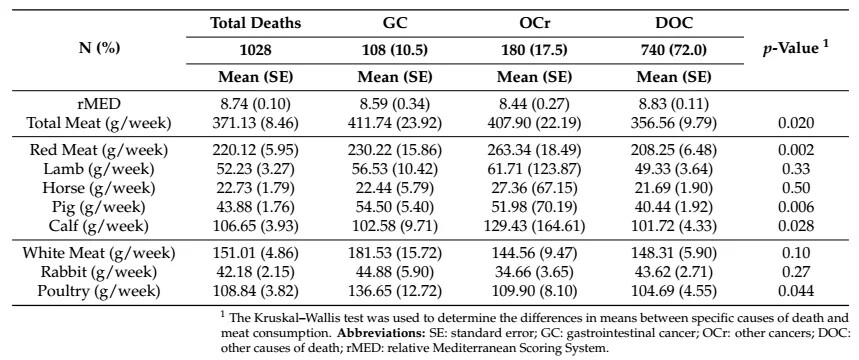
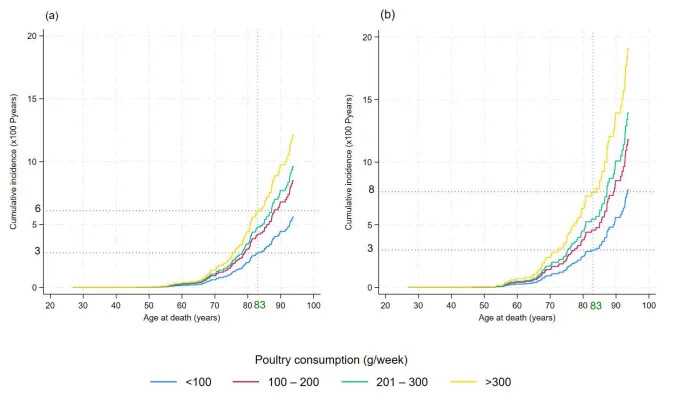
Gender differences were particularly pronounced in this association. For men consuming more than 300 g of poultry per week, the risk of gastrointestinal cancer mortality reached 261% (i.e., an increase of 161%), nearly double the risk observed in women. At the average Italian life expectancy of 83 years, the gastrointestinal cancer mortality rate in the high-intake group among men reached 8%, compared with only 3% in the low-intake group. More alarmingly, the risk divergence in men became apparent as early as age 60, whereas women did not show a marked increase in risk until after age 65.
Counterintuitive Conclusion: Moderate Red Meat Intake Shows a Protective Effect
In stark contrast to the risk associated with poultry, the study found that moderate consumption of red meat and total meat actually demonstrated a certain protective effect.
Data showed that those consuming 150–250 g of red meat per week had a 20% reduction in all-cause mortality risk, while those consuming 200–300 g of total meat per week not only had a 19% reduction in all-cause mortality risk but also a substantial 54% reduction in gastrointestinal cancer mortality risk. The protective effect was even more significant in men, with a risk reduction of up to 68%.