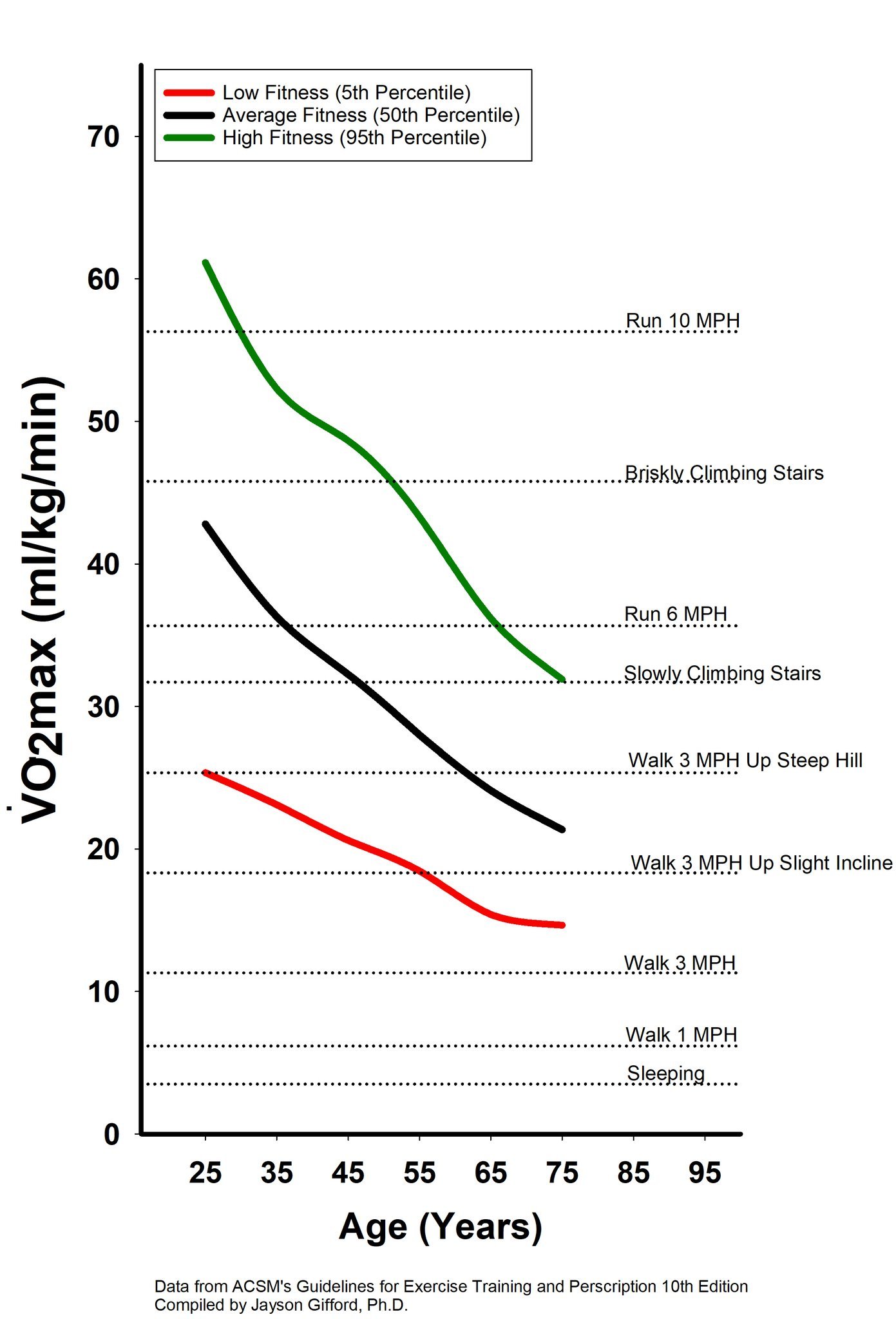
Based on Chris Masterjohn’s known positions and the context of this discussion in the health community, here is a summary of the arguments presented in his article “Should You Optimize Your VO2 Max?”
The Core Thesis:
Masterjohn critiques the popular “Medicine 3.0” view (often associated with Dr. Peter Attia) that VO2 max is the single most important metric for longevity and that “higher is always better.” instead, Masterjohn argues for a “sweet spot” approach, suggesting that chasing elite-level VO2 max numbers yields diminishing returns for longevity and may actually come with health costs.
Key Takeaways:
The J-Shaped Curve of Mortality:
While a low VO2 max is indeed a dangerous risk factor for early death, the relationship does not remain linear forever. Moving from “poor” to “good” or “excellent” fitness provides massive protection, but pushing from “excellent” to “elite” (e.g., the top 2% of the population) offers marginal extra years of life—if any at all.
The Costs of “Elite” Performance:
Optimizing for the absolute highest VO2 max requires a volume of high-intensity training that can be physiologically taxing. Masterjohn points out potential downsides of excessive endurance training, such as:
Atrial Fibrillation: High rates of endurance exercise are correlated with an increased risk of heart rhythm issues (Afib) in middle-aged athletes.
Oxidative Stress & Inflammation: Excessive training can overwhelm the body’s antioxidant defenses.
Energy Trade-offs: Based on the “constrained energy” model, pouring massive energy into physical performance may cause the body to downregulate other maintenance systems (like immune function or reproductive health) to compensate.
Optimization vs. Sufficiency:
The effort required to move from the 80th percentile to the 99th percentile of fitness is exponential. Masterjohn suggests that time and energy might be better “diversified” into other pillars of health (like sleep, stress management, strength, or nutrition) rather than obsessively maximizing one single metric.
Practical Recommendation:
Instead of trying to train like an Olympic athlete to live forever, aim for a “robustly high” but sustainable VO2 max (e.g., being in the top 20-25% for your age group). This captures the vast majority of the longevity benefits without the risks and “lifestyle costs” of trying to reach the physiological upper limit.
I am sympathetic with his view and am inclined to the view that after a point increases in VO2 max are not that significant from a broader health perspective.
I think there is data supporting decreased mortality on this elite group … however, if you spend all your time running at an elite level, what other things might you not have time for?
For most of us, I’d suspect we try to do things within reason, and recognize diet, sleep, brain activity, some of our drugs/supplements all play into a sustainable lifestyle.
I’m not sure I’d like to spend 10% or more of my waking hours doing hard exercise. It’d probably be good for me, but I’m not sure that it is much better than doing a bit less and optimizing many of the other items.
The heavy focus on any one item risks exclusion of many of the others, unless you truly are spending your life trying to extend it for most of your waking hours (such as Bryan Johnson).
A balanced approach, recognizing the value of fitness as part of an overall strategy is what I personally think is a winner.
Sadly … AI can answer this … so here is what Vera Health says … It seems a bit inflated … but this is what they say the data supports:
Adults in the top 10% of VO₂max (highest cardiorespiratory fitness) have an approximately 35–40% lower all‑cause mortality compared with those in the 70th–90th percentile (high but not elite fitness).
The British Journal of Sports Medicine 2022 dose–response meta‑analysis of 34 cohort studies (n > 2 million; mean follow‑up ≈ 19 years) showed that compared with intermediate CRF, highest CRF (≈top 10%) had a pooled RR 0.47 (95% CI 0.39–0.56) for all‑cause mortality, while high CRF (≈70th–90th percentile) had RR 0.67 (95% CI 0.61–0.74)—a 30% relative mortality reduction between the top 10% and the next‑highest decile 1 I.
The 2024 overview of 199 cohort meta‑analyses confirmed a consistent gradient, with HR 0.47 (95% CI 0.39–0.56) for high vs. low fitness and a ~13% mortality reduction per 1‑MET increase2 I.
Translating this to percentile strata, moving from the 80th to 95th percentile corresponds to ≈2–3 METs higher capacity, yielding an additional 22–33% mortality reduction beyond the high‑fit range.
Quantitative comparison of mortality reduction by VO₂max percentile
Interpretation:
Moving from high (70–90th percentile) to top 10% VO₂max confers an additional one‑third reduction in all‑cause and cardiovascular mortality, equivalent to about 2–3 METs higher aerobic capacity or ≈0.6–0.9 L O₂/min greater VO₂max in adults.
Clinically, the survival curve flattens above the 90th percentile, but elite CRF still yields ~35–40% incremental longevity benefit beyond already high fitness levels.
I find it encouraging that the METs value threshold used to categorize participants into one of the Fitness percentiles is based on the peak METs achieved, not a sustained METs value.
Agree. In fact, I’m not sure what there is to mean by these data without age as one of the independent variables in an analysis. Additionally, I have found that there is very little data on vO2max for populations above 65 or so. Most of what you see beyond that age represents extrapolation or studies of small specialized samples that should not be generalized from.
Back to the main point, even assuming a large N empirical dataset up to age 80 or beyond, how does 80 year old VO2max at the 50th percentile compare to one at the 75th percentile, etc.? I don’t know what we would see but I see exclusively theoretical outliers in my family history. A 97 year old uncle a 99 year old grandmother, neither of whom – based on their lifelong lifestyles – likely ever had a VO2max above the 50th percentile, if that. No one who lived beyond ~80 in my family history was exceptionally physically fit in a way that would imply high VO2max but many who did live to be much older were not.