More data coming?
Also, timestamps 1:58 re Rapamycin https://www.youtube.com/watch?v=u0IK3nAD_bM&t=6s
More data coming?
Also, timestamps 1:58 re Rapamycin https://www.youtube.com/watch?v=u0IK3nAD_bM&t=6s
It’s not going to make us live forever. We also likely already have access to more powerful lifespan extension molecules, they just don’t have the evidence that rapamycin does.
It does have an impressive range of benefits for health though. This video makes me want to take it more often again. I’m currently once every 2 weeks.
I was 6mg weekly, then went to 5mg every 14 days with 12 oz GFJ. thought was to save some money and have a higher dose but further apart (a 2 wk cycle). maybe I need to look at going back to weekly dosing…?
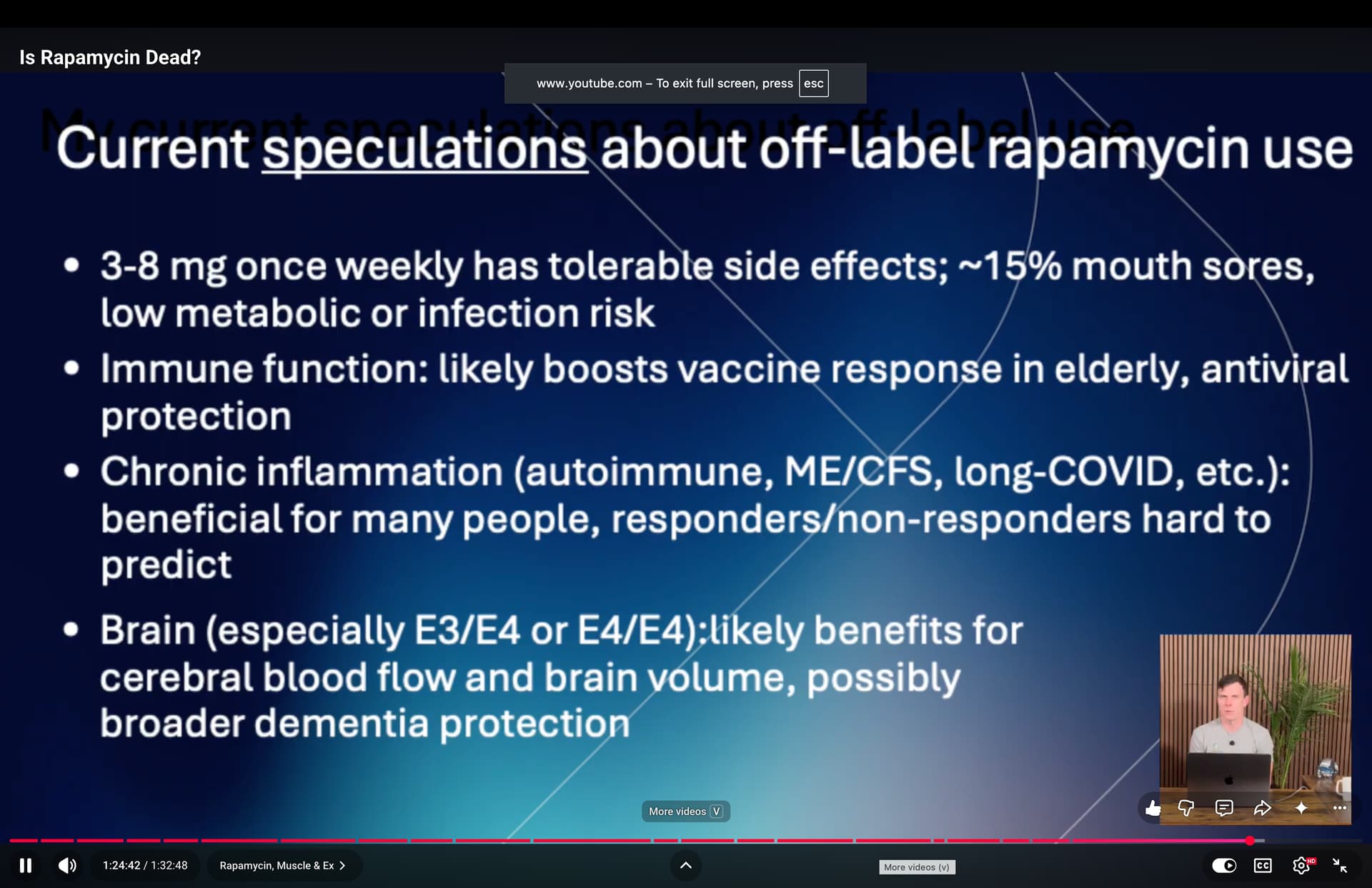
" The standard human off-label longevity protocol (3 to 8 mg once weekly) epxoits the drug’s half-life to intermittently inhibit mTORC1 while allowing the immune system and glucose pathways to recover between doses."
which is why I went to a higher dose but 2wks apart instead of 1 wk.
Is there any specific number to what is considered a “high dose daily” and “low dose daily”?
I have seen some references to that question but it was quite some time ago and I don’t know where to find it. There’s so much info here! Some of the Dr’s that have pt’s I think discussed it and some long time users also. maybe someone will chime in with link(s). It also has to do with individual symptoms from dosing. 8mg/wk for example may be fine for one person but too much for another…
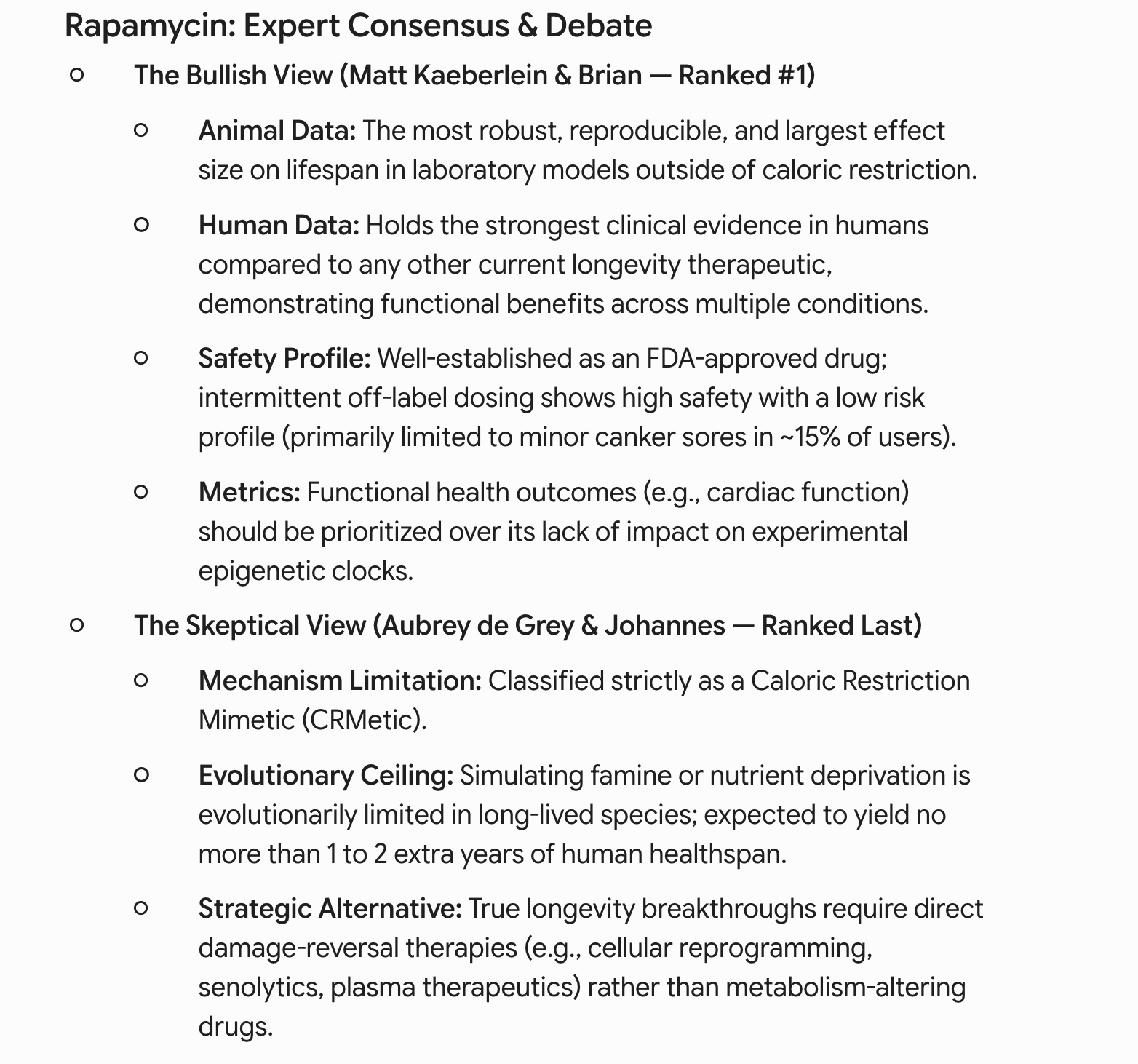
Despite recent backlash from high-profile wellness influencers claiming that rapamycin has failed as an anti-aging intervention, leading experts argue that the drug remains the most promising pharmaceutical candidate for extending human healthspan.
In a recent comprehensive review of the scientific literature, longevity scientist Matt Kaeberlein addressed the growing “signal-to-noise problem” in the longevity field, directly refuting claims from online personalities who have dismissed the drug. According to the actual data, rapamycin is not only far from dead, but it is currently yielding unprecedented results in both animal and early human studies.
Here is the latest breakdown of the science behind rapamycin.
Unmatched Pre-Clinical Success: Reversing, Not Just Slowing, Aging For the past 15 years, rapamycin has stood as the most robust and reproducible longevity drug in laboratory animals. Unlike other interventions, rapamycin extends the lifespan of mice by up to 30%, even when treatment is initiated in middle age (the equivalent of a 65-year-old human). Furthermore, short-term treatment of just 12 weeks has been shown to increase remaining life expectancy in mice by over 60%.
Crucially, researchers have discovered that rapamycin doesn’t just halt biological aging; it can partially reverse it by restoring function in multiple organs. Recent studies have demonstrated that short-term rapamycin treatment can:
Milestones in Companion Animals: A Historic FDA Approval The translational leap from mice to companion animals is already underway. In a landmark moment for the longevity field, a veterinary formulation of rapamycin developed by TriviumVet recently received conditional FDA approval to treat hypertrophic cardiomyopathy in cats. Experts argue this effectively marks the first-ever FDA approval for a “gerotherapeutic”—a drug that targets the underlying biology of aging.
Meanwhile, in dogs, early safety trials from the Dog Aging Project have shown positive, statistically significant changes in age-related heart function and owner-reported improvements in activity levels. The massive Phase-3 equivalent TRIAD (Test of Rapamycin in Aging Dogs) clinical trial is currently half-enrolled and is powered to determine if the drug officially extends canine lifespan.
Promising Human Data: Immunity, Brain Health, and Chronic Fatigue While large, fully funded clinical trials for human longevity are scarce due to a lack of financial incentives, off-label use and smaller human trials are providing highly compelling signals:
The Muscle Controversy Explained One of the primary fears surrounding rapamycin is that it inhibits mTOR, a pathway required to build muscle, leading to concerns that it could accelerate age-related frailty. However, pre-clinical data explicitly shows that rapamycin protects against age-related muscle loss in rodents.
In humans, a recent trial (Rapa EX01) of sedentary older adults placed on a new exercise regimen showed that while both the placebo and rapamycin groups gained strength, the rapamycin group saw slightly smaller “newbie gains”. This simply suggests that rapamycin may attenuate the initial anabolic adaptation to a brand-new exercise routine, rather than causing muscle loss. Conversely, data from the PEARL trial suggests that high-dose rapamycin might actually help preserve or increase lean muscle mass in women over a one-year period.
Safety and the Dosing Dilemma For off-label human use, the standard dosing protocol has largely settled around 3 to 8 milligrams taken just once a week. At these weekly doses, rapamycin appears incredibly safe. The primary known side effect is an increased risk of mouth sores (akin to canker sores), which affects about 15% of users. Strikingly, off-label users do not generally exhibit the severe side effects—such as immune suppression or major lipid/glucose dysregulation—typically seen in organ transplant patients who take high daily doses alongside other immunosuppressants.
The biggest remaining hurdle is determining the optimal dose, as the exact ideal dosage will likely vary depending on whether the patient is targeting heart health, brain function, or periodontal disease, and the field still lacks definitive biomarkers to perfectly tailor individual treatment.
The Bottom Line Despite the noise from wellness influencers, top scientists remain incredibly bullish on the drug. Renowned gerontologist Dr. Steve Austad recently noted that when it comes to the future of longevity, the field has “really hit on something with mTOR,” while expressing skepticism about overhyped supplements like NAD+ precursors.
Ultimately, rapamycin remains humanity’s “best shot on goal” for moving the needle on biological aging. As new, rigorously funded clinical trials prepare to launch, the science suggests that rumors of rapamycin’s death have been greatly exaggerated
How did you get it to include hyperlinks for the papers? What was your prompt?
I came off Rapamycin and caught a virus a month later that took 2 weeks to fully go away. It is quite rare that I get sick so I wonder if coming off enabled this to happen.
This video makes me want to start it up again but maybe just 3mg per week instead of 5mg I was previously doing.
Same. I am about to be 45, and reasonably healthy (I hope?). Also prioritizing strength + cardio. I’ve reconfigured my plan to dose 6 mg every 3 weeks.
Week 1- Dose 6mg, and for first 3-4 days only focus on cardio (Z2). Lift second half of week like normal. This is probably sub-optimal, but I will live with it.
Week 2 & 3 - Lift 4-6 days/week +Cardio (Z2 + VO2 Max)
Repeat.
Given i am taking it for preventative health measure vs fixing something (at least that I know about), I figure this give me the best mix. But reality is, I am not sure if anyone knows.
If we don’t have evidence for them, how do we know there are more powerful lifespan extension molecules than rapamycin?
Exactly… you’re fairly young… body not crapped out from bad habits and bad food, so a lower dose might be more appropriate.
My 6 mg weekly past 5 years has been excellent for 60 years up dosing.
See prompt here: Using AI for Health and Longevity and Research - Your Favorite Prompts - #162 by RapAdmin
I said it is likely. I think GLP1RA’s could easily outperform rapamycin in terms of life extension if they were tested head to head.
If we merely look at all of the individual possible health benefits given by rapamycin vs GLP1RAs I believe there are more benefits from GLP1RA’s.
That’s just looking at things currently approved, there are many new things being developed and studied right now.
The odds that one of them isn’t more powerful than rapamycin is low.
Rapamycin Longevity Lab discovered multiple mTOR modulating compounds that extended C elegans lifespan more than rapamycin.
I would say it’s possible that some of the GLP1s could provide better life extension than rapamycin. Certainly there is a lot more money being poured into clinical trials of GLP1s than there ever will be for rapamycin as rapamycin is off-patent (so even if rapamycin outperforms, or can outperform GLP1s the data is likely to be more voluminous than for rapa).
And yes, there may be other MTOR inhibitors that are better than rapamycin out there, but its going to take 20 to 30 years to build up the same level of clinical research data that we have on rapamycin, so don’t hold your breath on those being helpful and practically usable anytime soon.
And, it doesn’t really matter if a GLP1 is better than rapamycin, because they are largely complimentary drugs, so people can easily take both. From Claude Opus 4.8:
On current evidence, GLP-1 agonists and rapamycin are predominantly complementary, not contraindicated — but they share one real overlapping liability (muscle/lean-mass loss) that has to be actively managed. There is no known pharmacokinetic drug–drug interaction; the interaction is physiological and mostly favorable. The field’s own confidence in complementarity is signaled by the ARPA-H–funded VITAL-H trial (UT Health San Antonio, ~$38M, 2026), which puts semaglutide, rapamycin, and dapagliflozin head-to-head against placebo for healthspan.
The strongest argument for pairing is that **GLP-1 agonists directly offset rapamycin’s principal metabolic downside.**Rapamycin’s main liability at longevity-relevant exposures is glucose intolerance and insulin resistance, driven not by its intended mTORC1 inhibition but by off-target mTORC2 disruption (loss of insulin-mediated suppression of hepatic gluconeogenesis). Critically, this metabolic penalty is uncoupled from the longevity benefit — mice with genetically reduced mTORC1 live longer with normal glucose handling. So the insulin resistance is a side effect you’d like to erase without losing the lifespan effect. GLP-1 agonists do essentially the opposite thing metabolically: they enhance glucose-dependent insulin secretion and improve insulin sensitivity. Mechanistically that makes GLP-1 a rational “buffer” against rapamycin-induced glucose intolerance, which is most problematic in people who are already insulin-resistant or prediabetic.
Beyond glucose, the two hit different but converging aging pathways. Rapamycin’s core action is autophagy induction via mTORC1 inhibition. GLP-1 agonists act largely upstream/orthogonally — appetite and weight reduction, reduced systemic inflammation, senescence and epigenetic-aging effects (semaglutide slowed multiple DNA-methylation clocks in an RCT), and a ~20% reduction in major cardiovascular events (SELECT) that appears partly independent of weight loss. Interestingly, some of GLP-1’s benefit is itself described as mTORC1 modulation of inflammatory signaling, so there’s mechanistic rhyme rather than conflict. Non-overlapping mechanisms with a shared endpoint (reduced inflammaging, improved metabolic and cardiovascular aging) is the textbook profile for a complementary combination.
The pairing looks most favorable, and most like a true synergy, in metabolically unhealthy / overweight individuals: GLP-1 handles adiposity and neutralizes rapamycin’s glucose penalty. It warrants more caution in lean, older, or already-sarcopenic individuals, where combined lean-mass loss is the dominant risk. Standard mitigations map directly onto the mechanism: weekly (not daily) rapamycin dosing to spare mTORC2 and preserve anabolic windows, robust resistance training, high protein intake (timed away from the rapamycin dose so acute MPS isn’t blunted), and monitoring of body composition (DEXA), fasting glucose/HbA1c, and lipids. Minor additive tolerability issues also exist — GI effects from GLP-1 plus rapamycin’s mucosal/immune effects — but these are nuisance-level, not safety-defining.
It’s also not really fair to compare rapamycin, a single mTOR inhibitor, to an entire class of existing, in trial and future created GLP1RA drugs. But I still stand by my prediction.
I take both.
GLP-1 agonists also activate AMPK which causes downstream inhibition of mTORC1. So there could potentially be some additive effect when GLP-1 is added to a rapamycin protocol
I have been taking Rapa 6 mg weekly for 5 years now. I am 71, leaner, and have more muscle than I ever have. For the last 3 years, I have been sick (mild flu/cold) once a year, compared to 2 to 3 times a year, with sometimes much more serious symptoms before Rapa.
Is it all because of Rapa? I don’t know, but the data is compelling, and I am very optimistic and hopeful that Rapa could improve the lives of our aging population.
That mirrors my experiences, also 5 years of use. Rapamycin is amazing!
Old guys RULE! Gotta keep the machine moving:) The more you move, the longer you last.
I skimmed through the presentation and Matt Kaeberlein was really mogging throughout.