Checking Chat GPT on Low Uric Acid levels and any health implications:
Low uric acid levels (hypouricemia) are uncommon but can be associated with various health problems. While mild hypouricemia may not cause significant issues, persistently low levels can be linked to the following conditions:
1. Kidney and Urinary Problems
Impaired Kidney Function – Low uric acid may indicate underlying kidney problems, such as Fanconi syndrome, where the kidneys fail to properly reabsorb essential nutrients.
Increased Risk of Kidney Stones – Paradoxically, low uric acid (especially due to xanthinuria, a rare genetic disorder) can lead to xanthine stone formation, which is harder to detect and treat than uric acid stones.
2. Neurological Disorders
Multiple Sclerosis (MS) – Some studies suggest a link between low uric acid and an increased risk of MS, possibly due to reduced antioxidant protection.
Parkinson’s Disease – Low uric acid levels have been associated with a higher risk of developing Parkinson’s, as uric acid helps neutralize oxidative stress.
Cognitive Decline and Alzheimer’s Disease – Since uric acid functions as an antioxidant, very low levels may contribute to neurodegeneration and cognitive impairment.
3. Metabolic and Genetic Disorders
Xanthinuria – A rare genetic condition where the body cannot convert xanthine into uric acid, leading to muscle pain, kidney stones, and potential kidney damage.
Wilson’s Disease – A disorder of copper metabolism that can cause low uric acid levels along with liver and neurological issues.
Hypoparathyroidism – Low uric acid may be seen in disorders affecting calcium and phosphate metabolism.
4. Muscle and Fatigue Issues
Exercise-Induced Myopathy – Some cases of low uric acid have been linked to muscle fatigue and weakness, potentially due to metabolic imbalances.
Lesch-Nyhan Syndrome (Rare Cases) – Though typically associated with high uric acid, some variations can lead to impaired uric acid production.
5. Oxidative Stress and Antioxidant Deficiency
Uric acid acts as a natural antioxidant. Chronically low levels may make the body more susceptible to oxidative damage, which can contribute to inflammatory diseases and aging-related conditions.
6. Medication and Drug-Induced Issues
Certain medications can cause low uric acid levels, leading to side effects such as increased fatigue, kidney dysfunction, or altered metabolism:
Diuretics (e.g., furosemide, thiazides) – Can increase uric acid excretion.
Aspirin (Low Doses) – Can reduce uric acid reabsorption.
Allopurinol or Febuxostat – Used to treat gout but can sometimes cause excessively low uric acid levels.
Should You Be Concerned About Low Uric Acid?
While low uric acid is not always a direct cause of disease, it can be a sign of underlying metabolic or kidney issues. If you experience symptoms like muscle weakness, neurological changes, frequent urination, or kidney stones, it’s best to consult a doctor to evaluate potential causes.
Thank you. Because I have an apoe4 and lots of neurodegernative disease in my family, I guess I’m concerned low levels might be related.
I don’t know yet if trying to raise levels is helpful in this case. I did see, according to perplexity, the colchicine I’m taking does not lower levels.
Perhaps consider raising uric acid levels via some healthy foods? (choose those you like from below, avoid those that are not so healthy).
If you’re looking to increase uric acid levels, you should focus on foods that are rich in purines, as they break down into uric acid in the body. Here are some foods that can help:
1. High-Purine Animal-Based Foods
Red Meat – Beef, lamb, and pork contain high levels of purines.
Organ Meats – Liver, kidneys, and heart are particularly rich in purines.
Seafood – Sardines, anchovies, mackerel, herring, shrimp, and mussels have high purine content.
2. Protein-Rich Foods
Poultry – Chicken and turkey contain moderate-to-high purines.
Eggs – While lower in purines, eggs provide protein that supports overall metabolism.
3. Legumes and Plant-Based Sources
Lentils, Chickpeas, and Beans – Moderate sources of purines that can help increase uric acid.
Spinach and Mushrooms – These vegetables contain purines, though they are less likely to cause health issues compared to animal-based purines.
4. Dairy Products (Mild Effect)
Full-Fat Dairy – Cheese, whole milk, and yogurt may have a slight effect on uric acid levels, though they are generally considered safe for most people.
5. Sugary and Processed Foods
Fructose-Rich Foods – High-fructose corn syrup found in sodas, processed snacks, and fruit juices can increase uric acid production.
Honey and Table Sugar – High consumption can contribute to raised uric acid levels.
6. Alcohol
Beer and Liquor – Contain purines and increase uric acid production while also impairing its excretion.
Wine – Has a lesser effect compared to beer but can still contribute to increased levels.
Should You Be Concerned?
While increasing purine-rich foods can raise uric acid levels, excessive intake may increase the risk of gout and kidney stones. If you’re trying to balance uric acid levels for health reasons, consult a doctor before making major dietary changes.
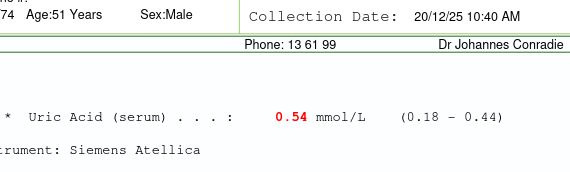
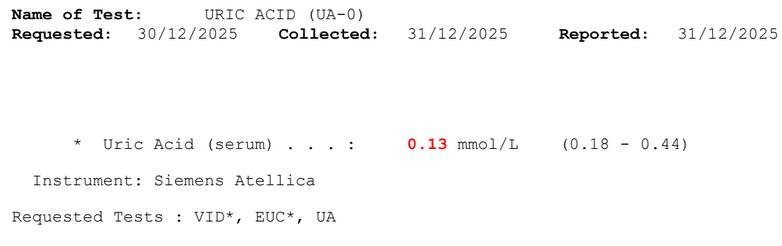
From what I’m researching (because my Uric acid level is very low, due to the empagliflozin) its actually not a bad thing …
Here is ChatGPT:
What happens to the body if your uric acid levels are low, due to using an SGLT2 inhibitor?
When uric acid levels are low due to the use of SGLT2 inhibitors (like empagliflozin, dapagliflozin, or canagliflozin), the effect on the body is usually neutral to beneficial, but here’s a breakdown of what can happen:
Mechanism
SGLT2 inhibitors:
Cause glucosuria (loss of glucose in urine).
Increase uric acid excretion in urine by altering kidney tubule transport (especially via GLUT9 and URAT1 transporters).
This leads to lower serum uric acid levels.
Potential Benefits of Lower Uric Acid
Reduced gout risk: Lower uric acid reduces the likelihood of urate crystal deposition in joints.
Less inflammation: Uric acid is pro-inflammatory in some tissues; lowering it may reduce systemic inflammation.
Improved cardiovascular profile: High uric acid is associated with hypertension, insulin resistance, and heart disease—so lowering it may help.
Potential (Rare) Effects or Concerns
While hypouricemia is rarely harmful, especially when caused by medications, very low levels or certain contexts could lead to:
1. Kidney stone risk
Increased uric acid in urine (uricosuria) can increase stone formation, particularly if the urine is acidic.
2. Loss of antioxidant protection
Uric acid is an antioxidant in plasma. Very low levels might slightly reduce protection against oxidative stress, though this is not clearly harmful.
3. Marker of other renal effects
Significant hypouricemia might reflect proximal tubule dysfunction (e.g., Fanconi-like syndrome), but SGLT2 inhibitors alone rarely cause this unless combined with other insults.
4. Potential for electrolyte disturbances
Because SGLT2 inhibitors also cause osmotic diuresis, mild dehydration and changes in sodium or potassium levels may accompany the uricosuria, but these are separate effects.
Bottom Line:
Low uric acid due to SGLT2 inhibitors is generally beneficial or neutral. It reduces gout risk and may support metabolic and cardiovascular health. However, extremely low levels or symptoms like kidney pain or frequent stones might warrant further evaluation.
Would you like to know what a “low” uric acid level typically means numerically (in mg/dL), or how to monitor for potential issues?
I’m not sure it’s the SGLT2i that’s responsible. I’ve posted studies showing these agents being protective against kidney stones, but I’m assuming he’s taking empagliflozin? If so, empa shows possible 40% lower risk, at least in diabetics, and there is no reason to think it’s different in nondiabetics.
Empagliflozin and Decreased Risk of Nephrolithiasis: A Potential New Role for SGLT2 Inhibition?
That doesn’t prove empa - or any SGLT2i - didn’t cause his kidney stone, but there’s no indication that it’s more likely.
Allipurinol made me faint and dizzy. I had to hold onto something solid to regain my balance. Febuxostat, on the other hand, does a good job of decreasing uric acid and has a lower side-effect profile. As a bonus, it eliminated the pedema caused by amlodipine.
I’m in jardiance 25mg every morning. After taking it for a month my uric acid went from 0.55 to 0.39. (0.44 is the max level). I’m getting tested again in 3 weeks. Hopefully it will be lower. I almost didn’t have any gout attack since.
On an SGLT2 inhibitor I can’t get my Uric acid above 4.0
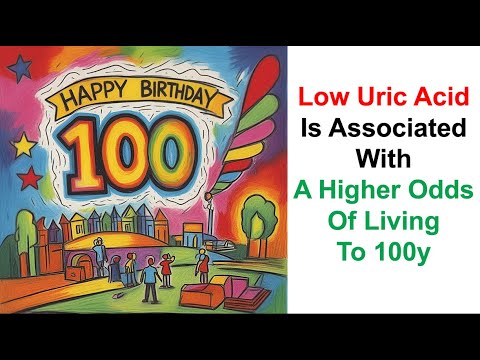
Low Uric Acid Is Associated With A Higher Odds Of Living To 100y
AI Summary:
Introduction to Biomarkers and Longevity
The video begins by posing a question regarding which biomarker is linked to a higher probability of living to 100 years old, revealing that uric acid is the answer.
The discussion transitions into an analysis of various biomarkers studied, including total cholesterol, glucose, creatinine, uric acid, and several liver enzymes and iron metrics.
A graphical representation of the odds ratio for living to 100 years is introduced, plotting these biomarkers against their concentrations to determine significance.
Significance of Uric Acid Levels
Uric acid levels below 4.17 mg per deciliter correlate with a significantly increased likelihood of living to 100 years, showing a 28% higher odds ratio of 1.28.
The proportion of centenarians with low uric acid levels stands at 4%, indicating a strong association with longevity.
Conversely, uric acid levels exceeding 6.5 mg per deciliter are linked to a 46% reduced odds of reaching 100 years, with only 1.2% of centenarians exhibiting such high levels.
The video emphasizes that the lowest and highest proportions of centenarians among all biomarkers studied are associated with low and high uric acid levels, respectively.
Gamma Glutamyl Transferase (GGT) and Longevity
Another biomarker associated with increased longevity is gamma glutamyl transferase (GGT), with levels between 18 to 23 units per liter linked to a 33% higher odds of living to 100 years.
The proportion of centenarians with GGT levels in this range is 3.6%, which is notable compared to other biomarkers.
High GGT levels above 42 units per liter correlate with a 43% reduced odds of reaching 100 years, indicating a potential risk factor for longevity.
Both uric acid and GGT levels tend to rise with age, suggesting that managing these biomarkers may be crucial for longevity.
Biomarkers Associated with Lower Odds of Living to 100
The video discusses various biomarkers that correlate with lower odds of reaching 100 years, emphasizing the importance of optimizing multiple biomarkers for longevity.
Total cholesterol levels below 201 mg per deciliter are associated with a 34% lower odds of living to 100, though the relationship is complex and influenced by multiple health factors.
Elevated glucose levels above 108 mg per deciliter are linked to a 47% lower odds of reaching 100 years.
Creatinine levels exceeding 1.14 mg per deciliter also show a 47% reduction in the odds of living to 100 years.
Increased levels of liver enzymes, such as aspartate aminotransferase (ASAT) above 30.1 units per liter, are associated with a 30% lower odds of longevity.
Other biomarkers, including alkaline phosphatase (ALP), lactate dehydrogenase (LD), and total iron binding capacity, also demonstrate associations with reduced odds of reaching 100 years.
Strategies for Improving Longevity
The video concludes with a guide for individuals interested in increasing their chances of living to 100 by managing biomarkers effectively.
It suggests tracking biomarkers to ensure they remain within optimal ranges, particularly those associated with increased longevity.
The importance of resisting age-related declines in biomarkers is highlighted as a strategy for enhancing longevity.
Perhaps a note of optimism for those whose UA levels are mildly elevated above optimal by the consumption of a nutrient rich purine rich diet. I won’t post the studies and generalizations at this time but the highest generalization is that slightly elevated UA from a high purine diet, especially when the purine source is beans, cauliflower, spinach, etc. does not elevate risks commonly associated with UA and likely reduces them. Not true, however, if you add alcohol and fructose as causes.
Following is one line of reasoning:
Fructose vs. Purine-derived hyperuricemia
UA derived from fructose
Fructose metabolism in hepatocytes rapidly depletes ATP, generating AMP that’s catabolized to uric acid independently of dietary purines
This pathway is associated with de novo lipogenesis, insulin resistance, and hepatic steatosis
Epidemiological data show strong associations between fructose-induced hyperuricemia and metabolic syndrome components
Purine-derived UA from whole foods
Concurrent intake of antioxidants, fiber, and anti-inflammatory compounds
No ATP depletion or metabolic stress signaling
Often accompanied by beneficial nutrients (omega-3s in sardines, folate in beans, etc.)
I am an advocate of treating high uric acid as aggressively as high blood pressure. Too much acid in the blood can eat away at your insides and turn you into a xenomorph, like the creature in “The Alien.”
I’m not an expert on gout or uric acid I but thought this was interesting in understanding why the body ‘thinks’ that having a propensity for raised uric acid levels and resultant gout is a good thing
Without uricase to reduce the levels of uric acid , humans are left vulnerable to gout.
Evolutionary pressures phased out the uricase gene in several different primate lineages some 20 to 29 million years ago. The thinking is that back then, extra uric acid was beneficial for converting fruit sugar into fat, to help survive food shortages.
 Mechanism
 Potential Benefits of Lower Uric Acid
 Potential (Rare) Effects or Concerns
 Bottom Line: