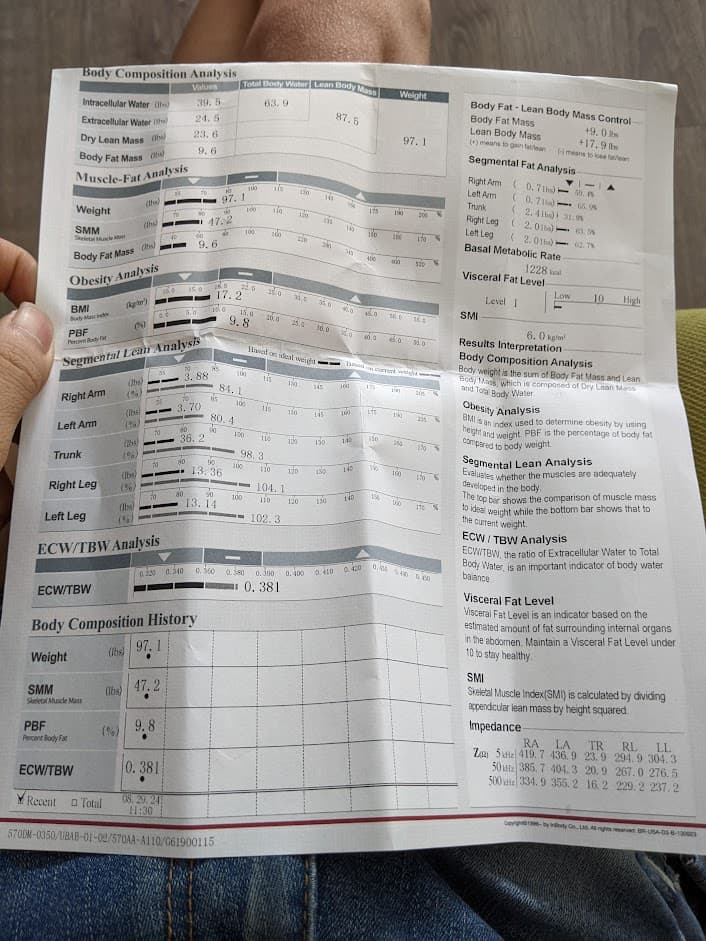
I got these values
| Metric |
DexaFit SF 11/23/2020 |
DexaFit Seattle 02/15/2021 |
BodySpec 05/17/2026 |
| Height entered |
63.0 in |
60.0 in |
63.0 in |
| Intake weight |
99.0 lb |
97.0 lb |
103.0 lb |
| DXA total mass |
97.9 lb |
101.5 lb |
100.1 lb |
| Body fat % |
16.9% |
16.3% |
10.9% |
| Fat mass |
16.5 lb |
16.6 lb |
10.9 lb |
| Lean tissue |
77.6 lb |
81.2 lb |
85.2 lb |
| BMC |
3.8 lb |
3.7 lb |
3.9 lb |
| VAT |
0.36 lb / 10.52 in³ |
0.40 lb / 11.82 in³ |
0.03 lb / 1.01 in³ |
| Total BMD |
0.897 |
0.935 |
0.955 |
| T / Z score |
-3.0 / -1.6 |
-2.6 / -2.6 |
-2.4 / -2.4 |
But maybe the scanners are different in important ways? The divergence between these values… is… a lot
In terms of the scanner/software, BodySpec probably wins, but only slightly, and mainly because your BodySpec file exposes more evidence that it came from a standardized GE/Lunar Encore workflow. The machine gods have spoken, apparently through a PDF footer. 
The key clue: the BodySpec report footer shows an Encore .dfb file path: C:\BodySpec\Encore\...dfb, and the bone section uses “USA (Combined NHANES/Lunar) (Enhanced Analysis)”. That strongly suggests a GE Lunar / Encore ecosystem scan. Your DexaFit reports also use “USA (Combined NHANES/Lunar) (Enhanced Analysis)”, so they also look like GE Lunar-family reports rather than Hologic-style reports.
So this is probably not “BodySpec scanner technology vs DexaFit scanner technology” in the abstract. It is more likely:
GE Lunar / Encore at BodySpec vs GE Lunar / Encore-ish DexaFit setup, with different locations, operators, calibration, and data-entry quality.
That means the biggest reliability differences are probably not the brand of scanner, but:
-
scanner model, e.g. GE Lunar iDXA vs Prodigy
- calibration / phantom QC
- operator positioning and segmentation corrections
- whether the site maintains consistent protocols
-
whether metadata are entered correctly, because apparently “height” was too advanced for one scan
BodySpec publicly says it uses GE Lunar iDXA at storefront sites and GE Lunar Prodigy for some mobile scanners, with harmonized software settings and QA. BodySpec also claims its GE iDXA systems have about 1% test-retest variation for total-body fat mass and mentions twice-daily phantom checks and fleet harmonization. That is BodySpec’s own claim, so take it as self-reported, not gospel chiseled into radiological stone.
GE Healthcare describes the Lunar iDXA as a system for bone density, fracture risk, metabolic health, pediatric development, and sarcopenia assessment, with high-resolution images and precise measurements. BodySpec’s own comparison page says GE Lunar Prodigy and iDXA are both GE DXA machines, with iDXA being the newer generation; both are effective, but they differ in detector/beam characteristics.
the bodyspec scanner was in a van and seemed to be way leaner than toher DEXA scans I’ve seemed.
1 Like
One percent test/retest seems good for the nature of what is being measured. The first question that comes to mind is the error terms of its other measures. I am most interested in bone density – absolute and relative body areas – for example.
I see this footnote on the $66 DEXA service offered by the sports lab of a local university:
. . . if you have previously had a DXA scan from our lab on the GE system, it is not recommended that you compare new data acquired from the Hologic to any previous GE scan you have acquired from our lab. The results you receive moving forward will be based on Hologic system data and will establish a new baseline for future tracking.
for comparison, this in 2024