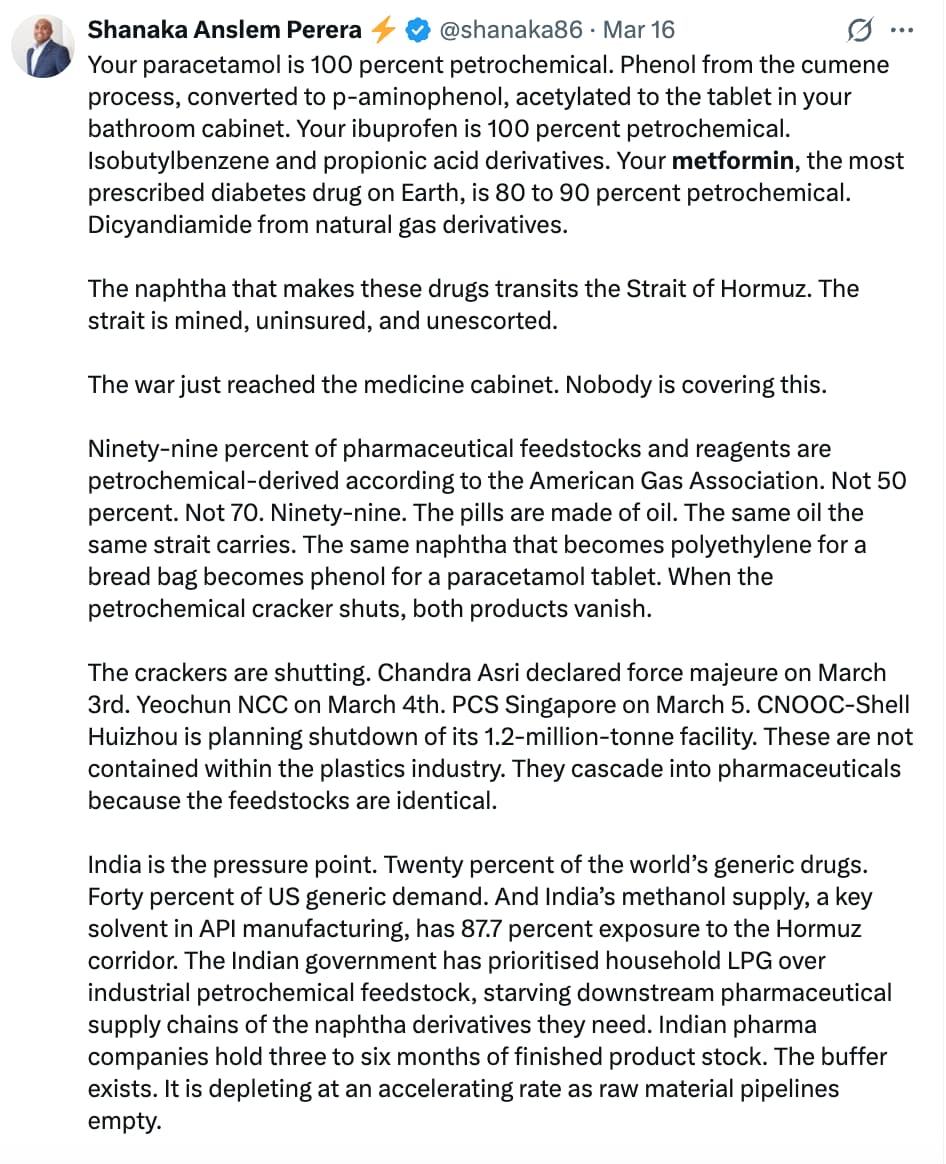
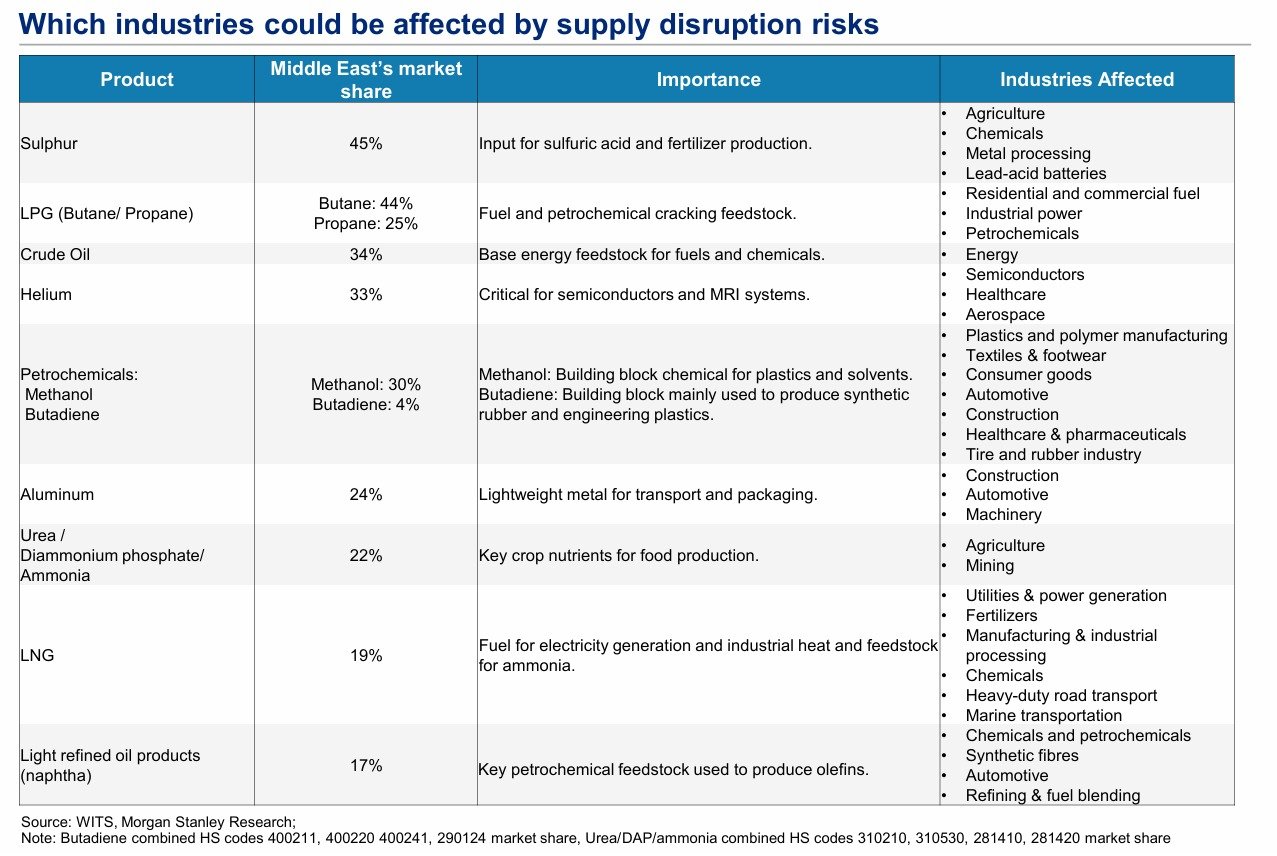
Folks, just an early warning here. We may want to stock up on any medications you rely on, because if the war in Iran goes on much longer there are going to be significant impacts on the price and availability of many medications. See the information below. Many pharmaceutical reagents and drugs use compounds derived from oil (I’ve just recently discovered).
I’m not trying to encourage any discussions on the war here, as thats very much outside our area of focus, but just like COVID, and Trump’s tariffs/import taxes, this is a major supply chain shock that could impact your healthspan and lifespan.
Thank you, RapAdmin for this “heads up”. This was a side effect of the War that I never anticipated - grateful for your post, and all the helpful information.
The escalation of conflict in the Middle East and the closure of the Strait of Hormuz (as of March 2026) have created a significant shock to the global pharmaceutical supply chain. While Iran is not a dominant exporter of finished drugs, it sits at a critical chokepoint for the raw materials and logistics hubs that sustain global medicine production.
The following categories of medications are most likely to see price increases or supply volatility:
1. Common Generic Medications (High Volume)
Generic drugs are the most vulnerable because they operate on thin profit margins and rely heavily on Indian manufacturing. India produces roughly 47% of U.S. generic prescriptions and depends on the Strait of Hormuz for 40% of its crude oil (the base for many pharmaceutical chemicals).
Antibiotics: Amoxicillin, Azithromycin, and Doxycycline.
Diabetes Treatments: Metformin and various generic insulins.
Pain Relief:Acetaminophen (Paracetamol)—traditionally made from phenol, a petroleum derivative—has already seen raw material price spikes of over 60%.
2. Temperature-Sensitive & “Cold-Chain” Drugs
The conflict has paralyzed major air-cargo hubs like Dubai (DXB) and Doha, which serve as the world’s primary “crossroads” for refrigerated medicines. Rerouting these through longer land or sea paths increases costs significantly.
Oncology (Cancer) Drugs: Monoclonal antibodies and chemotherapy agents that require strict temperature control.
Biologics: Complex drugs derived from living organisms.
Vaccines: Most vaccines must stay between 2°C and 8°C; delays in the Gulf region put these at high risk of spoiling.
3. Essential Raw Materials & Petrochemical Derivatives
Since the pharmaceutical industry is inextricably linked to energy markets, the surge in oil prices and shipping premiums directly impacts the “Active Pharmaceutical Ingredients” (APIs).
Ingredient
Role in Medicine
Status (March 2026)
Glycerin
Used in syrups, ointments, and solvents.
Price up 64%+
Isopropanol
Key solvent for drug synthesis/sanitizers.
Price up 60%+
Phenol
Base for Aspirin and Acetaminophen.
Price up 56%+
Methylene Chloride
Common solvent in pharmaceutical labs.
Price up 86%+
4. Medical Supplies & Packaging
The disruption also affects petroleum-based medical consumables shipped through the region.
IV Bags and Tubing: Made from plastics derived from Gulf petrochemicals.
Vial Stoppers: Small but critical components for injectable drugs.
Hand Sanitizers & Ointments: Highly dependent on affected chemical solvents.
Summary of Economic Impact
Freight Costs: Air freight rates from India have surged 200% to 350% as carriers avoid Gulf airspace.
War Premiums: Marine insurance for the Strait of Hormuz has surged by over 1,000%, a cost that is being passed directly to “Big Pharma” and eventually consumers.
Timeline: While most distributors hold 30–60 days of inventory, experts warn that price hikes and shortages could reach local pharmacies within 4 to 6 weeks if the corridor remains closed.
I would say, however, that medications are a high value petroleum product when a petroleum product. I would not expect the proportion of the costs of production that relates to fossil fuel inputs to be that high.
Thank you for this heads up. I was able to place a large stock-up order with Jagdish and he said current delivery times to my door are averaging 12 days.
You did a great job. I’ve started stockpiling some medicine myself. During the Russia-Ukraine war, the price of a topical ointment I use frequently tripled, and I’ve been very wary of war ever since.
Problem is we don’t know how long this will last, so it’s hard to make plans. What’s the difference between the Iran war and the Vietnam war? Trump had a plan on how to get out of Vietnam.