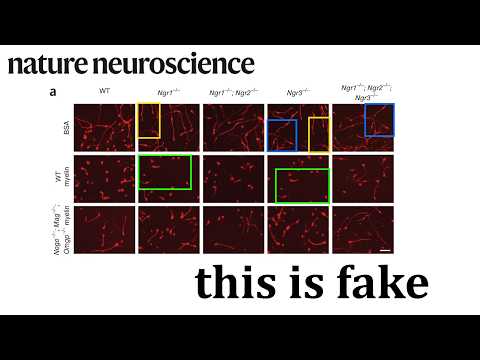
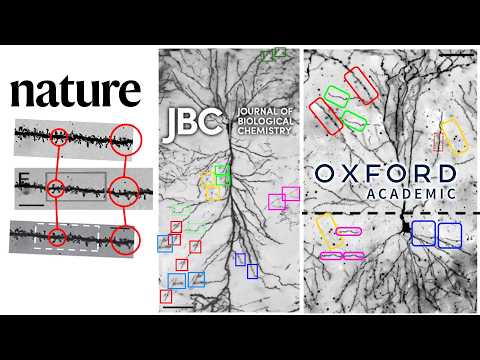
This is definitive proof that science as practiced today is comprehensively broken. After identyfying egregious fraud in a paper, the well known doctor who has already prominently found extensive fraud elsewhere, Dr. Sholto David emailed everyone involved: all the paper authors, the publication, the university, the reviewers. And what was the result? Silence for over a year, with only the publication chief editor originally emailing back that they’ll look into it, but it takes time. It’s been over a year, and crickets. As he said, they intend to bury it by dragging their feet. Meanwhile the fraudulent paper has already been cited over 500 times.
The authors are all vey prominent researchers and university, NIH, and Pfizer involved. One if the authors has a career long history of fraud. But there is too much prestige and money involved for the parties to wish to unravel this mess. And so it continues. RIP science.
Sholto David has his own yt channel and he talks about this paper.
Identyfying Image Fraud in a Nature Neuroscience Paper (via Sholto David)
No, this is just on his yt channel - he’s trying this mode of communication to see if it’s effective.
Sure progress can be made. But the question is: how do you know that any - any - given paper can be trusted, if you are just a reader (as most of us here are) rather than a researcher with his own lab doing replication studies. The impact on science is catastrophic as the fraud gets spread through citations. This is at crisis level right now.
I do not understand, how a “scientist” who provably engages in fraud - as in this example - continues to have a career and lucrative positions as CEO of biotech companies - these are often pump and dump schemes designed from the get go to fleece investors with outsize claims for the IPO, which of course is nothing but deliberate fraud.
Regarding investigation of fraud in science I can really recommend the Webpage from Leonid Schneider https://forbetterscience.com/
Shloto David also contributes to this site. The articles are always very funny but very brutal regarding the fraud detected. Especially the field of biogerontology unfortunately has issues.
Not just the paper should be retracted and trashed, the people involved should all be fired. We have enough trouble without doing it wrong on purpose. If we don’t clean it up it will get much worse.
More. Egregious. Keep this in mind for every paper you read - “there may be fraud” - no institution, no publication, no prominence of any researcher is a guarantee of integrity in the research presented to you.
Has the war against fraud in scientific research been lost? It’s an ongoing series by Sholto David. I’m not going to post every video - it’s an inexhaustable topic, but you can subscribe to or just monitor his yt channel for upcoming episodes.
Scientific Fraud in Top Journals: NeuroDigitech’s Faked Neurons (via Sholto David)
One contributing factor that hasn’t been mentioned, and that has been recognized at least since I was an undergraduate, is the long-standing bias against publishing negative findings. It persists despite some 50 years of information theory and empirical work showing that null results carry real information, and that suppressing them distorts the literature and increases the pressure to produce positive results by whatever means.
Still, as @John_Hemming implies above, fraud occurs at the margin. The steady, substantive progress across most disciplines, and the rate at which scientific knowledge continues to accumulate, make that clear. A finer point is that earlier eras, with less outright fraud, may well have published a higher proportion of faulty conclusions. Honest error is now and has always been the larger source of unreliable findings, and steady improvements in design, methodology, and analytic tools have raised the quality of what we produce.
Science is not broken and, in fact, continues to improve.
I think there remain problems with the difficulty of replicating results. That goes beyond the issue of fraud and gets into the more complex territory that you can have correlations between random results that have a p number less than 0.05.
In the end, however, if results are not replicated they won’t be taken that seriously.
There is a lot of rubbish around, but replication is the final and critical test.
My conclusion when it comes to ageing and longevity is that replication will be the step at which people are persuaded that an intervention works. Hence when I come to my own efforts I focus on the practical results side although I do write up and read into the mechanistic aspect. That, of course, is necessary in order to work out what interventions may be synergistic.
Yes. I thought this one had been mentioned. I was tossing in unmentioned loose ends. For my entire career, the incentive structure surrounding independent replication research has been honored in the breech. Some dissertation chairs and even more masters thesis chairs will approve a replication study but, even then, they are approved for students believed to be in the lower tiers of acceptability. This problem is more-or-less unique to the social and behavioral sciences. My friends in physics are heavily invested in, and reward, replication studies.
To be fair, what I would call quasi replication frequently takes place when research teams modify or extend the parameters slightly to extend previous research.
Agreed that replication is a broader problem than fraud, and that some chance findings will always clear p < .05. That’s built into the threshold. But much of the replication problem comes from significance shopping: running many comparisons and reporting the ones that “work.” Appropriate statistical practice reduces but does not eliminate the rewards of that approach. Corrections for multiple comparisons, pre-specified outcomes, and preregistration all make a fished-for result harder to publish as if it were a confirmatory finding. Where those standards are enforced, the false-positive rate moves back toward what the threshold actually promises.
Much of the significance shopping problem persists because the standards for correction are applied unevenly by journals and reviewers, not because the tools are lacking. That connects to the my point on publication bias: both come down to incentives rather than knowledge.