A story that reminds me I need to break out the slackline more often…
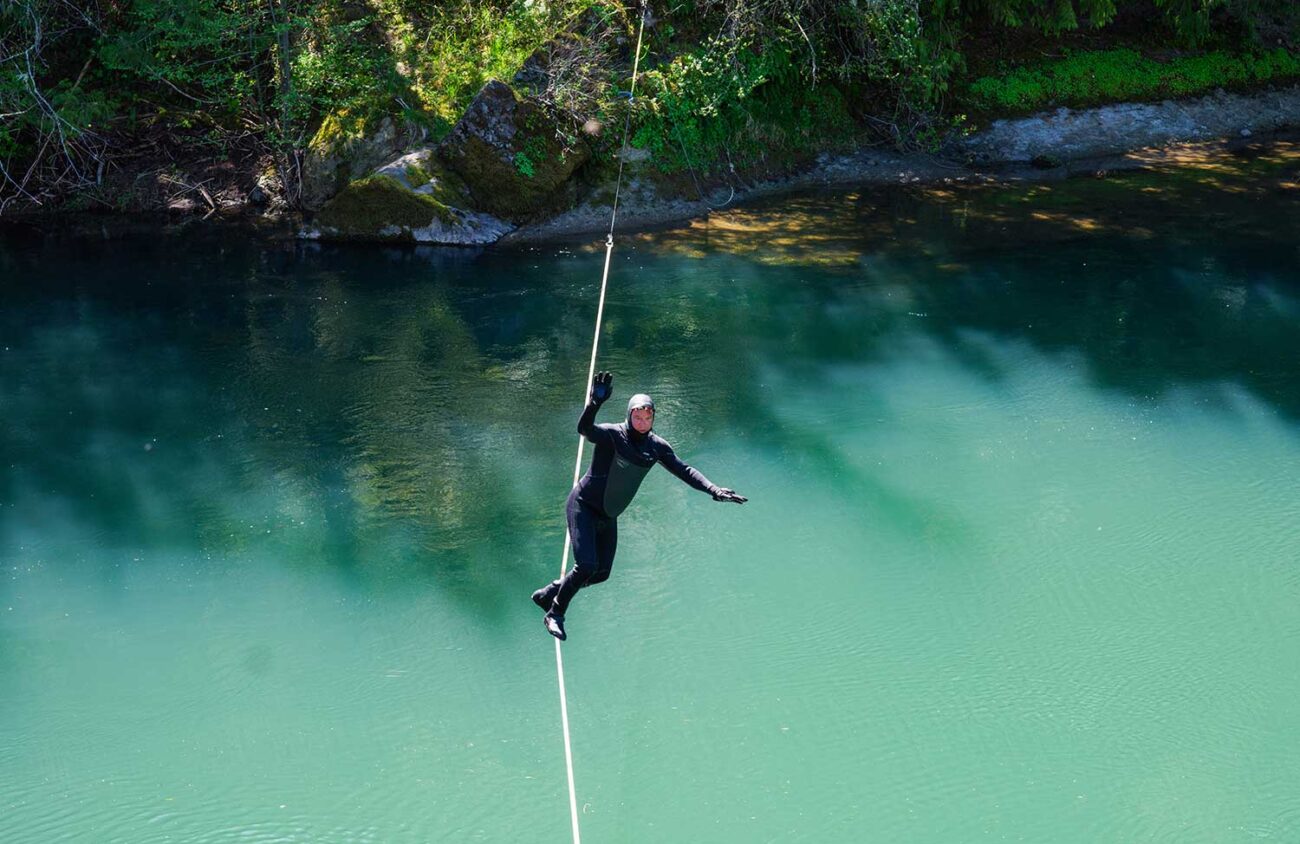
Like many men his age, Adam Grosowsky begins his workouts with stretching. What comes next is a bit more unusual: He wrestles himself into a wet suit and swims across the Row River, near his home in Eugene, Ore. Then he sets up a slackline and really gets to work: walking, turning and swaying on a thin band of webbing 15 feet above the river, surrounded by a cathedral of old-growth trees.
Mr. Grosowsky, 67, helped invent the sport of slacklining back in the late 1970s. It’s harder for him these days — but a lifetime of training has helped.
“As you get older, you realize how much you took for granted,” he said. Your balance, he added, “starts to erode, and you kind of have to keep restoring it, revisiting it every day.”
Balance isn’t a single skill but rather several physical, sensory and cognitive systems working together. As the body ages, those systems can weaken. But there are exercises and habits that can help — and it turns out that balance junkies like Mr. Grosowsky have a lot to teach the rest of us about how to age well.
Understand what goes into balance.
“I think probably the biggest misconception about balance is that there’s a magic bullet — do a few exercises and you’ll be good to go,” said Laurie King, a neurology professor at Oregon Health & Science University and co-director of the Balance Disorders Laboratory. “Think of those few exercises as a starting point, learn about the systems that help control balance, and choose activities that target those areas.”
Since then, Grosowsky has continuously added to his skillset: Handstands, juggling, surfing and knife throwing have all joined his slackline repertoire. Most of his current tricks are done over water, Grosowsky says, because while “water can be very, very unforgiving, it’s better than falling on the ground.”
The beauty of slacklining as a hobby, though, is that it doesn’t have to be an extreme sport. Instead, it can be a meditative session in the park.
“It’s incredibly good for my psyche,” Grosowsky says. “It’s just so calming and centering.”
It’s no surprise then that slacklining’s popularity expanded out of the climbing sphere and into the average Joe’s peaceful afternoon. Just be careful of “the falling down thing,” Grosowsky says, and take it one step at a time.
Incidentally - I met this guy at the last Buck Institute longevity summit, who is from Southern California and has started a business selling these home beginner slackline boards… which seem like a good way to work on your balance:
There are some very fundamental issues to be resolved with all so called “balance training”.
The common assumption is that a given balance training modality is transferable in the same way as muscle training is. When you train a muscle - for example by lifting weights - the muscle gets stronger in general and now you can lift any object in the same weight range, not just the specific kettle ball you were using to strengthen your muscles.
But “balance training” is not like that at all. It is not at all a given that if you learn to walk along a slack line, you are enhancing your sense of balance in general, which will then transfer to fewer falls for example if you should stumble on the stairs. When you are training on a slackline you will get better at walking along a skackline, period, it is super specific and not transferable like in the case of muscle training to other tasks requiring balance. You have learned a specific skill. If you train yourself to become a good ping pong player, you will become a good ping pong player, but it will have no impact on your becoming a good tennis player. You will learn to react quickly and accurately to a speeding ping pong ball, but you will not have developed a generalized ability to perceive and react to all speeding objects like a tennis ball or badminton shuttlecock or racquet ball; you have not trained your vision or proprioception or reflex speed neurons… or balance.
If your ambition is to learn to do high wire walking, by all means, break out that slackline. If you want to train your sense of balance however, be under no illusion that your skills on the slackline will transfer into a generalized “better balance” in all contexts - it doesn’t work that way.
You are learning a specific skill not a generalized enhancement of all your senses.
For many, the abductors lose strength disproportionally in aging. These muscles are critical in preventing one of the more common categories of falling: the unrecoverable stumble.
Speaking of, I’ll repeat here: do not trust your Apple watch to detect a serious fall. It routinely detects “falls” when I am working in the yard and bend over in a certain way to pick something up. The false positives are merely annoying (OK a little worse than that if your hands are gloved and muddy and you have five seconds left before it calls 911). More serious is that the watch was silent the only two times I have taken a real tumble when climbing hills. The current algorithm appears to lack a learning algorithm. I have indicated dozens of times that the movement that triggered a false positive was not a fall but it remains sensitive to the movement, which is not in any way similar to a fall.