https://x.com/davidasinclair/status/2052724890441019629?s=46&t=ujBXvjsf5sfNM8J1qi8RfQ
DHM compound could be found on Amazon and added to DIY formulations.
https://x.com/davidasinclair/status/2052724890441019629?s=46&t=ujBXvjsf5sfNM8J1qi8RfQ
DHM compound could be found on Amazon and added to DIY formulations.
Full details on paper here: Reversing the Clock: Epigenetic Serum Slashes Skin Age by Two Years Across All Skin Tones
Looks pretty subtle to me but Am thinking of making a DIY serum and dissolve a bunch of goods in transcutol then water. So adding this to my shopping list.
A lot of things seem to influence gene expression and epigenetic profile of skin – lasers, heat, copper peptides, etc. Maybe even just something like Amlactin and/or retinols over time can do it.
I am a little confused. I got sirolimus cream from India for dirt cheap. Should I not be using it for anti-aging?
Rapamycin at 16 μM resulted in hair loss and open wounds. Rapamycin 16 μM is about 0.0015%.
rapamycin, n = 17. Rapamycin at 100 nM gave similar results as 1.6 μM (Figure S2). Similar effects by rapamycin were seen in female mice (Figure S2B). Rapamycin at 16 μM, however, resulted in hair loss and open wounds, (data not shown), consistent with a previous vascular grafts study in rats receiving high-dose rapamycin (Walpoth et al., 2001); this may be due to more severe inhibition of mTOR, …
https://www.sciencedirect.com/science/article/pii/S2211124719306990?utm_source=chatgpt.com#mmc1
Rapamycin 0.1% cream is about 66 times higher than the hair loss concentration (16 μM =~ 0.0015%).
Retinol helps anti-aging of facial skin. It also helps hair regrowth when applied to scalp. There is no clear boundary between facial skin and scalp. Scalp is skin too.
But, if rapamycin cream 0.1% is applied for facial skin, its concentration is much higher than the concentration resulting in hair loss.
An anti-aging cream on facial skin resulting in hair loss? Does it make sense?
My thought so far is that rapamycin cream 0.1% was developed for severe skin diseases, not anti-aging.
If you have rapamycin cream 0.1%, I think that you can mix a small tip of the cream with other general skin cream to lower the concentration to be around 10 μM(or 0.001%).
Following is the references about the Rapamycin concentration.
Rapamycin at 16 μM does not enhance hair regeneration (data not shown); this may be due to more severe inhibition of mTOR which was reported to be required for HFSC activation (Castilho et al., 2009; Kellenberger and Tauchi, 2013; Deng et al., 2015
https://www.cell.com/cell-reports/fulltext/S2211-1247(19)30699-0?sf214499969=1
This paper presented three reference papers supporting it besides its own experiments as above. So, the concentration is pretty solid and concrete number supported by multiple researches.
A user here pointed out a similar issue in another thread before:
Damn. Now I don’t want to use it anymore
Why did you delete that post? Was something in error?
I mistakenly posted the same reply two times, so I deleted it. Please delete it completely including this reply if you can. I am new to use this website, and It was not easy for me to post a reply. You can see my original reply above.
You can mix your rapamycin cream with other general skin cream to lower the concentration. It is good that you can cut down the price of rapamycin cream almost 10 times.
If you are not sure that the concentration of your rapamycin cream is below the concentration resulting in hair loss, you can avoid using it near scalp. However, you can still use it for skin except areas you expect growing hairs.
I think that ideally the best way is to maintain the concentration of rapamacin cream in a level promoting both hair growth and skin improvement. Then, you can use the cream both in skin and scalp.
I am using retinol cream both on my facial skin and scalp around my hair line. I will feel better if I can use rapamycin cream in the same way.
I have been applying it with a moisturizer, Tretinoin (4x weekly), AHA/BHA (2x weekly), or vitamin C serum so I never use it on its own. Perhaps that’s a good thing for lowering the concentration.
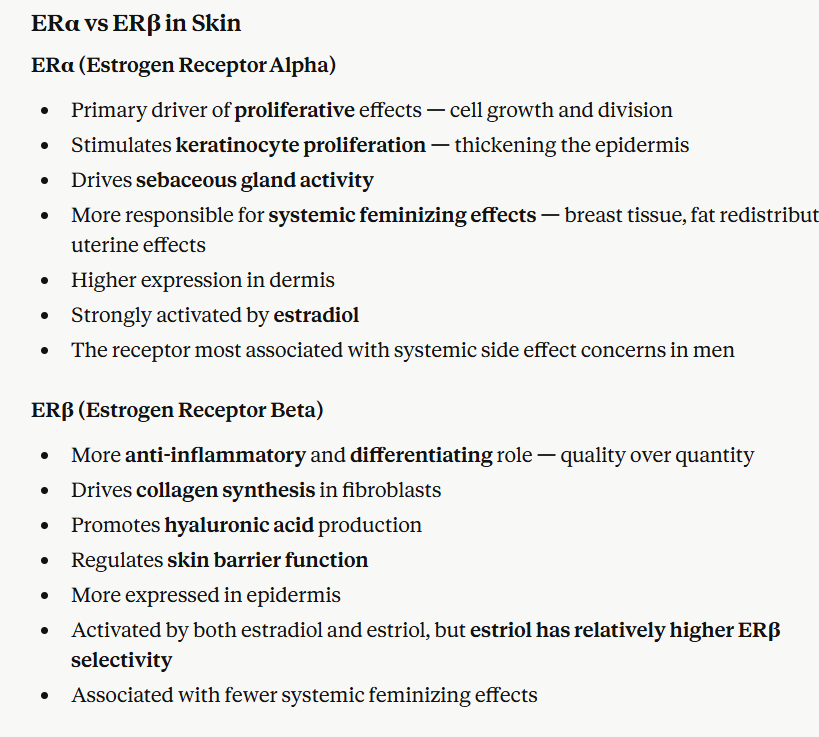
I’ve experimented with an 80:20 combo of estradiol:estriol cream on my face a couple of separate nights before bed and more than any other topical active I notice I wake up with better looking skin.
According to various AI models I’ve talked to about this they state estriol is likely a safer option longer term due to only agonising estrogen receptor beta, whereas estradiol agonises both ERa and ERb. I have tried estriol alone a number of times, I don’t recall having as dramatic an effect as the combination of estradiol and estriol.
This is what Claude says about the different estrogen receptors:
This assessment identifies eleven specific dermatological products recommended by the speaker for their formula stability, ingredient efficacy, and cost-efficiency. The speaker prioritizes topical agents that modulate the skin barrier and dermal structure, specifically those containing niacinamide, centella asiatica, and alpha-hydroxy acids. A central theme of the recommendations is the “K-Beauty” (Korean Beauty) sector, which the speaker evaluates as having superior price-to-performance ratios for hydrating and anti-inflammatory formulations.
Among the top-tier recommendations is Beauty of Joseon Dynasty Cream, valued for its use of niacinamide to inhibit melanosome transfer and rice bran water for hydration. Similarly, Skin1004 Madagascar Centella Soothing Cream is highlighted for its inclusion of centella asiatica and tranexamic acid, which address redness and barrier repair. The speaker also endorses Torriden products, specifically the Cellmazing Firming Gel Mask for its occlusive properties that maximize the penetration of humectants and reduce transepidermal water loss (TEWL).
In the Western retail category, the speaker confirms the clinical utility of AmLactin (12% Lactic Acid), citing its ability to address dermal atrophy and increase dermal thickness—a claim backed by its status as an alpha-hydroxy acid with significant molecular penetration. For general body care, Neutrogena Hydro Boost Hyaluronic Acid Body Lotion and Aveeno Skin Relief Healing Ointment are recommended for their ability to maintain skin suppleness and reduce inflammatory markers via colloidal oat avenanthramides.
The speaker’s methodology for recommendation relies on “R&D footprints,” specifically praising Olay Every Night Retinol for its formulation stability and penetration testing. Conversely, the speaker aggressively filters out oral supplements, such as Nature’s Bounty gummies, due to diagnostic interference risks (biotin) and hepatic toxicity concerns (vitamin A), reinforcing a “topical-first” intervention strategy for dermatological longevity.
Just a share and I’m not sure of the cause.
I have noticed I have some pigmentation on my face. There isn’t anything bad and I’m not even sure I’m going to bother treating it anytime soon, but my face was pretty clear before.
The only two things that are different are:
I went from alternating zinc spf and chemical spf to only using chemical (beauty of joseon or skin1004). The Korean SPFs are known to be good at blocking UVA, so this is unlikely the reason. If anything, I gave up zinc because I heard these provided better coverage.
More likely:
I realized I started using red light in the fall… there are some people who say it gives them pigmentation… I’m guessing this happened to me… but it could just be a coincedence.
That sounds like the likeliest culprit to me — red, infrared light. It will probably clear out on its own with time. Some azelaic acid is helpful too, and really cheap from IndiaMart.
Thanks @medaura! Good to know you think AA works. I’ll give that a try! I was just thinking BBL but I’m not sure I have enough pigmentation for BBL to do its job and hate wasting money. I did it many years ago and it did an excellent job clearing freckles off my chest, but it did nothing on the one slight spot on my face.
AA fades gently. If you really want them gone then a TCA peel will do the job.
This is an interesting image. It shows two twin sisters who aged very differently. One smoke and tanned and consequently had much older-looking, damaged skin than the other:
My brother isn’t a twin, and he is 3 years older than me. Back when we were in our early 20s people said we looked very similar, almost like twins. Today, I’m nearing 54 and my brother is 57; but the two of us look very different now. I barely have any gray hair and look younger than my age, and his hair has lost color for many years now, since he was in his mid-to-late 40s. His hair is also thinning while mine is still thick. His skin also looks a lot older than mine.
Our lifestyles are very different, which probably explains the difference much more than genetics. (He has for many years had a very unhealthy diet, while I have not. I also was vegetarian for a year or two, while he never was.)
…
I think it would be good to see some more examples of how lifestyle choices affect skin and hair in identical twins. E.g. how does omega-3 supplementation affect them? Polyphenol content? Fiber? Vegetarian or not? Protein?
@Beth For the last month I have tried increasing my OneSkin Face to 2x per day, and combining it with twice-weekly “nano needling”. That is, using the Dr. Pen microneedle pen with “nano” heads which are a silicon-based head that only penetrate 0.25mm. Ideally improving penetration into the epidermis, and it doesn’t hurt or cause redness.
Subjectively, I would say that it did help, and it kind of replicated the benefits I saw from starting OneSkin in the first place. I said back then that it did reduce some expression lines and wrinkles, and then stabilised at a ceiling of sorts. I think adding the nanoneedling and second application has given another improvement. So maybe worth a look?
Ok @relaxedmeatball, you’ve convinced me to stop being lazy and to use my GloPro microneedle! I’m not too lazy to actually use it, but cleaning it has been a mental block!
@medaura I think it’s likely you will have a great source to do a TCA peel at home on the cheap… yes?
Also, anyone have thoughts on a GHK CU diy serum. I have the power in my cart, but not sure if it’s worth fitting something else into my routine?
PS I did realize I stopped using Elevai serum a few months ago, but I doubt that is the cause because my skin was the same before and after using it. I’m still thinking it was the red light.
@Albina fyi, I think you’d like to follow this thread…