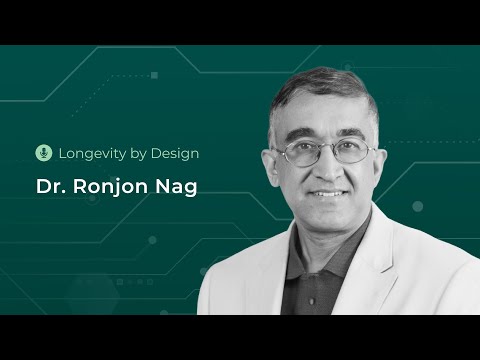
Is AI more intelligent than a clinician? The answer may surprise you. On #LongevitybyDesign
, Dr. RonjonNag @Stanford, discussed why #AI won’t replace doctors, but can become a powerful collaborator for better health & longevity decisions.
Gemini Pro AI Video Summary and Analysis:
Based on the transcript provided, here is the high-resolution summary and analysis of the conversation between Dr. Gil Blander and Dr. Ronjon Nag.
Executive Summary
Source: Longevity by Design Podcast | Guest: Dr. Ronjon Nag | Date: January 2026 (Contextual)
This dialogue explores the convergence of Artificial Intelligence, Systems Biology, and financial portfolio theory in the pursuit of human longevity. Dr. Ronjon Nag, a veteran of neural network development since 1983, argues that biology should be treated as a data science problem, shifting medicine from “trial and error” intuition to quantitative prediction.
The core thesis is that aging is a complex system failure that can be modeled and mitigated using AI-driven “Digital Twins” and high-throughput data integration (the “Ageosphere”). Nag introduces two significant venture-backed interventions: Amica, a proposed “vaccine for aging” that trains the immune system to eliminate senescent cells via specific peptide targets; and Pivot (Allactive Bio Solutions), a food-based, oral GLP-1 agonist intended for prophylactic weight management without the side effect profile or administration burden of current injectables.
Nag applies Modern Portfolio Theory to biotech investing, advocating for “counter-correlated” assets (e.g., balancing high-risk neurodegeneration research with lower-risk metabolic interventions) to finance moonshots. The discussion concludes with a polarizing prediction: Nag asserts that individuals currently under the age of 40 may reach “longevity escape velocity” and effectively live forever, provided they navigate the current transition period with aggressive lifestyle optimization.
Bullet Summary
- AI as Collaborator, Not Replacement: Current AI operates as a high-level “research assistant” or “collaborator” for scientists, accelerating coding and literature review, though it lacks genuine ambition or semantic understanding.
- The “Ageosphere”: A proposed ecosystem to integrate siloed health data (wearables, EHRs, genomic sequencing) into a unified format for AI analysis, overcoming current interoperability hurdles.
- Digital Twins: The ultimate goal of AI in health is to simulate an individual’s entire biochemical and electrical state to test interventions in silico before in vivo application.
- Biotech Portfolio Theory: Reducing the financial risk of longevity research by bundling counter-correlated therapeutic areas (e.g., Alzheimer’s drugs paired with orthopedics).
- Senolytic Vaccine (Amica): A novel approach using peptides to train the immune system to recognize and clear senescent cells (zombie cells) preventing them from degrading surrounding tissue.
- Oral “Food” GLP-1 (Pivot): A non-prescription, GRAS (Generally Recognized As Safe) supplement derived from food sources aimed at stimulating GLP-1 pathways for weight maintenance in non-obese populations.
- Running Efficiency: Nag identifies running as the single most time-efficient intervention for cardiovascular health, claiming superior benefits to walking due to heart rate intensity.
- Social Bio-Feedback: Social interaction is framed as a biological necessity for resilience; “digital exhaustion” from text-based communication depletes energy compared to face-to-face interaction.
- Supplement Sourcing: AI can identify negative interactions (e.g., Zinc and Magnesium competing for absorption) that pre-mixed supplements often ignore.
- Escape Velocity: Nag predicts that the convergence of AI and biotech will allow those currently under 40 to extend their lifespans indefinitely.
- Data-Driven Behavior Modification: The primary value of wearables is not the raw data, but the psychological “nudge” and feedback loop that gamifies health behavior.
Claims & Evidence Table (Adversarial Peer Review)
Role: Longevity Scientist / Peer Reviewer
Objective: Validate specific claims against current medical consensus and safety data.
| Claim from Video | Speaker’s Evidence | Scientific Reality (Best Available Data) | Evidence Grade | Verdict |
|---|---|---|---|---|
| “Vaccine for aging” (Amica) clears senescent cells. | Cites internal venture mechanism (Peptide training of immune system). | Senolytic vaccines (e.g., targeting GPNMB) show promise in mice (Suda et al., 2021). No Phase II/III human data confirms safety or efficacy in reversing aging. | D (Pre-clinical/Animal) | Speculative / Early Stage |
| Food-based GLP-1 (Pivot) induces weight loss similar to drugs. | Anecdotal (Founder lost 50 lbs); mechanism is “GRAS ingredients”. | Natural GLP-1 stimulants (berberine, fiber, whey) exist but have negligible potency compared to Semaglutide/Tirzepatide. “Nature’s Ozempic” claims are often marketing hyperbole. | E (Anecdote) | Weak / Translational Gap |
| Running is more time-efficient than walking for mortality risk. | States 10 mins running > 90 mins walking (implied). | Lee et al. (2014) & Wen et al. (2011): 5-10 min/day of vigorous running reduces mortality risk similarly to longer durations of moderate walking. High-intensity is time-efficient. | C (Cohort/Observational) | Strong Support |
| Zinc and Magnesium compete for absorption. | Cites AI analysis of metabolic pathways. | Confirmed mechanism: Both minerals use the same transporter (TRPM7/divalent cation channels). High doses of one inhibit the other if taken simultaneously. | D (Mechanistic) | True / Actionable |
| People under 40 today will “live forever.” | Extrapolation of AI/Biotech progress curves. | No biological evidence suggests halting aging is imminent. “Longevity Escape Velocity” remains a theoretical concept, not a validated roadmap. | E (Expert Opinion) | Unsupported / Hype |
| Micro-dosing GLP-1 is safe/beneficial for non-obese people. | Mentions “Hims & Hers” trends and general prophylaxis. | GLP-1 agonists carry risks (gastroparesis, muscle loss). Risk/benefit ratio for healthy BMI individuals is not established by RCTs. | E (Opinion) | Safety Warning |
Actionable Insights (Pragmatic & Prioritized)
Based on the synthesis of Dr. Nag’s engineering mindset and verified biological data, here is the prioritized protocol:
Top Tier (High Confidence / Low Risk)
- Run for Efficiency: Incorporate 10–15 minutes of vigorous running (or Zone 5 cardio) daily. This yields disproportionately high cardiovascular protection compared to long-duration walking.
- Separate Mineral Intake: Do not take Zinc and Magnesium supplements simultaneously. Space them by at least 2 hours to maximize absorption (e.g., Zinc in the morning, Magnesium before bed).
- High-Fidelity Socializing: Replace text/email interactions with video or in-person meetings specifically for “resilience.” Treat social engagement as a biological input (oxytocin/serotonin modulation) rather than just communication.
- Fiber Saturation: Increase fiber intake (via diet or psyllium husk/Metamucil) to naturally stimulate gut hormones (GLP-1) and regulate lipids, acting as a “low-tech” version of the Pivot concept.
Experimental (Risk/Reward Managed)
- Wearable Feedback Loops: Use a wearable (Whoop/Oura/Apple) strictly for Resting Heart Rate (RHR) and HRV trends. If RHR spikes >10% above baseline, treat it as a pre-symptomatic illness indicator: immediately increase sleep and reduce training intensity.
- “Counter-Correlated” Health Investments: Apply portfolio theory to your health. If you are focusing heavily on metabolic health (diet/GLP-1), balance it with orthopedic training (bone density/connective tissue) to prevent frailty, ensuring one system doesn’t fail while the other succeeds.
Avoid
- “Natural Ozempic” Supplements: Be highly skeptical of expensive “food-based GLP-1” pills unless they have a transparent ingredient label (usually just fiber/berberine).
- Simultaneous Supplement Stacking: Avoid taking “multivitamin” packs where minerals are combined in a single pill; absorption rates are likely compromised.
Technical Deep-Dive: The “Aging Vaccine” Mechanism
Dr. Nag’s mention of Amica refers to the emerging field of Senolytic Immunotherapy.
The Problem:
As organisms age, cells accumulate DNA damage. To prevent these damaged cells from becoming cancerous, they enter a state called cellular senescence (permanent cell cycle arrest). These “zombie cells” resist apoptosis (programmed cell death) and secrete a toxic cocktail of inflammatory cytokines, proteases, and growth factors known as the SASP (Senescence-Associated Secretory Phenotype). The SASP degrades surrounding tissue and induces senescence in healthy neighbors.
The Mechanism (Vaccine Approach):
- Target Identification: Senescent cells express specific surface proteins (antigens) that are not present (or expressed at low levels) in healthy cells. (e.g., GPNMB, uPAR).
- Peptide Selection: Amica likely uses AI to identify peptide sequences derived from these senescent-specific surface proteins.
- Immunization: These peptides are administered as a vaccine.
- Immune Response: The host’s immune system (B-cells and T-cells) creates antibodies against the specific peptide.
- Clearance: The immune system hunts down and destroys endogenous cells expressing the target protein (the senescent cells), theoretically reducing systemic inflammation and rejuvenating tissue function.
The Risk:
The primary safety risk is off-target toxicity. If the target antigen is expressed even at low levels on essential healthy tissues (e.g., heart or kidneys), the vaccine could induce an autoimmune reaction, causing organ damage. This is why “Translational Gap” is flagged in Section D.
Fact-Check: Artificial General Intelligence (AGI) & Medicine
Claim: AI will move from “Word Prediction” to “Causal Reasoning” and medical diagnosis superiority within 5 years.
Analysis:
- Current State: LLMs (Large Language Models) like GPT-4 are probabilistic token predictors. They excel at retrieving medical knowledge but hallucinate when forced to perform multi-step causal logic or when data is scarce (rare diseases).
- The Constraint: Dr. Nag correctly identifies that current AI lacks “ambition” and “state maintenance” over long periods.
- Evidence: A 2023 study in JAMA Internal Medicine found AI chatbots responded to patient questions with higher quality and empathy than physicians 79% of the time. However, diagnostic accuracy in complex, real-world clinical vignettes still lags behind board-certified specialists when visual and history data are unstructured.
- Verdict: The timeline of “5 years” for AGI is optimistic and hotly debated. However, the shift to AI as a “second opinion” or “collaborator” is already validated and active in clinical workflows.