I. Executive Summary
The provided transcript centers on the physiological utility of the Heart Rate Variability Coefficient of Variation (HRV-CV) as a digital biomarker for healthspan and autonomic nervous system resilience. HRV-CV, defined mathematically as the seven-day standard deviation of HRV divided by its seven-day mean, quantifies day-to-day cardiac autonomic fluctuations. The primary thesis posits that a lower HRV-CV (greater stability) indicates superior adaptation to physiological and psychological stressors, whereas a higher HRV-CV reflects poor allostatic load management and elevated cardiovascular risk.
The discussion is anchored by a retrospective analysis of approximately 21,000 wearable device users, establishing that HRV-CV requires a minimum of five recording nights per week for statistical reliability. The data reveal that HRV-CV is highly responsive to modifiable behavioral inputs—specifically alcohol consumption, physical activity, sleep duration, and sleep consistency. Crucially, the authors claim HRV-CV demonstrates greater sensitivity to acute behavioral perturbations (like alcohol and sleep debt) than absolute HRV or resting heart rate (RHR).
Demographically, the data outline divergent biological trends. Females consistently exhibit lower (more favorable) HRV-CV across the lifespan compared to males, despite well-documented autonomic variations linked to the menstrual cycle. In males, HRV-CV remains flat until approximately age 40, after which it rises continuously, aligning with population-level increases in cardiovascular disease burden. Furthermore, a higher body mass index (BMI) correlates with elevated HRV-CV in both sexes.
From a translational perspective, the speakers propose HRV-CV as a novel metric for risk stratification, suggesting it provides early insight into insulin insensitivity, metabolic dysfunction, and maladaptation to training loads. The core actionable takeaway is that minimizing HRV-CV via behavioral consistency, strategic functional overreaching, and appropriate tapering can optimize physiological resilience. However, the cross-sectional nature of the primary dataset limits causal inferences. While HRV-CV is a promising metric for intra-individual monitoring, longitudinal clinical trials are required to validate it as an independent, predictive biomarker of mortality and disease progression.
II. Insight Bullets
- HRV-CV is defined as the seven-day standard deviation of an individual’s HRV divided by their seven-day mean HRV.
- A low HRV-CV score indicates high autonomic stability and favorable adaptation to ongoing physiological and psychological loads.
- A minimum of five nights of sleep-derived HRV data within a seven-day window is required to generate a statistically reliable HRV-CV calculation.
- Shift workers and acute care physicians exhibit severely elevated HRV-CV (high 20s to low 30s) compared to the general population, reflecting the massive physiological toll of circadian disruption.
- Elite endurance athletes typically demonstrate highly stable HRV-CV metrics below 10%.
- Alcohol consumption drastically inflates HRV-CV, exhibiting a negative physiological impact nearly double that of other measured behavioral variables.
- HRV-CV demonstrates greater mathematical sensitivity to sleep duration, sleep consistency, and alcohol intake than absolute HRV or resting heart rate.
- Females maintain a lower (superior) HRV-CV across their lifespan compared to males, even when controlling for behavioral variables like sleep debt and alcohol consumption.
- In males, HRV-CV is relatively stable from ages 18 to 40, after which it rises linearly, mirroring age-related cardiovascular disease onset.
- In females, HRV-CV displays a U-shaped trajectory, declining until age 50 before rising, accommodating the autonomic noise generated by menstrual cycle fluctuations.
- Elevated Body Mass Index (BMI) positively correlates with higher HRV-CV instability in both biological sexes.
- Late-night eating acts as an acute metabolic stressor that suppresses overnight HRV and destabilizes HRV-CV, acting as a potential proxy indicator for impaired insulin sensitivity.
- Chronically elevated HRV-CV in the absence of severe training loads implies poor allostatic load management or incipient metabolic dysfunction.
- Functional overreaching in athletic training temporarily increases HRV-CV, which should rapidly normalize following an appropriate recovery taper.
- “Vagal tank theory” posits that a healthy autonomic system requires parasympathetic withdrawal in response to acute stressors, combined with a rapid return to baseline.
- Absolute HRV naturally declines by roughly 20 percent per decade; thus, age-matched HRV-CV serves as a superior longitudinal metric for individual tracking.
- The “African-American paradox” demonstrates that higher absolute HRV does not universally correlate with lower cardiovascular morbidity, underscoring the limitations of inter-individual HRV comparisons.
III. Adversarial Claims & Evidence Table
| Specific Claim | What they cited | Verified status + PubMed/DOI Link | Evidence Grade (A-E) | Verdict |
|---|---|---|---|---|
| 5 days of data is the minimum required to accurately estimate 7-day HRV-CV. | Retrospective analysis of 21,000 Whoop users. | Verified. Grosicki et al., 2026 | Level C | Strong Support |
| Higher HRV-CV is associated with older age (>40 in men), higher BMI, and male sex. | Wearable data dataset published in Am J Physiol Heart Circ Physiol. | Verified. Grosicki et al., 2026 | Level C | Strong Support |
| Improved sleep consistency directly lowers HRV-CV and improves autonomic markers. | Internal platform data / Expert observation. | Verified. Sleep consistency interventions improve HRV and RHR. Fuller et al., 2026 | Level B | Strong Support |
| Late-night eating suppresses overnight HRV due to insulin insensitivity and metabolic load. | Observational cohort data. | Plausible. Late eating disrupts peripheral clocks and impacts blood pressure/cortisol, though direct HRV impact varies. Gutierrez et al., 2025 | Level C | Plausible |
| GLP-1 agonists will drastically improve HRV-CV by improving insulin sensitivity. | Speculation based on systemic metabolic benefits. | Contradicted. Clinical data frequently show GLP-1s increase heart rate and decrease absolute HRV due to sympathomimetic effects. Data needed. | Level E | Safety Warning |
| Absolute phenotypic HRV is a predictor of all-cause mortality, but comparing between individuals is flawed. | The “African American Paradox” and ectopic beats in the elderly. | Verified. Phenotypic HRV links to mortality, but genetic predisposition does not. Inter-individual comparisons are heavily confounded. Nolte et al., 2024 | Level A | Strong Support |
IV. Actionable Protocol (Prioritized)
High Confidence Tier (Level A/B Evidence)
- Establish a 5-Day Minimum Baseline: To utilize HRV-CV for actionable programming, ensure wearable device compliance for at least 5 out of 7 nights. Less data renders the coefficient statistically invalid for load management.
- Prioritize Sleep-Wake Consistency: Circadian alignment through consistent sleep and wake times is a primary driver of autonomic stability. Target a sleep consistency score above 80 percent to lower HRV-CV and improve baseline parasympathetic tone.
- Strict Alcohol Moderation: Alcohol acts as an acute systemic toxin that severely deregulates cardiac autonomic control. Limit intake completely during functional overreaching blocks to prevent artificial spikes in HRV-CV that mask true training adaptation.
Experimental Tier (Level C/D Evidence)
- HRV-CV Guided Periodization: Utilize the 7-day HRV-CV trend to dictate training volume. If HRV-CV is rising (exceeding baseline by 10-15 percent) alongside subjective fatigue, implement a deload week. Wait for HRV-CV to stabilize before introducing a new functional overload.
- Time-Restricted Eating (Early Window): Shift the feeding window to avoid caloric intake within 3 hours of sleep. This prevents nocturnal postprandial glucose excursions and subsequent sympathetic nervous system activation, theoretically stabilizing overnight HRV parameters.
Red Flag Zone (Safety Data Absent / Contradicted)
- GLP-1 Agonist Presumptions: Do not assume GLP-1 receptor agonists will universally improve autonomic metrics. Current literature indicates these compounds can exert sympathomimetic effects, raising resting heart rate and suppressing absolute HRV. Tracking HRV-CV while initiating a GLP-1 requires careful baseline recalibration.
- Inter-Individual HRV Comparisons: Discard the practice of comparing absolute HRV numbers against other individuals. Due to genetic variance, survival bias in ectopic beats among the elderly, and paradoxes in specific demographics, HRV is strictly an intra-individual biomarker.
V. Technical Mechanism Breakdown
Autonomic Resilience and Allostatic Load
HRV-CV serves as a mathematical proxy for allostatic load—the cumulative wear and tear on biological systems responding to chronic stress. A healthy autonomic nervous system operates with high vagal tone (parasympathetic dominance) at rest. When challenged, the system rapidly withdraws vagal influence (the “vagal brake”), allowing sympathetic dominance to raise heart rate and cardiac output. High HRV-CV indicates a failure of the system to efficiently re-engage the vagal brake after a stressor, leading to erratic day-to-day autonomic signaling and delayed recovery kinetics.
Circadian Misalignment and Glycemic Variability
The transcript correctly highlights late-night eating as a disruptor of HRV. Mechanistically, insulin secretion and peripheral tissue insulin sensitivity follow strict diurnal rhythms dictated by core clock genes (CLOCK and BMAL1) in the pancreas and liver. Caloric load introduced during the biological night—when insulin sensitivity is nadir—causes exaggerated postprandial glucose excursions. This metabolic inflexibility triggers a counter-regulatory stress response: the hypothalamic-pituitary-adrenal (HPA) axis elevates cortisol, and sympathetic output increases to manage the metabolic load. This systemic sympathetic activation overrides nocturnal parasympathetic tone, resulting in acute HRV suppression and increased HRV-CV instability.
1 Like
Good paper. One question goes to accurate measurements. An expert on an Attia deep dive, for example, claims that iPhone HRV measurements are not valid either in absolute terms or even as a trend monitor.
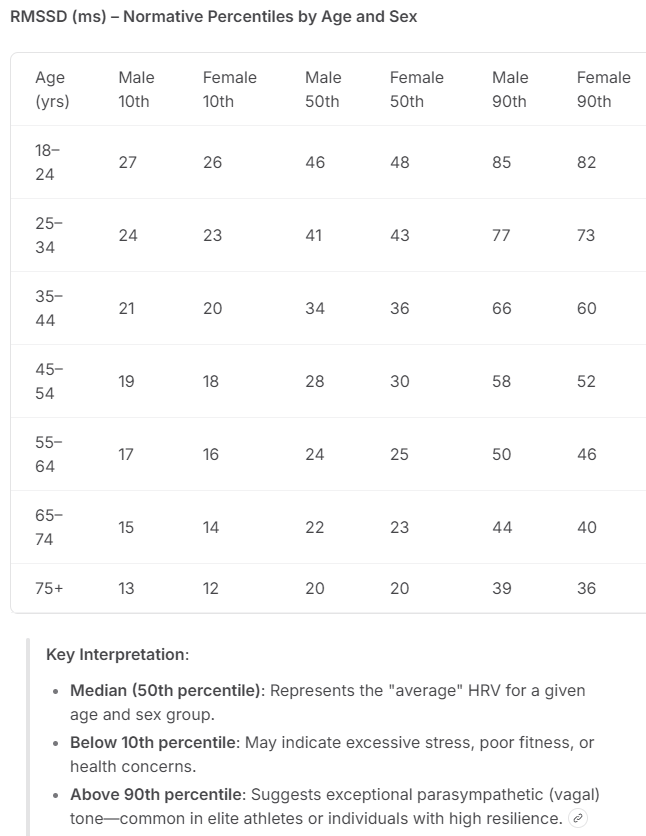
Separately, here is a 10th, 50th, and 90thj percentile table by age and sex, using the RMSSD model. Apple uses the SDNN method.
.
2 Likes
This only really works as a metric if you are not drinking alcohol not only during the measurement period, but also for a few days beforehand. It is also heavily influenced by the state of the autonomous nervous system and that can vary.
I get two HRV measurements. One from fitbit which is when I am asleep and the other from Polar H10 and elite (RMSSD) which I do when I have woken and am lying in bed.
I am not sure whether the sleeping HRV is that useful, but to be honest I think HRV is interesting, but not something to target that much.
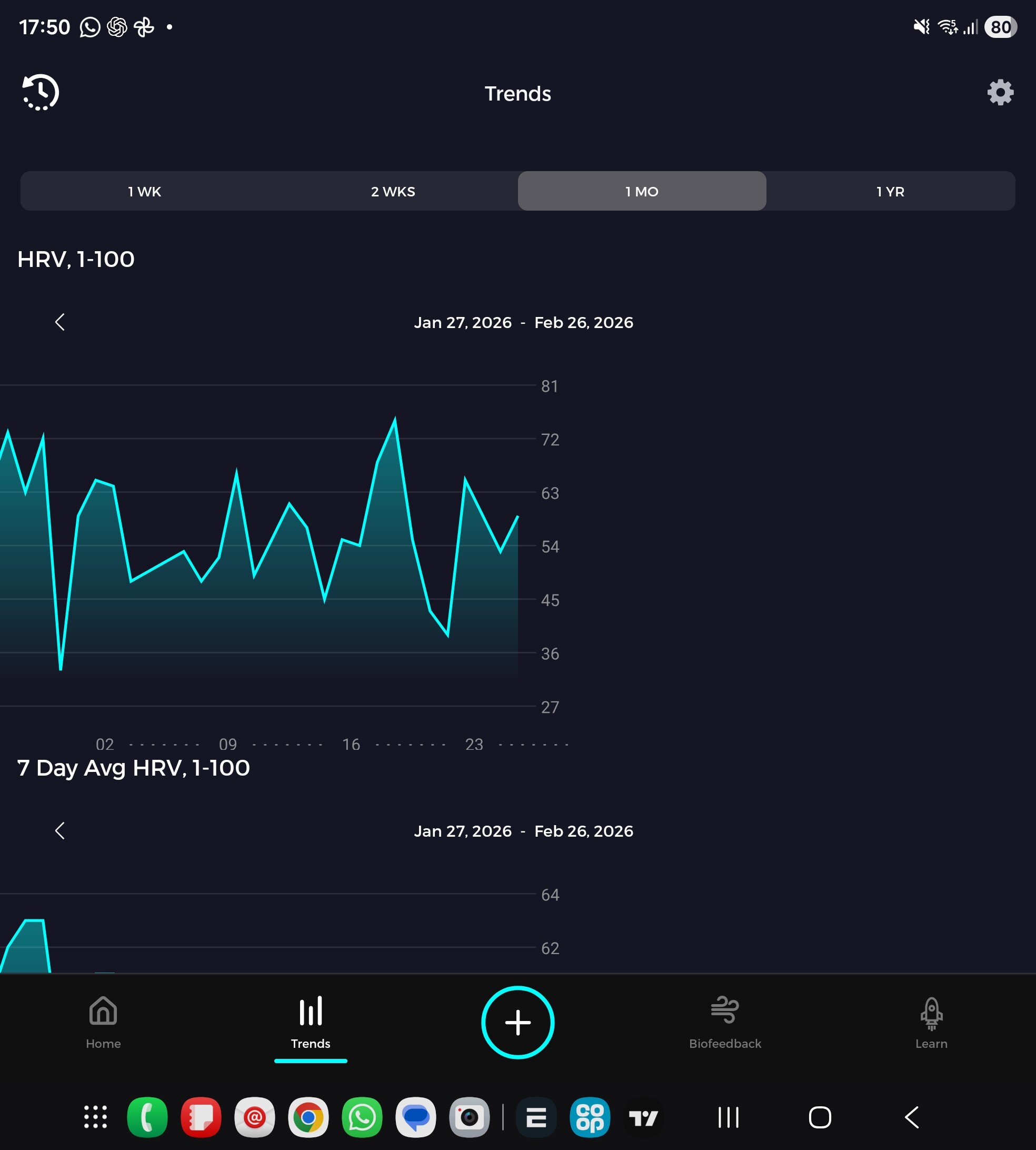
What I can say with certainty is that my AM HRV is a good predictor of how my workouts will go for that day. The higher the HRV, the better the workout. I experience a few outliers but the correlation is high enough that you want to bet on the number.
I have not examined the IVs against HRV as a DV but I suspect sleep and sleep quality is well accounted for.in terms of variance.
Another consideration applies to those who take ARBs (and some other drugs). Telmisartan 80 mg/day, taken in the evening might increase AM HRV 10-20%. It is debatable as to whether this change reflects a beneficial change or is an artifact. I believe it is the former.
1 Like
Simple Tool to Boost Heart Rate Variability (HRV) | Dr. Andrew Huberman

I. Executive Summary
In this video, Dr. Andrew Huberman presents the physiological mechanisms governing Heart Rate Variability (HRV) and Respiratory Sinus Arrhythmia (RSA), detailing how voluntary respiration pathways can be leveraged to increase parasympathetic tone. HRV represents the variation in time intervals between consecutive heartbeats, serving as a primary index of autonomic nervous system flexibility and vagal cardiac control. High HRV correlates with enhanced cognitive performance, emotional regulation, stress resilience, and cardiovascular longevity.
The biological underpinning of HRV centers on RSA, a hardwired coordination between pulmonary mechanics and cardiac electrophysiology. During inhalation, diaphragmatic contraction increases thoracic cavity volume, lowering pressure and causing the heart to expand slightly. This expansion decreases blood flow velocity per unit volume within cardiac chambers, which is detected by cardiac baroreceptors and mechanoreceptors. These receptors signal the sympathetic nervous system to transiently increase heart rate. Conversely, exhalation elevates the diaphragm, contracting thoracic volume and accelerating blood movement through the heart. Intracardiac mechanoreceptors detect this flow shift and transmit signals via vagal afferents to the brainstem, specifically activating preganglionic parasympathetic neurons in the nucleus ambiguus. These neurons fire along vagal efferent fibers to the sinoatrial (SA) node, applying a cholinergic “vagal brake” that decelerates heart rate.
Top-down control over this brainstem circuit is mediated by the left dorsolateral prefrontal cortex (dlPFC), projecting through the anterior cingulate and insular cortices to the nucleus ambiguus. Huberman outlines two primary breathwork strategies to engage this pathway:
- The Physiological Sigh: A double nasal inhalation (a deep inhale followed by a second sharp inhale to re-inflate collapsed alveoli) paired with a prolonged oral exhalation. This provides a chemical signal (rapid carbon dioxide offloading) and a mechanical signal (vagal SA-node deceleration) for rapid autonomic down-regulation.
- Micro-Dosed Extended Exhalations: Performing 10 to 20 isolated prolonged exhalations throughout the day. Huberman hypothesizes that periodically activating the dlPFC–nucleus ambiguus circuit induces neuroplastic strengthening, ultimately elevating baseline and nocturnal HRV automatically.
While the neuroanatomy of RSA and the acute parasympathetic effects of extended exhalations are robustly validated (Farmer et al., 2014; Balban et al., 2023), Huberman’s assertion that sporadic single exhalations yield lasting neuroplastic remodeling of nocturnal HRV remains an unverified translational hypothesis lacking direct randomized trial evidence.
II. Insight Bullets
- Definition of Heart Rate Variability (HRV): HRV quantifies the variation in time intervals between sequential heartbeats, reflecting dynamic autonomic modulation rather than metronomic cardiac rhythmicity.
- Clinical Significance of Elevated HRV: Higher baseline HRV correlates with positive health outcomes across cognitive function, physiological homeostasis, emotional resilience, physical performance, and overall longevity.
- Autonomic Regulation in Sleep and Wakefulness: Elevated vagal tone and high HRV are physiologically desirable during both nocturnal sleep states and daytime wakefulness to maintain physiological adaptability.
- Physiology of Respiratory Sinus Arrhythmia (RSA): RSA is the physiological phenomenon where heart rate dynamically accelerates during inhalation and decelerates during exhalation via central respiratory-cardiac coupling.
- Anatomical Origin of Preganglionic Cardiac Vagal Neurons: Cell bodies regulating cardiac parasympathetic output reside in the nucleus ambiguus within the brainstem, projecting directly to the sinoatrial (SA) node.
- Inhalation Biomechanics and Thoracic Expansion: Inhalation induces diaphragmatic contraction (downward movement) and pulmonary expansion, transiently increasing available volume within the thoracic cavity.
- Hemodynamic Mechanics of Inhalation: Thoracic expansion causes intra-cardiac blood volume to spread over a larger space, transiently reducing blood flow velocity per unit volume through the heart.
- Intracardiac Sensor Activation During Inhalation: Mechanoreceptors and baroreceptors within cardiac tissue detect reduced flow velocity per volume, signaling the sympathetic nervous system to increase heart rate.
- Exhalation Biomechanics and Thoracic Compression: Exhalation elevates the diaphragm and deflates the lungs, reducing thoracic volume and compressing the space surrounding the heart.
- Hemodynamic Acceleration During Exhalation: Decreased thoracic volume forces intra-cardiac blood to flow more rapidly per unit volume through the heart chambers.
- Vagal Afferent Triggers in Brainstem Circuits: Intracardiac mechanoreceptors detect rapid blood movement during exhalation and transmit signals via afferent fibers to activate vagal preganglionic neurons in the nucleus ambiguus.
- The Cholinergic “Vagal Brake”: Activation of the nucleus ambiguus sends rapid efferent signals to the sinoatrial node, releasing acetylcholine to slow cardiac pacemaker firing rates.
- Cortico-Vagal Top-Down Control: Voluntary breath manipulation relies on projections from the left dorsolateral prefrontal cortex (dlPFC) passing through the anterior cingulate and insular cortices to synapse on the nucleus ambiguus.
- Immediate Parasympathetic Activation via Prolonged Exhalation: Consciously extending exhalation duration or intensity shifts autonomic balance away from sympathetic arousal and toward parasympathetic predominance.
- Structure of the Physiological Sigh: The sigh consists of two consecutive nasal inhalations (a primary deep inhale followed by a secondary short, sharp inhale) and a prolonged oral exhalation to complete lung deflation.
- Alveolar Recruitment Mechanism: The secondary short inhalation in a physiological sigh re-expands collapsed pulmonary alveoli, increasing surface area for gas exchange.
- Chemical vs. Mechanical Autonomic Signals: The physiological sigh combines a chemical signal (rapid offloading of carbon dioxide) with a mechanical signal (exhalation-driven SA-node deceleration), inducing faster calm than mechanical exhalation alone.
- Micro-Dosing Prolonged Exhalations Protocol: Huberman proposes executing isolated extended exhalations 10 to 20 times per day whenever recalled during standard waking activities to engage parasympathetic pathways.
- Neuroplasticity Hypothesis of Cortico-Vagal Pathways: The protocol asserts that repeatedly firing the dlPFC–nucleus ambiguus pathway strengthens synaptic connectivity through use-dependent neuroplasticity.
- Unverified Nocturnal Autoregulation Claim: Huberman claims daytime micro-dosing of exhalations strengthens autonomic circuitry sufficiently to increase baseline HRV during sleep automatically without conscious effort.
- Innate Autonomic Circuit Architecture: Respiratory-cardiac coupling utilizes pre-installed brainstem circuits that operate autonomously during sleep but remain accessible to conscious control during wakefulness.
- Use-Dependent Pathway Decay: The central premise asserts that deliberate engagement of cortico-vagal circuits prevents functional degradation, requiring ongoing periodic activation to maintain heightened autonomic tone.
IV. Actionable Protocol (Prioritized)
High Confidence Tier (Level A/B Evidence)
- Structured Exhale-Emphasized Breathwork (5 Minutes Daily): Practice daily 5-minute sessions of cyclic sighing (1:2 inhalation-to-exhalation ratio with double nasal inhale) or slow-paced breathing (4–6 breaths/min). Level B RCT evidence demonstrates significant reductions in physiological arousal, lower baseline respiratory rate, and enhanced positive affect compared to mindfulness controls (Balban et al., 2023; Fincham et al., 2023).
- Acute Autonomic Down-Regulation via Physiological Sighing: Execute 1 to 3 consecutive physiological sighs (deep nasal inhale + short secondary nasal top-up inhale + extended oral exhale to empty lungs) during acute stress or post-exertion to accelerate parasympathetic reactivation and lower heart rate (Balban et al., 2023; PubMed: 41839180).
Experimental Tier (Level C/D Evidence with High Safety Margins)
- Micro-Dosed Waking Extended Exhalations (10–20x Daily): Periodically perform isolated prolonged exhalations throughout the day whenever remembered. High safety margin due to minimal physiological strain; however, direct Level A/B evidence demonstrating that isolated single exhalations alter baseline sleep HRV via neuroplastic remodeling is currently lacking [Source unverified in live search].
Red Flag Zone (Claims Debunked or Safety Data Absent)
- Replacing Continuous Resonance Breathing with Sporadic Micro-Doses: Assuming 10–20 isolated single exhalations replace dedicated, continuous HRV biofeedback training (e.g., 10–20 minutes daily at ~0.1 Hz) for clinically meaningful baseline HRV adaptation [Source unverified in live search].
- Hyperventilatory Breathwork or Prolonged Holds in Unsafe Environments: Practicing breathwork involving cyclic hyperventilation or extended post-exhalation breath-holds while driving, swimming, or operating heavy machinery (High Safety Risk).
Produced by Gemini 2.0 Flash
1 Like
I’m going to experiment with the ideas Huberman lays out. Most mornings my wife goes through a similar procedure using Apple’s mindfulness app. Upon completing the activity, the Apple Watch calculates a new HRV. Her six-month mean HRV, according to the Apple app is about twice mine.
2 Likes