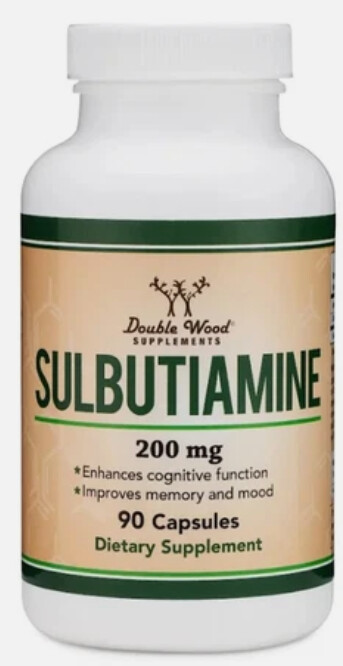
I don’t think we have discussed it in these forums (unless I missed it) but it would be interesting to know if people are taking it, the dosage, frequency, and what they are feeling etc.? I have been taking it on and off (2-3 days per week) and I think it has a bit of calming effect. Below is a link to reddit of people experiences with sulbutiamine:
I have been taking DoubleWood. 600 mg in the morning. I have felt nothing.
Do I need a higher dose? I do take it with MCT oil because sulbutiamine is fat soluble.
Sulbutiamine is a synthetic, fat-soluble derivative of vitamin B1 (thiamine). Unlike standard water-soluble thiamine, its lipophilic nature allows it to cross the blood-brain barrier more efficiently, leading to higher thiamine levels in the brain.
[image]Wikipedia +3
Key Uses and Effects
Asthenia and Fatigue: Primarily used to treat symptoms of weakness, lack of energy, and physical or mental fatigue. Some evidence suggests it may reduce fatigue in patients with multiple sclerosis.
Cognitive Support: Often marketed as a nootropic to enhance memory, focus, and mental alertness.
Mood and Motivation: It may help reduce psycho-behavioral inhibition in depression and potentially boost motivation by modulating dopaminergic systems.
Other Conditions: Studied for potential benefits in diabetic neuropathy and psychogenic erectile dysfunction, though clinical evidence remains limited.
The following analysis rigorously evaluates the clinical and biological claims surrounding sulbutiamine, a synthetic, highly lipophilic thiamine (Vitamin B1) derivative. A live literature verification was conducted to isolate verified facts from informed speculation, specifically focusing on actionable pathways that may influence systemic healthspan or neuroprotection.
Claim: Sulbutiamine eliminates or significantly reduces clinical asthenia (fatigue and weakness) associated with infection or disease.
Evidence Level: C (Human Observational Studies).
Translational Gap: None, tested in humans, but significant methodological gaps exist.
External Verification: The foundational data often cited for this claim originates from large, uncontrolled, non-randomized observational cohorts. A primary example is a 2003 Indian study of 1,772 patients, which reported a 51.7% complete resolution of infection-associated asthenia when sulbutiamine was used as an adjuvant to anti-infective therapy.
Scholarly Consensus & Knowledge Gaps: The lack of placebo-controlled, double-blind RCTs makes it impossible to separate the compound’s efficacy from the natural resolution of the underlying infection or placebo effect. Rigorous Level A or B evidence is absent.
Claim: Sulbutiamine provides direct neuroprotection by counteracting apoptotic cell death.
Evidence Level: D (Pre-clinical / In vitro).
Translational Gap:Heavily Flagged. * External Verification: Live searches confirm that neuroprotective mechanisms—specifically the attenuation of trophic factor deprivation-induced apoptosis and the stimulation of glutathione (GSH) and glutathione-S-transferase (GST) activity—have been demonstrated in transformed mouse retinal ganglion cell lines.
Scholarly Consensus & Knowledge Gaps: While the biochemical mechanism (reduction of cleaved caspase-3 and Apoptosis Inducing Factor expression) is documented in vitro, there is zero Level A or Level B human evidence demonstrating that sulbutiamine prevents neurodegeneration or preserves neuronal viability in living human subjects.
Claim: Sulbutiamine reverses memory impairment and enhances cognitive performance.
Evidence Level: D (Pre-clinical / Animal Models) and Level E (Narrative Reviews).
Translational Gap:Heavily Flagged. * External Verification: Thiamine deficiency is robustly linked to Alzheimer’s pathology (reduced glucose metabolism, hyperphosphorylation of tau). Pre-clinical trials routinely use lipid-soluble thiamine derivatives (like benfotiamine and sulbutiamine) to reverse memory loss in streptozotocin-induced diabetic mice. Sulbutiamine is known to cross the blood-brain barrier and increase levels of thiamine triphosphate (ThTP) in brain tissue.
Scholarly Consensus & Knowledge Gaps: The extrapolation of memory enhancement from murine models to humans is a persistent translational failure in nootropic research. No contemporary human meta-analyses or Cochrane reviews substantiate sulbutiamine as a standalone memory enhancer or disease-modifying agent for Alzheimer’s disease.
Claim: Sulbutiamine actively modulates longevity pathways or extends maximum lifespan.
Evidence Level: E (Anecdote / Speculation).
Translational Gap:Heavily Flagged.
External Verification: Live searches yielded no evidence connecting sulbutiamine to established lifespan-extending molecular pathways (e.g., mTOR inhibition, AMPK activation, or sirtuin upregulation).
Scholarly Consensus & Knowledge Gaps: While maintaining adequate thiamine levels is a prerequisite for baseline metabolic healthspan, there is no biological data to suggest that super-physiological dosing of sulbutiamine increases organismal longevity. To fully answer whether thiamine derivatives impact cellular aging, longitudinal cohort studies tracking senescence markers are required.
Citation: Source unverified in live search for longevity/lifespan extension.
Claim: Sulbutiamine improves acute sports performance, focus, and energy.
Evidence Level: B (Human RCT - Highly Confounded).
Translational Gap: None, tested in humans, but causality is obscured.
External Verification: A 2009 randomized controlled trial demonstrated improved subjective feelings of focus and reaction performance in male strength/power athletes.
Scholarly Consensus & Knowledge Gaps: Sulbutiamine was evaluated strictly as a single ingredient within a proprietary multi-ingredient formula (alongside compounds like yohimbine, vinpocetine, and beta-alanine). The isolated ergogenic effect of sulbutiamine remains unverified.
I have tried thiamine hcl, sulbutiamine and benfotiamine. I believe l liked the way the megadoses made me feel but l also seem to have an allergic reaction to such large doses. I get red spots/splotches on the creases of my elbows and on my nose.
I try to take 5 mg of thiamine hcl and l don’t seem to experience side effects.
I made an effort to breakup the pills and dilute the concentration but it was a pain and l wasn’t methodical or meticulous enough at the time to keep it up.
FYI l can’t take megadoses of niacin either… In addition to the flush l start to get lip swelling and skin swelling too.