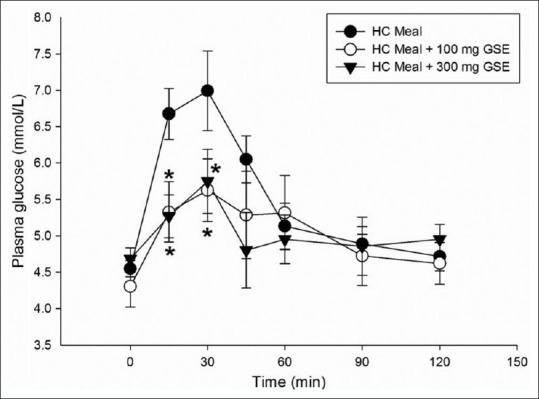
Grapeseed extract looks to have a lot of potential for longevity. In addition to the vascular benefits that are frequently touted, it also is a potent inhibitor of alpha glucosidase and alpha amylase, which means that it can slow the digestion of starches just like acarbose. In a clinical study, it gave a very nice reduction in AUC for blood glucose following a high carb meal:
“Reduced postprandial glycemia observed in the present study can be explained by the inhibitory activity of GSE (grape seed extract) proanthocyanidins against α-glucosidase and pancreatic α-amylas”.
The >100 grams of blueberries I include in my dessert carb meal contain more proanthocyanids than 200 mg of GSE and has a glucose AUC lowering effect, but of course the carbs in the blueberries contribute to the glucose spike on its own.
Am taking acarbose to counter this. Would be interesting to compare it with GSE however the potential anti-againg effects of acarbose may may be gut-mediated as well.
The other benefits of GSE, such as lowered blood pressure and perhaps decreased carotid intima-media thickness, are likely met by a substance like blueberries.
It seems difficult to imagine that the inhibition of alpha-amylase by GSE would be anywhere near the potency of acarbose because I get horrendous gas from even small doses of acarbose but literally zero from grape seed extract (and I’ve never even heard of GSE causing GI symptoms). Unless perhaps GSE can slow the absorption but still allow for complete absorption of the carbohydrates, thus nothing left for fermentation by colonic bacteria (unlike acarbose)?
China’s Lonvi Biosciences is turning a grapeseed compound, procyanidin C1 (PCC1), into a senolytic pill; designed to clear “zombie” cells that drive aging. The headline claim is huge (live to 150), but here’s the reality: in a 2021 Nature Metabolism study, PCC1 cleared senescent cells in mice and extended lifespan ~9% overall (and ~64% from the start of treatment). That’s promising biology; not proof for humans.
Translating mouse results to people is the hard part: dosing, safety, long-term effects, and whether benefits persist all need rigorous clinical trials. Bold lines like “no one gets cancer in 5–10 years” are extraordinary claims that will need extraordinary evidence.
Still, the direction is real. Senolytics are one piece of a broader longevity toolkit (alongside partial reprogramming, immune tuning, better early cancer detection). With China, the US, EU, Japan, and Korea pouring money into this space; and AI speeding target discovery; the odds of meaningful, safe age-modifying therapies this decade are improving. Hopeful? Yes. Proven? Not yet. Worth watching closely.
Sounds like a scam. Other compounds might slow aging a little, though. I’m still waiting to hear about all those fisetin studies Kirkland has talked about. (Kirkland does look younger in the more recent interviews I’ve seen online; remarkably so to my eyes, in fact. Maybe something he’s taking is having an effect.)
If they are lucky, they might find it works as well as Glycine (IMHO);
The data for PCC1 are promising but preliminary. A ~9% lifespan extension in mice is interesting, especially given the late-life intervention aspect, but we should not extrapolate to “huge life extension in humans” yet.
AI Summay from CGPT5.1
Here’s a detailed summary of the evidence (and limitations) for procyanidins (especially the trimer **Procyanidin C1 [PCC1]) in relation to longevity / life-extension. I’ll cover mechanistic plausibility, animal/higher-organism data, human evidence (if any), and caveats. Given your interest in longevity/biomarkers, I’ll lean toward the translational implications and note gaps clearly.
What are procyanidins and PCC1
Procyanidins are oligomeric flavan-3-ols (polyphenols) found in grape seed extract (GSE), cocoa, apples, etc.
PCC1 (Procyanidin C1) is a specific trimeric procyanidin (epicatechin-(4β→8)-epicatechin-(4β→8)-epicatechin) isolated from grape seed extract and identified in screening as a compound with senotherapeutic (senescence-modulating) activity.
The rationale for longevity interest: one of the hallmarks of aging is accumulation of senescent cells (cells that have exited the cell cycle, secrete a pro‐inflammatory SASP [senescence-associated secretory phenotype], and contribute to tissue dysfunction).
In the key study, PCC1 was shown to: (a) suppress SASP at lower concentrations, (b) kill senescent cells at higher concentrations (in vitro), and (c) when administered intermittently in aged mice, reduce senescent cell burden, improve physical function, and extend lifespan.
Animal / preclinical evidence
Here are the major findings:
Mouse study (Xu et al., Nature Metabolism 2021)
Mice (naturally aged old mice, or mice irradiated/implanted with senescent cells) received intermittent PCC1 treatment.
Outcomes: decreased senescence‐markers, improved physical performance (grip strength, treadmill endurance, activity), and a life-span extension of ~9.4 % (for median lifespan) in the very old mice treated.
The study also reports “64.2% longer median post-treatment survival” in one of the cohorts (though this likely reflects post-treatment window rather than full lifespan).
Mechanistic indications: at higher concentrations in vitro, PCC1 induced ROS (reactive oxygen species) and mitochondrial dysfunction selectively in senescent cells, triggering their apoptosis. At lower concentrations it suppressed SASP signaling.
The authors label PCC1 a “senotherapeutic agent” with in vivo activity.
Other models
A study in the fruit fly (Drosophila melanogaster) fed with a proanthocyanidin-rich fraction (from Tamarindus indica) showed improved lifespan, enhanced antioxidant enzyme activities (SOD, catalase, GST), reduced acetylcholinesterase and caspases. Suggests that proanthocyanidins (not necessarily PCC1 exactly) may enhance lifespan via reducing oxidative stress.
A rat study: 21-month‐old female rats treated with 500 mg GSPE/kg (grape seed procyanidin extract) for 10 days improved some parameters (though lifespan extension was not the endpoint).
Mechanistic observations
Procyanidins and related polyphenols show antioxidant, anti‐inflammatory, mitochondrial protective and metabolic modulating effects. For example, a review of dietary polyphenols describes their “geroprotective” potential.
In the Wilson et al study (mouse), the focus was on senescent cell clearance (senolysis) and SASP suppression rather than purely antioxidant effects, which is a more targeted aging-hallmark approach.
Some metabolism/clock gene effects: e.g., a GSPE (grape seed procyanidin extract) study in rats found modulation of hepatic circadian genes under varying photoperiods. Suggests procyanidins may influence metabolic rhythm/clock genes.
Translational/human evidence and gaps
Here’s where things get much weaker and murkier — important for you to keep in mind as a healthcare/biotech specialist.
Human clinical trials focused on lifespan extension? None that I found where PCC1 or procyanidin trimer doses were tied to human life-span extension or robust longevity endpoints. Most human studies are smaller, focused on antioxidant biomarkers, cardiovascular endpoints, metabolic syndrome, etc.
Bioavailability and dosage issues: Polyphenols often suffer from low bioavailability, metabolite complexity, potential for rapid elimination, and unclear human dosing equivalence from mouse data. The 2021 mouse study likely used relatively high exposures (and intermittent dosing) that may not map easily to human supplement regimens. The commentary from blog/forum (FightAging) notes that the actual content of PCC1 in typical GSE supplements is low (~0.9% to ~6.3%) and reaching study-levels in humans may require massive dosing.
Safety and long-term effects: Because the mechanism involves killing senescent cells (which may also have beneficial roles in wound healing etc.), long-term safety of senolytic strategies is still under investigation. Also, the study itself pointed out “errors in data” (see editor’s note in the paper) so replication is required.
Endpoints: The mouse study reports a ~9% median lifespan extension — while interesting, that is modest and in mice. It’s not yet known how that would translate to human life‐years, nor whether it impacts disease morbidity and functional healthspan meaningfully in humans.
Diversity of procyanidins and extract variability: Many “procyanidin” products or extracts contain mixtures of dimers, trimers, oligomers with different biological activity. PCC1 is one specific trimer; not all procyanidins are equivalent. The degree to which humans ingest or absorb PCC1 specifically is unclear.
Mechanistic generalization: While senolysis is a hot area, it is still early in translation. Many “anti-aging” compounds show promise in animals but fail human translation (either due to dosing, safety, or complexity of human aging). The review (Davinelli et al. 2025) includes procyanidins among a “number of polyphenols” with geroprotective potential but points out that human data are scarce.
Practical implications & critical view
Given your background (longevity/biomarkers etc.), here are my practical thoughts — unsugarcoated:
The data for PCC1 are promising but preliminary. A ~9% lifespan extension in mice is interesting, especially given the late-life intervention aspect, but we should not extrapolate to “huge life extension in humans” yet.
If one were exploring this compound in a translational program (pre-human trial, or for use in a longevity protocol), some key questions to address:
Bioavailability in humans: What dose of PCC1 achieves plasma/tissue levels comparable to the efficacious dose in mice? Are there human PK (pharmacokinetic) data?
Safety and tolerability: Although natural, occasional high‐dose usage or frequent senolysis (killing senescent cells) might carry risks (e.g., interfering with wound healing or regenerative responses).
Functional/healthspan endpoints: Rather than focusing only on lifespan, better to track functional biomarkers (frailty indices, activity levels, sarcopenia, inflammatory markers, senescence biomarkers [p16^INK4a, SASP factors], etc.).
Compound specificity: If using “grape seed extract” or “proanthocyanidin extract,” ensure the PCC1 content is well quantified. Many commercial GSEs may not have standardized trimer content. As noted, to mirror the study doses you may need highly concentrated extract.
Synergies / combination regimens: The message board commentary (FightAging) suggests interest in combining senolytics (e.g., dasatinib + quercetin, fisetin) with PCC1 — but there is no documented human trial of this yet.
From a biomarker standpoint, you might want to monitor before/after intervention (if one uses a procyanidin regimen) markers like: inflammatory cytokines (IL-6, TNF-α), senescence biomarkers in peripheral blood (p16, p21, SASP factors), perhaps mitochondrial function (OXPHOS capacity in PBMCs), oxidative stress markers (SOD, catalase, glutathione), functional tests (grip strength, gait speed). The existing fly and rat data support the notion that antioxidant/anti‐senescence mechanisms are involved.
From a cost‐benefit and priority standpoint: given the early stage of the evidence, this should be considered experimental/investigational rather than standard of care. If you are funding or designing a translational study, PCC1 could be a candidate, but it would require rigorous human dose-finding, safety evaluation, and possibly RCTs.
Bottom line
Yes — there is credible evidence that procyanidin C1 (and more broadly procyanidin-rich extracts) have potential to extend healthspan and lifespan (in animal models) via senescence‐modulation and antioxidant/metabolic effects. But the evidence in humans is very limited, dosing is uncertain, bioavailability issues remain, and we don’t have human lifespan or major longevity outcomes yet.
I view grapeseed extract as even worse than Fisetin. All the research comes from one Chinese study, and senolytics from natural compounds such as this have a poor track record. If you are looking to combat senescent cells, use taurine or Rapamycin.