Glycation - A deep dive into genetic pathways for actionable insights

Wonder why your HbA1C is too high or too low compared to your blood glucose levels?

I’m continuing my deep dives into the genetic pathways to get actionable insights as the previous ones have been incredible precise and useful. This time I’m looking at Glycation genetic pathways.

Here is the general description of the pathways and their variants. I will put the finding about my own genome below it as an example of what useful and actionable insights you can get.
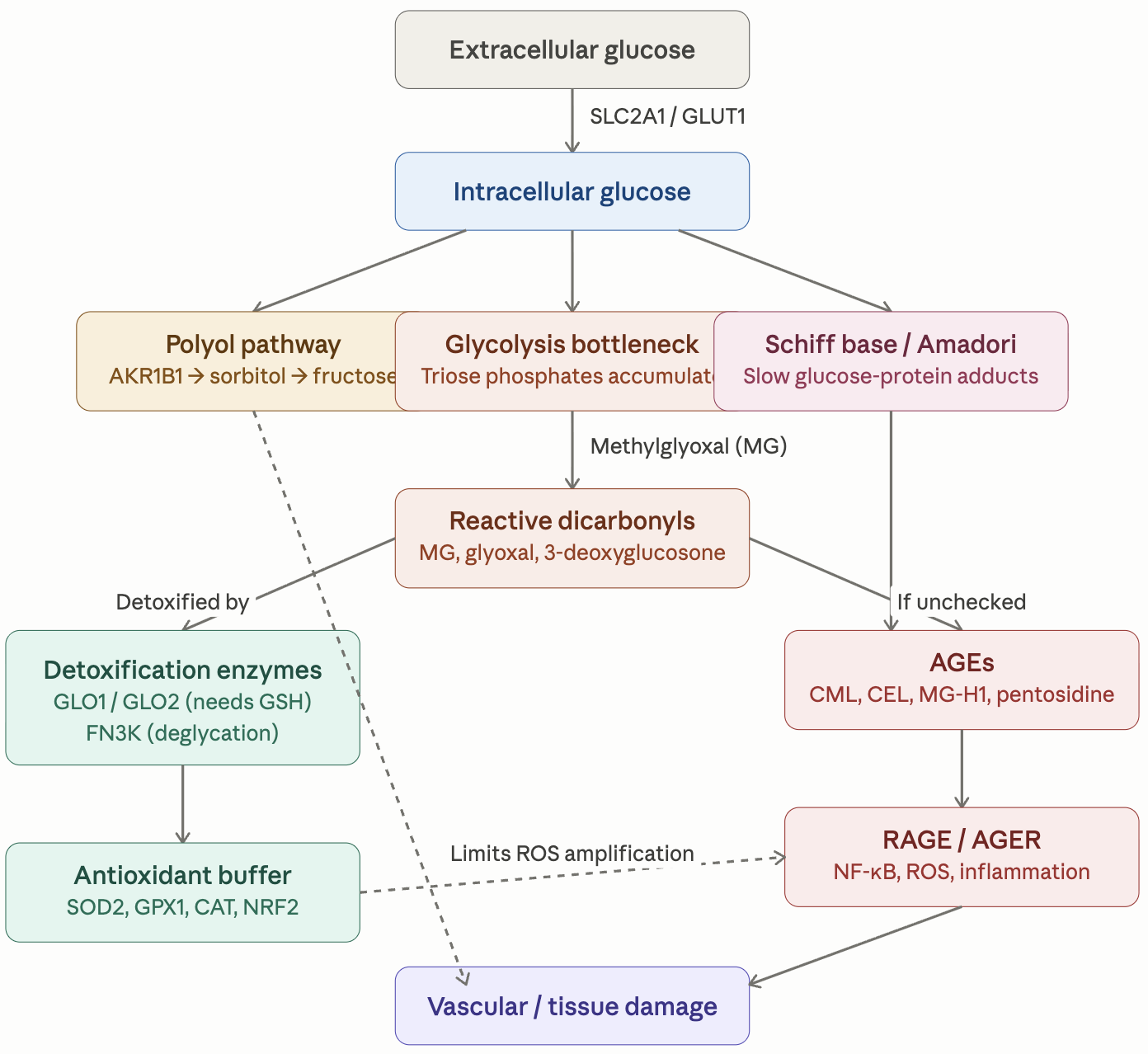
Glycation_Pathway_Reference.pdf (306.4 KB)


Here are the summary of the findings for my own genome. The full detailed report is 20 pages long.

Glycation Genetic Report — Top 10 Discussion Items

For your next physician appointment. Date: 2026-04-15. Source: personal WGS (60×, GRCh38). Companion: Glycation Genetic Report (full document).


The headline

Methylglyoxal-detoxification axis (GLO1 + NRF2-mediated GLO1 induction) is the dominant genetic vulnerability. Strongly favorable AGER (RAGE) profile partially offsets it. Existing diabetes and cardiovascular regimen is well-aligned. The two highest-priority gaps remain benfotiamine (upstream MG suppression) and sulforaphane (NRF2-driven GLO1 induction). L-carnosine is mechanistically near-ideal for the GLO1 bottleneck but is partially gated by your heterozygous CNDP1 genotype (intermediate carnosinase activity); it moves to a moderate-priority empirical trial rather than first-line.


Top 10 items to discuss

  1. Add benfotiamine 150–300 mg/day. Lipid-soluble thiamine prodrug; activates transketolase, shunts triose phosphates away from methylglyoxal formation. Mechanistically targets the upstream side of the GLO1 bottleneck (Hammes et al., Nat Med 2003). Verify Momentous Multi thiamine content first — standard thiamine HCl is not bioequivalent. Not gated by any genotype you carry.

  2. Add sulforaphane 10–40 mg/day (e.g., BroccoMax, Avmacol, MyrPro, or fresh broccoli sprouts). Most evidence-supported NRF2 activator; directly induces GLO1 transcription (Xue et al., Diabetes 2012). Addresses the three-SNP NRF2 stack identified in the report. Not gated by any genotype you carry.

  3. L-carnosine — empirical 12-week trial, not lifetime commitment. Your CNDP1 is heterozygous at the lead Ahluwalia SNP (rs2346061) — intermediate carnosinase activity, not the (CTG)₅/₅ “Mannheim” strong-responder genotype. Recommended protocol if pursuing: 2 g/day split BID, co-time with NACET (which inhibits CN1 via S-cysteinylation), measure fructosamine and serum CML before/after, discontinue if no biomarker change. Mechanistically near-ideal for the GLO1 bottleneck (carnosine directly scavenges MG via its imidazole ring), but a meaningful fraction of each oral dose will be degraded in plasma before reaching kidney/endothelial tissue.

  4. Verify Momentous Multi content. At half-dose, several cofactors may be sub-optimal: confirm actual delivered amounts of selenium (target 100–200 µg/day), manganese, thiamine, B6, and zinc before adding any of these separately.

  5. Consider pyridoxamine 50–200 mg/day (a B6 form). Direct AGE-precursor scavenger; intercepts Amadori intermediates before progression to AGEs (Voziyan & Hudson 2005). Mechanistically complementary to FN3K and not gated by CNDP1 — a more reliable AGE-precursor scavenger than carnosine in your genotype context. Discuss US availability with physician.

  6. Consider alpha-lipoic acid 300–600 mg/day (R-isomer preferred). Dual NRF2 activation and direct AGE-formation inhibition; also supports mitochondrial function (heterozygous SOD2 rs4880 finding). Insulin-sensitizing as a bonus.

  7. AGER (RAGE) genetics are protective — don’t worry about RAGE inhibitors. The most replicated cardiometabolic SNP in this domain (rs2070600, GWAS p ≈ 10⁻⁵²) is wild-type. Soluble RAGE production is genetically intact. The clinical priority is upstream AGE limitation, not downstream RAGE blockade.

  8. Empagliflozin and tirzepatide are well-aligned with the SLC2A1 + AKR1B1 + CNDP1 mesangial-vulnerability convergence. No change to the cardiometabolic regimen indicated by these findings — it’s already targeting the right bottleneck. The CNDP1 heterozygous finding adds a small increment to nephropathy-axis risk, reinforcing rather than changing the existing strategy.

  9. Order baseline labs if not already recent: fasting + 2-hour postprandial glucose (or CGM if not in use), fructosamine (to compute glycation gap given heterozygous FN3K rs1056534), erythrocyte transketolase activation coefficient or plasma thiamine, total glutathione (GSH/GSSG ratio), serum selenium and zinc, plasma B6 (PLP), and skin autofluorescence (AGE Reader) if available. If pursuing the carnosine trial: add serum CN1 activity measurement (Mannheim methodology / commercial ELISA) and paired serum CML or MG-H1 before and after the 12-week trial.

  10. Ongoing monitoring: HbA1c every 3–6 months, UACR + eGFR annually, dilated retinal exam annually, hsCRP annually. Particular attention to time-in-range (CGM) and glycemic variability rather than HbA1c alone — postprandial spikes drive MG generation more than mean glucose does.


Quick reference — primary genetic findings

Finding Status Strength of evidence
GLO1 rs1049346 AA Homozygous risk Strong (Peculis 2013, p = 2.6 × 10⁻⁵)
GLO1 rs1130534 + rs4746 Both heterozygous Moderate; additive
NFE2L2 rs6721961 + rs35652124 + rs2706110 Two homozygous, one het Moderate; cumulative
AKR1B1 rs759853 TT Homozygous Direction context-dependent
SLC2A1 rs841853 + rs841847 Both homozygous (LD) Moderate (DN meta-analyses)
SOD2 rs4880 AG Heterozygous Val/Ala Moderate
CNDP1 rs2346061 CA Heterozygous (intermediate CN1) Moderate (Ahluwalia 2011, p = 5.07 × 10⁻⁴)
AGER rs2070600 Wild-type Gly/Gly Very strong protective (GWAS p ≈ 10⁻⁵²)
FN3K rs3859206 AA Homozygous favorable Moderate protective
MMP1 rs1799750 het Mildly favorable Moderate

All variants high-confidence calls (DP 30–110, GQ 99, MQ 60). AGER variants not detected at 60× WGS = high-confidence absence-of-call. CNDP1 (CTG)ₙ leucine repeat itself indeterminate by short-read WGS; tag-SNP haplotype inference points to intermediate (not Mannheim 5L/5L) phenotype.


Quick reference — supplement priority for glycation pathway

Priority Intervention Genotype-gated?
HIGH Benfotiamine 150–300 mg/day No
HIGH Sulforaphane 10–40 mg/day No
MODERATE Pyridoxamine 50–200 mg/day No
MODERATE Alpha-lipoic acid 300–600 mg/day No
MODERATE — empirical trial L-carnosine 2 g/day BID + NACET co-timing Yes — CNDP1 heterozygous (intermediate response predicted)
WATCHLIST Carnosinol / carnostatine + carnosine Future — designed to bypass CN1 gate
6 Likes

These reports you are doing are awesome! Thanks for posting. This should stimulate a lot more thinking on these pathways and hopefully more discussion as we dig deeper.

2 Likes

Another great one! Thank you. If one did no more than look at your Quick Reference, it could be very helpful.

Running down a few tracks of relevance to me, I am reminded that my 23andMe database is inadequate, even with its enhancements.

1 Like

In conclusion, Lys inhibited protein glycation, improved glycemic control, and increased antioxidant markers in type 2 diabetic patients; thus, it could be suggested for combinatorial therapy of diabetes with oral hypoglycemic agents to protect against vascular risk factors and other diabetic complications.

2 Likes

Excellent and perfectly timed!
Now that Imeglimin failed to lower my HbA1C I’m going to try to work on my over-glycation predisposition. I did not want to do it before the end of my 20 weeks Imeglimin trial to avoid muddying the results.

2 Likes

Anything you’re planning on trying that isn’t lysine or what you’ve mentioned in this post?

I’m working to get my HBA1C from 5.9 down to 5.3. Here is the prompt I used for getting Claude to create a program for me:

Role: Endocrinologist and exercise physiologist.
Task: I am a XX-year-old male who for the past year has been exercising 6 days a week at a moderate level, alternating strength and cardio training. I now have an HbA1c of 5.9% (prediabetes range) and want to reduce it to 5.3% (optimal range for health and longevity). Provide me with a detailed and comprehensive program backed by the best scientific and clinical evidence for achieving this target, covering exercise, nutrition, sleep, stress management, and any other evidence-based interventions. Include the specific rationale for each action in the program, including the mechanisms by which each intervention reduces blood glucose and HbA1c. As a second section and phase of this analysis and action plan report identify, rate, prioritize and detail all the medications that would help accomplish these goals, such as SGLT2 inhibitors, Imeglimin, acarbose, etc.

And the resulting output:
HbA1c_Reduction_Program.pdf (208.0 KB)

1 Like

Good luck with your HbA1C lowering!
For my wife, low dose TZ was extremely efficient for that but, for desperate cases like mine, Claude answer is really not up to the task. I’ve tried absolutely everything in that except sauna, cold plunges and DPP4i. As to rapamycin it’s a joke, after 12mg (6+2+2) the glucose regulation takes 2 weeks to go back to its baseline.
In fact most of those interventions target insulin resistance but my genetics point toward a better than average insulin sensitivity.

2 Likes

Here is what I’m going to try:

  1. Carnosine 1.5–2 g/day — best meta-analyzed evidence, direct dicarbonyl scavenger, mechanistically additive to your quercetin.
  2. L-lysine 3 g/day with meals — two supporting RCTs (one moderate-quality, one low-quality), plus mechanistic preclinical base, plus the unique PON1/LCAT signal in the Bathaie paper that touches your apolipoprotein axis. Take separately from your citrulline doses to avoid CAT-1/CAT-2 transport competition.
  3. Benfotiamine 300 mg/day — clean mechanism (TKT REF/REF works on your substrate), modest outcome data, BenfoTeam phase 2b readout ~2027.

If you want to honor your stated commitment to evidence-based sources, carnosine has the cleanest fit for that criterion. The lysine literature is suggestive but the methodology is weaker, especially the trial you sent. If you’d rather pursue lysine because the mechanism appeals or because you’ve already got high-quality lysine on hand, that’s defensible — just don’t conflate the evidence strengths.

Ranked recommendation for raising tissue carnosine

  1. β-alanine 3.2 g/day divided (4 × 800 mg, or sustained-release CarnoSyn SR 1.6 g BID). Best-evidenced method for raising tissue carnosine; cheap; the paresthesia is a tolerability issue but manageable with divided dosing. Use this if the goal is tissue carnosine for glycation-buffer purposes.
  2. L-carnosine 1.5–2 g/day in 3 divided doses, on empty stomach. Use this if the goal is specifically plasma/extracellular carnosine for circulating dicarbonyl scavenging — which arguably maps best to GlycA-style readouts and to the published glycation-marker trials. The Baye 2022 meta-analysis used carnosine, not β-alanine, in most included trials, so for the specific evidence you’re hanging the recommendation on, carnosine is the more literature-aligned choice.
1 Like

Let us never lose sight of the hierarchy of priorities. Yes, glucose control is important. But in designing any protocol we must never forget that our aim is the totality of health and longevity. There may be methods of lowering A1c that are very efficient, but with deleterious side effects so that it nets out to worse outcomes on health/lifespan than a less efficient protocol wrt. glucose control, but a better overall health/lifespan outcome.

Carnosine is an interesting molecule. I do not know enough about it to confidently supplement with it. The literature, such as I was able to find on PubMed is not unambiguous enough for me to throw carnosine into my stack without worrying about interactions and ultimate outcomes higher up in priority above A1c. Obviously, everything we do is a gamble, so it’s all about comfort levels. By no means do I think supplementation with carnosine is somehow questionable, I just personally don’t know how it fits in with a broader view of higher plane health priorities. YMMV.

Carnosine and Beta-Alanine Supplementation in Human Medicine: Narrative Review and Critical Assessment

“This review discusses results from recent studies focusing on the impact of this supplementation in several areas of human medicine. We queried PubMed, Web of Science, the National Library of Medicine and the Cochrane Library, employing a search strategy using database-specific keywords. Evidence showed that the supplementation had a beneficial impact in the prevention of sarcopenia, the preservation of cognitive abilities and the improvement of neurodegenerative disorders. Furthermore, the improvement of diabetes mellitus parameters and symptoms of oral mucositis was seen, as well as the regression of esophagitis and taste disorders after chemotherapy, the protection of the gastrointestinal mucosa and the support of Helicobacter pylori eradication treatment. However, in the areas of senile cataracts, cardiovascular disease, schizophrenia and autistic disorders, the results are inconclusive.”

Tirzepatide + berberine am/pm + psyllium husk at night helped get mine to 4.6 or so.

1 Like

How do you take the psyllium husks? I’ve added it to my yogurt and fruit in the morning and it seems to turn the concoction into a rather weird congealed glue like substance. It’s a little hard to eat, for me.

On the berberine… it seems likely to cause the same muscle issues that daily Metformin causes (and why I avoid metformin).

From Gemini:

Based on current pharmacological evidence, the probability that berberine blunts muscle hypertrophy and strength gains in a manner similar to metformin is moderate-to-high.

The two compounds share overlapping pharmacodynamics. The landmark MASTERS trial (Walton et al., 2019)—referenced in your link—demonstrated that metformin blunts the hypertrophic response to progressive resistance exercise in older adults by inhibiting mechanical mammalian target of rapamycin complex 1 (mTORC1) signaling. Because berberine functions through a nearly identical primary metabolic axis, its molecular profile presents a clear risk for similar muscle-blunting effects.

Molecular Mechanisms and Overlap

The theoretical foundation for berberine’s potential to inhibit muscle growth rests on three distinct pathways:

1. AMP-Activated Protein Kinase (AMPK) Activation vs. mTORC1 Signaling

Like metformin, berberine acts as a mild mitochondrial toxin that transiently inhibits Complex I of the electron transport chain (Ren et al., 2023; Turner et al., 2008). This increases the cellular AMP/ATP ratio, triggering the activation of AMPK (Kim et al., 2009; McCarty, 2013).

  • The Conflict: Muscle hypertrophy is fundamentally driven by the mechanical activation of the mTORC1 pathway, which upregulates translation initiation and protein synthesis.
  • The Blunting Effect: Active AMPK directly counteracts this process. It phosphorylates Raptor (an essential component of mTORC1) and activates tuberous sclerosis complex 2 (TSC2), effectively turning off the molecular machinery required for muscle remodeling and growth following resistance training.

2. Atrogin-1 Induction and Myofibrillar Protein Degradation

In animal models, high doses of berberine have been shown to induce muscle atrophy rather than just blunting growth. Research published in Diabetes demonstrated that berberine administration significantly decreased muscle mass and fiber cross-sectional area in both wild-type and diabetic mice (Wang et al., 2010). The underlying mechanism involved:

  • The suppression of protein synthesis.
  • The upregulation of Atrogin-1 (muscle atrophy F-box protein), which drives ubiquitin-proteasome system-mediated muscle protein breakdown (Wang et al., 2010).

3. Myostatin Downregulation Context

Conversely, contradictory signaling data exists. For example, some rodent models using high-fat diets showed that berberine increased muscle mass relative to obese controls by downregulating Myostatin (a negative regulator of muscle mass) via the Smad pathway (Chen et al., 2020). However, this effect was observed in highly inflamed, insulin-resistant phenotypes where berberine corrected profound metabolic dysfunction. In healthy individuals undergoing resistance training, the baseline state is different, and the direct AMPK-mediated inhibition of mTORC1 is expected to dominate.

Knowledge Gaps and Uncertainties

While the mechanistic plausibility is strong, several translational gaps prevent a definitive assignment of a “100% probability” to this outcome:

  • Absence of Human Trials: Unlike metformin, which has been directly evaluated during resistance training in humans (Walton et al., 2019), there are no randomized controlled trials evaluating berberine co-ingestion with progressive resistance exercise in human subjects.
  • Bioavailability Limitations: Berberine exhibits notoriously poor oral bioavailability (typically less than 5% absorption in humans). It undergoes extensive first-pass metabolism in the liver and intestines via P-glycoprotein extrusion and CYP450 metabolism. Consequently, systemic plasma concentrations in humans rarely reach the micromolar levels used in the in-vitro and rodent models that documented severe muscle blunting.

I added it to yogurt at the time. Ive started it again just in water alongside lunch and dinner. I keep it away from breakfast and at night to avoid supplement interaction.

I stopped metformin for the same sort of reason, more because I was worried the effect on mitochondria would make me feel less energetic.

Thinking of cycling between metformin, berberine then taking a break.

The safety of benfotiamine is highly questionable. It’s already been established that high dietary intake of vitamin B1 is linked to an increase in all-cause mortality. If even getting B1 from food is that risky, supplements are bound to be even worse.