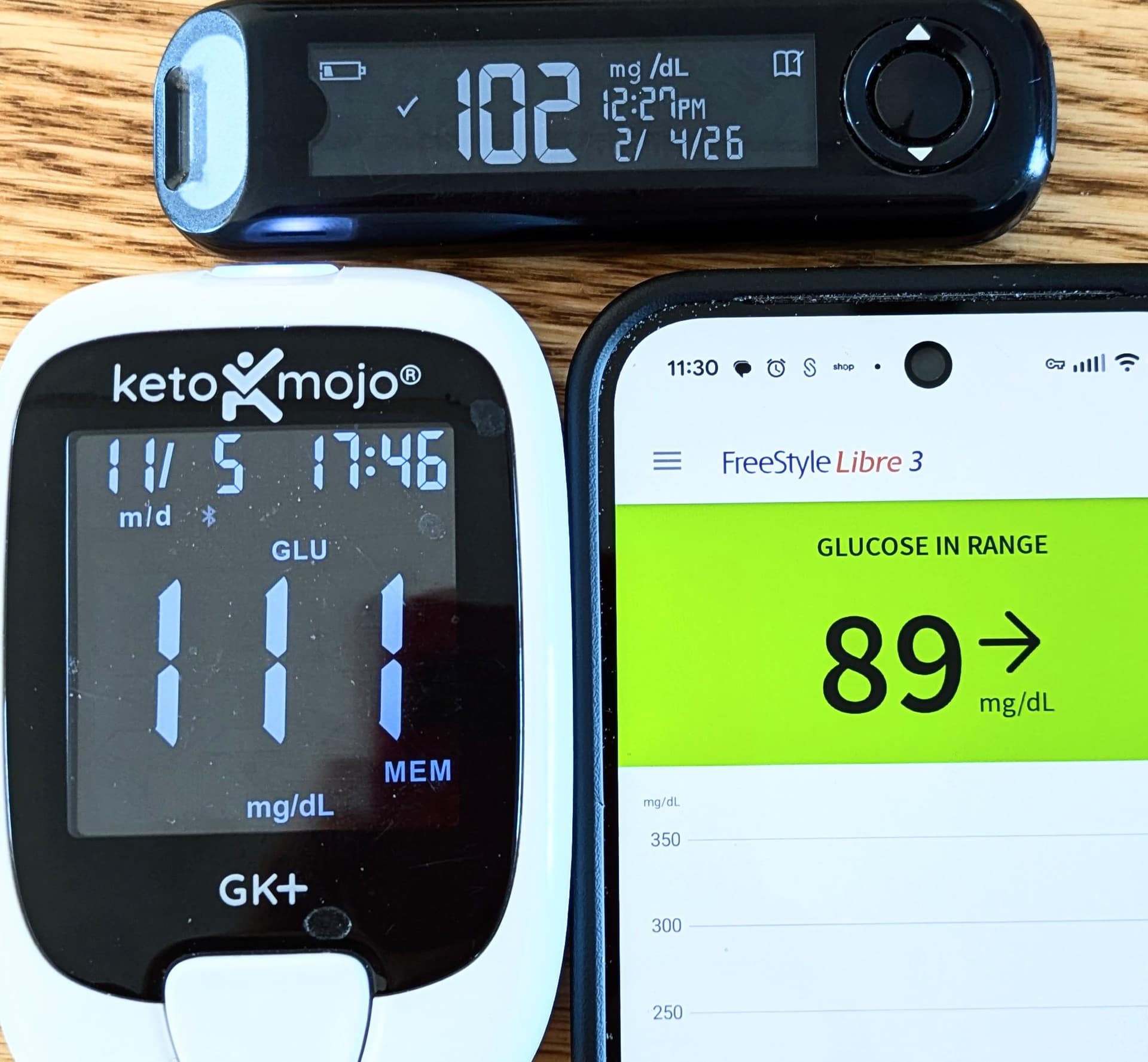
The photo tells all.
3 Likes
I would tend to go with the finger prick measure, which at 102 isn’t that bad (but obviously more than ideal). I’m assuming this is a fasted morning measure.
What have you tried in terms of efforts to Lowe fasting blood glucose? Have you also tested insulin levels or done a OGTT?
1 Like
I have learned they are all wildly inaccurate. And 20 min? behind the real blood serum glucose.
So use OneTouch as the bench marker (finger pricking), than enter the # and have you CGM re-calibrate it. Do it when you glucose is in a flattish curve.
1 Like
This is after 16h fasting. 2 finger prick mesurements and one CGM.
@Jonas The glucose has been flat for hours so it’s not the CGM lag and 20 min later the CGM was at 82!
BTW it’s a Libre 3 plus and it can’t be calibrated.
Anyway there is 9mg/dl difference with the 2 finger glucose measurements from the same blood drop.
It’s just so annoying.
1 Like
BTW those glucose levels correspond to HbA1C of 5.44, 5.75 and 5.97. That’s not small differences.
I used to think that, but my fasting glucose is always lower in lab tests. It doesn’t make sense because the margin of error is ±%, so I would expect that sometimes my readings would be lower. I always do a home test strip right before going to the lab, but the lab readings are always lower.
Apparently a fairly large margin of error isn’t as concerning to doctors as it is to us.
Query: What is the accuracy of OTC glucose test strips such as Contour Next?
-
ISO 15197:2013 Criteria: The current international standard requires that at least 95% of all test results must fall within: (What about the other 5%?)
- ±15 mg/dL of the laboratory reference value for blood glucose concentrations below 100 mg/dL.
- ±15% of the laboratory reference value for blood glucose concentrations at or above 100 mg/dL.
- Additionally, at least 99% of results must be within zones A and B of the Consensus Error Grid analysis, meaning any deviations have minimal or no effect on clinical action.
1 Like
Yes, you’ve hit upon a pet peeve of mine. Inaccurate glucose measurements. The tools we have are just so imprecise. There are several threads here wherein I rant fulsomely at my CGM experiences, where the readings are so absurdly wrong I completely stopped using CGMs and have no intention of starting again until there’s a revolution in the technology. I also did a three way experiment of blood draw reading at UCLA, finger, and CGM (the CGM at various points over 30 minutes), and the draw and finger had 7 points difference and CGM 30. Useless. I still use a home finger blood monitor (do 3 readings and average), but I don’t take the numbers as gospel. It’s frustrating. How can you measure the effects of interventions when the tools are this crude and unreliable. But sadly, this isn’t the only biomarker that has such problems with measurements. Lipid panels are also quite variable. And so on.
2 Likes
What is your corresponding fasting insulin?
Last blood test: Insulin 2.7, Glucose 90, HOMA-IR 0.6, HbA1C 5.9%
2 Likes
These numbers make no sense. Given your minimal insulin doing a good job of glucose disposal, how is your A1c so high? I’m in a similar A1c situation, though not as extreme numbers. On my last test: insulin 6.4, FBG 105, A1c 5.8 - not good obviously, but my numbers are plausible. I don’t understand yours. Maybe your hemoglobin lives super long, who knows. If your insulin sensitivity is good, your liver might still overproduce glucose (neoglucogenesis). That puts glucagon on the radar as a possible factor here.
We tested for that but it’s not the case.
Yes, that’s the current hypothesis.
BTW before taking pioglitazone my insulin was 6.8. It’s a good insulin sensitizer.
Waiting to see if imeglimin can help but, unfortunately, it takes time.
2 Likes
Amen to that. My finger prick measuring showed 105 before I went to the lab, and lab results (about an hour later) came back it showed 93. Don’t know what to think about it.
1 Like
I have similar contrast in my extremely healthy HOMA-IR (ranges between .5-.8 over years) versus my HbA1c pushing prediabetic levels (ranges 5.6-5.8 over years). I could never make sense of the stark contrast in these numbers until the thread on this site about endurance athletes having this problem because they retain their red blood cells longer. I don’t know how to formally test to prove causation, but the shoe fits and makes sense. I’m a distance runner and cyclist my entire adult life with a resting heart rate generally in the low 40s (sometimes reaching the high 30s) and VO2 max of 42-44 for a 64 year old male (almost 65). So yeah, there are people out there with huge contrast in these metabolic health markers. The large-population “standard” ranges have limited applicability if your lifestyle practices have you way outside the standard.
1 Like
Same here: glucose measured by KetoMojo finger prick always higher than lab. KetoMojo says there can be a 15% variance but the delta was greater than that.
I agree that finger prick glucose meters and GCMs both leave something to be desired.
For the last six years I’ve been measuring my morning fasting glucose with a Contour Next finger prick meter.
My numbers average around 94. I compared these readings with my lab fasted blood glucose measurements (also taken in the morning) on days when I had both measurements.
Below are the differences in the readings of the Contour Next and LabCorp readings. These numbers are from draws about 10 weeks apart.
A positive number means the ContourNext is higher.
6,9,11, 9, 5, 6, 1, 12, 0, 4, 6,4,3,7,6,15,7,16,11
So my finger prick glucose reading is always greater than or equal to the LabCorp number, by an average of 7 mg/dL.
4 Likes
I had reason to talk to someone about a cgm replacement yesterday (my cgm shut down after a few days).
He told me a freestyle libre 3 plus is expected to have up to a 30% variance on day 1, and then it settles down to 20% after 24 hours (I’ve always noticed it can be a little nutty on the first day)
You all know they aren’t always accurate, but what I thought was worth sharing is he said do a finger prick test and if it’s ever more inaccurate than that, call them and they will replace it.
1 Like
Exactly. This is the problem with biomarkers. So variable (imprecise, fluctuating real values, ranges of “normal” based on people not like me, etc). I’ve shifted to only using biomarkers to look for problems…markers way outside of “normal” or my own typical readings.