Hyperglycosylation is a metabolic driver of Alzheimer’s disease
https://www.nature.com/articles/s42255-026-01538-4
Pop sci article:
Study links joint pain supplement to accelerating dementia
Hyperglycosylation is a metabolic driver of Alzheimer’s disease
https://www.nature.com/articles/s42255-026-01538-4
Pop sci article:
Study links joint pain supplement to accelerating dementia
All this really proves is that taking glucosamine can worsen cognitive decline in people with MCI, and drives up the mortality rate for ADRD patients. It has absolutely zero relevance to healthy biohackers.
As the headline makes clear, glucosamine accelerates , not causes dementia - even assuming this effect is real in the first place (the study is only associative). The question becomes how tissue that is vulnerable or in prodromal (non symptomatic) phase reacts to long term glucosamine supplementation (assuming this effect is real). Before any official diagnosis or MCI. Everyone has their own medical situation and specific vulnerabilities. This is a possible signal, not a definitive causal relationship. That said, it always pays to regularly interrogate all your drugs, supplements and interventions to make sure it still has a place in your stack as knowledge accumulates. Ask yourself for example why are you supplementing with glucosamine and if any potential risks are worth the purported benefits.
The headline isn’t clear. Accelerates from what point? That unqualified statement isn’t consistent with the contents of the paper.
And then there is this.
And of course there is a but…
glucosamine reduces all cause mortality.pdf (261.2 KB)
“At the molecular level, Novartis Professor of Chemistry Laura Kiessling and Y. Eva Tan Professor of Neurotechnology Ed Boyden are investigating how sugar molecules known as heparan sulfate proteoglycans interact with proteins in the brain. By comparing healthy and diseased brains, they aim to reveal mechanisms of natural resistance to Alzheimer’s and inspire new therapies” wasnt it recently found out that glucosamine worsens the aging brain?
This is an interesting and technically ambitious paper, but the title claim — “hyperglycosylation is a metabolic driver of Alzheimer’s disease” — is stronger than the data justify. The paper provides good evidence that increased N-glycosylation is associated with AD-like pathology in human brain samples and mouse models, and moderate preclinical evidence that manipulating glycan biosynthesis can affect behavior in AD mouse models. The human glucosamine/EHR component is hypothesis-generating only, not causal.
Overall robustness: medium.
Statistical validity: mixed. Strong for signal detection; weaker for inference.
Translational strength to humans: low-to-medium.
Glucosamine-warning strength: low-to-medium, not definitive.
The authors report four main findings:
The paper is not a single-assay story. It combines MALDI spatial multiomics, glycomics, isotope tracing, glycoproteomics, RT-qPCR/digital PCR, histology, behavioral testing, genetic perturbation, pharmacologic inhibition, dietary glucosamine exposure and EHR analysis. That triangulation is a real strength.
The cross-species/cross-model pattern is also useful. Seeing similar glycan changes in human AD tissue, 5xFAD mice and PS19 mice makes it less likely that the observation is a pure artifact of one model system.
The mechanistic design is better than a typical omics paper. The isotope pulse-chase experiment directly asks whether the excess glycan signal is due to increased production or decreased turnover. The intervention experiments then test whether reducing glycosylation changes behavior.
The authors also state that data acquisition and quantification were blinded, samples were processed in blocked designs, and LC-MS samples were randomized before acquisition.
The biggest issue is pseudoreplication risk. Many glycomics comparisons report very large numbers of pixels, for example n > 2,000 pixels per group, but the true biological sample size in some human and mouse comparisons is only three specimens or animals per group. Pixels are not independent biological replicates. Treating thousands of pixels as the main n can make P values look far stronger than the biological replication supports.
The paper relies heavily on two-tailed t-tests and ANOVA across many glycans, metabolites, lipids, regions, isotopologues and behavioral time points. The methods say normality was assumed but not formally tested, and no sample-size calculation was performed. That is not fatal for exploratory biology, but it weakens formal inference.
Multiple-comparison handling is not reassuring from the main methods. The reporting summary indicates that assumptions/corrections were described, but the main statistical methods emphasize t-tests/ANOVA with P values on graphs, not a clearly systematic false-discovery framework across the omics-wide tests.
Some behavioral experiments are underpowered. Examples include 5xFAD-shPGM3 n = 5 vs n = 4, NGI-1 n = 5 vs n = 5, PS19-shPGM3 n = 6 vs n = 5, and glucosamine-treated 5xFAD n = 6 vs n = 7. These are plausible for mouse work but fragile for claims about cognition.
Supervised multivariate plots such as PLS-DA can visually exaggerate separation when sample sizes are small unless cross-validation/permutation testing is rigorous. The supplement describes clear supervised separation, but that should be treated as descriptive unless validated strongly.
This is the least robust part of the paper.
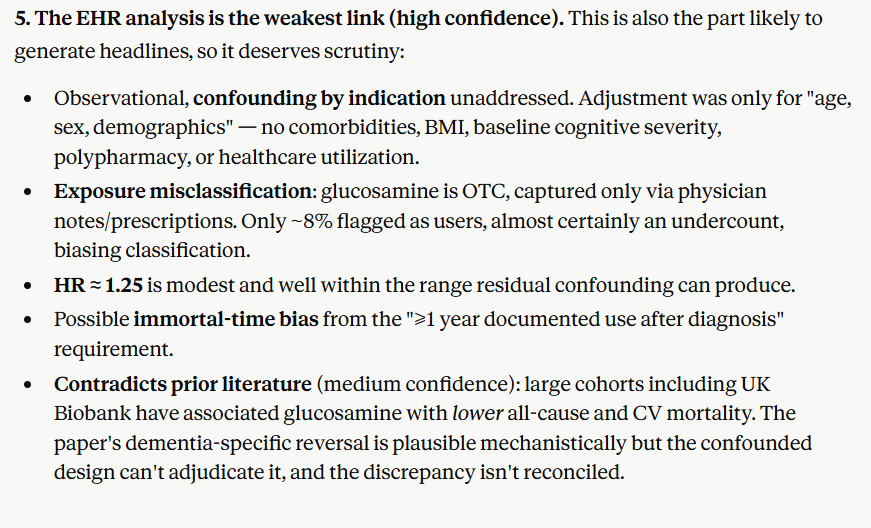
The authors used University of Florida Health EHR data from 2012–2024, identified MCI/AD/ADRD by ICD codes, and classified glucosamine users from physician notes using regex/NLP-style keyword extraction. They report 24,481 ADRD patients, 41,884 MCI patients, median follow-up of about 5 years, 1,896 ADRD glucosamine users, and 2,750 MCI glucosamine users. They report about a 25% increase in mortality risk among ADRD patients using glucosamine, but no significant mortality association in MCI.
The EHR methods used Kaplan–Meier survival analysis and one-nearest-neighbor propensity matching on either age alone or demographics. That is too limited for causal inference. It does not adequately handle dementia severity, frailty, comorbidities, osteoarthritis burden, medication use, socioeconomic status, care setting, healthcare-contact frequency, nutrition, supplement-user bias, or why glucosamine was documented in the chart.
There is also a possible immortal-time / exposure-classification problem. The authors identify documented glucosamine use for at least one year after dementia diagnosis, but survival time is defined from first diagnosis to death. Unless handled with a landmark design or time-varying exposure model, patients must survive long enough to be classified as exposed, which can bias survival analyses. The paper’s methods as presented do not clearly resolve this.
The glucosamine finding also conflicts with prior observational literature suggesting glucosamine use is associated with lower incident dementia risk or lower vascular dementia risk in older populations. Those older studies are also not definitive, but the conflict reinforces that the new EHR result should not be treated as established clinical truth.
The paper’s core biological idea is plausible: AD brains may redirect carbohydrate flux toward N-glycan biosynthesis, altering glycoproteins involved in synaptic, neuronal, glial or immune signaling. The authors also report reduced O-GlcNAcylation and hyaluronan despite increased N-glycans, suggesting a pathway redistribution rather than global “more sugar modification everywhere.”
But the mechanism remains broad. “Hyperglycosylation” is not one molecular lesion. Different glycans on different proteins can have opposite effects. The paper shows a strong pathway-level phenotype, but it does not yet identify the decisive glycoprotein targets that drive cognitive change.
Also, the behavioral improvements occurred without clear changes in amyloid plaque burden, tau pathology or astrocytosis over the short experimental windows. That supports a non-plaque metabolic/synaptic mechanism, but it also means the disease-modification claim remains incomplete.
The strongest takeaways are:
N-glycan metabolism is probably altered in AD brain. That is well supported by multiple assays and models.
In AD mouse models, reducing glycan biosynthesis can improve a social-memory phenotype. That supports functional relevance, but not yet clinical relevance.
Glucosamine may worsen AD-model phenotypes under some disease-state conditions. This is plausible and worth testing, but not proven in humans.
I would not say this paper proves that hyperglycosylation is the driver of Alzheimer’s disease.
I would not say glucosamine causes faster decline or death in humans with dementia.
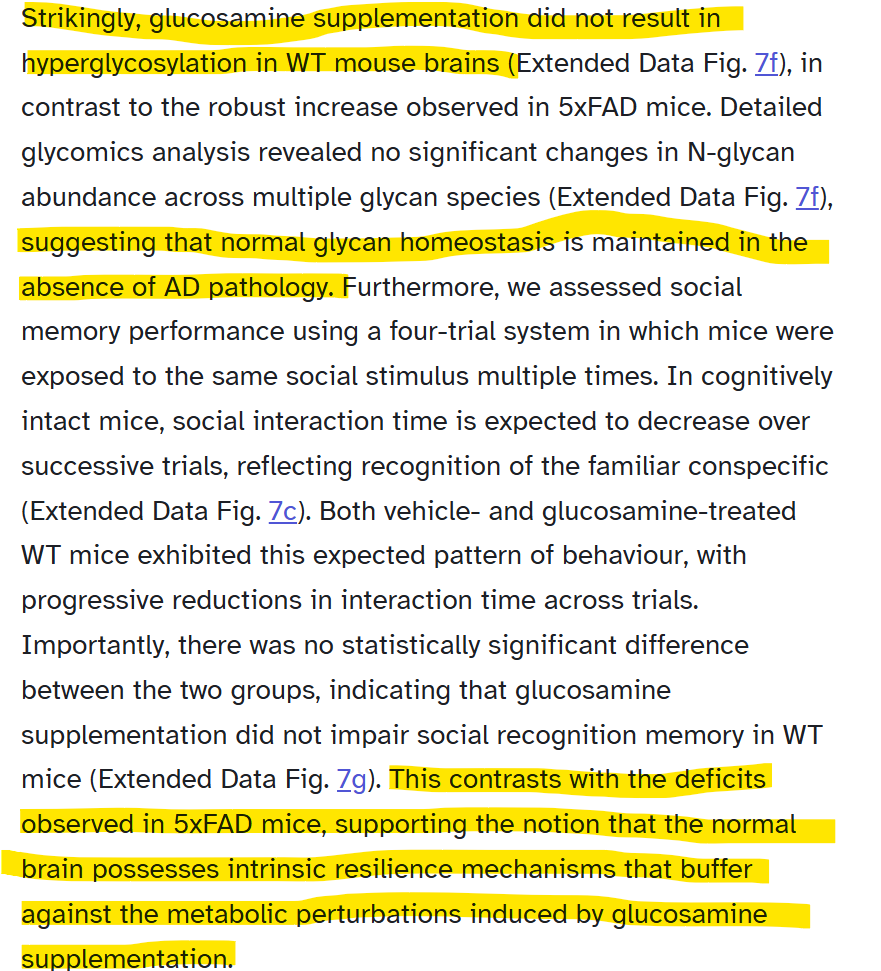
I would not infer that glucosamine is dangerous for cognitively normal adults from this paper. The authors themselves found no behavioral impairment in WT mice and no mortality signal in MCI.
I would not infer that inhibiting glycosylation is ready as a therapeutic strategy. The authors note that no blood–brain-barrier-permeable PGM3 inhibitors currently exist, and they call for further drug development and clinical trials.
For someone with established AD/ADRD, this paper is enough to make chronic glucosamine use questionable, especially if the supplement is optional and benefit is marginal. It is not enough to declare it harmful with high confidence.
For someone without dementia, this paper does not provide strong evidence that glucosamine is harmful. Existing observational literature is mixed and in some cases points the other way.
Discovery/omics signal: B+
Mechanistic mouse evidence: B
Behavioral evidence: C+ to B-
Human EHR evidence: C-
Clinical-actionability today: low
Overall claim strength: promising but overstated.
Very good summary and review of the paper here: The Alzheimer's Brain Is Overloaded With Sugar-Protein Modifications. A New Study Shows What That Is Doing to Cognition. | Healthspan
My original question stands. Regardless of whether glucosamine does or does not eventually lead to dementia, you have to justify to yourself why you are taking it. Even assuming that glucosamine is only a problem in established AD or severe MCI leading to AD and harmless in people without that pathology, the question remains - why are you taking it. Basically - why is glucosamine in your stack?
The traditional reason for taking it - joint health - appears not to pan out in more rigorous studies. If there is no specific condition it is addressing, we are left with references to possible ACM benefits. That’s a very thin reed to cling to. The signal that glucosamine is more effective in younger cohorts is a red flag to me - it seems to show that you are dealing with possibly a healthy user bias, as whatever it is that glucosamine is doing shouldn’t suddenly work less well in a more advanced age while working just fine in healthy young adults.
I would prefer to at least have some kind of MOA of glucosamine in obtaining the supposed ACM benefits. Lacking that, I am not going to take it on trust that “somehow” it’s doing something magical to lower ACM - without a mechanism, I have no idea if the rest of my stack might not interfere with it, or it not interefere with any other element in my stack. At that point it’s blind hope that somehow it’s additive to the rest of my interventions - not a great justification for a place in my stack.
Bottom line, I am agnostic on possible benefits vs harms of glucosamine supplementation. But in practical terms I can see no justification for including it in my stack with the present level of understanding we have about its MOA.
Of course, everyone will make their own determination, but it’s worth at least asking the question - something I think we should all do wrt. all of our interventions. Our stacks need to be rigorously vetted and regularly interrogated. There are thousands of molecules purporting to be beneficial to healthspan or lifespan - each molecule in my stack has to fight very hard to obtain a place in it; glucosamine has not won that fight. YMMV.
retrospective analyses provide far weaker evidence than Mendelian randomization . Glucosamine is arguably the single best supplement in the world, and APOE4 carriers have an even greater reason to take it than the general population. I don’t even need to cite a mountain of papers to prove its benefits, they’re just too obvious. Period.
https://pubmed.ncbi.nlm.nih.gov/36978077/
Results: During a median follow-up of 8.9 years, there were 2458 cases of all-cause dementia, 924 cases of AD, and 491 cases of vascular dementia. In multivariable analysis, the hazard ratios (HR) of glucosamine users for all-cause dementia, AD, and vascular dementia were 0.84 (95% CI 0.75-0.93), 0.83 (95% CI 0.71-0.98), and 0.74 (95% CI 0.58-0.95), respectively. The inverse associations between glucosamine use and AD appeared to be stronger among participants aged below 60 years than those aged above 60 years (p = 0.04 for interaction). The APOE genotype did not modify this association (p > 0.05 for interaction). Single-variable MR suggested a causal relationship between glucosamine use and lower dementia risk. Multivariable MR showed that taking glucosamine continued to protect against dementia after controlling for vitamin, chondroitin supplement use and osteoarthritis (all-cause dementia HR 0.88, 95% CI 0.81-0.95; AD HR 0.78, 95% CI 0.72-0.85; vascular dementia HR 0.73, 95% CI 0.57-0.94). Single and multivariable inverse variance weighted (MV-IVW) and MR-Egger sensitivity analyses produced similar results for these estimations.
If I could only take one single dietary supplement, my only answer would be glucosamine.